BY LARA DUNNING Whidbey Life Magazine Contributor August 31, 2016
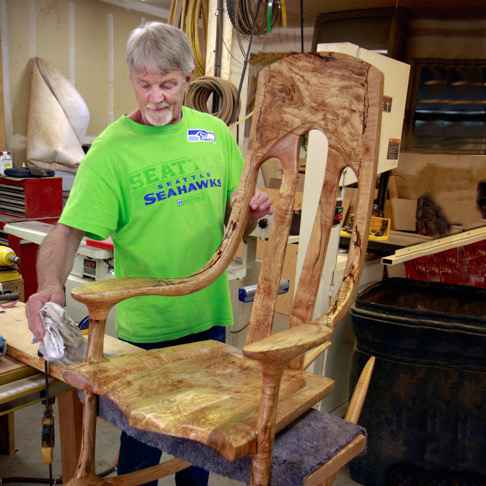
Don Bundy sits at his woodworking bench with a partially carved bird resting on a block of wood. He supports this bird-to-be with his right hand and carves with his left, a method he devised after a serious motorcycle accident resulted in the loss of use of his right hand due to extensive nerve damage. An array of woodworking tools and a picture of the bird he’s bringing to life are nearby.
“I like to get to know the character of my subject,” Bundy said. “Your product is much better if you know your subject well.” During our conversation, he tells me about his Woodpalooza piece, “Bullware’s Storm Petrel.” This small bird, which lives almost its entire life at sea, has an unusual protrusion on its beak that filters salt.
I also learned that bird carvers typically use a wood called Tupelo; it’s softer and has no visible grains, which can interfere with extremely fine feathers.
Don Bundy researches his subject before he begins carving.” (photo by David Welton)
An intimate conversation like this is one of the highlights of attending this weekend’s woodworking exhibition, “Art + Wood = Woodpalooza.” Craftsmanship can be experienced up-close, and artists are happy to talk about their process and craft.
The free exhibition takes place over Labor Day weekend at Zech Hall at Whidbey Island Center for the Arts on Camano Avenue in Langley. The event kicks off with a reception from 6 to 9 p.m. on Friday, Sept. 2 and continues through Monday, Sept. 5 from noon to 5 p.m.
Work from 16 woodworkers will be exhibited in an all-black room and each artist’s work will sit on a white pedestal, highlighted with lights. “It really makes the wood pop,” said Gary Leake, Whidbey Island Woodworkers Guild Secretary. “The venue looks like it should be in Seattle.”
Sixteen woodworkers will be on display at Woodpalooza. (photo courtesy of Gary Leake, Whidbey Island Woodworkers Guild Secretary)
Artists include David Gray, Bruce Schwager, Christine Schwager, Don Bundy, Gary Leake, Gordy Edberg, Janet Lewis, Jim Short, John Shinneman, Karl Nielson, Marian Quarrier, Mike Scott, Pat McVay, Rick Pitt, Wilson Binger and Mike Freal.
“We started Woodpalooza to educate the public about what woodworkers do and why it’s an important art form,” Leake said. “We also wanted to create a place that would encourage youth to explore the craft of woodworking.”
Woodworkers Bruce and Christine Schwager have been involved since the show’s inception 13 years ago. In the past, Christine has carved images of Pacific Northwest shells, such as oysters, abalones and sea snails. This year, her representation of a Pacific Madrone “Giant Clam” shell is from South Pacific waters. “I love collecting sea shells, and I love wood,” she said. “I’ve always wanted to do this one.” The woodworking duo has been in business for over 42 years at Schwager Design and Construction; they also create custom doors, furniture, cabinets and architectural woodwork.
“When we design something, we always collaborate,” Christine Schwager said, “and by doing that Bruce and I come up with a better design.” (photo by David Welton)A carpenter by trade, Rick Pitt made his first rocking chair for his father. (photo by David Welton)
“Woodpalooza” showcases many diverse types of woodworking, including Rick Pitt’s wooden rocking chairs; Mike Scott’s partially scorched “Cube” carved from maple and burl; and and Janet Lewis’s mahogany and pau ferro guitar, “Bird on a Wire Concert Guitar.” Other woodworkers carve sculptures; build, restore and refinish furniture; and create clocks and bowls. Clearly, each member of the guild may have a particular niche, but they all share one thing in common—their love of wood.
Image at top: Rick Pitt puts an extra wax coating on his chair to get it ready for the show. (photo by David Welton)
Lara Dunning is enthusiastic about small town living, and you can read about her discoveries atSmall Town Washington. She has been published in Bainbridge Island Magazine, Explore Anacortes and the WaggonerGuide.com. Her interests include young adult novels, history, hiking and locavore-inspired food.
Woodpalooza Poster (image courtesy of the Whidbey Island Woodworkers Guild)
WLM stories and blogs are copyrighted and all rights are reserved. Linking is permitted. To request permission to use or reprint content from this site, email info@whidbeylifemagazine.org.
BY DEB CRAGER
Whidbey Life Magazine Contributor
July 27, 2016
Imagine being a teenager without food or a place to sleep, or feeling like you don’t belong with your parents or family. Maybe it’s easier to live outside than to live with parents who may be abusive or are using drugs or alcohol. For whatever reason, you find yourself homeless.
For Lori Cavender, it’s a constant battle to help these young adults, but one she has embraced passionately for years. She’s a powerhouse representing the youth here on Whidbey, getting them food, a place to stay and whatever they need to survive, or giving them a chance to finish their education and an opportunity to simply be in charge of their own lives.
A young future resident pulls weeds to help maintain the grounds. (photo courtesy of Ryan’s House for Youth)
A parent of two teenagers herself, Cavender—the founder and Executive Director for Ryan’s House for Youth—started out as a youth minister for a Burien church 16 years ago. She was set on her life’s path when she and her husband took in a homeless teen. “That was the first experience that opened our eyes,” she said. Since then, her “daughter of the heart” has graduated from high school and is now working for the state.
Ryan’s House for Youth, with an office in Freeland, has always served the whole island. But recently, Cavender spearheaded a fundraising effort to purchase a permanent location. The community helped raised enough funds to open Ryan’s House for Youth in Coupeville and to secure more than 17 acres on the site of the former Country Inn. This former hotel will become their main headquarters, something they’ve needed for years.
The permanent home of Ryan’s House for Youth takes shape. (photo courtesy of Ryan’s House for Youth)
“We’re thrilled about the space, thrilled about the layout and the support. But now that we’re in, people assume we don’t we don’t need them any longer. We need their support more than ever,” Cavender said. During an inspection earlier this year, they learned that the building would need a new roof. Additionally, the annual insurance policy more than doubled, unexpectedly, to $17,000 because of the distance from the fire department.
Although this newest addition will offer housing, Ryan’s House For Youth—as an organization—has worked with the island’s school districts for years, offering multiple services—an outreach van; provision of clothing, food and toiletries to the schools for homeless kids’ use; mediation with parents or grandparents who may be struggling to understand their teenagers; and a successful host family program since 2011. The new facility offers a drop-in center for kids and young people from ages 12 to 24 with expanded services from 7 a.m. until 7 p.m. Monday through Friday, hot meals, a place to shower and to wash clothes. Case managers provide support in getting medical care and counseling, obtaining IDs and employment services—all onsite.
In the fall, Ryan’s House plans to offer transitional housing for up to 30 youth, ages 18 to 24. The young residents will help support the program by contributing part of their income to defray some of the costs.
One of the many Model A Fords, owned by members of “Whidbey A’s”—the island-wide Model A Ford Club—that participated in this year’s “Round the Rock” benefit for Ryan’s House. (photo courtesy of Ryan’s House for Youth)
Scott* is one of those planning to make the dorm-style room his transitional home. Verbally abused most of his life, he suffered from severe anxiety but has been staying with a kind, supportive family for several months. He recently started doing volunteer yard work around the new building, getting used to his new environment. At 19, he’s looking forward to finishing school and joining the Navy, which, he said, he feels stronger about now that he has a more supportive environment.
Although the facility is called Ryan’s House for Youth, these aren’t typical “kids,” Cavender said. For these young adults who need support, learning basic life skills has not come easily since their lives have been in such turmoil, sometimes for years. The staff at Ryan’s House offers support and opportunities so the young people can finish high school, go on to college and learn to live independently. Assistance in obtaining social services, for those eligible, or financial aid for college can make all the difference in their lives, Cavender said.
One young woman, Ashley*, was kicked out of her home when she was in sixth grade. Although she was allowed to return occasionally, the abuse continued until she finally left for good at age 16. Now 23, she’s studying psychology at Washington State University and planning on being a counselor. Through her own ongoing counseling, Ashley has learned to trust again and she feels she’s in a unique position to support those around her.
After she and her husband bought a house, they became long-term host families for three young adults and have been involved in the support of several others. “[My husband] knew, when he married me, that I would continue to be involved in Ryan’s House,” Ashley said. Several years ago, she joined the organization’s board and participated in “the big red couch” project, which brought more public awareness to the ongoing homelessness problem.
Staff and volunteers are proudly settling into their new home in Coupeville. (photo courtesy of Ryan’s House for Youth)
Although raising money is forefront for the board and volunteers right now, it isn’t the main goal, according to Cavender. Her biggest desire, and one that defines her dedication, is to keep the kids in school, to help them finish school despite difficult family situations and other obstacles. “We want to help them navigate through the rough times,” she said.
Currently, Ryan’s House is accepting any size monetary donations and they have an Amazon “Ryan’s House Wish List,” asking for staples, towels, yard tools and other household items. Check out their page at: http://www.amazon.com/gp/registry/wishlist/2PKZEYOHU87OP/ref=bnav_topnav_lists_1. For more information about Ryan’s House for Youth and their dedication to the community, see their Facebook page.
*The participants’ actual names have not been used in this article.
Deb Crager is originally from the Midwest but has lived on the island for 25 years. She wrote the book “101 Things to do on Whidbey Island: for a Day, a Weekend, or a Lifetime” available on iPad and Kindle Fire, with older copies in print from Amazon and ebay.
WLM stories and blogs are copyrighted and all rights are reserved. Linking is permitted. To request permission to use or reprint content from this site, email info@whidbeylifemagazine.org.
Well, here I am on my home island, the island of Manhattan, attending a wedding for my step-niece, Leah. The wedding will not take place on the island of Manhattan, but rather in Brooklyn, which is not an island, exactly. Read on.
I seem to have a love affair with islands. I grew up in Manhattan and spent summers on Whidbey Island and its coastal opposite—Long Island. I attended a small women’s college, which was a feminist island, I was a professor in the Ivory Tower Island, and I’m a poet and avant-garde fiction writer living on my own personal island of strange imaginings. Perhaps it’s true that “no man is an island,” but this woman is sometimes—for sure.
The author in her frum outfit with her other sister-in-law, the famous Rebbetzin Tap, orthodox tap dancer and teacher (who told her to “wear your red glasses!”) (photo courtesy of the author)
The wedding I’m attending takes place on a figurative and spiritual island: the island of Orthodox Jewry. My step-niece Leah is Orthodox, as is her stepmother, my sister-in-law (also named Leah), her husband, and their large extended family.
Orthodox Jews prefer the term “Observant” or frum (Yiddish for ‘devout or pious’), and they tend to live in communities that appear to hold themselves apart from the secular society in which they’re rooted. This has to do with dietary rules as well as the rules for keeping Shabbat (“Sabbath”), which goes from sundown on Friday night to a bit past sundown on Saturday night. If you follow these regulations, it’s helpful to have stores in the neighborhood that carry kosher food and that open and close in ways that follow religious guidelines. It’s also good to have neighbors who are on the same page with you because, in an emergency, they can help you and you can help them.
There is also—clearly—protection in numbers. Observant Jews are wary—with some justification-—of being the victims of anti-Semitism, particularly because they are often visibly “different.” The men, in particular, can stand out with their black hats and suits.
The bride, escorted by her stepmother (in gold) and her mother-in-law (in blue), as they circle the bridegroom. (photo courtesy of the author)
I have to be honest: I tend to visit this particular island with trepidation. I am not frum and, to make things more complicated, I am a convert to Judaism. Since I converted under Reform auspices, my conversion is not necessarily recognized as “kosher” (aka valid) in the community my step-niece, my sister-in-law and her family live in. So, when I step onto this island, I feel out of place and foreign.
I also have to dress quite differently. I have to wear a special long-sleeved, high-necked, ankle-length dress and, as a married woman, I’m expected (although not obliged) to cover my hair. I’ve also learned recently that the color red is not particularly favored by frum communities, which means that I may have to leave my beloved signature red glasses in the hotel room and wear my spare pair, which is a discreet dark brown.
But the fact is, my frum family treats me with respect and love, despite the fact that in my regular life I wear pants, use cuss words, and eat bacon.
So, am I really going someplace so different or is this an island I have created in my own imagination? Remember, I like to do that. Make stuff up.
The bride and groom with the bride’s immediate family (photo courtesy of the author)
As I put on my long dress and my hat and my closed-toe shoes, I invite all of us to consider what islands are real islands and what islands are islands that we make up in our own minds. What separations and distances do we create out of our own unease with people who are different than us?
I visited MAPS (the Muslim Association of Puget Sound) this past spring, and I felt fine wearing a scarf. So maybe I need to get over this internal island thing.
Still, I’m looking forward to getting back to Whidbey. I might even put on some shorts! BLT, here I come!
Stephanie Barbé Hammer is a four-time Pushcart Prize nominee in Fiction, Nonfiction, and Poetry. She is the author of a poetry chapbook “Sex with Buildings” (dancing girl press 2012), a full-length poetry collection “How Formal?” (Spout Hill Press, 2014), and a comic magical realist novel “The Puppet Turners of Narrow Interior” (Urban Farmhouse Press, 2015). You can follow her on twitter (stephabulist) or read her blog “Magically Real” as she tries to read “100 Years of Solitude” in less than 100 years at http://www.stephaniebarbehammer.net.
WLM stories and blogs are copyrighted and all rights are reserved. Linking is permitted. To request permission to use or reprint content from this site, email info@whidbeylifemagazine.org.
BY KATE POSS
Whidbey Life Magazine Contributor
September 13, 2016
Celebrate Whidbey’s winged nation from noon to 3 p.m. this Sunday, Sept. 18, at Whidbey Audubon’s “A Bird in the Hand” event at Bayview Farm and Garden.
Featuring specimens of the island’s birds, this unique avian library provides hands-on education to a public that typically sees them from a distance or in motion.
Watercolorist and avid birder Frances Wood hosted a past “Bird in the Hand” event. (photo by Julie Dougherty Winger)
This popular event has inspired visitors to appreciate our feathered brothers and sisters.
“The doors open and the magic of curiosity fills the room,” said Judy Feldman, a past visitor to Bird in the Hand. “It’s so wonderful to watch people be awestruck by the complex beauty of the wings and feathers and feet. It’s especially exciting to watch faces of small children as they get closer to birds than they’ve ever been.”
While there are more than 450 Audubon chapters nationwide that promote bird watching and preservation, our island Audubon branch has a rare collection of preserved birds that the public can hold and view close up.
Bird skulls of vireos and warblers are part of the collection. (photo by Kate Poss)
A gift to the Whidbey Audubon Society, these birds were once collected to identify the remains of birds that had collided with Navy planes, also known as Bird Aircraft Strike Hazards or BASH.
Matt Klope, an Oak Harbor biologist and taxidermist, worked for years as a coordinator with the Navy on preventing bird strikes. He started a collection around 30 years ago and used it to identify birds that routinely flew into planes. Once identified, Klope explained, the Navy could discourage those populations’ attraction to naval airspace.
“I’ve been working on birds since high school,” he said. “It’s a lifelong thing. The Navy needed someone to coordinate the bird strike program. When you strike a bird it is important to know what kind of a bird it was. We used forensic science developed by the Smithsonian to help us. They do feather comparisons, which are much cheaper than DNA analysis. They have close to 800,000 species from all over the world.”
Whidbey Audubon’s bird collection curators cut custom-shapes in foam to cushion bird specimens. Each bird is labeled and then stored in a box that is catalogued into a library system. (photo by Kate Poss)
When Klope retired from the Navy, he donated the collection to the local Audubon chapter. He continues to preserve birds that have met their demise and educates Audubon volunteers on his specialized techniques. Look for Klope at the Bird in Hand event to learn more about his skills.
Some of Klope’s animals are posed so naturally that one immediately feels Klope’s respect for them in their preserved form. It’s fascinating, for instance, to see the work he’s done preserving owls.
Owls, unfortunately, are routinely hit by cars,” said Robin Llewellyn, librarian for the Whidbey Audubon bird collection and co-chair of A Bird in the Hand this year.
A saw-whet owl, preserved and used in education programs: the owl lives in island woods and is only six to seven inches tall. (photo by Kate Poss)
“We get lots of owls; when they see prey, they look at it with total focus and don’t pay attention to cars,” Llewellyn said. Look for at least two owls on display at Sunday’s A Bird in Hand: a tiny saw-whet owl and a barred owl. Their feathers are remarkably soft. Llewellyn said that owl feathers are designed to promote quiet flight and stealth to aid owls catching their prey.
The Audubon chapter continues to accept certain birds for its collection.
“If you find a dead bird in good condition, call to see if we need it,” said Llewellyn, providing her number, 360-678-5403. “Wrap it in a newspaper and put it in a re-sealable plastic bag and squeeze the air out. Include your name, contact information, locality and date it was found and put it in the freezer.”
On a recent afternoon Llewellyn visited Klope’s Oak Harbor taxidermy studio with two birds she pulled from a cooler packed with ice. One was a sharp-shinned hawk, a small raptor that hunts other birds. Klope thought it might have been in the freezer too long and wasn’t sure he could restore it to its former glory, but, unfazed at his reticence, Llewellyn suggested he use the wings and tail for a future display. She also showed him a crow which she had recently picked up, mentioning that it can be added to the corvid collection.
Matt Klope’s talent with preserving birds, such as this barred owl, are considered museum quality by the Whidbey Audubon Society. (photo by Kate Poss)
The Audubon Society was created in the late 1800s originally to protect water fowl such as herons and egrets that were hunted to near extinction for feathers on popular ladies’ hats. One might imagine that wildlife artist John James Audubon created the society that bears his name, but it was one of his wife’s students who did the honors: George Bird Grinnell, one of three founders of the early Audubon Society in the late 1800s. Knowing Audubon’s passion for depicting the natural world, Grinnell chose Audubon as the name for the enduring preservation society, whose symbol is a great egret. Nowadays one of Audubon’s primary missions is to protect avian populations threatened by climate change and habitat loss.
The Whidbey Audubon Society’s collection, containing more than 500 birds, has been catalogued and permitted and is used in elementary schools and outdoor classrooms for education. A Bird in the Hand was created in 2008 and has been held biennially ever since, becoming more popular through the years. This Sunday’s event, held in the Bayview Farm and Garden’s Greenhouse, will host live raptors for the public to meet as well. Visitors can learn about and buy landscape materials that attract birds, as well. For information on everything about birds, look for Steve Ellis, the Whidbey Audubon’s “answer man,” who has been answering questions about birds for decades.
Image at top: American robins fiercely defend their nests, often ganging up to drive predators away. (photo by Jamie Whitaker)
Kate Poss worked as a library assistant at the Langley Library until last June. She was thrilled to work for three summers as a chef aboard a small Alaskan tour boat from 2008 to 2010. She was a newspaper reporter in Los Angeles for many years before moving to Whidbey Island where she likes “talking story,” hiking, hosting salons, and writing her novel.
WLM stories and blogs are copyrighted and all rights are reserved. Linking is permitted. To request permission to use or reprint content from this site, email info@whidbeylifemagazine.org.
TEXT AND PHOTOS BY DAVID WELTON
Whidbey Life Magazine Contributor
July 13, 2016
Have you ever wondered how water is delivered to a rural fire, far from the source, with no hydrants nearby?
Tanker trucks!
Actually, “pumper” trucks are the first to depart a fire station and they’re always ready to roll, loaded with a thousand gallons of water—a fraction of the amount required to extinguish a house fire. The massive tanker trucks quickly follow with 2,800 gallons.
Captain Jerry Beck details the fine points of tanker truck operation.
AJ Agnew, Brian Boyd and Maxwelton Station 33 Captain Tom Peterson, in red hat, prepare for a drill with the new tanker.
The South Whidbey Fire Department has two new tanker beauties, based at the Clinton and Maxwelton stations. Each machine has a complicated instruction manual to match the $350,000 price tag. Volunteer firefighters enthusiastically attended the first training session after the first truck arrived in April, learning how to adjust the various gauges, knobs and nozzles; they put it to use just a few days later at a barn fire near Ken’s Corner.
A collapsible 3,000-gallon portable swimming pool, stored on the tanker, is deployed next to the pumper and can be filled in five minutes. The depleted tankers then race back to the source for more water while the pumper sprays the fire.
The storage pool is deployed from a slot in the rear of the tanker.The framework is unfolded and the pool is erected, ready to receive water.AJ Agnew, with a twist of the valve, releases water into the pool.
The National Fire Protection Association estimates that almost 70% of the nation’s firefighters are volunteers. Volunteers don’t earn any wages, but they’re reimbursed for certain expenses and—on the south end of Whidbey—receive retirement benefits.
The fire department pays for training at the firefighting academy and a level-one firefighter certificate can lead to a full-time professional position. Male and female applicants must be over the age of 18 and be in “reasonable physical condition.” Volunteers can also receive training to become Emergency Medical Technicians. Weekly drill and training sessions help volunteers maintain and enhance skills and, periodically, buildings slated for demolition are provided for “practice fires.”
The pumper now has almost 3,000 gallons to quench the flames.
There are over 45-50 volunteers in the South Whidbey Fire Department and they responded to over 2,000 calls last year. The department was founded in 1950 and also employs a few professional full-time firefighters in administrative positions.
Tom Peterson, a circuit board designer at an engineering firm near Boeing, is Captain of Maxwelton Station 33 and has been with the department for over 21 years. “I always wanted to become a fireman,” Peterson said, adding that he played with Tonka fire trucks as a child. “The South Whidbey Fire Department feels the same as a winning team,” he said, recalling his high school football squad. “I know we have the right [skills and] tools to help people out.”
And, Peterson noted, if he’s the first person to arrive at the station when called, “I get to drive the fire truck.”
A practice fire at Little Lambs Daycare provides training for the volunteer firefighters.
Terry Welch, a Coupeville Middle School science and math teacher, had a first-hand experience fighting a wildfire while working for the Bureau of Land Management in Idaho. Always drawn to community service, she answered the call for volunteers in the wake of 9/11. She now specializes in marine rescue and firefighting, using the new firefighting boat based at the Langley marina. Some structures on the shoreline are more easily accessed from the water, she mentioned, and the boat is equipped with a water gun that pumps seawater. She’s always been accepted, she said, and has never had to prove herself to her male peers; firefighters are “ohana,” an ancient Hawaiian term for extended family.
The biggest reward, firefighters always note, is the respect and gratitude of the community. Joe Menth recalls the wildfire that threatened his home near Double Bluff Road on July 3 last year. “I was at work when I got the phone call and immediately headed home,” he said. Highway 525 was blocked so he took side roads. “Once we were home we could only watch while we awaited the evacuation notice. The wall of flames and smoke crept closer. Had the fire burned another 20 feet or so across the adjacent property, it would have ripped across the grass field next to our house, with a clear path for the flames to our front door.”
Jim Doberfuhl, with other volunteers, position themselves between the inferno and residents of South Whidbey Island
The experience of helping Menth and others like him—saving lives and protecting property in a way most people won’t experience—is more than sufficient compensation for the volunteer firefighters and EMTs of Whidbey Island.
Candidates may apply online or at department headquarters.
Image at top: Heroic volunteer firefighters of Whidbey Island combat the firestorms.
David Welton is a retired physician and staff photographer for Whidbey Life magazine.
WLM stories and blogs are copyrighted and all rights are reserved. Linking is permitted. To request permission to use or reprint content from this site, email info@whidbeylifemagazine.org.
BY DAVID MAYER
Whidbey Life Magazine Guest Contributor
September 7, 2016
An award-winning comedy will get a new musical treatment at Outcast Productions in Langley on Sept. 17 and 18.
The production company, along with a renowned writer and a New York City-based creative team, are out to give South Whidbey something to remember. Langley’s own black box theater company will offer a fully costumed multi-media musical extravaganza with a re-envisioning of Edward Jordan’s love romp—the film “Bollywood and Vine.”
While scripts will be in hand, the production team is pulling out all the stops (including a parrot puppet!) to give its audience the complete musical treatment. Outcast promotes the piece as “Sunset Boulevard meets La Cage aux Folles.” As with “La Cage,” the comedic trappings are an entry into meaningful stories that the creator felt needed to be told. Jordan said it’s a tale about “ageism, self-acceptance and openness to the possibility of love…’cause it can come when you least expect it.”
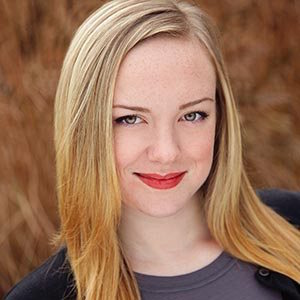
According to Outcast, the musical revolves around Hollywood scream queen Delilah Leigh, who hasn’t made a movie in years. However, she’s a superstar to love-struck Bhuvan Bannerji, a newly transplanted Indian who runs a bus tour of movie stars’ homes in Los Angeles. A “wannabe filmmaker,” Bannerji hopes to sweep Leigh off her feet and whisk her back to India’s Tinseltown, ‘Bollywood.’
This is the jumping-off point for a yarn full of twists that get at our assumptions about age, race, sex and gender.
As a youngster, Jordan was fascinated by the photos his father brought back from years spent in India. Those memories made their way into his 2004 film comedy, “Bollywood and Vine.” Its take on several “-isms” garnered the 2005 WorldFest Silver Award in the Romance category for Independent Theatrical Films and Videos.
Jordan wished to see where else he could take these characters and story. And when lyricist June Rachelson-Ospa and her musical collaborator, composer Daniel Neiden, got a look at Jordan’s proposed transformation of the film, they quickly found possibilities for the excited author. While happy to work in many genres, Jordan quipped, “I recently had my DNA checked. Turns out I’m 75% musical comedy.”
In revisiting the comedic plot for a musical take, the trio decided to clarify whose story this was. Adoring the bigger-than-life screen actresses of Hollywood’s Golden Age (think Bette Davis and Gloria Swanson), and despising what he saw as a modern dismissal of their work, Jordan found what he needed in Delilah—”a vital, talented, intelligent actress of a certain age, set adrift on an iceberg by Hollywood.” He would put that theme in focus.
After a successful reading in New York, the Long Island native returned to his new Whidbey home, seeking just the right Delilah for his next staging. Inspiration arrived when he saw K. Sandy O’Brien’s turn as Tallulah Bankhead in Outcast’s recent production of “Looped.” Jordan contacted Ned Farley, O’Brien’s Outcast co-founder, who immediately saw a fit.
Though essentially Delilah’s story, “Bollywood and Vine” has something to say about LGBTQ issues, as characters mask their identities in order to find love. And, as evidenced by the title, there is a multi-national flavor to which Farley and Jordan wished to remain true. Yet striving for racial diversity in a small town can require extra effort.
“While we’re pleased that we’ve been able to reflect diversity in some of our work,” Farley said, citing Outcast’s “Ain’t Misbehavin’” as the first all-Black production at a theater on Whidbey, “it’s an on-going challenge for us.” Recently, the company’s “The Flick” featured a character who is Asian-American and the company found its actor on the mainland.
“Creativity and casting from off-island are [again] going to be necessary,” Farley said.
In a hopefully precedent-setting conjunction, some of the New York-based cast from the original read will join local performers for this presentation. While being introduced to actors Levin Valayil, D.J. Bucciarelli, and Jaz Zepatos, audiences will recognize the local talents of O’Brien, Farley, Jennifer Bondelid, Gabe Harschman and long-time favorite, Gail Liston. Liston, perhaps known more for non-musical stage work—her Barbara in “August: Osage County” was necessary viewing—also enjoys the passion of musicals. She relishes, she said, “the way a scene builds in intensity until it’s necessary for the characters to burst into song.”
While the reading is directed by composer Neiden, Music Arranger/Orchestrator Charles Czarnecki (who has conducted on Broadway) will be consulting with Eileen Soskin, another accomplished South Whidbey transplant from New York who has signed on to handle musical direction. A person of most humble charm, she is a masterful pianist who was a professor and associate dean at Baltimore’s vaunted Peabody Institute and now directs and accompanies local talent. “She really helped me,” Liston said, “not only with the music, but to make choices and define my character.”
September’s production further prepares the work for a reading before several Broadway bigwigs. But Jordan is not leaving Whidbey behind. “We’re even discussing a full, full production at Outcast with a longer run,” he said. “Ned Farley has pretty much taken me—and “Bollywood”—under his wing. Then, offering appreciation with the wink of a comedic writer, he added, “I’m in really good wings.”
“Bollywood and Vine” plays at 7:30 p.m. on Saturday, Sept. 17 and 4 p.m. on Sunday, Sept. 18 in Outcast’s Black Box Theater at the Fairgrounds in downtown Langley. See OutcastProductions.net for ticket information and a synopsis of the story.
Image at top: D.J. Bucciarelli (left) and Levin Valayil (right) rehearse a scene from the Actors Equity reading of “Bollywood And Vine” at the Lion Theater, NYC.
David Mayer is an actor, playwright and director who trained in Seattle but found a home in Langley’s welcoming friends and artistry. He works in the tech world, but probably can’t fix your computer.
WLM stories and blogs are copyrighted and all rights are reserved. Linking is permitted. To request permission to use or reprint content from this site, email info@whidbeylifemagazine.org.
BY SHARON BETCHER Whidbey Life Magazine Contributor
July 6, 2016
While sociologists of religion speak of the Pacific Northwest as the epitome of “the none zone” (where the majority of persons register no official religious preference on a census), most residents know Whidbey Island to home contemplatives, mystics, naturalists and activists of many religio-spiritual strains with a paradisal dream of living in intimate reciprocity with all beings. Lumens lifts up the voices and wisdom of those who live among us—the creatives whose very creativity, their luminescence, opens out from the taproot of the spiritual path and/or religious faith.
Zoologist Steve Layman stood, quietly surveying the emotional surges moving among those gathered for Langley’s public forum on rabbits last October. Layman, the eagle-eyed falconer, watched how ideas collected and formed pockets of allegiance; he felt the effects, like winds and riptides, move through the room.
Here’s the scene:
European grassland rabbits, released on the Island County Fairgrounds and finding sanctuary there, have dug holes in the fairgrounds and the school’s athletic fields, endangering horses and athletes and creating warrens that undermine building structures. The problems and the cost of potential repairs seem to multiply as quickly as do bunnies.
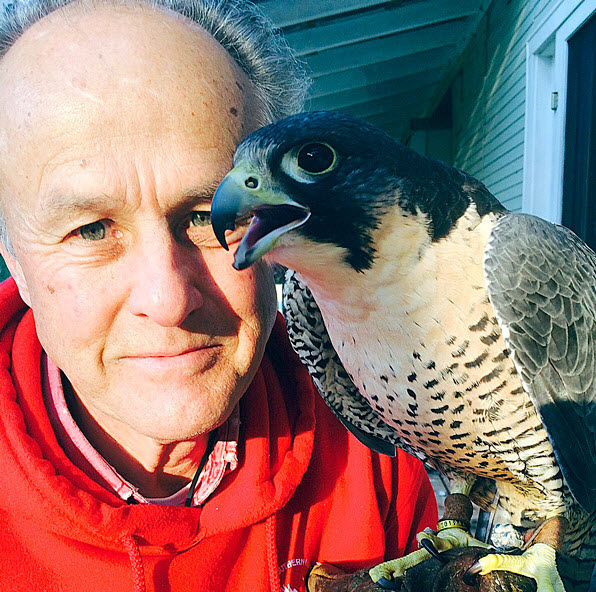
Layman reads the winds (photo by David Welton)
While some Langley citizens have become vexed at decimated gardens and landscaping, the floppy-eared bunnies—the very image of the Easter bunny—also engage other human sentiments. They are the epitome of cuddly cuteness, easily resembling a child’s first stuffed animal or summoning memories of Beatrix Potter stories. At the same time, some residents simply wonder how we avoid inflicting further animal suffering, or learn to welcome animals into human settlement patterns.
The October forum and this issue constitute—Layman has suggested, retrospectively—an ego-logical niche. His intriguing conceptual conflation reminds us that our conscious and unconscious fears, fantasies, resentments and desires shape not only this animal’s fate but our landscape, even our images of nature. When we negotiate the politics of ecological niches, the human ego is always already present.
And if he had to choose, Layman said, between tending the flight of falcons, a discipline built into the daily dimensions of his life, and a room as emotionally rife as this, he would, in a heartbeat, choose the latter—this ego-logical niche, that is. As he put it, “Being up in the mountains doesn’t interest me as much as [being in] that room.”
A Langley Rabbit, the epitome of the Easter bunny (photo by Kelsey Fein)
Tracking Layman:
Layman grew up on the edge of the Yakima Reserve in the town of Union Gap. As a kid totally immersed in the outdoors, tracking was his first language. An active hunter who captured his first hawk at age twelve, he learned to read the intersecting paths of a multitude of animals—their history as told by tracks and scat, and their possible future as projected paths through the ecological niche.
Only by applying his tracking skills to a printed textbook did Layman find his way in elementary school and then, later, the university. He learned that “knowledge is like a hunt”—a hunt for ideas, for the way emotions and affects carry ideas. At the same time, he worried—as he still does—that we Westerners have lost the ability to pay attention to the “white noise” of the universe—the ambient dimension of birds and bees, seasonal winds and animal movement, for example—as our first, primary sensibility.
Layman’s biological impulse turns philosophically reflective around the ideas and affects released as religion; he doesn’t trust that form of religion as textually anchored as is education today.
“Knowing is so much harder than believing,” he observed. But neither this critique nor his “natural history lifestyle” has led him to be dismissive of religion. “Religion, too, has had—evolutionarily speaking—adaptive outcomes, especially in terms of handling primitive emotions.”
Layman with son Seth and grandson Emmet (photo courtesy of Steve Layman)
Regarding Western Christianity specifically—the purview within which he grew up—Layman noted that religions have amended instinctual energies—the muscle of kinship welcoming a stranger or a step-child, for example. The sense of a “greater than self,” as Layman put it, led religious groups to value minorities, not just extend the crushing power of the majority.
Back to the Forum
The future of earth and its species, Layman said, will be deliberated in civil conversations like the one Langley organized for the veritable Easter bunny. The natural world is part of us now—symbiotically yoked to our human drives, desires and our disaffections.
Rabbits, a microcosm of the discussion ahead of the human community (photo by Kelsey Fein)
Rabbits are, in other words, a microcosm of the ethical conversations ahead for the human community, whether in small neighborhood and village pockets or on a bio-regional and planetary scale.
Gently and diplomatically, as a biologist offering information, Layman enlarged the Forum audience’s scope of concern: these non-indigenous rabbits have an eco-niche between city and woodlands, beyond which their population will not expand. Such a warren of rabbits also has alpha males and females, which push their juvenile competitors into the woods, where predation by coyote and birds of prey inherently takes over. By abetting feral “city rabbits,” we should know that a debt of suffering accrues outside of human eyesight.
The Washington State Department of Ecology has declared the “Langley rabbit” neither wild nor native. Without legislative guidelines to categorically declare them a wild or native species, the future of these rabbits depends solely upon human discernment. What resources do we have available as a city, school and/or among individuals to care for them?
Nature through the Lens of the Human Ego
Because we view them through human ego and sentiment, animals, insects and other life forms live in our shadow—left to die or come to illumination. The title of a recent book, Hal Herzog’s “Some We Love, Some We Hate, Some We Eat,” precisely encapsulates the situation.
And when it comes to rabbits—even the Easter bunny—we humans are not of a single mind. Or heart. Or appetite.
The ego-logical niche, humanity’s spiritual challenge (photo by Kelsey Fein)
We all have ego-invested pictures of ‘Nature,’” Layman added. Evolution teaches us that there is no “balance of nature.” There is no such “pre-set,” built-in design for survival. Life is a complex of symbiosis and striving.
The pastoral image of nature is not, we now know, a true picture of our evolutionary world. Such a romantic view of “nature” is a photo still—an ego-informed cognitive bias, a picture affected by our economic position and how and where we work. As Darwin insisted, what appears “nature’s harmony” is always in flux—a complex of dynamics, like adaptation, variation, symbiosis and struggle—all dynamically interlaced.
Steve Layman with falcon (photo courtesy of Steve Layman)
Of Spirit and Ego
Earth’s evolution now moves, Layman repeated, through just such human, emotional niches as we experienced in discussing the Langley rabbits. These ego-logical niches present us with something of a new religio-spiritual challenge. Tracking our human attachments, learning how to navigate such dynamic intensities, becomes as significant—even spiritually so—as any other work on human conservation.
An academic theologian and philosopher by background, Sharon Betcher is now an independent scholar, writer and wannabe farmer living on south Whidbey. As a writer, she won the 2012 Short Story Smash and took first place in the memoir category of the Whidbey Island Writers Association’s 2012 contest. In March 2015, Betcher presented at the annual Women of Whidbey (WOW) Stories Conference.
WLM stories and blogs are copyrighted and all rights are reserved. Linking is permitted. To request permission to use or reprint content from this site, email info@whidbeylifemagazine.org.
PHOTO ESSAY BY DAVID WELTON Whidbey Life Magazine Contributor
July 6, 2016
Whidbey Islanders had two simultaneous celebrations: our country’s 240th Independence Day and the 101st Anniversary of the Maxwelton Fourth of July Parade. The well-organized event was attended by thousands and all had a good time.
WLM staff photographer David Welton was present to record the festivities.
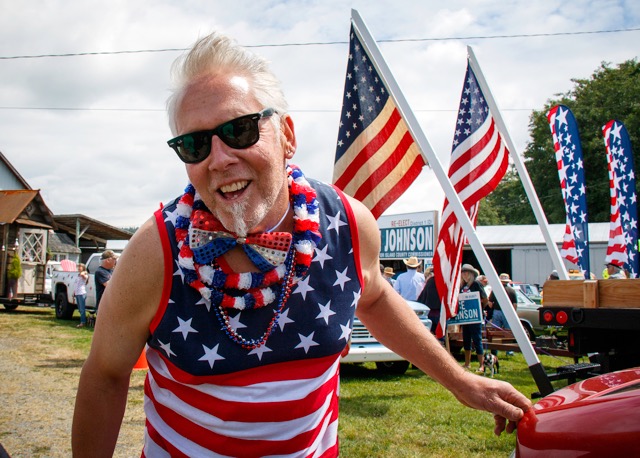
A contemporary Uncle Sam, aka Bob Bowling, greets marchers at the foot of Swede Hill Road.Korean War Veteran veteran Herbert Weissblum, of the Whidbey Island Marine Corps League Color Guard, led the parade.This year TWO gorillas shared their bananas, courtesy of The Goose Grocer.
Chickens and ducks and marchers tossed candy to children along the two-block parade route.
Racecars sped along Maxwelton Road to Dave Mackie Park.Others chose to walk the whole parade while hula-hooping.Candidates Helen Price-Johnson, Angie Homola and their political supporters exercised their First Amendment rights.
Dan Anderson, in traditional Swedish garb, marched with Island Strings as he played his nyckelharpa.Patriotic attire was mode du jour.
Fun and games, and hot dogs awaited at Dave Mackie Park.
David Welton is a retired physician and staff photographer for Whidbey Life Magazine.
WLM stories and blogs are copyrighted and all rights are reserved. Linking is permitted. To request permission to use or reprint content from this site, email info@whidbeylifemagazine.org.
By Leslie Irish Evans Whidbey Life Magazine Contributor June 29, 2016
Whidbey’s Island Shakespeare Festival’s seventh season kicks off on Friday, July 8 with Shakespeare’s comedy “As You Like It.” The following evening will feature the opening of “Jane Eyre” and “Julius Caesar,” completing the season’s rotation, will open Thursday, July 14. Whidbey actor Olena Hodges, who made her 2010 debut with the festival in the role of Rosalind, returns to that same role this season. In fact, she’s appearing in all three productions.
Hodges, a founding member of ISF’s acting company, was recently named the Associate Artistic Director for Island Shakespeare Festival (ISF).
2016 ISF company members Paul Dederick as Caesar in “Julius Caesar,” Olena Hodges (center) as Rosalind in “As You Like It” and Maya Sugarman (right) as Jane in “Jane Eyre” (photo by Michael Stadler)
Acting has been Hodges’ passion for virtually her entire life. She remembers playing drama games in preschool. “We would turn our chairs upside down, pretend they were spaceships, and then create a story.” Her face lights up at the memory. “It was so much fun!”
Workshops with Seattle Children’s Theater followed. “I played Hades. My mother altered a vintage black dress for my costume. I had this line: ‘I am Hades, goddess of the Underworld and of all the Dead.’ I remember being onstage for this moment and thinking This is so good.”
In 1996 her family moved from Seattle to Whidbey Island. “Lucky for me, there was an amazing children’s theater here, just waiting.” Whidbey Children’s Theater proved a fertile creative home for the young thespian.
Hodges performing with Whidbey Children’s Theater in 2001 (photo courtesy of WCT)
In 2008, Hodges moved to New York City and completed Circle in the Square Theater School’s two-year professional acting conservatory. “The mantra of Circle in the Square is ‘It’s a journey towards you,’” she said. “I think that’s really true.”
“As a young actor, there’s so much fear of being good—being a good actor,” she continued. “It’s not about being good. That doesn’t really matter. What’s going to make a performance worth watching is the human condition being portrayed truthfully.”
In addition to currently acting in three plays at once and serving as associate artistic director for ISF, Hodges blogs for a retail website, writes for Whidbey Life Magazine, and serves as associate producer for Theatrical Mustang, Seattle’s premier theatrical podcast. “It’s been amazing for me, talking to other artists,” said Hodges, who usually conducts the program’s classical theater interviews. “And it’s been a really great way to get word of ISF out there.”
She’s also a newlywed. Hodges married audio engineer and sound designer Erick Johnson (he’s designing all three ISF shows this summer) in July, 2015.
Hodges (upper right, green leggings) leading an ISF Classic Conservatory for Young Adults workshop (photo by Ahna Dunn-Wilder)
Hodges’ hard work does not go unappreciated.
“Olena is talented but also incredibly hard-working and trained,” said longtime friend and fellow ISF actor Bristol Branson. “I absolutely love to see how far she and ISF have come. I count myself extremely lucky to have worked with her as a fellow actor and to call her one of my dearest friends.”
“Olena’s passion for ISF, for Shakespeare, for theater and for life is astounding,” said Susanna Rose Woods, ISF’s founder and artistic director. “She seems to have limitless energy and creativity and dives into everything that needs doing with indomitable spirit.”
Woods founded ISF in 2010 with the goal of “demystifying” Shakespeare’s work and bringing it to the widest possible audience with a “pay what you will” business model. Understandably anxious about attendance for their new endeavor, Woods gathered the company before curtain on opening night and told them “If we have as many people in the audience as we do onstage, we’re good.” Approximately 800 people attended the play over the first two weekends. Attendance has consistently risen in the years since.
“This type of theater,” Hodges said, “is something our community is hungry for and really embraces.”
After a few location changes, ISF settled in 2015 at their current location in the field behind the South Whidbey Academy in Langley. A recent Kickstarter campaign enabled the purchase of four large shipping containers that have been modified to create storage and dressing rooms as well as to delineate a theater space.
“We’re creating an amphitheater,” Hodges said. “Plus, being outside allows for more creative license. For example, [the production] ‘Jane Eyre’ needs to be two stories high.”
But what about the circus tent that’s been an iconic landmark for the group? Returning patrons needn’t worry. The tent will now serve as the festival’s “lobby.”
Hodges as Rosalind in “As You Like It”: Photo at left—Hodges (right) in 2010 with Bristol Branson (photo courtesy of ISF). Photo at right—Hodges this year (photo by Michael Stadler)
“This is a huge year of growth for us,” Hodges said. “I’m excited that so much of this season’s company is from Seattle. We have some really established artists with a following, and that will increase ISF’s relationship with the Seattle community.”
“I’m also excited to work with new directors,” she said, referencing award-winning Seattle directors Corey McDaniel, who is directing “Julius Caesar” and Julie Beckman, directing her own adaptation of “Jane Eyre.”
A particularly significant aspect of ISF’s 2016 season for Hodges is their production of “As You Like It” (directed by Woods
“I’m really stoked for ‘As You Like It’,” Hodges said. “I’m so excited to come back to Rosalind and her Forest of Arden when I’m so much further along in my craft. It’s definitely part of that journey to self [that she learned in conservatory].”
When asked what her favorite part of being an actor is, Hodges grows thoughtful: “I’m grateful for the empathy I’m reminded of every day in my work. To be an actor you have to really be able to understand and embody a different perspective. As a human that’s what I’m most grateful for.”
Her least favorite?
“Closing night!” she howls. “It’s the worst! So depressing.”
Catch Olena Hodges and the rest of the Island Shakespeare Festival in “As You Like It,” “Jane Eyre” and “Julius Caesar” from July 8 through Sept. 11in Langley. For details, please visit http://www.islandshakespearefest.org/.
Image at top: Olena Hodges (photo by Michael Stadler)
Leslie Irish Evans is a podcast host, Huffington Post blogger, and the author of “Peeling Mom Off the Ceiling: Reclaiming Your Life From Your Kids.” She lives in Langley. Learn more about her at http://www.leslieirishevans.com.
WLM stories and blogs are copyrighted and all rights are reserved. Linking is permitted. To request permission to use or reprint content from this site, email info@whidbeylifemagazine.org.
BY DEB CRAGER
Whidbey Life Magazine Contributor
June 22, 2016
“The great thing about hiking on Whidbey,” said Sarah Boin, a longtime, avid hiker, is that you can’t get too lost; you’ll find yourself at the water or on a road.” She has hikes she affectionately calls “wood walks”—easy, relaxing and good training for her more rigorous 10-mile treks. Her favorite place to start out is Ebey’s Landing, where the view is spectacular and the trail connects with Kettle’s Trails. Other beginner hikes include Saratoga Woods or the trails at South Whidbey State Park.
Boin began hiking as a child with her family and has hiked all over the Northwest, both alone and with others. She said that Washington offers the most extraordinary hiking. There is something unexpected in hiking alone, she added, and says it’s a completely different experience when you can hear and see some things you might miss in a group.
Some of the Sons of the Beach (l-r): Bill Vogt, Dale Christiansen, Wayne Nehrlich, Paul Goldfinger and Dennis White (photo by Chuck Clark)
“My experience is exactly the opposite,” Roger Britt said, referring to solitary hiking. “People enjoy chatting and socializing in these groups.” Britt is a member of the hiking groups Meet Feet and Sons of the Beach. “We don’t want people in these groups walking alone….” he said “Many trails have numerous forks and we wait at the forks so people don’t get lost.”
Sons of the Beach (SOB), a hiking group that is now closed, began with seven hikers in 2008. Paul Goldfinger, a long-time hiker when he moved to Whidbey 14 years ago, was one of the founding members; he credits George Jackman, a fellow hiker, with teaching him the local trails. “George is a great source of hiking knowledge, both here on Whidbey and all over the Northwest,” Goldfinger said. They met in 2004 during a work party to reroute a trail in Putney Woods on South Whidbey and began hiking many of the island’s trails: Saratoga Woods, South Whidbey State Park, Possession Point State Park, and Fort Ebey State Park. Jackman wanted to start a hiking group; Goldfinger had heard of the long-standing Ladies of the Beach, and knew a men’s group could draw similar interest.
Jackman, here since 1987, said he’s always enjoyed hiking, although he’s slowed down a bit. “Some people golf; this is what I do, I hike,” he said. He enjoys the group, he added, and the fact that many of the trails offer a period of time when you can choose to be alone, something some members have told him they prefer. “It’s the safest way to hike,” Jackson said. “You’re alone, but someone is still around.”
Dennis White on the trail (photo by Chuck Clark)
The men’s hiking group has grown, with more than 100 hikers on the e-mail list, although only a dozen or so walk on any given week. Over a period of a year, they complete approximately 50 different trails. During the winter, the group meets for half-day hikes and then goes to lunch, or out for a beer. “Getting a beer is almost a requirement,” Goldfinger said. “We’ve debated calling ourselves the ‘Sons of the Brew.’”
During the summer, the SOBs occasionally go off-island, to areas such as Anacortes and Cranberry Lake, for longer, more challenging hikes. One of the most recent hikes was to Cougar Mountain in King County, with a distance of 6.4 miles and an elevation gain of 1,650 feet. The finale, according to Goldfinger, was a fine lunch at the Issaquah Brew House. The off-island hikes require coordination with ferry reservations and carpooling, but offer a more challenging trek. Goldfinger said he believes it’s the longer hikes that keep him fit.
Another hiking group with a long history is Meet Feet. Once called Whidbey Walkers, this group evolved into a coed group that gets together on Saturdays. During the summer, they sometimes schedule hikes on Fridays so members can be part of all the summer activity on Whidbey.
Trying not to get lost—Paul Goldfinger and Bill Vogt (photo by Chuck Clark)
Britt started hiking with Meet Feet before joining Sons of the Beach. He has developed websites for both groups that record the key points, often including GPS-generated maps. The websites (see below) list the hikes and offer information about past hikes—a wealth of information for those just beginning to hike.
Almost all the current hikers with Meet Feet are retired; some still work, however, so the Saturday times are convenient for them, and there has been some recruitment to get younger hikers involved. In addition, Meet Feet allows dogs on leashes, so one’s best friend can also exercise. Meet Feet is always open and the hikes aren’t complicated, from both a hiking and carpooling perspective.
Richard Renninger, also a member of both groups, was a hiker in Juneau, Alaska, where the hikes were typically four to six hours. He said he still appreciates the longer, harder hikes off-island. “There are lots of pleasant hikes on the island, which is wonderful,” he added, “but I’ve pushed for rigorous activity, so we can work at the Cascades and Olympics.”
Renninger said he finds a certain peacefulness in the silence, and he enjoys the times and places you can break away, depending on the hike. But he also enjoys the socializing too, and “if you’re with a group, you’ll be missed eventually!”
Hikers Paul Goldfinger and Dale Christiansen (photo by Chuck Clark)
° ° °
For more information on Sons of the Beach and Meet Feet, check out the websites created by Roger Britt.
Sons of the Beach: http://www.maxxeon.com/sotb/ (closed group, check “maps” for routes hikers have taken in the past)
Meet Feet: http://www.maxxeon.com/meetfeet/ (coed group, open; sign up for emails and check “maps” for routes hikers have taken in the past)
Deb Crager is originally from the Midwest but has lived on the island for 25 years. She wrote the book “101 Things to do on Whidbey Island: for a Day, a Weekend, or a Lifetime,” available on iPad and Kindle Fire, with older copies in print from Amazon and eBay.
WLM stories and blogs are copyrighted and all rights are reserved. Linking is permitted. To request permission to use or reprint content from this site, email info@whidbeylifemagazine.org.












 According to Outcast, the musical revolves around Hollywood scream queen Delilah Leigh, who hasn’t made a movie in years. However, she’s a superstar to love-struck Bhuvan Bannerji, a newly transplanted Indian who runs a bus tour of movie stars’ homes in Los Angeles. A “wannabe filmmaker,” Bannerji hopes to sweep Leigh off her feet and whisk her back to India’s Tinseltown, ‘Bollywood.’