BY MELISSA KOCH
LAUREN ATKINSON Whidbey Life Magazine guest contributors DAVID WELTON
Photography April 7, 2014
The artLAB is designed for children, as a place to imagine, create and play while having fun learning the basics of making art. It’s a kid-focused place where children learn new things, tell stories, and create characters and their adventures while learning to draw, paint and make the things they see in their dreams and imagination. Kids collaborate with other kids, creating costumes, hats and masks—becoming the characters from their stories.
The last class of the season begins with special snacks.
Visual artists, Lauren Atkinson and Melissa Koch consider themselves creative guides. They work with an “emergent” teaching pedagogy, which supports and nurtures the interests and ideas that sprout from each child’s imagination. They make this happen with gentle guidance, they said, taking children on a learning journey that instills confidence—allowing children to discover and express their authentic voices—and empowers each child’s artistic discovery and self-expression.
Children discuss the outcome of their day with Roses and Thorns
Atkinson and Koch believe that children need to live fully in their imaginations. As “life-long creatives” they feel, based on their life experiences, that the imagination is the place where one can see what has not yet been seen or created; it is “the place of endless possibility.”
Dress rehearsal begins at Whidbey Children’s Theater.
“Teaching children the practice of bringing in the new, coming up with creative solutions and supporting how they see and experience the world in which they are growing up is a powerful learning tool,” Koch said. “It can infuse all that they learn and do, at school and at home with their families and communities.”
Children make a pact with Lauren and Mel to do the best of their ability
“Making art, telling stories and working in collaboration with others is a necessary ingredient in supporting children’s growth into their essential selves, so they can be confident in who they are,” she added.
The play begins
Children begin their shadow puppet performance for their parents. They created their own characters and props and wrote the accompanying story: “There was a shadow, it was all alone. Sad, lonely, glum. Driving a shadow car. Suddenly someone appeared; it was a girl. She asked the sad shadow if it was here to drive her to the shadow party.”
Behind the stage children work their puppets. Joshua works the lights
Mel and Isabella look on as Joshua and Spencer place props and characters
“The girl says goodbye to the shadow and heads in. She begins to climb the spiral staircase when she hears the voice of the shadow: ‘I forgot to tell you the party is in the giant mushroom, you will find that in the upper canopy of the ancient tree.’”
Joshua works back stage to animate the scene
“At the party the girl sees a carrot singing, a radish playing the fiddle, a heart laughing so hard it is shaking and a meerkat telling an adventure story.”
Syha, Joshua and others at work
“The girl climbs for a long time. She feels like she will never get there. She passes a small dragon on her way—he is resting, he is tired from the climb, out of breath, little puffs of smoke float out of his nostrils.”
Jojo, Roslyn, Isabella and Syha concentrate on their performance
CLICK HERE to read more entertaining and informative WLM stories and blogs.
WLM stories and blogs are copyrighted and all rights are reserved. Linking is permitted. To request permission to use or reprint content from this site, email info@whidbeylifemagazine.org.
The South Whidbey Science Fund, a new nonprofit dedicated to improving the math and science literacy of South Whidbey kids, has announced plans to create MakerTron Labs—the first “maker-space” on Whidbey.
What’s a maker-space? It’s a place where people of all ages can come together to build things—whether they be made of wood or metal, fabric or computer code. MakerTron Labs will first open The Repair Space where folks can learn how to repair and maintain computers, appliances and simple electronics. They will be able to take things apart and be guided into putting them back together again. Additional classes in the future might include game design, computer animation and art, robotics and making smart phones work for you.
Eventually the goal is to also have a tech room with a laser cutter, 3D printer, 3D scanner, a CNC router or cutting machine and other state-of-the-art equipment, and eventually a wood shop and a metal shop. Some space would also be available to local fabricators willing to open their shops now and then for a class or an apprenticeship. Participation in MakerTron Labs activities is expected to be either by membership or by donation. Some repair services will be free to seniors.
The SWSciFund is the brainchild of SWHS alum Andy Gilbert, son of middle-school science teacher Sandy Gilbert and inventor/machinist Bill Gilbert. Its mission is “to foster future leaders in the fields of science, engineering and technology through education, hands-on experience and community involvement.” Damien Cortez, a fellow team member on South Whidbey Science Champions and Science Olympiad teams back in the day, is working with Gilbert as the fund’s executive director.
Gilbert grew up watching his dad take things apart and put them back together so they worked, so he has always been interested in engineering and technology. He has worked at Facebook and co-founded a successful data analysis and warehousing business in California that employs several of his fellow alums. When he returned to Whidbey to live with his wife and son, he realized that more could be done to help prepare our kids for the jobs of the future—like those at his own company.
For the past six months Gilbert and Cortez have been doing their research and talking to dozens of people with an interest in increasing the STEM (science, technology, engineering, and math) skills of South Whidbey kids. Science teachers Sandy Gilbert, Greg Ballog and K-8 educator Katja Willeford joined the SWSciFund board, along with statistician Andy Martin, another SWHS grad.
Since Gilbert and Cortez are fathers of young children, their first priority is to offer STEM enrichment classes and programs at all levels in school and off-site to students of both public and private schools. They are currently working with South Whidbey educators to offer enrichment classes in creating computer games at Langley Middle School and a club at South Whidbey High School for potential Internet entrepreneurs (and maybe drone builders)—so if technology is your field, consider helping with a class.
They also want to give young people a chance to experience the joy of working with their hands and their heads, of putting things together and taking them apart (in either order). SWSciFund advisor Lynn Willeford proposed a maker-space as a signature project for the new organization. Gilbert liked the intergenerational aspect of the idea. Cortez saw that the maker-space might help provide income to support the fund, a model he recognized as a former coordinator of the Good Cheer food bank, which is partially supported by the profits of its thrift stores.
The organization has already leased space in the mall at Ken’s Korner for MakerTron Labs, a program they expect to expand greatly over the next few years. Now they are looking for people who are interested in helping make this dream a reality. They’re looking for volunteers right now to help paint the spaces, re-install rubber base, build lab tables and more. They want to identify people who know how to make and fix things and are willing to teach, facilitate, or mentor. They are on the lookout for old chairs for seating and other office furniture. They are looking for retired carpenters and metal workers willing to let go of some of their equipment and avid garage-sale shoppers willing to keep an eye out for tools. “We want spare tools, spare parts and your spare time,” Gilbert says.
If you’re interested in volunteering to help make MakerTron Labs a reality or want to donate materials, please contact Damien or Andy at info@swsci.org. If you’d like to stop by the MakerTron Labs space in the Ken’s Korner Mall behind Skagit Valley College on Mondays between 2 and 6 p.m., they’ll be glad to give you a tour and expand on their vision.
Watch for a Grand Opening in late April with demos of upcoming activities. For more information, contact Damien Cortez at dcortez@swsci.org or Andy Gilbert at agilbert@swsci.org .
BY RUSSELL CLEPPER Whidbey Life Magazine Contributor
March 26, 2014
In 1959, Leonard Good saved the Western World.
Nikita Krushchev had come to America and, while touring through Iowa, participated in a parade through Des Moines. The crowd along the route was silent as the Communist leader passed by; some held placards that read “We butcher hogs, not people.” Krushchev held his hand up and wiggled his fingers at them.
Good helps Victoria Alumbaugh, Magnus Nyberg, Linzey Allen, and Erin Baublitz assemble their gliders. Behind them, their teacher, John LaVassar, helps another classmate. Photo by David Welton
Good, a college student at Drake University at the time, noticed the icy reception the Midwestern crowd was giving the visitor and thought it was no way to treat a guest. As Krushchev, seated in a light blue Cadillac convertible, passed near him, Good began to wave and blow kisses to the Russian leader.
Krushchev saw him and turned to the young American and waved back. As the convertible rolled on past him, the Russian leader continued waving to him, standing up and turning around backwards to offer a thankful response to this single, enthusiastic crowd member. Good jokes that perhaps that moment of mutual acknowledgement served to temper any aggressive U. S. sentiments that Krushchev may have harbored. What we do know is that nobody got blown up in the ensuing years.
Good, however, has gone on to blow up many things in his career as an outside-the-box science teacher. What he hasn’t blown up, he’s sent flying high into the air, shot it through with electric current, dissolved it, submerged it in various solutions, burned it, frozen it, built it, broken it or simply used it in countless different experiments and demonstrations. Students love to see Mr. Good walk into class; even better, they love to visit him at his shop tucked away deep in the woods.
“I want to see something blow up,” said a young lass during a recent science class Good delivered to the fifth-grade students of John LaVassar at South Whidbey Elementary school.
Dominick Anderson, Nathanial Hall and Lucy Nowlin put their own personal touches on their gliders before taking them outside to launch. Photo by David Welton
“I like the explosions,” said another. “I hope the sprinklers don’t go off. That’s what Leonard said. He’s funny.”
“He says some stuff I sometimes kind of get,” said another student when asked what he liked about Good’s classes.
“You have to get their attention,” said Good. “I begin one lesson on electricity by asking, ‘Okay, who’s not afraid to die?’ Six or seven kids jump up, and they’re not all boys.”
In LaVassar’s class, Good warns the students about the strength of a certain kind of glue he is using to assemble some balsa wood gliders that the class will test fly. “This glue is so strong you could put some on the back of your toy poodle, if you had one, pick it up and press it against the ceiling and it would stick there with its little legs dangling.”
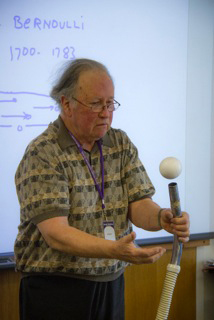
The kids love it. Soon they’re all outside, tossing their gliders everywhere, testing out one of Daniel Bernoulli’s theories of fluid mechanics, which Good had explained to them using a vacuum cleaner and a styrofoam ball. Before long, a few of them are bringing damaged gliders back to Good who patiently fixes each one from a little tube of that super glue.
Although this day’s lesson had to do mostly with physics, Good says he likes to begin teaching science to new students by introducing them to chemistry. “It’s the queen of them all—the focus of all the sciences,” he said.
Cooper Ullman cocks his arm to send his glider on a long flight. Photo by David Welton
Ergo—explosions. What happens when you drop a little chunk of sodium metal into a container of water? “It produces an explosive reaction that is quite satisfying,” said Good.
Good’s own interest in science was sparked, in part, by annual spring trips with his father to the open house of Oklahoma University’s Engineering Department. There he was always fascinated by one demonstration in particular. A conveyor belt carried ball bearings along to its end where they dropped onto a piece of polished steel. They would bounce high into the air from there onto another polished steel landing, then to another and another, until they would finally fall into a funnel-shaped collector that would deposit them back onto the conveyor belt where they would start their journey anew.
“I still don’t know how they did that,” said Good, who credits his grandmother with her hybridized lily garden as being the first person to pique his interest in science. “She knew the Latin name of every plant in her garden.”
Good’s parents were both accomplished, award-winning artists, not scientists. His father became the head of the Art Department at Drake University, where Good encountered Krushchev. The following year, he experienced an even more personally momentous encounter at Drake. He met his future wife, Linda, in the summer of 1960.
“The girls in Iowa were corn-fed and attractive, but they just didn’t seem to have any ambition or desire to do anything,” he said, “except marry some guy who was working at the Firestone. Then here was this tall, tan, young and lovely thing who had just come from sailing in the Bahamas. Man, it was love at first sight.”
Member’s of John Lavassar’s class line up for a group launching of their lightweight balsa gliders. Photo by David Welton
He gave her a ride back to her Seattle home at the end of the summer. She rode all the way on the back of his German-made Zunndapp motorcycle. They slept under picnic tables and visited Yellowstone before heading north across the border into Canada. At the Kootenay River, the ferry couldn’t carry them across because of a flood. Good looked up and noticed a railroad bridge crossing high above them; they crossed the river on it, bumping along the cross ties between the rails. That trip was the first in a lifetime of adventures together. They married in 1962.
In 1968 they moved to Whidbey Island from Hawaii, looking for cheap land where they could settle down. Linda was related to the Metcalf family, a well-established island clan, and had spent many happy hours exploring the beaches and forests here as a child. They bought 10 acres with a house and some outbuildings for $11,000.
Soon afterwards, Good landed his first job teaching science at the Evergreen School in Seattle. “It was an alternative school. There was no curriculum. No book. It was great,” he said.
In the 45 years since, he has never lost his enthusiasm for teaching. “if I were a millionaire,” he said, “I’d pay them to let me do this.”
Russell Clepper is a singer-songwriter who plies his trade locally and around the country. He is also a substitute teacher for the Oak Harbor School District. Clepper would like to acknowledge Ro Purser for alerting him to the story about Krushchev and Good.
Photo at top: Leonard Good demonstrates one of Bernoulli’s theories of fluid mechanics with a vacuum cleaner and a styrofoam ball. (Photo by David Welton)
CLICK HERE to read more entertaining and informative WLM stories and blogs.WLM stories and blogs are copyrighted and all rights are reserved. Linking is permitted.
What does Rear Admiral Ret. Bill McDaniel have in common with 1) a towering Texan/Québécois singing cowboy who yodels, 2) a classically-trained Soprano 3) circus performers, 4) six local, women entrepreneurs and 5) a local, community-run, public radio station?
They are all putting on a fantastic. family-friendly Vaudevillian Variety show in Oak Harbor from 2:30 to 4:30 p.m. this Sunday, March 30 at Oak Harbor High School.
McDaniel is working with ‘Vaudeville’ producer Mary Rose Anderson of Coupeville and director Annie Zeller Horton of Greenbank. Together they are spearheading the variety show matinee to raise funds to pay musical licensing fees and studio rent for Whidbey Air public radio.
“Recipe for Disaster” performers Matt Hoar and Siobhan Wright (photo credit John Pendleton)
“Working with the variety show is not just fun and exiciting, but also a meaningful effort; the internet station provides a connection close to home for the sailors and officers who are deployed all over the world,” said McDaniel, who also joined the Whidbey Air Board of Directors last Spring.
The performers at the Vaudeville show will be the following: singer/songwriter Karin Blaine of Clinton; musical duo “The Muse and eye” (Russell Clepper and Sarah Dial Primrose of Langley); belly dancer Gwendolyn Sipes of Freeland; the dynamo music teacher from Oak Harbor High School, Darren McCoy of Oak Harbor; accordion player David Locke of Freeland; classically-trained soprano Meredith Ellen Reichmann of Oak Harbor, singer/songwriter Lowell Sipes of Freeland, Honky Tonk County Classics Crooner Jack Hubbart of Oak Harbor; circus performers “Recipe for Disaster” (Matt Hoar of Freeland and Siobhan Wright of Langely) and actress/singer/Vaudevillian vamp Allenda Jenkins of Oak Harbor.
Allende Jenkins (photo courtesy Vaudeville show)
Tickets to the “Whidbey Air Public Radio’s ‘Isle of the Arts’ Visits Vaudeville” variety show are $10 for adults and $1 for kids 15-years-old and under. Concessions and fabulous door prizes, donated from businesses throughout Whibey Island, will be offered also.
“We want all ages—young and old—to celebrate Whidbey Island, which is why we made the tickets affordable,” said Kathy Baxter of Coupeville who is Chair of the Board .
“Hopefully, those who can afford to donate more to the radio station will do so, but it’s important to price the tickets so everyone can come and join in the fun this Sunday,” says Baxter.
“We want Whidbey Air Public Radio to build a strong community from Clinton to Deception Pass, and that’s what we want this Vaudeville variety show to do, too,” Baxter says.
Gwendolyn Sipes (photo courtesy of Vaudeville)
Getting behind this spectacular event are six-women-owned businesses as sponsors: Sue Taves and Jan Shannon of Whidbey Life Magazine in Langley, Avi Rostov of Click Music in Oak Harbor, Sarah Richards of Lavender Wind Store in Coupeville, Janet Burchfield of Front Street Realty in Coupeville and Amy Carpenter of AAC Design of Coupeville.
In support of women entrepreneurs on Whidbey Island during March—Women’s History Month, the Whidbey Weekly shopper is also sponsoring the variety show. In addition, John Pendleton of Pendleton Imaging in Oak Harbor and Angela Mariti Newton of Coupecakes in Coupeville are receiving honory mention for their donations in-kind.
Whidbey Air Public Radio, based in Coupeville, streams radio programming over the internet and is produced and hosted by local volunteer talent from Clinton to Deception Pass. “Its longest running show is a talk show that showcases the “depth and breath of the island’s artistic community,” said Board member and “Isle of the Arts” co-host Anderson.
Karin Blaine (photo courtesy of Vaudeville)
“As an internet radio station, our station’s mission is to bring the sounds, colors, and flavors of the Whidbey Island area to the world,” said Anderson’s talk show cohort, Horton of Greenbank.
“Whidbey Air Public Radio is still kind of a fledgling operation. While it’s entirely volunteer-run, this community radio station boasts both a wide variety of shows and listeners, local, domestic and abroad,” said Horton, who is also a member of the Board of Directors.
The Muse & the Eye (photo courtesy of Vaudeville)
“Isle of the Arts” specifically showcases artists, writers, musicians, actors, dancers, culinary artists—even circus performers and local vintners. It streams live on Mondays at 1 p.m. PST and is rebroadcast the following week on Tuesday morning through early Monday morning. Finally, it is posted on the http://www.Whidbeyair.org as a podcast.
“In the same spirit that the show ‘Isle of the Arts’ provides a venue for the talent from the Whidbey Island area, this fundraiser variety show will do the very same thing,” said producer Anderson.
“We want to ‘wow’ people who come to the Vaudeville show with just how rich the talent pool of performers is right here in our own backyard,” said Horton.
“In addition, Locke on his accordion will be acting as the ‘Doc Severinson’ to Rear Admiral McDaniel’s ‘Johnny Carson’,” said Horton. “Together the two—the emcee and his sidekick—will provide entertaining distractions between the acts.”
Gwen Samuelson of Coupeville, a member of the Board, said, “Whidbey AIR has listeners who have made themselves known in Egypt, Korea, Afghanistan, Iraq, England, Canada, Saudi Arabia, Morocco, Germany and France. And that’s just to name a few. Plus our internet station has an audienceacross the United States. So we’re going to record this Vaudeville show and bring it to the world!”
“Whidbey Air is proud to have locally generated content, produced and hosted by Whidbey Island residents for the enjoyment of our island communities, as well as islanders serving and living abroad,” adds Baxter. “It’s Whidbey to the World,” she notes, repeating the station’s slogan.
Listeners can contact the radio station with their questions and comments by going to “contact us” on the website (www.WhidbeyAir.org) or by ‘liking’ the station’s Facebook page: “Whidbey Air Public Radio” and then posting messages there.
Tickets for the Sunday Vaudeville Variety Show are being sold both in advance and at the door. Advance tickets are available in Oak Harbor at Click Music on 7th Avenue. In Coupeville, they can be purchased at Lavender Wind store on Coveland and Linds Drugs on Main Street. In Greenbank, advance tickets can be purchased at the Greenbank Farms Cheese Store at Greenbank Farms. In Langely, they are available at Moonraker Books on 209 1st St.
NOTE: SPECIAL ACCESS AND SEATING is available to elderly and disabled; please call or text the producer in advance at 515-451-3749 (cell). Or just arrive no less than 45 minutes in advance.
BY DIANNA MACLEOD Whidbey Life Magazine contributor
March 19, 2014
When you think of an art gallery show, you probably think of portraits and landscapes. Yet, in the ten years since Sandra Jarvis has been curating exhibits at Museo Gallery in Langley, she has never held a show devoted entirely to landscapes. Until now.
“When deciding on the theme of this show, I chose the title ‘Surroundings’ because it was suitably broad. I didn’t want to limit the artists’ interpretations of the subject matter.”
Melissa Koch, David Price and Evelyn Woods are three of those artists whose work will hang at Museo through Sunday, March 30. Each one works in a different medium to interpret and represent her or his surroundings.
Artist Melissa Koch (photo credit Linda Tippens)
Melissa Koch creates mixed-media art with names that range from whimsical to mythical to literal. The three panels of her “Picnic at Ebey’s Landing”—silhouettes of foliage, fern, and flower against a background as subtle as ancient Chinese silk—take up one entire wall at Museo. A newcomer to Whidbey Island, Koch finds herself constantly inspired by the place. “I notice the ever-changing colors and moods created by light interacting with water. The islands and mountains, viewed through passageways, add to the magic.”
Koch often takes her camera or sketchbook on walks in order to record natural forms. “Being on the island has deepened my connection with the land so that I’m working less from imaginary settings and more directly from my surroundings.”
“Vertumnus and Pamona” by Melissa Koch (photo courtesy of the artist)“Fancy Free” Six panels by Melissa Koch (photo courtesy of the artist)David Price (photo courtesy of the artist)
David Price finds inspiration “in the biggest of skies and the smallest of scenes.” His encaustics (paintings using pigments and beeswax) cast a dream-like spell, enveloping the viewer in pearly mist or golden haze. “I’m inspired by the quiet solitude of the shorelines, especially when fog hangs in the air or clouds obscure the sun. I like my skies dramatic.”
Although most of Price’s work currently on display is suggestive of seascapes, he claims he is just as often attracted to the little things such as “a pile of freshly foraged chanterelles on a bed of moss.” Since Price builds his own panels and applies several layers of materials, by necessity he works out of doors for “the loudest, dustiest part of the process.” Once he moves into the studio, he begins working with color, light, proportion and texture to create the canvas on which borders blur and boundaries smudge, shimmer and shift.
“Blue Note” by David Price (photo credit Harrison Price)“San Juan Approach, 2 of 3” by David Price (photo credit Harrison Price)Evelyn Woods in her studio working on a new painting (photo credit David Welton)
The tree portraits by painter Evelyn Woods represent a lifetime of observing and appreciating the unique histories and forms of trunk and limb, leaf and branch. Her extreme close-up perspective reveals the blemishes and beauties of each form, made more so by the separation of the tree from the surrounding landscape.
Woods works from photographs supplemented by memory, which she defines as “a felt sense of place and a perceived visual stored in my psyche over many years.” Her favorite walks on the island include Ebey’s Landing and Deer Lagoon, where she finds the requisite space and solitude. But the trees that become subjects in her paintings are not always found in faraway places or pristine nature. “One of my favorites is a Japanese maple in a courtyard in Langley. I also painted a birch I found growing at the edge of a grocery store parking lot in Freeland.”
“Tree #12” by Evelyn Woods (photo credit Michael Stadler)“Tree #8” by Evelyn Woods (photo credit Michael Stadler)
Photos at the top: “Picnic at Ebey’s Landing” by Melissa Koch as part of the Surroundings show at Museo Gallery (photo courtesy of the artist)
Dianna MacLeod is an alumna of Hedgebrook and holds a degree in journalism from the University of Michigan. Her novel “Sainted” is somewhere between nearly finished and on its way back to the drawing board.
CLICK HERE to read more entertaining and informative WLM stories and blogs.
WLM stories and blogs are copyrighted and all rights are reserved. Linking is permitted. To request permission to use or reprint content from this site, email info@whidbeylifemagazine.org.
A meeting has been scheduled at 7 p.m. on Wednesday, March 26 so South Whidbey residents can comment on the proposed redevelopment of the Fairgrounds in Langley. A plan has been presented that will reportedly call for taking down most of the fair buildings and constructing an event center. Sandey Brandon, fair manager, said the meeting will be hosted by Fred McCarthy, Helen Price Johnson and Curt Gordon. It will be held in the Coffman (4-H) Building on the Fairgrounds. The Fairgrounds currently provide space for many different artists’ groups to meet and to show their work.
Access to detailed information on this plan can be found at http://iscoedc.com/?page_id=786. The site includes a place for users’ comments on the plan.
Local islanders are urging a large attendance to discuss this issue. “This is very important for the future of the Fair,” they stated, “that as many people as possible come and be heard.”
BY CAROLYN TAMLER Whidbey Life Magazine Contributor March 18, 2014
“Our music is not defined by a genre. We put together classical, jazz and our own compositions and have created our own style of music. When we play together, it’s just fun!” So said the members of Three Cent Stamp—James Hinkley, Levi Burkle and Gloria Ferry-Brennan—when asked to define their music.
The trio will be performing at 7:30 p.m. on Friday and Saturday, March 21 and 22 at the Unitarian Universalist Church on Highway 525 north of Freeland. Tickets are on sale at Moonraker Books in Langley (360-221-6962), Joe’s Music in Langley (360-221-2505) and at the door (if still available).
The concert will provide a preview of a CD they will be recording the week following the concert in the studio of Robbie Cribbs.
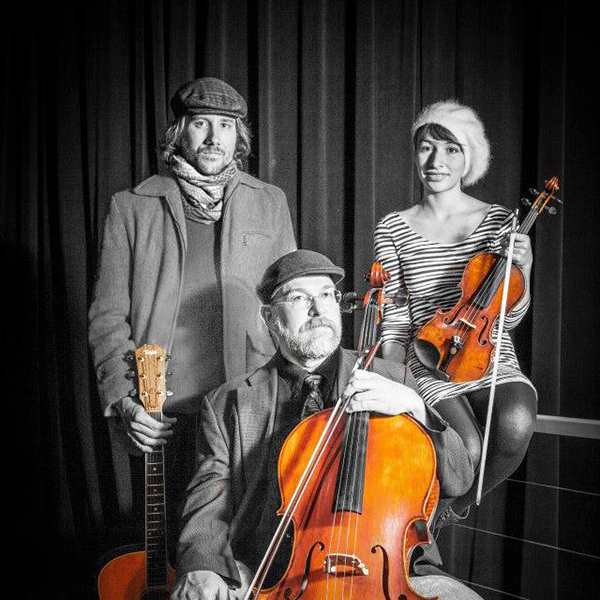
Levi Burkle, guitarist; Gloria Ferry-Brennan, violinist and James Hinkley, cellist, find their way into a Three Cent Stamp (Photo by Jim Carroll)
These impressive musicians come from three generations. Hinkley, who plays cello and was responsible for bringing the three of them together, is 56. Burkle plays guitar and is 37, and Ferry-Brennan, who plays violin, is just 17 with a year to go in high school. Playing on the concept of “three” suggested the name for the group, Burkle said with some whimsy in his voice: “We were searching for a name; there are three of us and we just wanted to be a stamp we can use now and then.” He added, “We didn’t want to be an ordinary stamp that’s used every day.”
So, how did this unlikely threesome, who came from diverse locales and life experiences, get together?
The trio started with Hinkley and Burkle in Montana. After a series of negative life experiences left Hinkley broke and without the cello he’d played for many years (he’d had to hock it), life turned around for him in Montana when he went to a jazz club to listen to some music. He heard Burkle and was “blown away” by his talent and creativity. A mutual friend introduced them and commented, “This guy plays the cello.”
“I didn’t know what a cello was,” Burkle recalled, “and I asked him if he’d show it to me. In North Dakota where I grew up, I’d never heard of that instrument.”
Burkle was fascinated by the large stringed instrument and hired the cellist to play a gig with him. Hinkley got his instrument out of hock, began practicing and got himself ready in just a week. “We had an immediate musical connection,” he said. “When we play together, it’s almost as if we’re telepathic.”
After playing gigs for three years, Burkle and Hinkley decided to tour. They first traveled to Burkle’s home state of North Dakota and then made a trip out west.
Thinking they might move to Seattle, they came for visit in 2003. An old friend invited them to come first to Whidbey Island. They came here—and stayed, but they’ve performed many times since in Seattle.
Enter Ms. Ferry-Brennan.
Gloria Ferry-Brennan was born on Whidbey and began taking violin lessons from Linda Good at Island Strings when she was four. After playing for a few years, she took a master class from Michael Nutt, who had started the Saratoga Chamber Orchestra. Recognizing her as a prodigy, he became one of her mentors. When she was 10, Legh Burns, Director of the Saratoga Orchestra (which evolved from the Saratoga Chamber Orchestra), invited her to become a member.
Hinkley and Ferry-Brennan met through the orchestra in 2006. Their first experience playing together was when pianist Eileen Soskin invited Hinkley to play with her and he invited Ferry-Brennan to join them.
Hinkley and Ferry-Brennan said they felt an immediate musical link. They were invited to perform at WICA in 2011 as part of the Local Artists Series.
That concert was the first time the trio played together, after Hinkley suggested Burkle join them for the second half of the show. “The very first time we were together, it was magic,” Hinkley recalled. “Now I’m playing with the two favorite musicians I want to play with.”
Ferry-Brennan said she believes both of her music partners are “true geniuses who constantly improvise and compose. And when we play together, it’s a true joy.” The music of Three Cent Stamp includes many of the compositions that Burkle and Hinkley have written.
In addition to their instrumentation, the Three Cent Stamp musicians sing together in three-part harmony. “Our music is fun-loving,” said Ferry-Bennan.
“Just like life,” Burkle said, “we’re all making it up as we go along. We like including humor in what we do,” he added. “We don’t want to get too serious.” Hinkley mentioned that, every once in a while, “Burkle makes a comment on stage that startles me, and I have to come up with a response.”
Hinkley and Burkle have each written hundreds (or maybe that’s thousands) of compositions, which have become part of the trio’s repertoire. The future of Three Cent Stamp includes making the CD, performing several concerts this summer and being part of the DjangoFest lineup this September.
Photo at top: Levi Burkle, James Hinkley and Gloria Ferry-Brennan of Three Cent Stamp (Photo by Jim Carroll)
Carolyn Tamler was a marketing research and community involvement consultant in the Seattle Area for many years before moving to Whidbey Island, where she has become known as a writer who enjoys telling the stories about the many businesses and entrepreneurs on the island.
CLICK HERE to read more entertaining and informative WLM stories and blogs.
WLM stories and blogs are copyrighted and all rights are reserved. Linking is permitted. To request permission to use or reprint content from this site, email info@whidbeylifemagazine.org.
BY RUSSELL CLEPPER Whidbey Life Magazine Contributor March 17, 2014
Choochokam Festival of the Arts has announced the performers for the 2014 Saturday night street dance, the highlight event of the 39-year-old celebration in Langley. The festival this year is scheduled for Saturday and Sunday, July 12-13. Festival organizers expect the construction work on Second Street will have no adverse impact on festival music or any of its other activities.
“We are all trusting the city to have it completed, or nearly completed, in time,” said Celia Black, president and Entertainment Chair of the Choochokam Arts Foundation.
The Ben Rice Blues Band will headline the street dance on Saturday night from 8 p.m. until 10 p.m. Seattle funk/hip-hop group 20 Riverside will open with an hour-long set beginning at 6:30 p.m. Black said that Choochokam is still accepting applications from local and regional acts to perform on one of the three stages that will be set up during the two-day celebration of the arts.
The award-winning Oregon-based Ben Rice Blues Band has earned significant recognition from various blues enthusiasts and organizations. Rice represented the Cascade Blues Association at the 2014 International Blues Challenge in Memphis, Tenn. this past January with a back-up group called the iLLamatics. They were one of the top nine finalists out of 250 acts.
Rice writes much of the group’s material and plays slide, electric, dobro, lap steel and cigar box guitars. He has described his playing as “a kitchen sink of blues.” He first performed for Choochokam in 2010.
Festival president Celia Black said the group 20 Riverside has been a crowd favorite for six years, ever since their first performance at the Useless Bay Coffee Company
The members of 20 Riverside (Photo used by permission of the artists.)
Pavillion in 2008. “Their music blends the classic rock and brassy horns of Chicago, the funky grooves of Tower of Power, and the hip-hop rhythms and socially conscious lyrics of the Roots,” she said.
Both street dance groups consist of young players and Black expects they will have a great deal of cross-generational appeal. She said one of Choochokam’s goals is to serve the entire community and one way to do that is to provide music that appeals to all generations.
“We try to provide opportunities for young musicians and up-and-coming acts as well as feature more established musicians and local favorites,” Black said. “We have had high school students right along with seasoned pros perform on the Choochokam stages.”
Musicians may apply to play at Choochokam until Tuesday, April 1, either through the website or through Sonicbids. Applications are also open for exhibitors through the end of March.
Photo at top: Ben Rice (photo used by permission of the artist)
Russell Clepper is a singer-songwriter who plies his trade locally and around the country. He also is a substitute teacher for the Oak Harbor School District.
CLICK HERE to read more entertaining and informative WLM stories and blogs.
WLM stories and blogs are copyrighted and all rights are reserved. Linking is permitted. To request permission to use or reprint content from this site, email info@whidbeylifemagazine.org.
BY DIANNA MACLEOD Whidbey Life Magazine contributor
March 11, 2014
By the time she moved to Whidbey Island in 2006, author Elizabeth George had 13 published novels to her credit, all set in Britain and all featuring the aristocratic Inspector Lynley and his working-class sidekick, Barbara Havers. Both characters have been immortalized on film by the BBC and have been broadcast on PBS’s “Mystery” series.
From her home overlooking Saratoga Passage, George penned three more novels about Lynley and Havers, expanding her fan base and expanding her reputation as an international best-selling author. After completing her sixteenth novel in the series, “This Body of Death,” George decided to try her hand at creating a completely different world—Whidbey Island—for completely different readers: young adults. The first book of the three, “The Edge of Nowhere,” appeared in 2012; the second, “The Edge of the Water,” makes its debut this month.
I interviewed Elizabeth George to find out more about how her island home influences her fiction and vice (not the criminal kind) versa.
Early in “The Edge of Nowhere,” protagonist Becca King boards a ferry from Mukilteo to make her first trip across Puget Sound. Readers see Whidbey Island through her eyes. How did the island contribute to the fictional world you created?
In front of the historic Dog House Tavern, George mingles with replicas of town founders who populate the window. Constructed by the Langley Main Street Association, these one-dimensional characters whisper their stories through the glass. (Photo by David Welton)
I found several locations—even the names of those locations—atmospheric and evocative. Double Bluff Beach. Smuggler’s Cove. Fisherman’s Alibi, which is an old fishing resort near Greenbank. These and many more offered themselves up in the service of the story.
Did you find it difficult to live in the real world of Whidbey Island while simultaneously creating the fictional Whidbey Island of the book? Were there moments when the two worlds rubbed shoulders? Or even collided?
Writing about place means seeing and describing the things that make that place different from any other. It’s easier to see those things in a foreign place; I know this from my many trips to Britain to research location for the Lynley novels. Here at home I faced two challenges. The first was seeing my surroundings with fresh eyes in order to choose the telling details that would evoke Whidbey Island.
Yes, I was struck by the way you described Becca’s first ferry trip from Mukilteo. She notices the roar of motorcycles amplified in the interior of the ferry so that four motorcycles sound like an army. Waiting to board, I’ve heard those motorcycles many times.
Exactly. That is a telling detail that distinguishes Whidbey from any other island, that ferry from any other.
And the way Becca first sees Whidbey through “a billowing gray veil.” Once the ferry penetrates the fog, the island appears to her to be nothing but trees.
We take our mist and fog for granted, don’t we? But Becca is from a desert environment, so these things strike her. They also add to the sense of mystery of this unknown place that is, for her, on the edge of nowhere. The challenge for me was to make my familiar surroundings fresh and vivid to myself so I could make them fresh and vivid to my readers.
And your second challenge?
Separating my daily life from my writing life. When I’m on my way to the grocery store, I’m thinking about my shopping list, not the lovely old barn I’m passing that may, in fact, make a wonderful setting in my story. Living in my story location also changed my method.
What is your method, and how did it change?
I never write about a place I haven’t visited. Normally, I do my location research in advance and then immerse myself in the writing process, using notes and photographs to recreate location. Writing about the island meant I could stop what I was writing and visit a location or interview a person. The locale was at my fingertips…fingertips that are usually on the keyboard. Convenient, yes, but also distracting.
And I would imagine you are less anonymous here than you might be in Britain. I do recall going to the fairgrounds to see the “Timebenders” perform and being asked if I was making notes for a novel. I was, of course.
Your main character arrives on Whidbey Island alone and in danger because of her unique ability to hear the thoughts of other people. While many of us may have occasionally toyed with the idea of this kind of mental eavesdropping, you’ve based all three of the “Edge” novels on this concept. Of all of the paranormal powers you could have chosen for your protagonist, why this one?
I’m intrigued by the duality of this power, which may seem like a gift on the surface but is just as often an affliction, or at least an impediment. Becca finds it hard to live a normal life. She’s burdened with the kind of insights that immerse her in conflict, and conflict is, of course, the stuff of story. Becca has no way to filter out the thoughts of other people. Information bombards her.
Her journey in the three novels is to learn how to control her ability. I suspect this parallels the real life of teens surrounded by social media, advertising, constant chatter and loads of stimulus.
Did you have help in capturing the sensibilities of a teenager? Did you channel your inner teen?
I taught high school for 13 years, so I’ve had plenty of exposure to teens. In addition, all my novels written for adults have included young people and children as characters, so I’m used to writing about them and from their point of view.
Did writing for young adults pose any problems for you?
In the YA genre, all the information that moves the story forward must come from the teens. The revelations have to come from the kids. I wrote five drafts of the first book before I learned that lesson. While I knew that each genre has its own rules, I wasn’t sure how quickly I’d be able to master the rules of the YA genre. My editor, who has been editing YA novels for 25 years, was very helpful.
The plots of your Lynley books are complex and layered, as are the characters and relationships. Did you have to adjust this for a younger audience?
I learned to simplify plot because it’s difficult for kids to hold the plot in their mind if it becomes too complicated. I limited the number of characters for the same reason. For me as a writer, creating character is the most fascinating part of the process; the bigger the attitude, the easier the character is to write. Some of my teen characters have a lot of attitude!
Readers of any age who live on Whidbey Island would enjoy your descriptions of the places we inhabit. Which of the many settings featured in “The Edge of Nowhere” have evoked the most response?
Elizabeth George’s newest YA novel, set on Whidbey Island.
A class of seventh graders in a Mukilteo school read the book together. None of them had ever been to Whidbey Island. Their teacher brought them over and took them on a tour of the local settings. Afterward, I met the class. It was thrilling for me, and I hope it was thrilling for them.
You are admirably prolific, completing a lengthy novel every one or two years since your first book in 1988. In 2012, two were published, another in 2013, and now “The Edge of the Water.” Do you find the island environment conducive to writing?
I appreciate the unparalleled natural beauty here on Whidbey. Whales in the Passage in front of my home. Eagles in the tree outside my window. Taking a bike ride or a hike anywhere on this island is like walking into a National Geographic special.
Gardening also helps me connect to the physical world. I especially love trees and have created, on my property, a forest I can walk through. I spend an hour every day communing with the ferns. If I’m stumped by a problem in my writing, spending time in nature usually helps me to find a solution.
What is the name of the third book in the YA series, and when should we expect it?
The publication date for “The Edge of the Shadows” is sometime in 2015.
If readers would like signed copies of the first and second “Edge” novels, could that be arranged?
Certainly. Moonraker Books in Langley carries both. If a reader would like a signed copy, just let the Moonraker folks know and I will gladly come by and put pen to paper.
I love the Shakespeare quote you selected to begin “The Edge of Nowhere:”
“Be not afeared; the isle is full of noises,
Sounds and sweet airs, that give delight, and hurt not.”
Yes, it expresses so much of what is to follow, both on the island and in the minds and hearts of the characters.
Dianna MacLeod holds a journalism degree from the University of Michigan and has worked as a writer and editor for individuals and nonprofit organizations. She moved to the Isle of Whidbey in 2011 to complete a novel—and never left.
The Elizabeth George Foundation makes grants to unpublished fiction writers, poets, emerging playwrights and organizations benefiting disadvantaged youth. For further information, including guidelines and deadlines, write to the Elizabeth George Foundation, PO Box 1429, Langley WA 98260.
(Pictured at the top: The author in front of Village Pizzeria on First Street in Langley/Photo by David Welton)
CLICK HERE to read more entertaining and informative WLM stories and blogs.WLM stories and blogs are copyrighted and all rights are reserved. Linking is permitted.
BY PENNY WEBB Whidbey Life Magazine contributor
March 4, 2014
The 12th annual spring edition of Whidbey Working Artists Studio Tour lets tour-goers spend time this weekend with artists in their studios, seeing firsthand what goes into making their art.
Coinciding with Musselfest in Coupeville, the Tour highlights 25 artists in 17 different venues.
The free tour was established 12 years ago by a group of artists who felt the central and north end of the island was being under-represented in the arts community. Over the years, the tour has grown and there are now two tours each year—one in spring—to coincide with Musselfest—and the other in summer, on the same weekend as the Oak Harbor Music Festival.
Christine Crowell
“About half of the folks who come to the art tour are from off-island,” said, Kay Parsons, this year’s tour coordinator. “And, of those, a surprising number are from Canada!”
Planning the tour to coincide with two of the upper island’s big events creates a real weekend getaway opportunity. “It just made good sense for us to buddy up with Musselfest and the Music Fest and promote our events together,” Parsons said.
Gary Leake
A group of about seven artists make up the core group behind the Tour. “We are a club that supports and appreciates each other’s work,” Parsons said. “This year we have a couple of new artists that we’re really excited about.”
One of the new additions is Janet C. Lewis, a luthier, who creates beautiful, one of a kind wooden instruments with inlays inspired from nature. Kim Tinuviel, who works with both encaustic paper and hand-hewn metal to create gorgeous working lamps, will be showing her work at Lewis’ studio also.
Two other artists, who use encaustic techniques, are Kathleen Otley and Anne Smidt. Both incorporate subjects from nature in their compositions. Otley also creates large woven willow sculptures.
Janet Lewis
Jim Short calls himself a rescuer of wood. He finds interesting pieces of wood headed for the landfill or the fireplace and turns them into beautiful works of art. Another artist working with wood, Rob Hetler, makes fine wood furniture and exquisite treasure boxes. Gary A. Leake specializes in one-of-a-kind wooden furniture, custom orders, and restorations.
The Pacific Northwest Art School, in downtown Coupeville, serves as a central hub for the tour and is showcasing five artists. On display will be Patty Picco, who works in mixed media; Carol Ann Bauer, pottery; Kay Parsons, watercolors and the mother/daughter team of Mary Ellen O’Connor, who works primarily in silver and etched glass and Linnane Armstrong, woodcut prints.
Katrina Hude
Stretching from Freeland (Island Art Glass) to Oak Harbor (Dan Ishler, hand thrown pottery), the tour winds through scenic Whidbey Island landscapes that inspire so many artists. Luckily, the tour lasts three days, giving everyone an opportunity to visit with artists at all 17 locations.
Tour hours are 10-5 Friday through Sunday. Brochures, with a map, are available at Ishler Studio, 30678 State Route 20 (just south of Oak Harbor) or at Pacific Northwest Art School, 15 NW Birch Street, in Coupeville. For a downloadable version visit WhidbeyWorkingArtists.
Penny Webb is a writer, musician, gardener and mom. She is currently writing feverishly on her memoir and loving two hormonal teenagers.
(Photo at the top: Pottery by Dan Ishler, this photo and others are courtesy of Whidbey Working Artists)
CLICK HERE to read more entertaining and informative WLM stories and blogs.
WLM stories and blogs are copyrighted and all rights are reserved. Linking is permitted. To request permission to use or reprint content from this site, email info@whidbeylifemagazine.org.