PHOTOESSAY BY SUSAN SCOTT Whidbey Life Magazine Contributor
February 3, 2016
One of my favorite walks through Langley is along a slender dirt lane, reminiscent of the historic footpaths of the Cotswolds in England. Melsen Alley, just a third of a mile long, serves neighbors as the main footpath into downtown Langley and outlying areas. For the 20 years I’ve lived in Langley, I find that meandering up or down this path can be as enjoyable as my destinations. Homes and businesses along the lane tend both front and back entrances, making it an inviting passageway to explore for people of all ages. But, what I appreciate most is the changing natural beauty to behold in every season.
Well-tended front and back entrances welcome Langley walkers.
A rain-bejeweled plant growing at Second Street and Melsen Alley
Setting out from the Whale Bell on First Street in Langley on Jan. 15, camera in hand, I turned left on Melsen Alley and headed uphill, thinking about the joy of living with neighbors who consider wildlife to be a cherished part of our community. At Second Street I noticed how the lush community park featured sculptures of a prayer wheel and heron. I felt privileged to be living under the flight pattern of a nearby heron rookery, catching glimpses of hawks and eagles, and the colorful clans of rabbits sharing our neighborhood.
A diversity of foot traffic enjoys sharing the path together.
Metal art decorates the side of a home.
Nature’s beauty offers quiet grace to the winter sky.
Henry David Thoreau could have been speaking about my home town when he said, “My vicinity affords many good walks; and though for so many years I have walked almost everyday, and sometimes for several days, I have not yet exhausted them.” Though he traversed familiar ground, he almost always discovered a new delight along the way. I find this to be true when exploring the pathways in and around Langley, with no goal in mind beyond the pleasures of seeing whatever there is to see in each moment.
A pinecone bouquet reaches into the walkway.
A neighbor’s old fence is a natural for abstract art.
Little Free Library on the lane is a welcome post for swapping books.
About halfway up Melsen Alley, I encountered a winter visitor coming down the hill on her way to the library. We greeted each other, simultaneously glancing upward to watch a flock of 15 herons gracefully flying over our heads. Neither of us spoke again until they descended, landing on the trees that marked their rookery behind the middle school’s sporting fields. Before proceeding on our separate ways, we both laughed at how the neighborhood would be filled with their raucous mating calls in February. There’s nothing quite like the herons’ ancient sounding chorus of harsh croaks rising and falling in that almost deafening, yet glorious crescendo that promises new life in Springtime.
Melsen Alley at Sixth Street leads to downtown Langley with a view of Saratoga Passage.
A Great Blue Heron flies solo from his rookery toward Langley’s waterfront.
When I reached my journey’s end at Melsen Alley and Sixth Street, I looked back down the lane to see that Saratoga Passage beckoned me forth now. As I traipsed downhill, I felt immensely thankful not only for the lovely sky and water views ahead, but for all the treasures that would be opening along the way.
Henry David Thoreau quote from “Nature Walking,” Beacon Press, Boston, 1991
Susan Scott, photographer and author, enjoys daily walks on Whidbey Island and catching glimpses of extraordinary moments of ordinary life with her camera.
WLM stories and blogs are copyrighted and all rights are reserved. Linking is permitted. To request permission to use or reprint content from this site, email info@whidbeylifemagazine.org.
BY DIANNA MACLEOD Whidbey Life Magazine Contributor February 3, 2016
Last fall we reported on a partnership among several Island nonprofits—Whidbey Island Nourishes (WIN), Good Cheer Food Bank, the Whidbey Institute and Goosefoot Community Fund—to support a bold plan to provide school children with the educational and practical benefits of growing a garden, the kind of benefits most children once received in the course of daily life. The partners decided they would prepare the ground, plant the seeds, add hard work and patience and a sunny outlook…and wait for the South Whidbey School District Garden Program to take root and sprout.
That sunny outlook was helped along by a promise by the Goosefoot Community Fund—an organization that exists to build a sense of community, preserve rural traditions, enhance local commerce and create a sustainable future for South Whidbey Island— to raise $15,000 each year for three years and a commitment from the Goose Grocer to match that amount every year.
The big thermometers (photo by Lis David)
During the 2013-2014 school year, the Goosefoot Community Fund had raised more than promised. That amount of $22,000—matched by the Goose Grocer—helped to create a half-acre farm on the Maxwelton Road school premises. The School Farm included a 960-square-foot hoop house (the “Big wHOOP”) erected on the fringes of the elementary school playground, a large plot of ground plowed and ready for planting, and a cluster of small buildings. Once those were in place, teachers developed a curriculum that included lessons taught by earth mover and seed shaker Cary Peterson on the how’s, why’s, and what’s of growing a garden. (What makes a healthy soil? Why are worms our friends? How does a seed make a plant?) Before the year was over, students were contributing home-grown vegetables to their school cafeteria.
So it was no wonder that a large group of planters and sowers—the many volunteers who helped with teaching, curriculum development, building the School Farm infrastructure—gathered at the Goose Grocer on Thursday to celebrate the presentation of the second big check—this time in the amount of $52,000—to the South Whidbey School District Garden Program, the little sprout that could!
Garden program partners hold up the big check (photo by Lis David)
A big whoopee greeted the big check. Children would continue their collective love affair with the earth and its bounty. Students would continue to feel the pride of farmers who were raising food for their school as well as extra produce to donate to the food bank. Kids would still be able to pull on their garden gloves and pick up their trowels to spend time in the garden during recess.
The whoopin’ and hollerin’ was followed by some eatin’ of a big cake that boasted a frosting photograph of a plate of fresh vegetables and letters in shades of orange (to match the carrots in the photograph), green (think lettuce), yellow (squash, anyone?).
The big cake (photo by Lis David)
By the way, the cake turned out to be everything a cake should be: gooey, sugary, chocolatey—a wonderfully bad cake to celebrate a wonderfully good achievement by wonderfully dedicated people.
* * *
To read the feature Big wHOOP from November click here.
Donations to the School Garden Project can be sent to Goosefoot, PO Box 114, Langley WA 98260. You may also donate online at www.goosefoot.org; be sure to make your contribution to the School Garden Program. Questions? Call 360-321-4232.
Dianna MacLeod holds a degree in journalism from the University of Michigan. An alumna of Hedgebrook, she moved to the island in October of 2011 to complete a novel—and never left.
WLM stories and blogs are copyrighted and all rights are reserved. Linking is permitted. To request permission to use or reprint content from this site, email info@whidbeylifemagazine.org.
Congratulations to Stephanie Barbé Hammer, our “Whidbey Writes” featured writer for February. We’re pleased to be able to share her work of poetry, “I experience nature myopically” with you.
The purpose of “Whidbey Writes” is to encourage writers with a Whidbey connection to submit short fiction and poetry for publication in Whidbey Life Magazine, thereby giving our readers an opportunity to enjoy these creative writings. Throughout the past year, Whidbey Writes published monthly selections of short fiction and poetry online. The most popular of these entries was also published in the Fall/Winter 2015 print issue.
We publish the original work of selected winners at the beginning of each month as part of Whidbey Writes. WLM congratulates Stephanie and thanks to volunteer editors Heather Anderson, Mureall Hebert and Chris Spencer, who review submissions on Solstices and Equinoxes and pass on the work they enjoy most to Whidbey Life Magazine for publication online and in print.
This competition, originally created as a collaboration between Whidbey Life Magazine and the Northwest Institute of Literary Arts, will now continue as part of the creative writing section of Whidbey Life Magazine. Whidbey Life Magazine extends thanks to the Northwest Institute of Literary Arts for their ongoing support of Whidbey Writes.
To find out more about Whidbey Writes and the submission criteria, visit the Whidbey Writes Submission page. To see previously selected writings, visit the Whidbey Writes page here.
_______________________
I experience nature myopically
By Stephanie Barbé Hammer
We walk me and my dad
Looking for pine cones
To start the fire in the cabin —
I don’t wear my glasses though
They are new to me and sit strangely
On my ears, so when I pick up the thing
That is brown and mottled like a pine cone it
Just feels wrong. Pine cones are brittle and dry
This brown thing is wet and it’s cold so I
Crouch down to investigate with my already
Not very good eyes. A slug. I let go. Stand up.
We walk to the stream and we skip tiny stones
Forget about pine cones. But I personally never
Forget the slime-wondrous feel of that being
That I thought at first was a dead piece of plant.
Stephanie Barbé Hammer’s prose poem chapbook “Sex with Buildings” appeared with Dancing Girl Press in 2012. Her 2014 collection, “How Formal?” is available from Spout Hill Press. Her first novel “The Puppet Turners of Narrow Interior” was published with Urban Farmhouse Press in 2015.
WLM stories and blogs are copyrighted and all rights are reserved. Linking is permitted. To request permission to use or reprint content from this site, email info@whidbeylifemagazine.org.
Telling the public that you’re closing your dairy is one thing. Actually getting out of farming—quite another.
Farming is not simply an occupation. It’s a lifestyle.
Farmers don’t just work. They pour every cell of their being into the soil, their animals and their crops, from sun-up to sundown—and often long past then. One doesn’t just give that up.
Our life “after” farming? We still have more than 20 livestock (goats, sheep, llama) on our farm. They still need care, food and water twice daily, supplements, hoof trimming, shelter, fence mending, attention. Only now I’m working off the farm with a vengeance as well as taking care of our farm.
However, the closing of the dairy allowed me enough time to take a “clay class” in October and November of 2015 and to uncover a newfound passion for playing with a new type of mud or, to be more precise, clay.
Ooh la la… let me tell you about pottery! Better yet, let me show you.
Some days we don’t make anything but joy in the studio, and it can look like this:
Kylie Beard, center, and Vicky Brown get “muddy.” (photo by Tom Brown)
Some days it can be spending quality time with your husband (and our amazing instructor, Sharon Warwick of Wellspring Pottery):
Tom Brown at the wheel, coached by instructor Sharon Warwick of Wellspring Pottery (photo by Vicky Brown)
Or working with the rest of the class, watching each other learn and grow:
Gordon Stewart and John Heard listen to Instructor Clovy Tsuchiya of Clovy Tsuchiya Pottery (photo by Vicky Brown)
Kate Nunn, Anna Dozer, Aureya Magdalen, working in Warwick’s class (photo by Vicky Brown)
If you practice what you learn and add your own flair you might just get lucky and get a finished product like this to boast about:
My green bamboo pot (photo by Vicky Brown)
So, life after farming? I don’t know yet. It’s in my blood… I’m not anxious to close the barn door.
I’m grateful I was led to a place like The Paint Escape to land, to soothe me after the heart-wrenching decision to close our dairy. It kept me distracted and offered me comfort in a safe, supportive, creative and fun environment.
I’m heartbroken that this place had to be lost to our community. The loss, while still raw from the pain of shuttering our own business, felt personal and it hurt.
Yet a new spark of joy has hit. One of the tenacious previous owners of The Paint Escape, Tina Beard, is committed to opening a new business: her business, her vision and—if you asked her—the fulfillment of her “calling,” to create this space for the community.
Whidbey Art Escape will be so much more than what started as a paint-your-own-pottery spot in Freeland. It will be bursting at the seams with its delightful, brightly windowed studio for painting bisque-ware in delightful and useful shapes, a fun Glass Escape Studio for glasswork and, of course, the rather large Clay Escape Studio—now with eight wheels, a pug mill, a slab roller and beautiful space for handwork, carving and glazing fun.
There will be classes going on; top talent from our community will provide up to three group classes a week, with even more one-on-one “experience” classes.
If you’re ever wondering about it, come on by when they open (tentatively March, 2016). If I’m not at work, I’ll probably be there—throwing a pot, or carving, or glazing, or maybe just having a cup of coffee with my new studio-mates and friends. Odds are, we’ll be laughing and sharing joy. You’re welcome to come get your dose; we’d love to see you.
A gang of us, creating fun at Whidbey Art Escape, is even forming our own group. (A business that has its own groupies is probably a good thing, right?) Our little gang, The Escapees, are creating and learning and playing and will be soon offering our unique handmade objects to the public.
Stay tuned. I promise to keep you posted.
Beth Ryder helping to move growing baby goats from the nursery to the barn years ago when the farm was bustling this time of year. (photo by Vicky Brown)
So, while I still miss my bucket of baby goats with a very real ache in my heart, as part of my first gang—the Escapees—I know that love is not limited to one thing. I’m quite certain that the more we love, the larger our heart swells to accommodate it. In the arena of passion, certainly less will never be more.
Perhaps your passion won’t be struck by hands in the mud or the dirt of a farm, or even by the mud or clay on a wheel, but I hope you find it, wherever it lies. When you do find it, unharness your constraints and seize it with your whole heart… whether you’re any good at it or not…
My FIRST pot, from my first class in October, 2015 (photo by Vicky Brown)
Thank you for your support along my journey.
Vicky Brown (still a “farmer,” even if she’s milking less often), puts her passions on the page writing about food, agriculture and the tender web of community.
WLM stories and blogs are copyrighted and all rights are reserved. Linking is permitted. To request permission to use or reprint content from this site, email info@whidbeylifemagazine.org.
PHOTO ESSAY BY MARSHA MORGAN
Whidbey Life Magazine Staff Photographer
January 27, 2016
Winter on Whidbey can obviously be rainy and drizzly and, at other times in this season, it can present us with beautiful landscapes and photographic subjects. Marsha Morgan captured a few of these scenes to share with you.
The sunset, heading home to the island on the Mukilteo Ferry
Heron at rest in the Langley marina
Bare-limbed wintry trees near Greenbank
Mt. Ranier barely peeks through the sunset at Double Bluff.
WLM stories and blogs are copyrighted and all rights are reserved. Linking is permitted. To request permission to use or reprint content from this site, email info@whidbeylifemagazine.org.
BY HARRY ANDERSON
Whidbey Life Magazine Contributor
January 20, 2016
Nancy Conard first came to Coupeville when she was a year and a half old; her dad was in the Navy. That was in 1953, and she proves it by showing a picture of herself as a tow-headed toddler playing on the beach at Ebey’s Landing. What’s remarkable is that, except for a brief stretch after high school, she’s never lived any place else.
Toddler Nancy Conard at Ebey’s Landing, 1955 (photo furnished by Nancy Conard)
“I feel so fortunate to live where I grew up,” she said “It’s comfortable to be around the memories of your whole life in a very nurturing environment. And being able to contribute some in public service is kind of my pay back.”
“Contribute some” is a modest understatement, a typical posture for Nancy Conard. She retired the first of this year after serving 20 years as mayor of Coupeville, with four years before that on the town council. In the past couple of months, she has received numerous tributes from Whidbey and the state for her achievements and her people-pleasing disposition.
As she talked about her life and public service, the memories began to pour out. Coupeville’s population was less than 400 when her family moved to town but, by 1960, it had almost doubled to 740, much of it due to growth at the Navy base in neighboring Oak Harbor. (The town population in 2014, per the latest Census Bureau estimate, was 1,860.)
Conard with her younger sister, Maureen, outside their Coupeville home, 1955 (photo furnished by Nancy Conard)
“Coupeville was a small town but we had a lot of kids,” Conard said. “We lived right across the street from a playground where we all congregated, unsupervised by adults. We made up games and built play forts. There was a well house in one corner and one of the maintenance men attached his rock polisher to the pump and he let us go pull out agates while they were polishing. I’ve been fascinated by agates ever since.”
She and all the kids walked unescorted up the sometimes-muddy path along Main Street to Coupeville Elementary School. No need to wait for the famous Coupeville stoplight; it didn’t exist because Highway 20 wasn’t built until the 1960s.
The Conards lived next door to Polly Harpole’s Maternity Home on Haller Street, a local institution where many babies were born before Whidbey General Hospital opened in 1970. Conard and her sister Maureen, two years younger, were excited when Polly let them come over and see the babies through the window.
“It was the Baby Boom and there were lots of babies being born,” she said. “At Polly’s they used to make bracelets to identify the babies, with their names in little cube letters. Polly let my sister and me put the letters together.”
At Coupeville High School, Conard was a good student and a classic over-achiever. She was treasurer; class vice president and sergeant at arms; on the honor roll; editor of the Wolves Howl; a member of the drama, pep and girls clubs; a sports team manager and a performer in the school plays.
Conard’s Coupeville High School graduation picture, class of 1970 (photo furnished by Nancy Conard)
“I think there were 36 kids in my graduating class of 1970,” she said, “and at least 24 of us had been together since kindergarten.”
After high school, she headed off to America—actually, it was Shoreline Community College—where she studied to be a dental hygienist. “But we had a fairly dysfunctional family and, after a year, I ended up feeling like I needed to come home and help my mom with some stuff.”
That turn of events, which might have depressed a less positive person, actually proved to be a launching pad for Nancy Conard. Through an early 1970s job-training program, she landed a job at the Coupeville School District as a part-time office clerk and part-time lunchroom helper. “By then my mom had moved and I was a young adult living on my own, and the school cooks really nurtured and took care of me. I still have their recipe for hamburger gravy, and today it’s (her husband) Gordon’s absolute favorite meal.”
From there she gradually climbed the ladder at the school district, first as a secretary and then as assistant to the superintendent. Impressed by her business and people skills, the superintendent took a leap of faith in 1977 and promoted her to district business manager, responsible for such things as accounting, financial reporting and negotiating contracts. It was a job she held for 27 years, until she retired in 2004.
In that position, Conard won accolades and eventually became president of the Washington State Association of School Business Officials, the first representative of a small district to serve in the position. And it drew her notices at home, as well; friends urged to run for Coupeville Town Council when openings come up in 1992.
“I was blessed with a good work ethic and, maybe because the oldest child of alcoholic parents, I’m just naturally prone to be a workaholic and a people pleaser,” she said.
All her skills were put to the test almost from the minute she was elected. There was tension in the town over growth issues, with newcomers pitted against long-time residents. The election of 1992 was virtually a clean sweep, bringing in three new council members and a new mayor.
“I ran because I was so devoted to my hometown and I gravitated toward wanting to be a leader,” she recalled.
The leadership challenges were growing; the times were changing. The town population more than doubled between 1970 and 1990. Whidbey General Hospital was built. The new high school and middle school were constructed. The county jail and administration offices were expanded. Two mobile home parks were opened. The Ebey’s Landing National Historical Reserve was created. And—creating a fair portion of the tension between newcomers and long-timers—several apartment buildings and multi-family residences sprang up in a town that had rarely seen them before.
In addition, tourism was becoming a huge part of the local economy and that changed the town. “Tourism has been good for Coupeville because it has made it possible to make a decent living with a business in our historic buildings. Front Street today is geared for tourists, but when I grew up it was where you went for everything, including food, the Post Office and several gas stations.”
In 1995, the mayor’s position was open and Conard ran unopposed. “I saw some changes I wanted to make,” she said, in her understated manner. The first was to fire the police chief, with whom she had major disagreements. “I tried to work with him and we had a mediation, but it failed.”
It was a painful episode for a natural people-pleaser. “We had public meetings and a lot of people were upset with me,” she recalled. “An angry man at one of the meetings actually stood up and yelled at me to ‘get back in the kitchen,’ which was awkward and insulting.”
In response, her sister Maureen wrote a letter to the editor of the local newspaper in which she said “[Nancy] doesn’t belong in the kitchen because she doesn’t cook that well” and “what she’s doing is what she does well.”
Conard, dressed as Frosty The Snowman, in the annual “Greening of Coupeville Parade.” (photo by Megan Hansen, The Whidbey Examiner)
Twenty years later, the firing of the police chief and the aftermath still remains with her as the hardest thing she’s handled as mayor. But the next few years became a “golden time,” with the hiring of the new police chief, a clerk-treasurer and a town planner all about the same time. “We were all people who wanted to get things done,” she said. “We thought up things and we got them done. It was a fun, productive time.”
But in the early 2000s, things got difficult again. “We had a rather nasty time with more growth tension, especially over subdividing property. So the old tension with the status quo versus growth came back with a vengeance. I’ve lived through several cycles of it,” she added. When the economy nosedived in 2008, growth—and therefore the tension it brought—slowed dramatically.
Then, on New Year’s Eve 2009, the mayor’s personal life changed drastically. At a party, she met Gordon McMillan, a widower with a home on Snakelum Point just outside the town limits of Coupeville. A whirlwind courtship ensued and they married in July 2011; the two are currently raising Gordon’s granddaughter, Madison, at their home. “I had been thinking about retiring anyway when my term ended in 2015, but marriage and a granddaughter to help raise made the decision easier.”
As she looks back, she’s generally pleased at what she sees. “In the past 20 or 30 years, it has been really cool for me to see the diversity of people who have moved to Coupeville and what they’ve brought. It’s added so much more depth and richness to our community. And the nice part is that I think the community’s personality hasn’t been spoiled, or changed that much. People come because of what they see here, and they know it’s up to them to perpetuate that.”
But she’s also a frank realist. “Coupeville is not a place to be if you have a lot of problems or have very low income and are pulling yourself up by your bootstraps,” she said. “We just don’t have a lot to offer. This is a community that supports our neighbors through thick and thin. But that’s not the case if you move here needing a lot.”
Conard, husband Gordon McMillan and their granddaughter Madison, leaving for a cruise to Mexico in late December (photo furnished by Nancy Conard)
As the clock ticked down to her term’s end last month, she worried a bit about having “withdrawals” from a job that has required her full attention for a very long time. But she already has her eye on several projects in which she plans to get involved.
And, to ease her transition, Nancy, Gordon and Madison left just before Christmas on a cruise to Mexico. That was something Her Honor, the Mayor, never had time for.
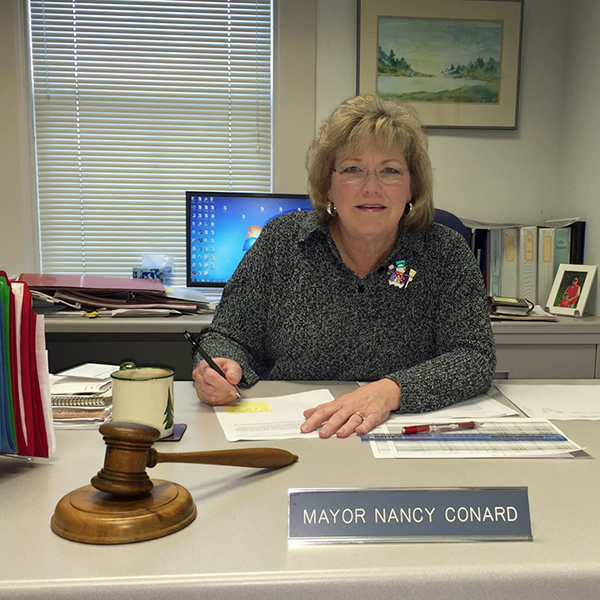
Image at top: Mayor Conard at her desk, a week before she retired (photo by Harry Anderson)
Once upon a time, Harry Anderson made an honest living as a reporter, editor and columnist at the Los Angeles Times. He now lives in central Whidbey, where he spends his time gardening and ruminating on things that interest him.
WLM stories and blogs are copyrighted and all rights are reserved. Linking is permitted. To request permission to use or reprint content from this site, email info@whidbeylifemagazine.org.
BY RUSSELL CLEPPER
Whidbey Life Magazine Contributor
January 20, 2015
Talk about a good story. There was this dad in Issaquah—Beaver Lake, to be precise—back when you could still ride your horse into town and tie it to a hitching post. That was not as long ago and far away as you might think.
Anyway, this dad knew his little son was talented and creative. That’s why he taught him how to use his camcorder. The little 4-year-old kid was soon making films, setting up his Star Wars toys and capturing their wild adventures. His dad had no idea that by his boy’s early 30s, the prestigious Sundance Film Festival would have accepted his son’s work for the third time.
Of course, it’s a true story, and Langley resident Drew Christie, the Issaquah kid, is represented—not just once, but twice—in this year’s festival, which kicks off Jan. 21. His live-action short film “The Emperor of Time” will precede each of the six showings of “Nuts!”—a full length documentary by Penny Lane—which features some of Christie’s acclaimed animation work. Both films tell stories of enigmatic characters whose impressive accomplishments were colored, if not tainted, by notorious episodes or behavior in their personal lives.
“Storytelling!” Christie said. “In all my education and schooling, nobody told me how important writing was, how important storytelling is. [That understanding evolved for me] as I noticed what resonated with people who viewed my films. They liked anything with a strong story.”
Christie demonstrates the mutoscope, or flip box—an old, simple technology for viewing motion pictures. The device is prominently featured in “The Emperor of Time.” (photo by Dave Welton)
Christie’s third Sundance film combines his respect for strong stories with his lifelong passion for photography, and for filmmaking in particular. “The Emperor of Time” is about Eadweard Muybridge, who pioneered the photographic study of motion and who also did some of the earliest projection of motion pictures.
The film’s narrator is Muybridge’s son, Florado, an intriguing choice for the role. Muybridge was tried for the murder of his wife’s lover and eventually acquitted on the grounds of justifiable homicide. His wife, Florado’s mother, died shortly after the verdict. Muybridge paid to put the boy in an orphanage, believing he was not his child, and had virtually no contact with his wife’s son for the rest of his life.
Another Whidbey Islander, Richard Evans, plays Muybridge in the film. It’s a silent role that the veteran television actor handles with grave aplomb. Whether as the cuckolded killer or the methodical, dogged innovator, Evans—as Muybridge—effuses steadfast determination, a resolve that denies or represses anything that would deter it.
“Bruce Launer, the woodworker, knew about Drew’s project and told him about me,” Evans said. “He called me, I read the narration and I thought it was really good. Drew is a very good writer. I loved doing it, too. It’s the way I really like to make films: hands-on, everybody doing anything they can to get it done.”
Christie used this vintage Russian camera as a prop in “The Emperor of Time” during a segment that explained how Muybridge devised a system to photograph galloping horses. His system eventually resulted in the first motion pictures. (photo by Dave Welton)
Musician and songwriter Eli Moore is yet another Whidbey Island resident who helped make the film. Moore created sound effects that, along with Spencer Thun’s musical score and Hugh Ross’ narration, help create the stoically melancholic mood that carries the tale to its lonely, elegant conclusion.
“I really enjoy doing sound design and was glad that Drew asked for my help on this,” Moore said. “His work inspires me to create sounds out of unexpected or unconnected objects and combinations of objects. The train sound was my favorite to make. I recorded the sound of beating on a washing machine and added the sound of a gourd instrument that you blow. It sounds like a train whistle to the undiscerning ear.”
Christie is proud of the participation of community members in his project. “Yeah, it’s local! We filmed it all here on Whidbey except for one scene. We even have Georgia Gerber’s horses in it.”
Gerber is the much-acclaimed sculptor who created the “Boy and his Dog” on the terrace in Langley and “Rachel the Pig” at Pike’s Place Market in Seattle, among many others. Both have achieved almost iconic status in their respective locations.
Although “The Emperor of Time” is live-action, Christie mostly makes animated films. His previous two Sundance entries, “Song of the Spindle” (2012) and “Allergy to Originality” (2014), represent some of his finest work in this genre.
Drew Christie during a moment of reflection. “We are all mirrors,” he said. People tend to mirror the information they receive and project it back to the world.” (photo by Dave Welton)
Christie is highly prolific and many of his animated shorts are published on the internet. His work also appears in “Op Docs,” the New York Times’ award-winning forum for short, opinionated documentaries (http://www.nytimes.com/video/opdocs-drew-christie).They all bear Christie’s signature technique of telling stories in a way that sidesteps the viewer’s expectations and shines light on the frailty and faults in our shaky framework of received knowledge.
“I’m a natural skeptic,” he said. “I’m skeptical of everything, even my own opinions. There’s this truth we have that is filtered. We’re mirrors. People tend to mirror the information they receive and project it back to the world. One thing I do is to direct my audience, in a way they’re not used to, to examine things from a different angle.”
Strong story, different angles, skeptical outlooks, filters of truth. Christie works it all into “The Emperor of Time.” No wonder that the judges at Sundance were impressed enough to invite him to show it there. Third time’s the charm.
* * *
For more information about Drew Christie, and to view more of his films, his website provides a good starting place: http://www.drewchristie.com/. His whale video, “Song of the Spindle,” is also on Vimeo at https://vimeo.com/24884553.
Image at top: Drew Christie in his Whidbey Island Studio (photo by Dave Welton)
Russell Clepper is a singer-songwriter who plies his trade locally and around the country. He also is a substitute teacher for the Oak Harbor School District.
Holden Sandal, a senior at South Whidbey High School, contributed to this article.
WLM stories and blogs are copyrighted and all rights are reserved. Linking is permitted. To request permission to use or reprint content from this site, email info@whidbeylifemagazine.org.
This article was originally printed in Whidbey Life Magazine’s Fall/Winter 2015/2016 print issue.
BY LES MCCARTHY Whidbey Life Magazine Contributor
January 13, 2016
It’s that time of year again— when one season slides into the next. A hint of crispness in the air and the damp earthiness of the woods tell us things are changing—and that it’s time to snuggle in.
Sensing the passing of the seasonal baton and the shortening of the days, we pull on our fleece, light our fires and peruse cookbooks rather than gardening manuals. Mom Nature shows off her colored and varied landscapes, frost whitens the pumpkins, and as our days grow grayer, wet and mizzly…our thoughts turn to all things cozy.
Langley’s South Whidbey Commons, a cozy spot for community and coffee (photo by Marsha Morgan)
Hygge, pronounced (HOO-guh), is an old Danish concept meaning “coziness.” Be careful saying it in a group of people unfamiliar with the term, as they might think you need the Heimlich Maneuver.
Years ago, I was fortunate enough to land in Copenhagen during the holiday season and found the city enchanting; torchlight reflected on the canals turned them into flowing ribbons of bronze glitter. On plazas and restaurant patios, friends and families gathered, day and night, in the cold—bundled in scarves, furs and blankets, holding mugs of steaming satisfaction. Their laughter tinkled and their breath hung in frosted puffs in the frigid air. Those scenes are quintessential Danish hygge—where even in the cold, warmth abides.
Even our pets want to “gear up” for all things cozy. (photo of Brutus by Sam McCarthy)
In Holland, the Dutch use the word gezellig (heh-SELL-ick). It, too, embodies the concept of coziness and warmth, and like the Danish word, a precise and accurate translation to English is somewhat elusive. Gezellig encompasses everything from cozy to friendly to relaxing and involves solitary activities as well as gatherings with friends and loved ones.
When we think cozy, the creature comforts readily come to mind: a marshmallow-soft comforter, a crackling fire, fuzzy socks; add in a hot toddy and a snoring pet and you can envision the scene. Snug as a bug in a rug.
But it’s just not the tangible things that make up those Old World concepts and all things cozy. Woven in are the emotional intangibles—shared conversation, friendship, security and shelter—that when blended together result in that “everything’s good” feeling of comfort and coziness.
So, here on the island when the rains begin and twilight arrives shortly after lunch (and summer is a distant memory or far-off dream), point your internal compass to the north. We’ve got plenty of long, dark, wet days (dare I say months) ahead, and if the Danes and the Dutch can heartily embrace coziness to help them through their winters, we can, too!
Yearn for yarn for a winter handicraft project? Visit Knitty Purls in Langley or Whidbey Isle Yarns, Gifts and Teas in Coupeville. (photo by Marsha Morgan)
These soggy months offer a well-timed respite for rejuvenating hibernation, exploration or doing things you didn’t have time for until now. Go it alone or in a friendly gathering. (Perhaps a lovely balance of both.) Snuggle in and use some of our ideas and conjure up some of your own. Let your mind wander and flow like those canals so far away, and you’ll soon be on your way to making this season your coziest yet.
“Gather” is a comforting word; gather together even more so. We gather together to discuss, to worship, to plan, to eat, to laugh, to console. We gather together with candlelight to celebrate the passing of years, the sharing of a holiday tradition or as illumination after a wind storm. Gathering together is usually a cozy thing. So…gather!
Solitude, however, should not be dismissed. A bit of bear-like slumber and lingering in an overstuffed armchair in a quiet corner with a soft throw and a stack of books nearby (old favorites or ones you have been meaning to read) is a delightful way to wile away a few (dozen) gray and wet days.
If you need real books (it’s hard to cozy up to an electronic device!), put on your galoshes and head out to one of our many local bookstores or libraries. Pick up and read “Wind in the Willows” (aloud to a child while inside a blanket fort) and try to decide whose home is cozier, Badger’s or Toad’s.
Cook up coziness…and dinner (photo by Gina O. Burrill, courtesy of Cook on Clay)
Autumn and winter are great cooking months—so many seasonal fruits and root vegetables. What’s cozier than a bubbling pot of stew or soup, chili or chowder? Cook up something slow and soul-satisfying. Put up some preserves, bake some cookies, braise. Let the warmth and aroma scent your home. Share your bounty with a neighbor. (If cooking isn’t your “thing,” perhaps taking a cooking class, getting a new piece of cookware or trying out a new recipe may help.)
Up and down the British Isles, one wouldn’t dream of being cosy without tea. Perhaps it’s time to learn how to make the perfect pot and enjoy the pleasant tradition of afternoon tea (complete with scones, nibbles and a tea cozy). Tea, sipped alone or shared, is a sure way to beat the winter blues.
If you live here, you know that Northwesterners aren’t stopped by any amount of rain—after all, it’s only water—so there’s no reason not to pull on your rain gear, grab some friends and share some outdoor adventure; find out what hygge is all about.
Weather the weather and walk the beaches and forests of our captivating island. Photograph the bare branches and the scuttling clouds. Savor this time of winter-rest and soft, seasonal light. Linger over conversation and coffee (or a meal) in one of our many restaurants or coffee shops (some have fireplaces—all the better). Travel the art, wine and farm trails; follow a guide or follow your heart. Visit one of our fiber farms or mills and kiss an alpaca. Take a tour, take a class, take each other, take your time. Share, laugh and warm your soul. Cozy in.
Tuck in for a movie and popcorn at Langley’s historic theatre, The Clyde Theatre or, if you’re on the north end, check out Oak Harbor’s movie theater. (photo by Marsha Morgan)
Just too gray and mizzly for your cozy meter? Duck inside and catch a matinee, spend an afternoon in one of our island museums or indulge in a bit of retail therapy. And on those days when you just don’t want to leave the comforts of home, light the fire and spend the afternoon with a board game, a good book or an old movie. Make a big bowl of popcorn, pour some cocoa, and you’ve got the start of a snug-fest.
Share your life lessons, talents and gifts. Learn (or teach) how to knit, draw or dance. Take a wreath-making class, make or paint some pottery, join a book club, donate your time. There are enough studios and events on this island to keep you busy for several fall and winter seasons, and they are all guaranteed to give you the coziest of feelings.
Come home to hygge, gezellig, and all things cozy. (photo by Marsha Morgan)
Whatever you do when the days are short and the evenings and nights are long—relax and find your inner cozy. Leave home and venture forth and then experience the wonderment of returning home again—your windows aglow in the gathering dusk—to hygge and gezillig and whatever coziness awaits you inside. Enjoy the season and delight in all things cozy.
Image at top: Cook up coziness…and dinner (photo by Gina O. Burrill, courtesy of Cook on Clay)
Les McCarthy is an author, entrepreneur and IPPY bronze medalist for her yearly “Healthy Living ~ Healthy Life: 365 Days of Nutrition & Health for the Family” calendars. She is now a full-fledged islander and loves every moment of life on this special rock. She joyfully tends to her geriatric fur factory but is rethinking the cuteness of the local deer and deck slugs.
WLM stories and blogs are copyrighted and all rights are reserved. Linking is permitted. To request permission to use or reprint content from this site, email info@whidbeylifemagazine.org.
PHOTO ESSAY BY DAVID WELTON
Whidbey Life Magazine Contributor
January 13, 2016
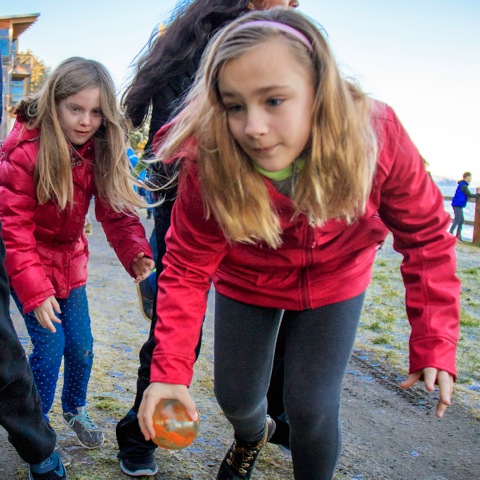
A huge crowd braved frost and freeze on Saturday morning, Jan. 9 at Seawall Park in Langley for the third annual Seafloat Scramble. Over 200 hand-blown glass seafloats were “hidden in plain view” for youngsters of all ages to find.
With a massive retinue of scramblers, all 200 seafloats disappeared in a matter of minutes. David Welton, WLM staff photographer, was there to capture some of the fun!
Newly elected mayor Tim Callison, in one of his first official acts, prepares to sound the starting bell.
Crowds rushed from the east and west ends of the park, hoping for one of over 200 hand crafted glass seafloats, “hidden” in plain sight.
The colorful, one-of-a-kind treasures were created by Callahan McVay of Callahan’s Firehouse. A second location for the Scramble was held at the park at 2nd and Anthes for kids under the age of five. The event was sponsored by the Langley Main Street Association and Callahan’s Firehouse.
This intrepid woman waded into the frigid waters of Saratoga Passage to retrieve her orange globe, anchored to a glass seastar.
She emerged from the waters victorious!
A family displays their booty. (The gentleman in the foreground scrambled for his coffee on First Street.)
David Welton is a retired physician and staff photographer for Whidbey Life magazine.
WLM stories and blogs are copyrighted and all rights are reserved. Linking is permitted. To request permission to use or reprint content from this site, email info@whidbeylifemagazine.org.
A few months ago a Langley acquaintance told me he felt sorry for me because I live north of Classic Road. That is to say, he pitied me because I live in Coupeville, which—if you’re reading this blog and aren’t from these parts—is in the middle of Whidbey Island.
Now friends, don’t get me wrong. I love spending time in South Whidbey. The Clinton Ferry gives me a thrill every time I ride it and I’m a denizen of the Star Store and Star Store Annex, as well as all the Langley bookstores. I’m a huge fan of the Bayview Taproom and the Bayview Famer’s Market.
Kettle Drive will put you on the trail to see the kettles in the area. (photo by the author)
I love that walk past the statues near the bench in downtown Langley where you can see the water. And who doesn’t dig the Music for the Eyes boutique? Last time I was there, I snagged an amazing pair of hamsa earrings that I lent to my daughter and then never saw again; she loved them so much she, uh, requisitioned them. The South Whidbey libraries are gorgeous, and I’ve heard wonderful concerts and attended neat writing workshops at the high school in Langley.
But listen—if you take the time to drive a little bit further up the road, it’s pretty nifty here, too.
Last Thursday is a case in point. I took my usual walk past the kettle in Pheasant Farm Acres. We have a couple of kettles in our neighborhood and they’re super cool to look at. They’re huge bowl-like holes that were created by the melting of detached, buried glaciers. Over time, the holes have filled in with trees. (To learn more, you can check out http://www.britannica.com/science/kettle.)
Looking down into one of the kettles (photo by the author)
Then I turned up the road and took in a view of the prairie that’s managed by the Pacific Rim Institute. The Institute’s volunteers are bringing several endangered plants, endemic to the area, back to health and they have an owl barn that’s home to several BIG owls. You can see them, sometimes, flying around the neighborhood. The birds, not the volunteers. Just to be clear.
I came home, put on some nicer clothes and went off to Thirsty Thursday at the bayleaf wine shop in downtown Coupeville. “Gosh,” my husband said, “hope it’s not too deserted there. It can get pretty quiet here in the winter.”
Here’s a picture of the scene:
Thirsty Thursday wine tasting at bayleaf (photo by the author)
I think it’s safe to report that the joint was jumping. Our friend Sara joined us in this packed-to-capacity tasting room. FYI, Beth, the owner, is an incredible connoisseur of wines from Washington State and beyond (like Greece), and she’s the most nicely knowledgeable person I know regarding what libation to try and what yummy cheese to pair with it.
Then Sara and I drove further north to go see “Star Wars: The Force Awakens” in Oak Harbor. A young dad and his tiny son held the doors for us as we came in from the cold and stood in a line of about six people.
“You see?” Sara said. “It’s not complicated going to the movies here.”
The lobby at Oak Harbor Theater (photo by the author)
I won’t say that the Oak Harbor movie theater is grandiose. But it’s clean, the seats are comfortable and they show first-run movies without a hitch. The sound was great and the projectionist was on point.
And the folks in the theater with us—let me tell you about them.
I’ve already mentioned the man and his son. There was another man with an even tinier daughter. And there were lots of youngish guys who were each sitting alone throughout the room.
I asked Sara about them. “Well,” she said. “Remember, this is a military town.”
Then the movie began. I chomped on popcorn and wished my mom was still alive to see the movie with Sara and me. My mom and I saw three of the original Star Wars movies together and she loved watching handsome Harrison Ford in action. (Sara and I do too, just for the record).
As I looked around the room, I noticed the guys in the audience raptly watching the X-wing star fighters, and realized that many of them would actually know how to fly fighter planes. Or repair them
I probably should confess, at this point, that I’m one of those leftist-leaning hippy-pacifist types, and I’m not crazy for the airplane noise that we get sometimes on my part of the island. But I have to tell you—there was something moving about being in the room with those guys, watching Star Wars. Because—like it or not—they are our Jedi.
So friends, remember this: when you go further up Highway 20, past Langley and Freeland and, yes, even past Greenbank (technically, a central-island community), you’ll see owls and deer, and navy guys and gals. You can also drink some incredible wines, visit delicious restaurants, and still see some inspiring views of the water and the land.
And, by the way, we don’t have a rabbit problem here. At least not yet.
Stephanie is a published poet and novelist who loves teaching. She is offering a class on the origins of magical realism on Jan. 23 at the Writers Workshoppe in Port Townsend. Visit here for more information: http://www.writersworkshoppe.com/workshops.
WLM stories and blogs are copyrighted and all rights are reserved. Linking is permitted. To request permission to use or reprint content from this site, email info@whidbeylifemagazine.org.