Author: Dianna MacLeod

  • New Documentary by Island Filmmakers Premieres on PBS on KCTS 9 at 5 p.m. on Sunday, April 6

    New Documentary by Island Filmmakers Premieres on PBS on KCTS 9 at 5 p.m. on Sunday, April 6

    BY DIANNA MACLEOD
    Whidbey Life Magazine contributor
    March 27, 2014

    When Mark Dworkin sat in the projectionist’s booth of The Clyde Theatre in the 1970s making sure the images on the screen kept moving, he didn’t know his own movies would one day be projected on that screen. He knew only that he enjoyed filming amateur theatricals and local events all over Whidbey Island.

    When carpenter Melissa Young traveled to Central America to build schools in the 1980s, she couldn’t foresee that her excellent Spanish and rapport with villagers would lead her to help edit a short film about the effect of the war on the peoples of Nicaragua. In fact, as she was leading the building brigade, she considered the film—shot on location—a distraction from the real work of reconstruction.

    But when they found each other in the course of making that film, Dworkin and Young each found a life path, one dedicated to telling the stories of ordinary people—determined and sometimes visionary—living extraordinary lives. They also found the perfect name to describe their new venture.

    Moving Images.

    “When I saw the power of witnessing, the power of storytelling, the power of film, I traded my woodworking tools for a camera,” commented Young.

    Filmmakers Melissa Young and Mark Dworkin    Photo by David Welton
    Filmmakers Melissa Young and Mark Dworkin (Photo by David Welton)

    “There’s a disconnect between media coverage and human testimony,” said Dworkin. “It’s important to remedy that, to connect media with our success stories as human beings.”

    If their films—many award-winning—follow a similar trajectory, it is to identify a conflict, problem or injustice and present individuals resisting the status quo, finding alternatives, struggling to remake the world. You might say that Young and Dworkin put a human face on the dynamics of change—individual as well as institutional.

    Although every one of their 22 films made since 1986 explores how change happens, the who, what, and why is unique in each case. Among their subjects: The plight of post-industrial Detroit (“We are not Ghosts,” 2012). Threats posed by farmed salmon (“Net Loss,” 2003). The impacts of genetic engineering on agriculture (“Risky Business,” 1996). The lives of 19th-century women in Central Washington and British Columbia (How Can I Keep on Singing?” 2001).

    Their latest film, “Shift Change,” examines employee-owned workplaces inside and outside the U.S.

    “At a time of disillusionment with big banks, big corporations and growing inequality, our film presents some alternatives to people looking for models,” observed Young. “All too often, work is degrading. But in the worker-owned cooperatives we filmed, work has dignity.”

    Dworkin and Young at work (photo by David Welton)
    Dworkin and Young at work (photo by David Welton)

    Through on-camera interviews and visits to the factory floor, Dworkin and Young capture the spirit of these cooperatives: bakeries, fair-trade coffee and chocolate wholesalers, solar-power ventures and engineering firms—including one enterprise located in Seattle. “We don’t advocate a particular answer,” Dworkin added. “We look at positive models that people can build on.”

    “Shift Change” has screened in hundreds of festivals, theatres, universities and community settings in the U.S., Canada, Spain, Austria, Australia and Taiwan. More than 25,000 people have watched the preview online. The filmmakers have appeared on several national talk shows. “The response to ‘Shift Change’ has been greater than any of our previous films,” commented Young. “We’ve been contacted by university business schools, community groups, new economists, organized labor, entrepreneurs.” Dworkin attributes the response to widespread concern over the scarcity of jobs, increasing inequality and corporate control.

    The filmmakers choose their subjects carefully before investing the several years needed from conception to finished product. Research and preparation is usually followed by travel to selected locations and interviews with selected individuals. All along the way, the team invites collaboration and solicits advice to help them understand the realities and nuances of their chosen subject. To keep overhead costs down, Young and Dworkin return to their Whidbey Island home to edit the film.

    “Funding for independent documentary filmmakers is hard to come by,” commented Dworkin. “But we’ve had a lot of generous support. Seventy people here on the Island donated to our Kickstarter campaign.”

    Those 70 people, and many more besides, were thrilled to be occupying the seats of The Clyde in late December, 2012 when “Shift Change” made its local debut. During a subsequent conversation with the audience, the filmmakers expressed their deep gratitude for the faith and support of their friends and neighbors.

    The response to the film and the filmmakers was the kind you’d expect from an audience that had watched their duo of documentarians “bring it on home”—time after time, film after film. It was the kind of response you’d expect from folks who had witnessed two ordinary people doing extraordinary things: Mark Dworkin, part-time projectionist, community archivist, filmmaker (most Sundays you can still find him in the projection booth at The Clyde) and Melissa Young, carpenter, filmmaker, and builder of new structures to house our hopes and dreams.

    Dianna MacLeod holds a degree in journalism from the University of Michigan. She moved to Whidbey Island in 2011 to complete a novel.

    CLICK HERE to read more entertaining and informative WLM stories and blogs.

    WLM stories and blogs are copyrighted and all rights are reserved. Linking is permitted. To request permission to use or reprint content from this site, email info@whidbeylifemagazine.org.


  • ‘Surroundings’ Shine at Museo Gallery

    ‘Surroundings’ Shine at Museo Gallery

    BY DIANNA MACLEOD
    Whidbey Life Magazine contributor
    March 19, 2014

    When you think of an art gallery show, you probably think of portraits and landscapes. Yet, in the ten years since Sandra Jarvis has been curating exhibits at Museo Gallery in Langley, she has never held a show devoted entirely to landscapes. Until now.

    “When deciding on the theme of this show, I chose the title ‘Surroundings’ because it was suitably broad. I didn’t want to limit the artists’ interpretations of the subject matter.”

    Melissa Koch, David Price and Evelyn Woods are three of those artists whose work will hang at Museo through Sunday, March 30. Each one works in a different medium to interpret and represent her or his surroundings.

    Artist Melissa Koch (photo credit Linda Tippens)
    Artist Melissa Koch (photo credit Linda Tippens)

    Melissa Koch creates mixed-media art with names that range from whimsical to mythical to literal. The three panels of her “Picnic at Ebey’s Landing”—silhouettes of foliage, fern, and flower against a background as subtle as ancient Chinese silk—take up one entire wall at Museo. A newcomer to Whidbey Island, Koch finds herself constantly inspired by the place. “I notice the ever-changing colors and moods created by light interacting with water. The islands and mountains, viewed through passageways, add to the magic.”

    Koch often takes her camera or sketchbook on walks in order to record natural forms. “Being on the island has deepened my connection with the land so that I’m working less from imaginary settings and more directly from my surroundings.”

    "Vertumnus and Pamona" by Melissa Koch (photo courtesy of the artist)
    “Vertumnus and Pamona” by Melissa Koch (photo courtesy of the artist)
    "Fancy Free" Six panels by Melissa Koch (photo courtesy of the artist)
    “Fancy Free” Six panels by Melissa Koch (photo courtesy of the artist)
    David Price (photo courtesy of the artist)
    David Price (photo courtesy of the artist)

    David Price finds inspiration “in the biggest of skies and the smallest of scenes.” His encaustics (paintings using pigments and beeswax) cast a dream-like spell, enveloping the viewer in pearly mist or golden haze. “I’m inspired by the quiet solitude of the shorelines, especially when fog hangs in the air or clouds obscure the sun. I like my skies dramatic.”

    Although most of Price’s work currently on display is suggestive of seascapes, he claims he is just as often attracted to the little things such as “a pile of freshly foraged chanterelles on a bed of moss.” Since Price builds his own panels and applies several layers of materials, by necessity he works out of doors for “the loudest, dustiest part of the process.” Once he moves into the studio, he begins working with color, light, proportion and texture to create the canvas on which borders blur and boundaries smudge, shimmer and shift.

    "Blue Note" by David Price (photo credit Harrison Price)
    “Blue Note” by David Price (photo credit Harrison Price)
    "San Juan Approach, 2 of 3" by David Price (photo credit Harrison Price)
    “San Juan Approach, 2 of 3” by David Price (photo credit Harrison Price)
    Evelyn Woods in her studio working on a new painting (photo credit David Welton)
    Evelyn Woods in her studio working on a new painting (photo credit David Welton)

    The tree portraits by painter Evelyn Woods represent a lifetime of observing and appreciating the unique histories and forms of trunk and limb, leaf and branch. Her extreme close-up perspective reveals the blemishes and beauties of each form, made more so by the separation of the tree from the surrounding landscape.

    Woods works from photographs supplemented by memory, which she defines as “a felt sense of place and a perceived visual stored in my psyche over many years.” Her favorite walks on the island include Ebey’s Landing and Deer Lagoon, where she finds the requisite space and solitude. But the trees that become subjects in her paintings are not always found in faraway places or pristine nature. “One of my favorites is a Japanese maple in a courtyard in Langley. I also painted a birch I found growing at the edge of a grocery store parking lot in Freeland.”

    Museo_Woods-tree-12_48x48
    “Tree #12” by Evelyn Woods (photo credit Michael Stadler)
    "Tree 8" by Evelyn Woods (photo credit ??)
    “Tree #8” by Evelyn Woods (photo credit Michael Stadler)

    Photos at the top:  “Picnic at Ebey’s Landing” by Melissa Koch as part of the Surroundings show at Museo Gallery (photo courtesy of the artist)

    Dianna MacLeod is an alumna of Hedgebrook and holds a degree in journalism from the University of Michigan. Her novel “Sainted” is somewhere between nearly finished and on its way back to the drawing board.

    CLICK HERE to read more entertaining and informative WLM stories and blogs.

    WLM stories and blogs are copyrighted and all rights are reserved. Linking is permitted. To request permission to use or reprint content from this site, email info@whidbeylifemagazine.org.

  • Elizabeth George Reflects on the “Sounds and Sweet Airs” of the Isle of Whidbey

    Elizabeth George Reflects on the “Sounds and Sweet Airs” of the Isle of Whidbey

    BY DIANNA MACLEOD
    Whidbey Life Magazine contributor
    March 11, 2014

    By the time she moved to Whidbey Island in 2006, author Elizabeth George had 13 published novels to her credit, all set in Britain and all featuring the aristocratic Inspector Lynley and his working-class sidekick, Barbara Havers. Both characters have been immortalized on film by the BBC and have been broadcast on PBS’s “Mystery” series.

    From her home overlooking Saratoga Passage, George penned three more novels about Lynley and Havers, expanding her fan base and expanding her reputation as an international best-selling author. After completing her sixteenth novel in the series, “This Body of Death,” George decided to try her hand at creating a completely different world—Whidbey Island—for completely different readers: young adults. The first book of the three, “The Edge of Nowhere,” appeared in 2012; the second, “The Edge of the Water,” makes its debut this month.

    I interviewed Elizabeth George to find out more about how her island home influences her fiction and vice (not the criminal kind) versa.

    Early in “The Edge of Nowhere,” protagonist Becca King boards a ferry from Mukilteo to make her first trip across Puget Sound. Readers see Whidbey Island through her eyes. How did the island contribute to the fictional world you created?

    In front of the historic Dog House Tavern, George mingles with replicas of town founders who populate the window.  Constructed by the Langley Main Street Association, these one-dimensional characters whisper their stories through the glass. (Photo by David Welton)
    In front of the historic Dog House Tavern, George mingles with replicas of town founders who populate the window. Constructed by the Langley Main Street Association, these one-dimensional characters whisper their stories through the glass. (Photo by David Welton)

    I found several locations—even the names of those locations—atmospheric and evocative. Double Bluff Beach. Smuggler’s Cove. Fisherman’s Alibi, which is an old fishing resort near Greenbank. These and many more offered themselves up in the service of the story.

    Did you find it difficult to live in the real world of Whidbey Island while simultaneously creating the fictional Whidbey Island of the book? Were there moments when the two worlds rubbed shoulders? Or even collided?

    Writing about place means seeing and describing the things that make that place different from any other. It’s easier to see those things in a foreign place; I know this from my many trips to Britain to research location for the Lynley novels. Here at home I faced two challenges. The first was seeing my surroundings with fresh eyes in order to choose the telling details that would evoke Whidbey Island.

    Yes, I was struck by the way you described Becca’s first ferry trip from Mukilteo. She notices the roar of motorcycles amplified in the interior of the ferry so that four motorcycles sound like an army. Waiting to board, I’ve heard those motorcycles many times.

    Exactly. That is a telling detail that distinguishes Whidbey from any other island, that ferry from any other.

    And the way Becca first sees Whidbey through “a billowing gray veil.” Once the ferry penetrates the fog, the island appears to her to be nothing but trees.

    We take our mist and fog for granted, don’t we? But Becca is from a desert environment, so these things strike her. They also add to the sense of mystery of this unknown place that is, for her, on the edge of nowhere. The challenge for me was to make my familiar surroundings fresh and vivid to myself so I could make them fresh and vivid to my readers.

    And your second challenge?
    Separating my daily life from my writing life. When I’m on my way to the grocery store, I’m thinking about my shopping list, not the lovely old barn I’m passing that may, in fact, make a wonderful setting in my story. Living in my story location also changed my method.

    What is your method, and how did it change?
    I never write about a place I haven’t visited. Normally, I do my location research in advance and then immerse myself in the writing process, using notes and photographs to recreate location. Writing about the island meant I could stop what I was writing and visit a location or interview a person. The locale was at my fingertips…fingertips that are usually on the keyboard. Convenient, yes, but also distracting.

    And I would imagine you are less anonymous here than you might be in Britain.
    I do recall going to the fairgrounds to see the “Timebenders” perform and being asked if I was making notes for a novel. I was, of course.

    Your main character arrives on Whidbey Island alone and in danger because of her unique ability to hear the thoughts of other people. While many of us may have occasionally toyed with the idea of this kind of mental eavesdropping, you’ve based all three of the “Edge” novels on this concept. Of all of the paranormal powers you could have chosen for your protagonist, why this one?

    I’m intrigued by the duality of this power, which may seem like a gift on the surface but is just as often an affliction, or at least an impediment. Becca finds it hard to live a normal life. She’s burdened with the kind of insights that immerse her in conflict, and conflict is, of course, the stuff of story. Becca has no way to filter out the thoughts of other people. Information bombards her.

    Her journey in the three novels is to learn how to control her ability. I suspect this parallels the real life of teens surrounded by social media, advertising, constant chatter and loads of stimulus.

    Did you have help in capturing the sensibilities of a teenager? Did you channel your inner teen?

    I taught high school for 13 years, so I’ve had plenty of exposure to teens. In addition, all my novels written for adults have included young people and children as characters, so I’m used to writing about them and from their point of view.

    Did writing for young adults pose any problems for you?

    In the YA genre, all the information that moves the story forward must come from the teens. The revelations have to come from the kids. I wrote five drafts of the first book before I learned that lesson. While I knew that each genre has its own rules, I wasn’t sure how quickly I’d be able to master the rules of the YA genre. My editor, who has been editing YA novels for 25 years, was very helpful.

    The plots of your Lynley books are complex and layered, as are the characters and relationships. Did you have to adjust this for a younger audience?

    I learned to simplify plot because it’s difficult for kids to hold the plot in their mind if it becomes too complicated. I limited the number of characters for the same reason. For me as a writer, creating character is the most fascinating part of the process; the bigger the attitude, the easier the character is to write. Some of my teen characters have a lot of attitude!

    Readers of any age who live on Whidbey Island would enjoy your descriptions of the places we inhabit. Which of the many settings featured in “The Edge of Nowhere” have evoked the most response?


    Elizabeth George's newest YA novel, set on Whidbey Island.
    Elizabeth George’s newest YA novel, set on Whidbey Island.

    A class of seventh graders in a Mukilteo school read the book together. None of them had ever been to Whidbey Island. Their teacher brought them over and took them on a tour of the local settings. Afterward, I met the class. It was thrilling for me, and I hope it was thrilling for them.

    You are admirably prolific, completing a lengthy novel every one or two years since your first book in 1988. In 2012, two were published, another in 2013, and now “The Edge of the Water.” Do you find the island environment conducive to writing?

    I appreciate the unparalleled natural beauty here on Whidbey. Whales in the Passage in front of my home. Eagles in the tree outside my window. Taking a bike ride or a hike anywhere on this island is like walking into a National Geographic special.

    Gardening also helps me connect to the physical world. I especially love trees and have created, on my property, a forest I can walk through. I spend an hour every day communing with the ferns. If I’m stumped by a problem in my writing, spending time in nature usually helps me to find a solution.

    What is the name of the third book in the YA series, and when should we expect it?

    The publication date for “The Edge of the Shadows” is sometime in 2015.

    If readers would like signed copies of the first and second “Edge” novels, could that be arranged?

    Certainly. Moonraker Books in Langley carries both. If a reader would like a signed copy, just let the Moonraker folks know and I will gladly come by and put pen to paper.

    I love the Shakespeare quote you selected to begin “The Edge of Nowhere:”

    “Be not afeared; the isle is full of noises,
    Sounds and sweet airs, that give delight, and hurt not.”

    Yes, it expresses so much of what is to follow, both on the island and in the minds and hearts of the characters.

    Dianna MacLeod holds a journalism degree from the University of Michigan and has worked as a writer and editor for individuals and nonprofit organizations. She moved to the Isle of Whidbey in 2011 to complete a novel—and never left.

    The Elizabeth George Foundation makes grants to unpublished fiction writers, poets, emerging playwrights and organizations benefiting disadvantaged youth.  For further information, including guidelines and deadlines, write to the Elizabeth George Foundation, PO Box 1429, Langley WA 98260.

    (Pictured at the top: The author in front of Village Pizzeria on First Street in Langley/Photo by David Welton)

    CLICK HERE to read more entertaining and informative WLM stories and blogs. WLM stories and blogs are copyrighted and all rights are reserved. Linking is permitted.

    To request permission to use or reprint content from this site, email info@whidbeylifemagazine.org.

  • A Musical Love Story Illuminates a ‘Gray and Lovely Day’

    A Musical Love Story Illuminates a ‘Gray and Lovely Day’

    BY DIANNA MACLEOD
    Whidbey Life Magazine contributor
    Feb 10, 2014

    Let the rain pitter-patter
    But it really doesn’t matter
    If the skies are gray,
    Long as I can be with you, it’s a lovely day

    Rain falling steadily from gray skies—it’s what we Whidbey Islanders might call a lovely day. It’s certainly what composer Irving Berlin was referring to when he wrote, “Isn’t This a Lovely Day (to be Caught in the Rain),” the song Fred Astaire sang to Ginger Rogers as they sought shelter from a downpour in the 1935 film “Top Hat.”

    Now imagine a fictional couple—we’ll call them Fred and Ginger—as newlyweds buying their first house right here in our mists…er, midst.

    That’s just what collaborators Ken Merrell and Eileen Soskin ask you to envision in their upcoming musical, “Fred and Ginger—No Dancing!” Performances will be held at 7:30 p.m., Thursday through Saturday, Feb. 13 through 15 at the Unitarian Universalist Church at 20103 Hwy. 525 just north of Freeland. Songs from the repertoire of Maestro Berlin, Jerome Kern, Richard Rodgers and the brothers Gershwin are woven into a love story, one that is told by a real estate agent who helps the couple discover, and rediscover, the meaning of home, right here on Whidbey Island.

    "Fred & Ginger - No Dancing" poster
    “Fred & Ginger – No Dancing” poster

    “We follow Fred and Ginger over 40 years, from starry-eyed to clear-eyed, from a couple in love to two loving individuals. It’s an emotionally powerful story with a great soundtrack and, as advertised, no dancing,” said musical director Soskin.

    She and scriptwriter/director Merrell are lifelong fans of musical theatre and keenly aware of the importance of dialogue, song and movement in developing character and telling a story.

    “Part of the challenge, and the excitement, was to place these classic songs in a new context to advance our plot and develop our characters,” commented Soskin. “Finding superb singers was easy; Whidbey has a wealth of musical talent.”

    The ten or so Astaire-Rogers films made with RKO Studios during the 1930’s not only featured two dancers who seemed unbound by gravity, but introduced songs that have become classics in the national repertoire.

    “As a boy, I had a huge crush on Ginger Rogers,” admitted Merrell. “And I always loved the songs. Those composers made an enormous contribution to the American songbook.” In fact, the abundance of great songs posed a challenge for the creative duo when selecting the songs they would eventually use; with difficulty they winnowed their original list of over 40 down to 27.

    Unlike the original films, top hats, tails, ball gowns and champagne don’t figure into Merrell’s story about a Vietnam veteran named Fred and a flower child named Ginger. Although Merrell set his story in more recent times, he managed to reference details from some of the original films. For example, the real estate agent who sells Fred and Ginger their Whidbey Island honeymoon cottage goes by the same name as the character played by Ginger Rogers in “Shall We Dance.”

    Musical director Soskin arranged the music, helped the actors interpret and master the songs and found the right “sound” for the production. She also went back to the original scores and retrieved the introductions to the songs for inclusion in the script. Merrell helped the actors on the stage realize the characters he had created on the page.

    Soskin and Merrell decided to cast six actors to play Fred and Ginger—one pair for each of the three time periods illuminated in the show. “This decision both shows the effects of aging on our couple and allows for a variety of singers. Each actor performs three or four solos, plus several duets,” said Merrell.

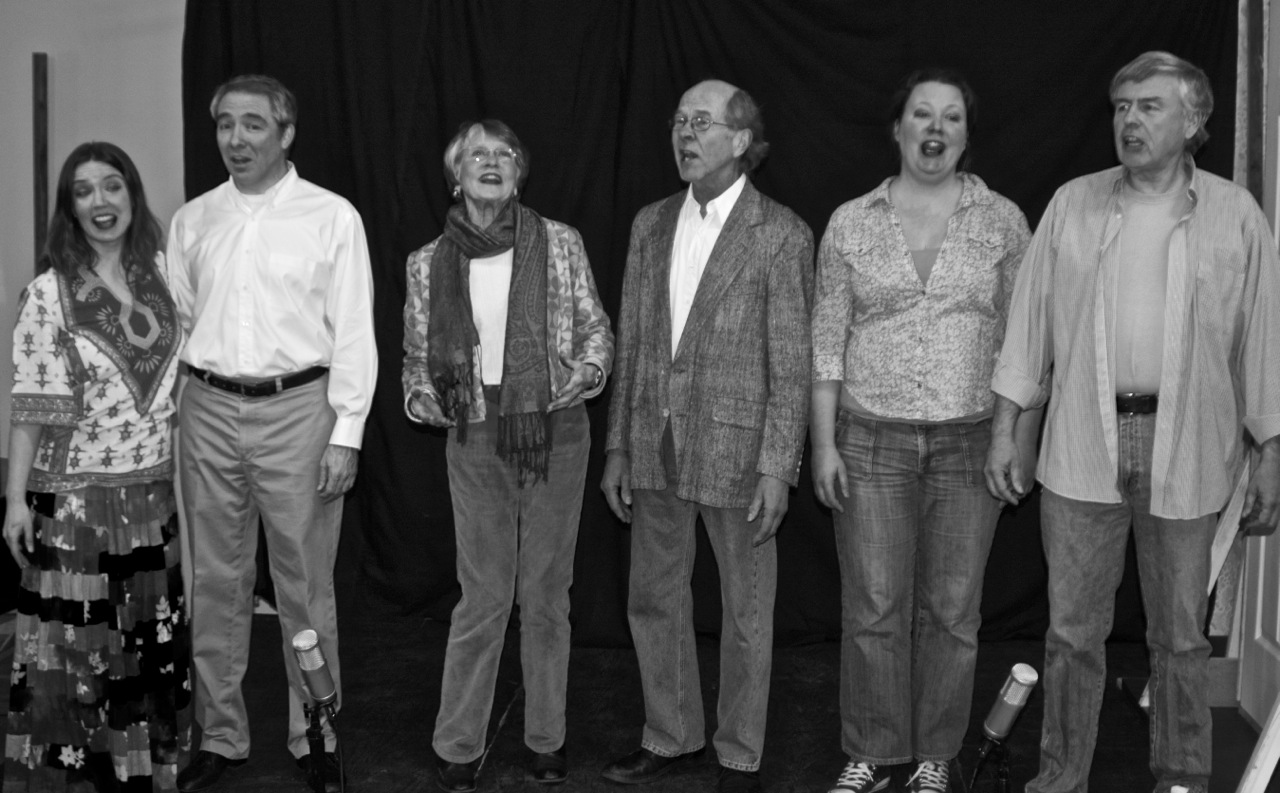
    Cast names, left to right: Melanie Lowey, Ken Stephens, Gretchen d’Armand, Les Asplund, Kristie Bingham, Rich Doyle (Photo Credit: Helene Chandler )
    Cast names, left to right: Melanie Lowey, Ken Stephens, Gretchen d’Armand, Les Asplund, Kristie Bingham, Rich Doyle (Photo Credit: Helene Chandler )

    “It’s a tremendous cast,” commented Soskin. “Professional, immensely talented and a pleasure to work with. And the songs, well, they beg to be sung, even after all this time.”

    The weather is fright’ning
    The thunder and lightning
    Seem to be having their way
    But as far as I’m concerned, it’s a lovely day.

    (Tickets for “Fred and Ginger—No Dancing!” may be reserved online up until 3 p.m. on the day of each show at concerts@uucwi.org or purchased at the door prior to each show if still available.)

    Dianna MacLeod holds a degree in journalism from the University of Michigan. An alumna of Hedgebrook, she moved to the island in October of 2011 to complete a novel—and never left. 

    CLICK HERE to read more entertaining and informative WLM stories and blogs.

    WLM stories and blogs are copyrighted and all rights are reserved. Linking is permitted. To request permission to use or reprint content from this site, email info@whidbeylifemagazine.org.