Not nearly enough space on this postcard to write about the gypsy-themed annual fundraising event held by W.I.N. (Whidbey Island Nourishes) this past Saturday night.
Gypsies are also known as Travelers, but for this one August evening, camp was made in a clearing along Heggenes Road.
From inside a painted gypsy wagon, a tarot deck spread before me, a one-eyed mistress swathed in scarves interpreted my cards. Pentacles, cups, wands, swords. She told her tales and I listened, rapt.
Minutes or lifetimes later, future safely tucked in my pocket, I emerged to the sounds of the Hot Club of Troy strumming their particular brand of gypsy jazz. Banners flew and treetops swayed as if moving to the music; the shirts of the men and the shawls of the women billowed in the breeze.
The bar did a brisk trade as a feast befitting gypsy kings and queens was served in thanks to those who help W.I.N. provide 2,000 meals every month to the hungry on our island.
Following a dessert of island ice cream and Mutiny Bay blues, a ragman with a gift for hawking things threw jokes like gold pieces to the crowd, who seemed to agree on one true thing: all of us are Travelers together through this life, and our fortunes depend on much beyond our control. Good luck shared is good luck sure.
Under an apricot moon rising between the scimitar curves of the pale tents that sheltered us, I listened to a mandolin strummed, the clink of bangle bracelets, the whinny of a horse.
In the waning light, silver and gold tattoos—whimsical wings, braided fate—seemed to float through the air on their own.
A postcard doesn’t hold much, I know, and I’m almost out of space.
But if good luck has favored you, and circumstances permit, please send a little something to W.I.N. A website awaits you, of course; but if you’re like me, a fan of the old-fashioned post, drop a bit of your fortune into an envelope and send it along.
If you attended the W.I.N. fundraiser in your gypsy garb, I’m glad to have traveled with you.
If not, I wish you were here!
Editor’s note: For more on WIN and the Frolic read this feature by Betty Freeman.
Photos by Dianna MacLeod.
Dianna MacLeod holds a journalism degree from the University of Michigan and has worked as a writer and editor for individuals and nonprofit organizations. An alumna of Hedgebrook. She moved to the Isle of Whidbey in 2011 to complete a novel—and never left. (photos by the author)
WLM stories and blogs are copyrighted and all rights are reserved. Linking is permitted. To request permission to use or reprint content from this site, email info@whidbeylifemagazine.org.
BY DIANNA MacLEOD
Whidbey Life Magazine Contributor
June 3, 2015
On Wednesday, May 27, writer Chris Spencer, wearing his signature gold sequined shoes, teamed up with actor Shelley Hartle to present, to an audience at Whidbey Island Center for the Arts, 55 little masterpieces in the short, short story genre. In this, the eighth such contest, island writers tackled subjects both serious and funny. Spencer and Hartle brought their thespian talents and impeccable sense of timing to each and every one, reading the texts aloud, as imaginative “book covers” were projected on a screen behind them.
Judges were briefly introduced and then sequestered in order to avoid the temptation to offer, or accept, bribes. Cash prizes were awarded to the three winning stories, although Spencer did not cross the stage to present them to the recipients because “my shoes hurt too much to walk in.”
Volumes one and two of Spencer’s own short stories were on sale in the lobby, providing writers with inspiration in plenty of time for next year’s contest. Spencer warned against plagiarizing stories out of his books and submitting them under another name. “My memory is not as bad as people think,” he said. “Well, you might get away with it if you lifted a story from volume one. I wrote that a while ago.”
The winners of the 2015 Short Story Smash, along with their winning stories, are:
First Place:
Book cover for The Singers (image courtesy of Short Story Smash artists)
The Singers by Natalie Olsen
I should have known better. My daughter and her choir friend were ten when I took them to see the movie “Look Who’s Talking.”
The theater was packed, but we managed to find three seats together and I quickly understood the reasoning behind the PG-13 rating. When Kirstie Alley’s character confided about her failed birth-control, I heard my daughter’s loud whisper, “What’s a diaphragm?” then muffled laughter in the rows behind.
“You know. We use them all the time.” It was suddenly quiet.
I held my breath until I heard, “You dummy, it’s what we breathe with when we sing!”
Second Place:
Book cover for How Much Is a Penny Worth? (image courtesy of Short Story Smash artists)
How Much is a Penny Worth? by Elizabeth Booth
I found a penny once as a child. Daddy laughed and said, “Put it in your shoe for good luck.” When I was older, he told me to throw it into the fountain. “Make a wish!” When I was older still, he advised me to put it into the bank. “A penny saved is a penny earned.” Last year, I tiptoed into his room and pressed a penny into his still, paper-thin hand. With our fingers entwined, wrapped around that insignificant piece of copper, he smiled and whispered, “This is me, watching over you.” How much is a penny worth?
Third Place:
Book cover for Adventures in Laundry (image courtesy of Short Story Smash artists)
Adventures in Laundry by Linda Russell
“Four seconds,” my sister shouted as our cat landed on a pile of sheets at the bottom of the laundry chute. My father had given us a stopwatch, and we began timing everything: in this case, how long it took a cat to descend to the basement via the laundry chute.
My little brother observed this activity with interest. “I wonder,” my sister mused as we headed upstairs again—brother in tow.
“Would you like to take a trip?” I asked opening the laundry chute.
“Lunch time! Get your brother!” my mother called.
“He’ll be right down!” my sister answered.
Honorable Mention:
The Ferry Mouse by David Anderson
OK, I was just minding my own business 120 miles east of here. Last July, this terrifying hay machine rips me away from my extensive family, bundles me up, trucks me over here, rolls on this boat. I wiggled out and jumped off.
It’s not a bad life, lots of nibble bits. No cats. But now I’m living on a boat that never seems to get anywhere; back and forth all day. Cars roll on, cars roll off. I don‘t get the point. It’s a real existential dilemma. Damn. Time to get to my bolt hole. Here they come again.
Honorable Mention:
Cops and Joggers by Shelly Miller
Blue lights and a bullhorn pierced the pre-dawn peace. “Jogger, pull over and stop.”
Plucking out my ear-buds, I asked. “You talkin’ to me?”
Out of his cruiser he gave me his best grizzled, tough-guy look. “Jogger, between dusk and dawn it’s the law you run opposite traffic flow.”
“Huh?”
“Jogger,” he started, then stopped. “What’s that?”
“It’s a Craftsman flathead screwdriver. Why?”
Officer Self-Important studied me like an undiagnosed mental disease.
“Why the shop-tool while running?”
“Protection. I’m scared of the dark.”
“If you’re so afraid, why the headphones?”
Duh, “I don’t wanna hear someone sneaking up on me!”
WLM stories and blogs are copyrighted and all rights are reserved. Linking is permitted. To request permission to use or reprint content from this site, email info@whidbeylifemagazine.org
By DIANNA MACLEOD Whidbey Life Magazine Contributor
May 20, 2015
A man of few words…but all of them carefully chosen.
Meet Chris Spencer, creator of the upcoming Short Story Smash.
Every year Spencer challenges the storytellers of Whidbey Island—that is, all of us—to submit a story of exactly 100 words in length (sans title). The entries are read aloud by “well-dressed rhetoricians” while a pseudo/suitable book cover is projected on a screen behind them. Authors, see your name writ large!
If you’d like to get an idea of how tough it is to tell a story in 100 words, well, you are coming up on my hundredth word…right…now.
* * *
Chris Spencer and his dog Fred (original photo by Michael Stadler, modified by Chris Spencer)
Dianna MacLeod: What draws you to the short story form?
Chris Spencer: I am drawn to the short story because my interests in literature lean toward brevity and variety.
DM: Why 100 words?
CS: The choice of 100 words was arbitrary. I wrestled with 204 and 79 for a while.
Professional counseling helped me choose a random number.
DM: Why did you decide to launch a contest?
CS: I was curious to see who on the island would want to, and could, write.
DM: When was the first contest and has it changed much over the years? How many entries did you have for the first contest? Now?
CS: I started five years ago. This May is the eighth extravaganza. The only major change is the audience has grown and suffered more traumas.
DM: Have you ever been to or heard of a contest anything like this? Was yours modeled on something, somewhere?
CS: This idea for a contest grew only from my fevered head.
2015 Event Poster
DM: Have you ever sought corporate sponsorship?
CS: Grovel at the feet of corporate America? Absolutely! The trouble is I’m an artiste, not a marketer.
DM: What’s your own writing background?
CS: I am a thwarted closet writer with the proverbial novel in the slow-bake oven. I’ve written short stories for years, which are neatly stored in a bottom drawer. I do have two books published now: “100 Quickies; One hundred, one hundred-word short stories (vol. 1)” and the same title, (Vol. 2) available at Moonraker and on Amazon.
DM: What are the most common problems writers have when they tackle the short short story?
CS: The power of good writing is to communicate effectively. Authors of these stories tend to forget this and become esoteric, vague, tangled and muddled. It is not easy to effectively create an image or elicit an emotion in just 100 words.
DM: What qualities do you seek in the judges? Are bribes accepted? What kinds of bribes are most likely to be effective?
CS: Someone who can speak English helps. I try for three to seven judges. Bribes are simple: sex, drugs and rock and roll. (Nowadays that consists of glucosamine, a romance novel, a beach pebble and a poppy seed bagel.)
DM: What’s your method for choosing the book covers to go with the stories?
CS: Covers are whatever sort of fits my stock of photoshop artwork. I can’t get too fancy; this is volunteer work, for chrissake.
DM: Do you and your fellow actor(s) rehearse much?
CS: Yes, briefly. We pre-read the works, decide whose voice is appropriate (male, female, or both as dialogue). Racy stories I let Shelley (Hartle) read; I’m too sensitive.
DM: What does the well-dressed rhetorician of today wear?
CS: Gold shoes; it’s all about the shoes.
Winners of the 2014 Short Story Smash
First prize
The Way These Things Happen by Judi Nyerges
I didn’t turn around, when you whistled into the kitchen, trailed by our dog. Your warm flannelled arms wrapped ’round my waist and you nuzzled my neck with a playful, bearded kiss. I leaned back and laughed, but I didn’t turn around.
“Sun’s out. We’re going up to get a few shots. I’ll be home early.”
I felt your happiness. It made me smile. But I was busy washing up, and I didn’t turn around. You grabbed your cameras, singing, and out you went.
I didn’t turn around. And now you’re gone. Now you’re gone.
And I didn’t turn around.
Second prize
Ima Goen by Les McCarthy
You’d think my mama and daddy were humorous folks. Not so.
Contrarily, my name defies their stern nature. My name is Ima Goen. And that’s what I plan on doin’.
I’m sick of saying Ima Goen, ’cuz I know someone’s gonna ask me, “Where?”
It ain’t funny. So, I’m a goin’. I don’t know where and I don’t know when but I’m a goin’ somewhere where I can breathe air so fresh my lungs will laugh.
Today’s not the day. But one day I’ll just go. And when I do, I’ll no longer be Ima Goen,
I’ll be Ima Gone.
Third prize
The Switching Hour by Dianna MacLeod
Cincinnati Zoo. The last passenger pigeon, Martha by name, dies in captivity.
Rural Ohio natural history museum. Beneath a dusty glass case, microscopic mites make a slow-motion meal of Martha.
God said to all, Let birds fly across the heavens.
God said to me, save Martha.
Hatch a plan.
Trap, kill, and mount a pigeon.
Dye feathers. Alter markings.
Smuggle counterfeit into museum.
Hide in second-floor janitor’s closet.
Await the switching hour.
Swap out pigeons.
Rappel to the ground.
Resurrect the body.
Revere the species.
Remember the extinction.
Who am I to quarrel?
Me, a humble taxidermist.
Attend Chris Spencer’s 100 Word Short Story Smash at 7:30 p.m. on Wednesday, May 27 at Whidbey Island Center for the Arts in Langley. And mark your calendar for next year’s contest deadline. Click here for tickets.
Dianna MacLeod also has a novel in the slow-bake oven and wonders if it’s time to turn up the temperature.
WLM stories and blogs are copyrighted and all rights are reserved. Linking is permitted. To request permission to use or reprint content from this site, email info@whidbeylifemagazine.org.
BY DIANNA MACLEOD Whidbey Life Magazine Contributor April 29, 2015
Over the last 13 years, potter Robbie Lobell has dedicated herself to making clay cookware: researching and experimenting with clay bodies and glazes tolerant of heat and cold, joining form with function in the service of food preparation, developing pots that bring pleasure to cooks and beauty to the table.
Four years ago, Lobell and her partner, Maryon Attwood, created a line of flameware known as “Cook on Clay.” Right from the beginning, the flameware produced by Cook on Clay had a fabulous form, a durable function and a user-friendly feel.
Robbie Lobell (left) and Maryon Attwood (right)
“When we began, we wanted to design and make cookware that would suit a variety of cooking methods: sauteing, boiling, broiling, braising, grilling, stewing and roasting,” Lobell recollects. “Each of Cook on Clay’s current cooking pots are designed to be at home anywhere: stove, oven, microwave, refrigerator, freezer and, most of all, table top.”
This month, Lobell and Attwood traveled to New York, all expenses paid, to receive accolades for their cookware—and the enterprise that produces it—from none other than Eileen Fisher, fashion icon known for the enduring style of her clothing designs. Fisher may be less well known as a mentor and supporter of women in business, but she does exactly that through her company.
Fisher launched her grant program in 2004 to encourage women entrepreneurs, support leadership programs for women and girls and promote the well-being of communities. In the 2014 grant cycle, Cook on Clay was among six grant recipients selected from thousands of applicants; the grants are intended to support innovative, woman-owned companies that are beyond the start-up phase and ready to expand their business as well as their social and environmental impact.
2014 award winners
Cook on Clay’s emphasis on sustainability appealed to the Eileen Fisher employee awards committee; after all, Lobell and Attwood aim to produce enduring objects that are meant to be used for a lifetime and then passed on to children and grandchildren. “We believe that cooking and serving food in handmade pottery forges connections,” said Attwood. “Connections with the farms that grow it, the earth that nourishes it and the people who share it.”
Equally impressive to the committee was the emphasis on local and healthy. All materials used in Cook on Clay pots are from the earth. Excess clay is recycled and reused. The pots are fired in a clean-burning propane-fueled kiln, and the bricks that line the kiln are made in America. Lobell and Attwood continually search for ways to use less fuel to fire the pots. The cookware does not leach metals or other chemicals into food or into the environment. And the design of each of the pots is simple, durable, and elegant—just like the garments that bear the Eileen Fisher label.
Perhaps that’s why a Cook on Clay pot—the lift of its sides, the fit of its lid, the way the flat bottom joins to the curved sides—was recognized by the selection committee as being an outstanding example of good design. Lobell applies those exacting standards to each one of the 1,200 pieces she produces annually.
“We produce a cooking pot that resists trends, is loved, can be used over a lifetime and passed to the next generation. For us, this is the definition of good design and a rugged product,” said Lobell. “In a throw-away society, our goal is the opposite. Use it everyday, and then pass it on!”
Whidbey Islanders familiar with Cook on Clay’s distinctive flameware hardly need reminding of the intelligent design and environmental friendliness of the pottery they own and enjoy.
When Lobell and Attwood traveled to New York to personally accept the grant from Fisher’s foundation, they had the opportunity to mingle with the other recipients and to exchange stories about their origins as entrepreneurs and their plans for the future. They became friends with four sisters from Detroit who make raw juices, a designer of home goods from Maine, a producer of products made from domestic wool, two women from California who turn textile factory waste into hats and accessories, and a Hawaiian jam maker who creates artisanal jams from locally sourced fruit. They also met and learned from Fisher’s corporate departmental managers, chief operating officers, public relations and marketing staff. “It was an intense, exciting and exhilarating two days of immersion in the Eileen Fisher culture and values,” said Attwood. “In addition to bringing home our award, we’re enthusiastic about bringing home what we’ve learned.”
Lobell and Attwood intend to use the grant to build up their inventory, create new molds for their designs, and upgrade their website. Beyond these immediate goals, they look toward encouraging the next generation of young women studio potters, art entrepreneurs and manufacturers to focus on domestic production and think creatively about business models as well as the value of quality and design.
“Cook on Clay’s success has an impact on other potters in our field and on young women artists interested in crossing over from studio art to manufacturing,” said Lobell. “The grant from Eileen Fisher allows us to magnify our impact and to tell two stories: one about our flameware ceramic pots and one about a niche manufacturing company owned and operated by women and apprentices.”
“We are especially grateful to local investors from Whidbey Island Local Lending who believed in us and supported us financially,” said Attwood. “Without them, this Eileen Fisher award could not have happened. This shows how important local investment is to local producers. We’re proof that dreams are possible.”
Dreams are, indeed, possible…and sometimes even fashionable.
Robbie Lobell enjoying Eileen Fisher creations
Now is the time to apply to the Eileen Fisher Business Grant Program. In 2015, up to 10 winners will be selected to receive a trip to New York City and funding to advance their business goals. Guidelines and application available at www.eileenfisher.com/businessgrant.
Cook on Clay welcomes visitors. The showroom on Patmore Road near Coupeville is open daily 10 a.m. to 5 p.m. Please call ahead to 360-678-1414 when possible. Cook on Clay pots may be found in several Whidbey Island shops and restaurants including Trillium, Kalakala, Oystercatcher, Bayleaf, and on Lummi Island at the Willows Inn. Pots may also be purchased online at cookonclay.com (shipping available throughout the U.S.).
Featured photo: Attwood and Lobell receive their award from Eileen Fisher. All photos courtesy of Lobell/Attwood.
Dianna MacLeod holds a degree in journalism from the University of Michigan. An alumna of Hedgebrook, she moved to the island in October of 2011 to complete a novel—and never left.
WLM stories and blogs are copyrighted and all rights are reserved. Linking is permitted. To request permission to use or reprint content from this site, email info@whidbeylifemagazine.org.
BY DIANNA MACLEOD Whidbey Life Magazine Contributor
March 25, 2015
“What is home to you?”
That was the question asked of the 85 people gathered at the Whidbey Institute for a three-day conference on Shelter that began on Thursday, March 19.
If there’s a more soulful place to ask this most fundamental of questions than the Thomas Berry Hall at the Institute, it’s hard to imagine it. The hall, with its soaring roof, skylight to the heavens, stone hearth and artfully designed windows that draw the eye into the forest beyond, seems designed to both engender feelings of home and prompt ideas about connection and community. The massive image of earth that hangs over the hearth reminds us of the magnificence and vulnerability of our planet—a planet on which large numbers of people lack a home.
“The four pillars of the conference, and of a resilient community, are dignity, respect, trust and a sense of belonging,” said conference organizer Jerry Millhon. In pursuit of an accelerated way for organizations to find each other and collaborate, Millhon and his team (Aimie Vallat and Noah Dassel) spent an entire year scouting out small, innovative grassroots projects in both urban and rural settings and making short videos about them.
Architect Ross Chapin presenting his plan for community development of a 40-acre parcel in Langley on Whidbey Island (photo by Eric Neurath)
Like everything that comes out of The Whidbey Institute, the videos have heart—lots of it. In seven minutes or less, project founders, staff, and beneficiaries explain their solutions to housing in terms guaranteed to move you. (These same folks were in attendance to answer questions and confer with others, putting the “confer” back in “conference.”) The videos aren’t just talking heads; they’re chock full of spaces and structures: clustered groups of neighboring houses with shared open areas (Langley architect Ross Chapin’s “pocket neighborhoods”), cottages that replace tents for the homeless (Quixote Village), private and common rooms that provide a safe haven for teens (Cocoon House), repaired houses for the aging and disabled (Hearts and Hammers), affordable houses designed with land stewardship in mind (Lopez Community Land Trust), healthy building technologies that go beyond conventional green building standards (Thriving Communities EcoVillages).
Indeed, behind each and every project can be found exactly who and what the conference promises: common people doing uncommon work for the common good.
Attendee Donald King, a Seattle architect, was impressed by the stories of hope, justice and equality. “These folks are looking at housing issues through a different lens. We need a different lens, because large challenges require a holistic strategy.” King, who echoed Chapin’s goal of “creating small scale community in a large scale world” hopes to learn from others working on the challenges of housing insecurity in order to avoid repeating the failures of the past.
Lars Henrikson, an employee of Seattle City Light’s conservation programs, has a long-standing interest in the kinds of buildings that contribute to making communities sustainable. “Something is calling me to work in that area after retirement, but I don’t know what just yet.” Henrikson finds the openness and fluidity of the conference just right for engaging with fresh ideas and entertaining new possibilities.
Chaitanya Burgess sharing her experience being a homeless teenager and finding assistance through Cocoon House in Everett (photo by Eric Neurath)
As executive director of Cocoon House, Snohomish County’s emergency shelter for at-risk youth, Cassie Franklin appreciates the diversity of the organizations participating in Thriving Communities. Although Cocoon House was established in 1991, Franklin still looks for ways to become a better leader and for ideas to bring to her county’s Homeless Policy Task Force.
Tonya Burgess, 25, first entered Cocoon’s transitional housing at the age of 14. She had lived on the streets, in the woods and in various shelters before finding a home at Cocoon. Although she “aged out” of Cocoon when she turned 17, she remains close to the staff and is currently a member of the board. “At this conference, I hope to wake up the spirit of community in every person, old or young. I hope I can find a way to inspire new generations to listen to this call before they’re the ones in need,” Burgess said.
From left to right: conference organizer Jerry Millhon, Georgia poet Tannur Ali, Chicago architect Antonio Guitierrez (photo by Eric Neurath)
How to provide housing that honors the cultural heritage of the Black community in the Central District of Seattle while using a business model? That’s the question that preoccupies Thomas Bangasser of the Union Street Business Association. Bangasser’s grandfather began buying property in 1941 within one square block at the intersection of 23rd and East Union, and Bangasser himself grew up there. “The racism inherent in large lending institutions has prevented the district from flourishing as it might have,” he said. Bangasser hopes the conference will give him new leads and connections to others with useful insights and similar goals.
“Community has become more important since I’ve retired,” commented Nancy Hager of Bend, Oregon. “At my age, I’m asking myself what I want, and how do I want to be challenged, for the next 20 years.” Hager is considering a new place to settle, finds “pre-packaged” retirement communities sterile and unappealing, and seeks a situation where she can retain her creativity and independence while interacting with others around her. “Here at the conference I’m finding an exciting network of people who are trying to rebalance the inequities of the world.”
Saviour Knowledge presents the plans of the Union Street Business Association to help revitalize Seattle’s Central District (photo by Eric Neurath)
Architect Antonio Gutierrez coordinates housing, fights for tenants’ rights and stops foreclosures in the Chicago neighborhood of Albany Park. He was inspired by the video stories, by the people featured in them and by what has been accomplished. Gutierrez feels the topic of Shelter is of widespread concern. “Across the nation similar conversations are occurring among people of different backgrounds, races, classes, cultures, languages…creating a chain of actions and reactions that will create better communities for future generations.” The challenges he faces—zoning ordinances, limited volunteer labor due to potential liability, access to land—are typical in an urban setting. Gutierrez is determined to translate the lessons of the conference to his neighborhood. “Solidarity is happening, and happening organically,” he observed.
Island County Commissioner Helen Price Johnson has attended every one of the four Thriving Communities conferences (previous themes include food, local economies and health). “It’s always inspiring,” Price Johnson commented. “This one on Shelter is especially timely because of the County’s Comprehensive Plan update—our effort to look ahead 20 years at the sheltering needs of our community. Do we have the right support from the county regulations to support the ways we want to live?” She encouraged Island County residents to visit the County’s website to express their vision for the future.
Admittedly, the challenge of providing shelter to those who need it is a daunting one. But Millhon and the Institute staff, modeling the conference on the kind of communities they seek to encourage, built in plenty of spirit-lifting activities: song, spoken word performance, dialogue, idea forums, tasty and healthy food, outdoor fires to celebrate the equinox, visual reporting (drawing concepts as they emerge), and harmonic incantations.
Over lunch, participants discuss reclaiming abandoned homes. (photo by Eric Neurath)
As if to reflect the swirl of ideas and alliances, chairs—comfortable chairs, no less—were rearranged into endless configurations to form ever-shifting “nodes of connection.”
And at the very end of the conference, a word—both pledge and farewell among the members of this thriving but temporary community—was uttered. Together. Three times. Across a standing circle. A word much like “OM.”
Featured photo at the top: Artist Anne Jesse translates themes of the conference to dynamic visuals using a technique known as “live graphic recording.” (photo by Eric Neurath)
Dianna MacLeod has lived in intentional community for most of her adult life. Her own shelter is currently being constructed in modular form as a learning project by students in the homebuilding program at Seattle Central Community College. She travels frequently from the island to visit her house as it evolves beneath the large and sheltering roof of the Wood Technology Center.
WLM stories and blogs are copyrighted and all rights are reserved. Linking is permitted. To request permission to use or reprint content from this site, email info@whidbeylifemagazine.org.
BY DIANNA MacLEOD PHOTOGRAPHS BY MARTHA McCARTNEY Whidbey Life Magazine Contributors
December 3, 2014
Whidbey Island’s best-kept seasonal secret, accessible a mere five days a year, can be found in an area no larger than a potting shed.
In fact, it is a potting shed.
Located at the end of a winding road, set amid espaliered dwarf apple trees, evergreen hedges and tawny towers of ornamental grasses displaying their winter splendor, the potting shed at Cultus Bay Nursery is all dressed up for the holidays and packed full of unusual and exquisite seasonal gifts.
Cultus Bay Nursery has been owned and operated by Mary Fisher since 1986. The quiet of an out-of-season nursery seems to reflect Fisher’s philosophy about how to live life. “Whether you’re an artist or a scientist, it requires patience to observe nature. In order to see the patterns, move slowly and develop your observational skills,” she said as she served up a cup of hot cider to a customer.
Fisher inherited a love of plants from her father, who worked for the Department of Agriculture, and a love of textiles from her mother, who was “a beautiful seamstress.” With two brothers who are ornithologists and a grandfather who studied entomology, Fisher’s love of birds, bugs and the natural world seems bred in the bone. She is proud of her great-aunt Penn who—blessed with beautiful handwriting—worked for the Smithsonian inscribing labels for the birds and insects under glass. Her great-grandfather, Sievert Allen Rohwer, and father, George Gregor Rohwer, collected specimens for that same institution to display.
Fisher herself majored in textiles at the California College of Art. The materials of her creative desires these days are primarily paper and plants—twin loves on display at the holiday cottage. Suspended from the ceiling are dozens of intricate paper ornaments she has fashioned, fusing both Hispanic Ramilleta and German Dresden traditions. Hanging on the walls are wreaths stunning in their shapes and unusual materials. Vases of foliage in striking combinations grace the shelves.
Although floral arrangements scent the air and delight the eye, plants have also made their way into the jellies and jams displayed on the windowsills. Quince gleams ruby red. Cornelian cherry (described by one food writer as tasting of carnations, cherry liqueur, black cherries, and the fragrance of a night-blooming cactus) shimmers like a bottle of merlot. Jellies made from the berries of the Japanese silverberry plant and the white wine grape—Elaeagnus umbellata and Siegerrebbe—seem lit from within.
The fruit is harvested by Fisher from her own trees and vines and the hand-lettered Latin labels make it seem that Great Aunt Penn’s spirit hovers somewhere near. Garden gourmets will also appreciate the small loaves of fruitcake on offer. “All the fruitcake jokes are laid to rest once you taste these,” claims Fisher. “They are a holiday tradition among my friends and family; everyone anticipates the yearly batch.”
Fisher’s creative partner and fellow artist in the holiday cottage is Linda Apsitis. Apsitis, who possesses a horticulture degree from Edmonds Community College, shares Fisher’s love of plants. “I grew up under a shrub in north Seattle when it was still rural,” she joked.
From March through September, Apsitis works alongside Fisher at Cultus Bay Nursery. But the minute the nursery closes, she begins creating gifts for the cottage. “My home becomes a Santa factory. I take over my husband’s woodworking shop with my glitter, paper and glue.”
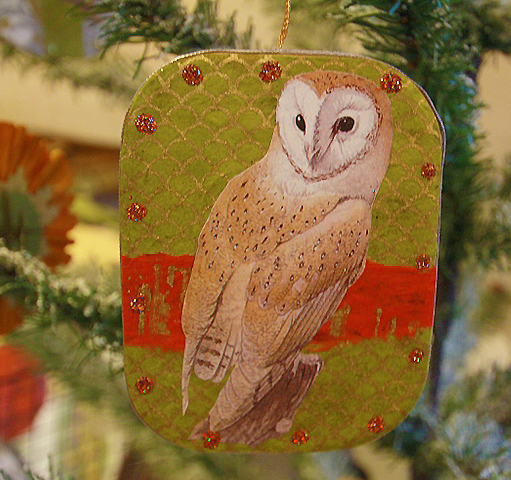
Like Fisher, Apsitis loves birds and applies images of her feathered favorites to cards, notebooks, boxes, candles, tree ornaments and even plates. While she’s busy at the nursery seven months of the year and making bird-themed art for another ten weeks, she’s always on the lookout at thrift stores and estate sales for interesting vases for her floral arrangements. Unique paper is her great passion and she searches it out twelve months a year. “Most of what I buy is handmade,” she said. “And certain papers can be found only once in a lifetime.” Fisher and Apsitis agree they are “paperholics.”
Although Fisher has been filling the potting shed with gifts to sell in late November/early December for the past 19 years, Apsitis joined her only five years ago. Judging from the birds flitting among twinkling lights and ornaments crisscrossing the ceiling, their artistic sensibilities are extraordinarily similar.
In a mass-produced, bigger-is-better, glowing-screen age, the cottage—with its complimentary cider and samples of home-made fruitcake—is less like shopping and more like wandering through an enchanted realm. The potting shed is as far from a Pottery Barn as it’s possible to get—and Fisher and Apsitis like it that way.
“Whidbey is an island of unique people,” observed Fisher. “Being local ourselves, we know what locals like.”
And that, it turns out, is a small potting shed in the greenwood where you can listen to classical music, drink cider with neighbors and admire the glories of the natural world gathered, arranged and interpreted by two artists with a deep appreciation of the pleasures of a northwest, cedar-dusted winter.
• • •
The holiday cottage is open one more weekend this year, from 10 a.m. to 4 p.m. on Saturday and Sunday, Dec. 6 and 7. Visit http://www.cultusbaynursery.com for directions.
Look below to view more festive and vibrant gifts
available at the
Cultus Bay Nursery holiday cottage.
• • •
Dianna MacLeod holds a degree in journalism from the University of Michigan. An alumna of Hedgebrook, she moved to the island in October of 2011 to complete a novel—and never left.
________________
CLICK HERE to read more entertaining and informative WLM stories and blogs.
WLM stories and blogs are copyrighted and all rights are reserved. Linking is permitted. To request permission to use or reprint content from this site, email info@whidbeylifemagazine.org.
BY DIANNA MACLEOD Whidbey Life Magazine Contributor
November 26, 2014
The land surrounding our local schools has lately resounded with several big wHOOPs of joy.
Fresh lettuce growing in the hoophouse (photo by David Welton)
A big wHOOP was heard when volunteers finished constructing the 960-square-foot hoophouse that shelters vegetables growing through the four seasons at the school farm adjacent to the South Whidbey Elementary School.
A big wHOOP was heard when students from the school first caught sight of the gleaming structure on the fringes of their playground.
Another big wHOOP was heard this week when islanders gathered to celebrate the generosity of the organization that funded the hoophouse (the Whidbey Island Garden Tour) and the dozens of volunteers who assembled it.
Gillian Beattie, Sandy Whiting, Vincent Nattress, Nancy Nordhoff and Lee Compton in front of the hoop house (photo by David Welton)
Since the creation of the half-acre School Farm, wHOOPs have become frequent here on this stretch of Maxwelton Road.
More than a few of the wHOOPs come from kids gathered together for “garden recess,” an option that students can choose as an alternative to regular recess.
“I like gardening because it gives me a chance to experience nature,” commented third-grader Rylie as she excavated a cavity in one of the garden beds intended for overwintering potatoes. “It’s fun to use a trowel. I know how to dig dirt and not have it fall back in the hole.”
Kids naturally appreciate the pleasures of dirt and second-grader Ava is no exception. She doesn’t shy away from things that wiggle and crawl. “I like everything about gardening, even worms, spiders, snails and snakes.”
Lilja Ringsrud inspects garden produce prior to a taste test (photo by David Welton)
On a nearby picnic table, second-grader Kristian clipped stringy roots from large, recently-harvested potatoes. “I like digging, helping the earth. I like being outside in all weather. My favorite vegetable is potatoes.” Surrounded by potatoes—recently dug, sorted by size, some ready to cook and some ready to bury—Kristian was in his element.
Garden coordinator Cary Peterson—“Miss Cary” as she’s known to the children—is never short of wHOOPs. A background in ecology, an interest in healing, years of gardening experience and boundless enthusiasm for building community have made Peterson the driving force behind the school farm. “We’re all the same age as we experience discovery, wonder, excitement, delight. I’m at the second-grade level myself. I run around and wave my hands a lot,” said Peterson as she led students toward the mulch pile to gather hay for the potato patch.
Scott Connor, Jude Bierman, Cary Peterson and Kevin Dunham (photo by David Welton)
Although garden recess may look like pure fun and fresh-air exercise, these small gardeners are learning plenty of lessons. Peterson coordinates closely with classroom teachers to integrate outdoor lessons with indoor learning, ranging from subjects like biology, math and earth sciences to life skills like planning, cooperation and teamwork. Classroom teachers inform Peterson about developmental goals so that she can tailor outdoor activities accordingly. “I consult with teachers to see what concepts they plan to teach—energy cycles, compare and contrast, decomposition, bugs—and then reinforce those concepts in the garden.” Once the lessons have been prepared, Peterson implements them at garden recess and at classes held at the school farm.
“Last season I learned that dried peas are actually seeds. I kept some of the seeds to plant next season,” boasted third-grade student Mimi as she worked elbow to elbow with her classmates separating small potatoes from large. “These little potatoes are the seeds for our next crop.”
As intent as they were on sorting potatoes, the students produced a few wHOOPs as they spotted hidden faces in the knobby surfaces of the tubers, demonstrating once again that the natural world—from clouds above to potatoes below—develops the imagination.
Marian Myszkowski demonstrates how to make a fresh kale taco (photo by David Welton)
Principal Jeff Cravey added a wHOOP of his own as he observed the digging and sorting. “First-grade teacher Debra Davies wrote a grant for garden gloves and trowels to use at the School Farm. The kids are eager to participate in garden recess. And, best of all, the kids are excited to see food they’ve grown served in their cafeteria.” Currently, 300 of the 500 students are involved in the garden-based curriculum taught in classes at the School Farm. Cravey expects that within three years, kindergarten through grade 12 will be involved.
How did the South Whidbey School District come to make gardening a part of the primary school curriculum? According to Superintendent Jo Moccia, Whidbey Island’s high standards for good food were pivotal. “The school district did a lot to provide healthy options for kids long before it was required by law. We took out soda machines and changed menus. The garden became possible because of a few teachers who wanted to integrate it into the curriculum…along with the perseverance, knowledge and skill of Cary Peterson—and her ability to forge partnerships.”
Thanks to Peterson’s inclination to “think in ecosystems,” four other organizations are partnered with the school district to ensure the sustainability of the South Whidbey School District Garden Program: Whidbey Island Nourishes (WIN), Good Cheer Food Bank, the Whidbey Institute and the Goosefoot Community Fund.
Chef Vincent Nattress and daughter Maggie admire the rows of kale she has grown with classmates (photo by David Welton)
Founder Mary Fisher felt WIN’s mission to make sure kids have nutritious food and to educate families about nutrition aligned closely with the goals of the Garden Program and saw an opportunity for reciprocity. “The produce raised by the school kids will go into WIN backpack lunches. WIN will give money to the school district to hire a garden educator.” Volunteers from WIN also helped construct the hoop house and fence the garden.
Triumphant volunteers put the finishing touches on the hoophouse (photo by Cary Peterson)
According to Executive Director Kathy McCabe, “Good Cheer is more than just a food bank; we want families to learn to eat healthy and well.” Although Good Cheer’s relationship with the school district dates back to 2007 when Good Cheer sponsored a (still-thriving) garden at the middle school, McCabe has seen momentum accelerate as partnerships have multiplied. “Local farmers donate more food. Good Cheer hired two of the former garden apprentices to manage our garden at the food bank. A teacher at the high school runs an agriculture class behind the building and provided fresh food to Good Cheer this fall.” Additionally, McCabe believes that gardening activities offer certain children the opportunity to excel. “Some kids who fail to shine in the classroom rise to leadership positions in the garden,” she observed.
The third partner in the school district garden project is the Whidbey Institute, which teaches techniques of small-scale food production and leadership skills in community gardening. Extensive outreach efforts coupled with stipends and home-stays have attracted motivated individuals seeking careers in sustainable gardening. Focused on strengthening community-driven food systems, the Whidbey Institute contributed much needed labor to the school farm during the construction phase. “The Whidbey Institute will continue to maintain and develop the Garden Leadership program for the benefit of all,” said Executive Director Jerry Millhon.
Goosefoot exists to build a sense of community, preserve rural traditions, enhance local commerce and create a sustainable future for South Whidbey Island. After five years of operation, the Goose Community Grocery Store is turning enough of a profit to give back to the community. Executive Director Sandy Whiting felt a partnership with the school district was a natural fit. “The School Farm made sense in light of our mission, which is to encourage Whidbey Island food sustainability.” In October, Goosefoot launched a fundraising campaign with a dollar-for-dollar match; once $15,000 has been raised, Goosefoot plans to donate another $15,000.
Sandy Whiting, Executive Director of Goosefoot, speaks while Gillian Beattie looks on (photo by David Welton)
One partnership—perhaps the most critical of all—had to be forged with Chartwells, the food service corporation that manages the South Whidbey school cafeterias along with hundreds of other schools across the nation. Although the bureaucratic hurdle to getting school-grown produce into the cafeteria was huge, Cary Peterson’s persistence eventually paid off; in 2013 the corporation agreed to buy produce from the garden program for all cafeterias district wide.
Squash displayed by proud growers and harvesters (photo by Cary Peterson)
While third-grader Marina doesn’t know much about bureaucratic hurdles or fundraising goals, she does know about the superiority of school-grown food. “The carrots that come from our ground are way sweeter than regular carrots!”
Second-grader Kaylie, busy tossing seed potatoes into the freshly-dug hole, agreed. “Carrots are my favorite vegetable.”
When vegetables from the School Farm began showing up in the cafeteria, head cook Sandy Poolman saw increased enthusiasm at the salad bar. “Out of our student population of 500, nearly 200 eat cafeteria food, either breakfast, lunch, or both.”
Students and their teacher let out a big wHOOP over greens (photo by Cary Peterson)
Nutrition, freshness and flavor are priorities for the cafeteria staff. Their commitment to good nutrition has always been strong; in fact, even before just-picked produce began coming through the school doors, they cooked from scratch for the students and looked for ways to make vegetables and fruit appetizing to young eaters. Roasted carrots shaped like french fries. Carrots glazed with cinnamon. Is it any mystery that many of the gardeners-in-training cite carrots as their favorite vegetable?
Back at the potato patch, the kids spread the hay on the raised bed while “Miss Cary” explained the importance of mulch to protect the baby potatoes from freezing.
Kids are not afraid to get their hands dirty in the garden adjacent to the hoophouse (photo by Cary Peterson)
As the end of garden recess neared, some children cleaned up stray bits of hay, some gathered up shovels and trowels, some loaded harvested potatoes into a cardboard box destined for the Good Cheer Food Bank.
And that, it seems, is how community is built.
Potato by potato.
Partnership by partnership.
Isn’t that worth a big wHOOP?
Donations to the School Garden Project can be sent to Goosefoot, PO Box 114, Langley WA 98260. You may also donate online at www.goosefoot.org; be sure to make your contribution to the School Garden Program. Every dollar will be matched by Goosefoot. Questions? Call 360-321-4232.
Image at top: Debra Davies, Kimmer Morris and Cary Peterson (photo by David Welton)
• • •
Dianna MacLeod holds a degree in journalism from the University of Michigan. An alumna of Hedgebrook, she moved to the island in October of 2011 to complete a novel—and never left.
________________
CLICK HERE to read more entertaining and informative WLM stories and blogs.
WLM stories and blogs are copyrighted and all rights are reserved. Linking is permitted. To request permission to use or reprint content from this site, email info@whidbeylifemagazine.org.
On Friday night I had the pleasure of leading tours through the haunted house at Whidbey Island Center for the Cursed Arts (WICCA: old English for witch, wizard, sorcerer, soothsayer). For the frighteningly low price of five dollars, folks got a spine-tingling tour through a haunted forest.
I wore a cape supplied by the costume department. Knee-length, made of thick felted wool, the cape looked to be sewn somewhere in the forests of Bavaria, so seemingly authentic it could have been worn by Red herself. My face was shadowed by its deep hood; the weight of the cape hung heavy on my shoulders.
Buttoned into my cape, my curly silver hair covered by a long, dark wig, a lantern in my hand, at five o’clock on All Hallows Eve I was ready to venture into the WICCA woods.
The entrance to the forest—a gentle and dark incline, my lantern the only light—gave me time to whisper a hushed warning to my first group of tourists to stay together and keep moving. Ah, the power of suspense. Things that go bump in the night.
The things that bumped in WICCA’s haunted wood were fairy tales characters. In the spooky forest and maze-like passages of the theatre, we encountered iconic fairy-tale beings in extremis. Rumplestiltskin screamed at the miller’s daughter to spin straw into gold. Cinderella’s stepmother caned the cinder-covered girl as she scrubbed. Among tall, mossy trees lit by sporadic flashes of lightning to a soundtrack of cawing crows, muffled screams, crashing thunder and a giant beating heart, an evil queen ordered the woodsman to take a hatchet to the fleeing Snow White. Down a dark passage, a half-baked Hansel fell out of the witch’s oven in a cloud of smoke. Further along a wolf gobbled up granny as she dozed in her cozy fire-lit cottage. Fractured fairy tales, indeed.
Near the end of the tour we paused at the top of the ramp leading to the lobby—lit EXIT sign in sight. Ah, safety. It was here my tourists were set upon by the axe-wielding woodsman and ravenous wolf, who’d stepped out of their scenes to become the bogeymen they were all along. These apparitions sent the group running down the ramp and out into the lobby, where golden lights and cider and doughnuts awaited.
I realize that tour guides are not often called upon as authorities on human behavior. But after you’ve watched 75 or more people over five hours respond to exactly the same stimuli, you can’t help but make some observations.
Here are mine.
We are all intrigued by the unknown; some hang back, others rush forward.
Certain children are either very brave, indifferent by nature, or top-notch blusterers. You-can’t-scare-me kids. Nothing could rattle ’em. Good thing? Bad thing? Who knows? I doubt anyone is tracking the correlation between fear shown in haunted houses and eventual life outcomes.
Kids under the age of eight or nine are willing to be entranced, those between 10 and 14 eager to show disdain, those 15 and over once again willing to suspend disbelief (or act as if they have). Is this a return to innocence? Nostalgia? Something else entirely?
Small children can be very brave—if their mothers go first.
Teenage girls find strength—and humor—in numbers. (They proceeded in lockstep with arms tightly linked, as if they were glued together, laughed nervously the whole way in and screamed the whole way out.) Teenage girls are great examples of the therapeutic effects of full-throated screaming—especially screaming while running, arms linked, with best buddies.
Some kids freely dispense advice. (One came to me with suggestions of how it could be a better haunted house: “More technical effects and not so many real people.” He put me in mind of a little entrepreneur finding ways to automate and outsource. Another kid cornered me after the tour to deliver a dissertation on what makes a haunted house haunted. “More people jumping out at you more often.” The fairy-tale vignettes were wasted on him. And I’m not sure he’s wrong: startled and scared are pretty close together.)
Adults are more spontaneous masked than unmasked.
Women wearing wings are tougher than they look.
In dark unknown places, we don’t tiptoe. We shuffle.
“Smoke and mirrors” is the perfect phrase for various kinds of skullduggery. You see things that aren’t there and don’t see things that are.
Tall men hunch in dark places.
Some children have a heightened capacity for empathy; they are more worried about the fate of fairy-tale characters than they are about their own safety.
Small groups of people following each other through a dark passage form lines, but not straight lines; they zig and zag. (Is this a survival thing? You don’t want to be first to confront danger and be sacrificed, you don’t want to be last and be picked off; the safest place is somewhere in the middle, but not squarely behind the person in front of you, because that person reduces your ability to see what’s coming and what’s going.)
People like clinging to each other—all for one and one for all—and we look for reasons to do it.
When a child says, “I might need to hold somebody’s hand,” they mean yours.
An effective antidote for fear is the immediate application of powdered-sugar doughnuts and apple cider. (Fear is a basic instinct, but so is food—most especially fat and sugar.)
________
I’m counting on the wizards and witches at WICCA hosting another haunted house next Halloween. In fact, I wish they’d do it more often—like, say, every full moon.
Think how much I’d learn about my fellow human beings.
Not to mention all those chances to wear that splendid cape.
Dianna MacLeod holds a degree in journalism from the University of Michigan. An alumna of Hedgebrook, she moved to the island in October of 2011 to complete a novel—and never left.
________________
CLICK HERE to read more entertaining and informative WLM stories and blogs.
WLM stories and blogs are copyrighted and all rights are reserved. Linking is permitted. To request permission to use or reprint content from this site, email info@whidbeylifemagazine.org.
BY DIANNA MacLEOD Whidbey Life Magazine Contributor
October 29, 2014
As Day One of the fall Whidbey Island Writers Conference unfolded, both my brain and binder filled with tips on the art and craft of writing: constructing dialogue, creating conflict, developing character.
The format—small group meetings at private homes—was designed to put me and my fellow writers at ease as we conversed with Prominent Authors. Prominent Authors are a lot like the rest of us; nothing brings this fact home more than seeing them snuggled into an overstuffed leather armchair, feet propped on an ottoman. Or sipping coffee and grimacing because their cup of joe went cold hours ago. Published or unpublished, we all like our feet up and our coffee hot.
This cozy informality (the only thing more homey would be for us all to show up in our pajamas) lulled me into a sense of well-being and camaraderie…which may explain my insanely ambitious agenda for the next afternoon.
The morning of Day Two, I attended a workshop titled “The Realities of Publishing with the Big Five,” which gave me a chance to spend a couple of hours with Daniel James Brown, the Prominent Author of the recent mega hit (and soon-to-be movie), “The Boys in the Boat.”
Daniel James Brown, author of “The Boys in the Boat” (photo courtesy of NILA)
I’m always interested in how private stories become public sensations, and it seemed to me that Brown’s own account of his trajectory as an author would be especially interesting. After all, he labored for years with moderate success (including self-funded book tours and publicists who wouldn’t return his calls) before his ascension from semi-obscurity to full frontal fame (publishers vying for book rights).
I was sure Brown would be a treasure trove of advice. He was. On top of that, he was as humble and approachable as the Prominent Authors I met on Day One. But the phrase that stuck with me as his workshop ended was hardly the one I expected to remember.
To paraphrase Brown, authors and their books are viewed by the publishing industry as commodities to be sold like “a can of beans.”
On some level, I knew this already. We all know this. Although devotion to story certainly exists among individual agents and editors, the publishing industry is primarily a money-making enterprise, and all involved in it are looking for the next hit.
It was this metaphor—my mostly-finished novel as a can of beans—I carried with me into my self-inflicted afternoon activity: pitching my book to eight different agents and editors in six-minute consecutive segments.
The chance to make a case for our books is a wonderful feature of the conference. We pitch the story and hope the editor/agent across the table will catch it. How many words? What genre? Who’s the readership? What are comparable titles? What shelf would it occupy in a bookstore? Is it finished?
I had six minutes to make it clear why my manuscript should come off my screen and onto their radar.
Prior to pitching, I tried pumping myself up. Get to yes. Eyes on the prize. Go for the gold. But my pep talk was constantly interrupted by the image of baked beans packed into a can bearing a red-and-white label and the sound of an infectious jingle consisting of the words “ummm ummm” and “good.”
Eight agents/editors in 48 minutes was like speed dating book junkies. I learned a lot about what they want and don’t want. I learned my novel isn’t a mystery (mystery readers expect dead bodies). My novel is too long for a first-time author (the sales of an unknown author’s book don’t justify the paper and ink of a tale over 100,000 words). The youngest agents had never heard of the authors I count in my literary fiction genre camp. (Yes, they’re mostly British and mostly female and mostly dead, but c’mon, they’re fantastic!)
I emerged feeling grateful to the agents and editors who, despite my missteps and blunders, expressed interest in my not-mystery, too-long, of-dubious-parentage, unfinished manuscript.
I emerged ravenous, seeking comfort and comfort food, ready to celebrate. So what did I make myself for dinner?
I’m betting you can ummm ummm guess.
The Northwest Institute of Language Arts (NILA) encompasses the Whidbey Writers Workshop low-residency Master of Fine Arts in Creative Writing, the Whidbey Island Writers Conference, and the Whidbey Island Writers Association. NILA also produces the Soundings Review literary magazine.
Read more about the conference from blogger Siri Bardarson and view David Welton’s photo essay here.
Dianna MacLeod holds a degree in journalism from the University of Michigan. An alumna of Hedgebrook, she moved to the island in October of 2011 to complete a novel—and never left.
________________
CLICK HERE to read more entertaining and informative WLM stories and blogs.
WLM stories and blogs are copyrighted and all rights are reserved. Linking is permitted. To request permission to use or reprint content from this site, email info@whidbeylifemagazine.org.
BY DIANNA MACLEOD
Whidbey Life Magazine contributor
October 22, 2014
There are at least 150 good reasons to take part in the upcoming Whidbey Island Writers Conference (WIWC)—at least one for every writer who plans to attend.
Just ask Kristen Nelson. A brother’s military service inspired her to write a novel with a premise as intriguing as it is surprising: the trials and rewards of a soldier leaving the male-dominated field of special ops to learn, of all things, midwifery.
The task of writing a first novel is a daunting one.
“I second-guess myself and doubt my ability to do this,” admitted Nelson, a resident of Useless Bay. She considers the conference a great opportunity to experience camaraderie with others like herself who labor away in silence and solitude, chasing a vision only they can see.
“Writing can be an isolated, solo experience, but it can also be a collaboration. I’ve realized that other people are here to help. This is my first WIWA conference, and I’m looking forward to learning about craft.”
Whidbey Island Writer’s Conference Poster
Conference veteran Gloria Koll has her own reason for attending the gathering. A seasoned writer, Koll is finishing a novel she plans to release in early 2015 through Amazon’s CreateSpace, a means by which authors can self-publish their work. Set between the years 1885 and 1945, Koll’s saga involves a young woman journeying from Norway to Dakota Territory.
Koll is a regular participant in the fall WIWC and counts on it to sharpen her storytelling skills. “Speakers give me inspiration to go off in a different direction,” she said. “Breakout sessions make it easy to ask questions and exchange ideas.”
Indeed, Day One is filled with small, intimate classes that allow instructors and attendees one-on-one interaction in a casual setting. Access to the workshop leaders and keynote speakers is one of the most popular features of the event.
“Our unique Chat House format is informal, friendly and welcoming,” notes conference director Terry Persun. “Everything is geared to help attendees feel comfortable working with professionals who can help them achieve their writing goals.”
According to Freeland resident Valerie Johnson, the conference will help her decide “whether I can do this thing.” For years Johnson has considered capturing her rich family history, much of it written down by ancestors, in a novel. “It would include the grittier parts of ‘mountain’ life: folklore and a little black magic,” she said. Part of her desire to turn family memories into historical fiction stems from the recent death of a relative (and local Missouri storyteller) at age 102.
“My motivation to call myself a writer may be as simple as, if these people, with their hardscrabble lives, could do it, I can. I know I’m drawn to try.”
Setting is important to writers, and WIWC organizers have sought out inspirational settings for events in private homes, historic buildings, and local businesses scattered throughout Coupeville and the Ebey’s Landing National Historical Reserve.
Tranquil settings are a welcome counterpoint to the political and psychological thriller Geoff Tapert first conceived in 2010.
“I have a big story to tell involving a citizen getting caught up in the American surveillance state, getting out of it and creating change along the way. If I want my story to assist with much-needed reforms, it has to intrigue the reader. I’ve done more than enough research. For an engineer, excluding information isn’t easy.”
Tapert attended part of last year’s conference and liked what he saw. His primary reason for returning this year is to learn more about developing his characters as well as how to identify and understand his target audience.
Tapert is not alone. Carving out a niche, creating a platform, finding a readership is one of the writer’s greatest challenges. Accordingly, conference organizers have included sessions on the practicalities of publishing and marketing, including opportunities to meet with agents and editors.
Susan Wingate will be teaching at a Chat House, “Breaking the rules of fiction” with Nicole Persun. (photo courtesy of WIWC)
Tim Mack plans on taking full advantage.
A newcomer to Langley, Mack has written a nonfiction book about young wealthy technology philanthropists and how they seek to change the world in ways that are often more wistful than workable. A long-time public policy analyst and consultant, Mack has a keen interest in utopian societies that start out with idealistic aims.
“How do people get together in the modern age in constructive ways? Solutions aren’t enough,” Mack stated. “We need folks with implementation skills.”
His book completed, Mack is ready to pen a proposal. “I need to learn how to talk to people who might be interested. The conference is a service to people who are newbies to nonfiction.”
But Mack has yet another reason for attending. “It’s a chance for me to watch and listen and begin to immerse myself in the writers’ community. I’m seeking some kind of support system.”
Daniel James Brown, author of “The Boys in the Boat” (photo courtesy of NILA)
In recognition of the need to cut loose every now and then, participants will be given plenty of time to take the stage, enjoy live music and mingle. A “Write Night” party at Greenbank Farm promises writers the opportunity to wordsmith together, inspired by the Saturday evening keynote speech of best-selling author Daniel James Brown (“The Boys in the Boat”). Open mics will offer writers the possibility to read their work aloud. Music by The Western Heroes will tempt writers to trade the computer screen for the dance floor.
At least until Monday, when it’s time to wake up and pound the keys again.
To learn more about the conference and to register, visit nila.edu/wiwc.
The Northwest Institute of Language Arts (NILA) encompasses the Whidbey Writers Workshop low-residency Master of Fine Arts in Creative Writing, the Whidbey Island Writers Conference, and the Whidbey Island Writers Association. NILA also produces the Soundings Review literary magazine.
Photo at the top: Sarah Zale, teaching at this year’s conference with Bill Kenower: “Life as story: in poem, memoir, and personal essay.” (photo courtesy of WIWC)
_________________________
Dianna MacLeod received her journalism degree from the University of Michigan and is an alumnae of Hedgebrook writing retreat for women. Under the critical eye of her Whidbey Island writing group, she hopes to complete her novel, “Sainted,” in 2015.
CLICK HERE to read more entertaining and informative WLM stories and blogs.
WLM stories and blogs are copyrighted and all rights are reserved. Linking is permitted. To request permission to use or reprint content from this site, email info@whidbeylifemagazine.org.

 Gypsies are also known as Travelers, but for this one August evening, camp was made in a clearing along Heggenes Road.
 Under an apricot moon rising between the scimitar curves of the pale tents that sheltered us, I listened to a mandolin strummed, the clink of bangle bracelets, the whinny of a horse.
 But if good luck has favored you, and circumstances permit, please send a little something to W.I.N. A website awaits you, of course; but if you’re like me, a fan of the old-fashioned post, drop a bit of your fortune into an envelope and send it along.
 If you attended the W.I.N. fundraiser in your gypsy garb, I’m glad to have traveled with you.