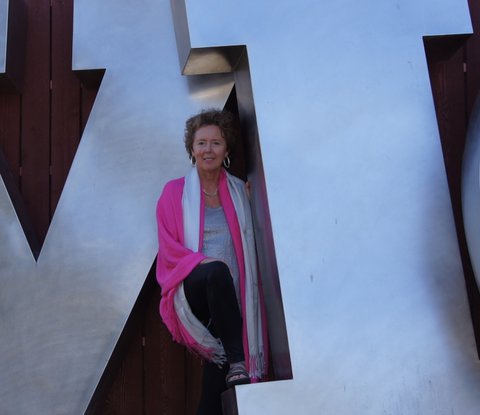
BY DIANNA MACLEOD
Whidbey Life Magazine Contributor
March 15, 2017
When Welsh sheep farmer Eifion Morgan visited the Island County Fair in 2004 with his Whidbey-born wife, Jane Clyde, it was natural for him to make his way to the livestock area to mingle with island sheep farmers. They talked breeds, quality of fleece, and other matters of mutual interest. When it came to the subject of shearing, the talk turned to quantity; most farmers said they managed six sheep per hour. When asked how many sheep he could shear in an hour, Morgan cited a number most listeners assumed was an exaggeration: 20. To position a sheep and remove the fleece in three minutes seemed, well, unbelievable. And to do it without ceasing, one 175-pound animal after another, for a total of 20 an hour? Farfetched, surely.
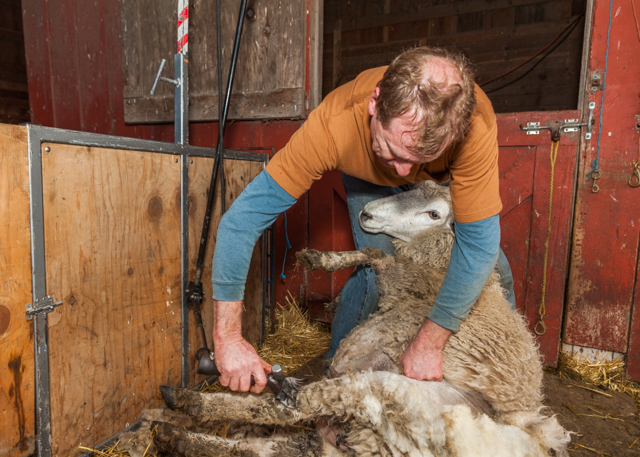
Master shearer Eifion Morgan before the hard work begins. (Photo by jim carroll – jshuimages.coml)
That conversation gave Eifion (pronounced I-vee-on) Morgan something to ponder. Since visits to the island to see Clyde’s family were a yearly event, he knew he would be back in 2005 — and every year after. He decided to advertise his services to islanders via the internet, and folks began signing up. Soon, Morgan had confirmed a shearing schedule for his next visit. When he arrived on Whidbey Island in the spring of 2005, 167 sheep of various breeds — Southdown, Black Welsh Mountain, Icelandic, Shetland, Corriedale — awaited him. To general surprise and admiration, he made good on his word, shearing, on average, a sheep every three minutes, continuously.
The flock at Shauna Lundstrom’s 5LRanch in Oak Harbor contained in the holding pen. (Photo by jim carroll – jshuimages.com)
That bit of self-promotion was the first and last Morgan ever had to do. “From then on, it was all word of mouth. Sheep people here on the island talk and blog, so word spreads,” he says. “Farmers back home don’t blog; they just chat in the market.”
In 2006, during an extended, leisurely visit to the Clyde family, Morgan made unhurried visits to farms, deepening his knowledge of Whidbey farmers and shearing 400 sheep during his six-week stay. Increased demand for his services caused him to purchase miscellaneous supplies (hoof trimmers, wormers, inoculates), electric shears (mounted on a panel), portable metal railings (for an impromptu holding pen), and a pickup truck (kept parked at the Clyde family home). He’s logged considerable miles on that truck every spring since, regularly driving as far north as Linden, as far south as Elma, as far east as Carnation, as far west as Quilcene.
The right tool for the job: electric shears. (Photo by jim carroll – jshuimages.com)
Morgan’s clients consult him as they would a veterinarian. He’s also become somewhat of a sheep broker; he knows what his clients want to acquire, sell, trade. Many of his customers have become more than acquaintances. “They are loyal to me, and I’m loyal to them. They are genuine friends,” he said. “Some have visited Jane and me in Great Britain.”
As it has turned out, Jane Clyde’s trip to Wales in 1979 on a pony-trekking expedition, and her subsequent marriage to Morgan in 1981, was a stroke of luck, albeit several years deferred, for Pacific Northwest sheep farmers.
Although his shearing pace seems jaw-droppingly fast to island sheep farmers, it elicits shrugs in the Aber Valley, where Morgan and Clyde reside. Among Welsh sheep farmers, shearing is organized for efficiency. “Five shearers lined up in a row handle 4,000 sheep in three days while helpers remove the wool as fast as it comes off the animals. It’s an assembly line,” Morgan says.
Morgan is a pro at calming the ewe during shearing. (Photo by jim carroll – jshuimages.com)
When it comes to sheep, Morgan has observed other differences between Wales and Whidbey. There are more breeds on the island than is typical in Morgan’s part of the world. “In Wales, I deal mostly with Welsh Cross Cheviots,” he observes.
Morgan also finds that Whidbey Island sheep tend to be an older crowd. “Here, I’m shearing sheep that are 14 years old. They’ve become family pets. Back home, a sheep would be long gone by that age.”
That’s because Welsh farmers can’t afford to be sentimental about their animals; in order to make a viable living from a farm in Wales, it must support 800 to 1,000 sheep and at least 50 head of cattle. Morgan himself learned to shear sheep at the age of 13. It was expected in the same way that completing chores before going to school was expected.
A shorn ewe adjusts to the chilly air. (Photo by jim carroll – jshuimages.com)
Through his own training and 44 years of experience, Morgan has learned the qualities that make a good shearer: strength, endurance, patience, and confidence. “You have to be confident to push that blade through the wool without damaging the skin,” he says. Tolerance for mess and dirt are also high on the list. “You’re not going to want to wear the same clothes tomorrow that you sheared in today.”
Although the size of Morgan’s own flock has diminished from a one-time high of 400 breeding ewes, he derives additional income from the land in other ways. He makes and sells cider under the label Aber Valley Apple Juice. For several years, Jane managed a bed-and-breakfast based in the couple’s 400-year-old farmhouse located in Brecon Beacons National Park. The 60-acre farm, which belonged to Morgan’s father, is ideally situated in a landscape of escarpments and cirques, peaks and valleys carved out by glaciers.
The mother and child reunion. (Photo by jim carroll – jshuimages.com)
Although raising his own sheep is less of an occupation for Morgan these days, he knows his sheep statistics backward and forward. He keeps meticulous records in a small notebook: 80 clients this trip; 1,500 sheep sheared. He cites the record time clocked at The Golden Shears international competition: 40 seconds. His own personal best is 400 sheep sheared in a day, achieved several years before he reached his present age of 57. He looks forward to the day shearing is included in the Olympics. If and when it is, there’s no doubt who Whidbey’s sheep farmers will be betting on.
“No, I won’t be a competitor,” Morgan says. “I’m still a good shearer, but I’m semi-retired.”
A blue-eyed ewe waits her turn. (Photo by jim carroll – jshuimages.com)
Separated from their mothers, lambs huddle together. (Photo by jim carroll – jshuimages.com)
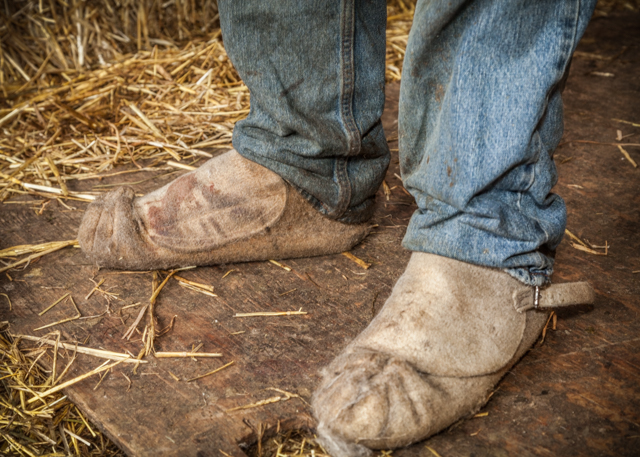
Morgan’s preferred footwear: Australian moccasins. (Photo by jim carroll – jshuimages.com)
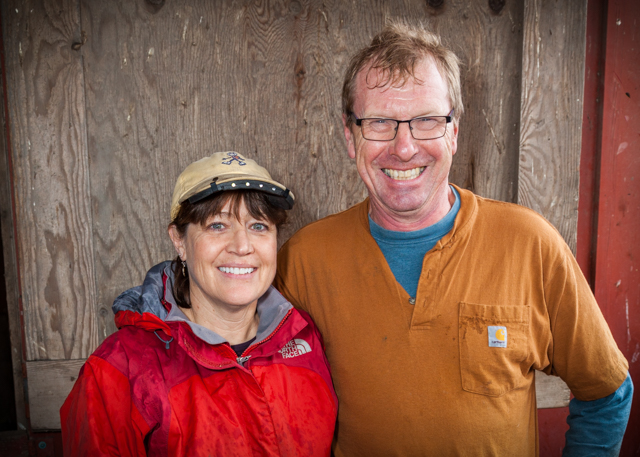
Shearer Morgan and farmer Shauna Lundstrom. (Photo by jim carroll – jshuimages.com)
Dianna MacLeod developed a fondness for sheep during her extended stays in rural Cornwall, where she observed the rhythms of sheep and farmers in the fields around her various rental cottages, sampled the many ways lamb is prepared, and attended numerous county fairs at which a variety of breeds were shown.
WLM stories and blogs are copyrighted and all rights are reserved. You may link to this story. To request permission to use or reprint content from this site, email info@whidbeylifemagazine.org.
BY DIANNA MACLEOD Whidbey Life Magazine Contributor October 12, 2016
When the Friends of Clinton Library decided to hold a fundraiser, they settled on the idea of a spellathon–and then set about finding folks who would be willing to form teams, don costumes, invent names for themselves, and then spend Saturday evening, Oct. 1, testing their knowledge of words.
Elaborate costumes included the gray hippos, representing hippopotomonstrosesquipedaliophobia: the fear of long words. (photo by Marcia Wiley)
According to Clinton Library manager Debby Colfer, the Friends consulted with staff of the Everett Public Library, who had learned lessons from their own spelling bees. “The costumes were our own addition,” said Colfer. “Because we were holding it in October, it seemed right.” The Friends decided to offer prizes for best spellers and best team names and costumes.
Jane Jeszeck, Georgia Gerber and Sara Benum made up the Hedgehog WannaBees. (photo by Marcia Wiley)Rebel Readers (photo by Marcia Wiley)Spellbound (photo by Marcia Wiley)Stellar Spellers (photo by Marcia Wiley)
Thirty-six adults entered the competition, dressed in costumes from minimalist (The Queen’s English) to maximalist (gray hippos, representing hippopotomonstrosesquipedaliophobia: the fear of long words). Each team–consisting of three individuals–was part of a swarm of four teams. The competition within a swarm produced one winning team, who went on to compete against the winners from the other two swarms. Each team had 30 seconds to write the given word on a white board, which–at the ringing of a bell–was held up to the audience and the judges. Those 30 seconds passed remarkably quickly for both the teams as they arrived at their decision about a word and also for spectators, who were entertained by the music and musings of Clinton resident (and Rural Character) Randy Hudson and Joe Jeszeck, one of the members of Hudson’s band, Heggeness Valley Boys.
Each team had 30 seconds to confer and write their chosen spelling of a word. (photo by Marcia Wiley)
In addition to the monies raised by the teams’ entry fees, several local businesses acted as sponsors. During the event, which was free to the public, a silent auction was also held. According to Colfer, the spellathon generated over $2,000. She and Friends’ president Arlene Stebbins were pleased by the community response; the funds will help pay for library programs in 2017.
“And we were happy to be able to rent the Clinton Community Hall and support the Clinton Progressive Association,” Colfer said. The hall, a gathering place for the Clinton community, was built by the 100 year old Association in the 1960s.
The winning team, The Brainiacs, included (right to left) Marshall Goldberg (Oak Harbor), Dianna MacLeod (Langley), and Paul Thompson (Freeland) took home trophies for best costume and best spelling.
The Spellathon title for the evening went to the Brainiacs, who sweated and spelled their way to victory against The Queen’s English. The winning word was onychophagia: the practice of biting one’s nails.
And a nail-biting finish it was.
This was Dianna MacLeod’s first spelling bee. Despite her hippopotomonstrosesquipedaliophobia, she looks forward to the next one.
WLM stories and blogs are copyrighted and all rights are reserved. Linking is permitted. To request permission to use or reprint content from this site, email info@whidbeylifemagazine.org.
This article was originally printed in Whidbey Life Magazine’s Spring/Summer 2016 print issue. The Fall/Winter 2016-17 print issue of Whidbey Life Magazine will be out in a couple of weeks! Look for it in your mailbox {subscribe here} or grab it at one of our local distributors. To whet your appetite, we thought you’d like to read an article from the Spring/Summer 2016 print issue.
BY DIANNA MACLEOD
Whidbey Life Magazine Contributor
October 5, 2016
Have you ever pulled dandelions from a city lot to make a childhood bouquet? Broken off blooming branches from an untended shrub to display on a windowsill? Wandered along the side of a country road picking Queen Anne’s lace and foxglove, butterfly weed and yarrow?
Tobey Nelson of Vases Wild selects flowers for an arrangement. Photo by Marsha Morgan
Have you ever grown a row of flowers between your vegetables? Left a couple of dollars in a neighbor’s honesty box for a Mason jar full of blooms? Gathered a handful, or an armload, of something beautiful that grew right beneath your feet?
If you did, count yourself a slow flower enthusiast—an admirer of flowers that are seasonally available, suited to local conditions and free of chemicals.
Such pullers and pickers count themselves among the increasing number of Americans who love the simple elegance and admirable hardiness of blooms grown in their own part of the world. They are less well known, and a little bit behind, those who have joined together to form the movement known as Slow Food—those advocates who promote local food grown with taste, nutritional value and sustainable agriculture in mind. But the movement known as Slow Flowers, is…well…steadily growing. Locavores, move over and make room for locaflores.
Some might ask whether it really matters if our flowers come from far away or from our own backyards. Whether it matters if our blooms take their time coming to maturity under the open sky or are sped along by fertilizers applied in precise doses at precise times in the confines of a greenhouse that operates like a factory.
To Amy Stewart, author of “Flower Confidential,” it matters very much. She claims that once you understand the difference between imported and homegrown, “you’ll never look at a cut flower the same way again.”
Three Whidbey Island flower growers agree. With shovels, secateurs and seeds, they make both a living and a life raising and selling blooms that are sustainable, artistic, ethical and breathtakingly gorgeous. They are our very own, homegrown Slow Flower farmers.
Wedding centerpieces created by Vases Wild. Photo by Molly Landreth Weddings, Lightworks360
Vases Wild
This marks the fifth summer that gardener, horticulturist and wedding planner Tobey Nelson has been making flower art under the name Vases Wild.
It all started at a wedding show in Seattle when she asked herself why nuptials were not being exchanged more often on Whidbey, an island within easy reach of the city that offers the perfect backdrop for one of life’s most important rituals. As she researched the situation, Nelson found that Whidbey was something of a secret. “I talked to people who didn’t know about the island, attended a wedding here, and then fell in love with the place.”
That realization coincided with her innate pride of place. “I feel strongly about promoting Whidbey Island as a destination and as a community. Events in general, and weddings in particular, provide jobs.”
Hellebore and black pussy willow oral jewelry created by Vases Wild. Photo by Suzanne Rothmeyer
As she began promoting Whidbey as a wedding destination among her clients and peers, Nelson also polished her social media skills in order to market to the betrothed. And, since brides are bombarded with imagery and information, she had to find ways to make her creations stand out. Fresh and dried floral jewelry, botanical headpieces and arrangements using succulents are some of the ways she distinguished herself from other floral designers. Her jewelry and headpieces, delicate yet durable, can be worn for a wedding or for any special event—a date, a prom, a night at the theatre.
Five years later, Nelson continues to take every opportunity to recommend local hair salons, stylists, dressmakers, musicians, chefs, caterers, vintners, brewers, hoteliers, venues, photographers, officiants. She also employs local artisans—metal workers and carpenters—to make custom forms, including floral chandeliers, cylinders to support flowers in vases and arbors. A collaborator by nature, Nelson values the synergistic spirit present among Whidbey Island flower growers, who refer clients back and forth, lend and borrow equipment and sell flowers to each other.
But for a floral artist to locate on Whidbey, far from the lucrative urban wedding trade, other factors must be at work. So it is with Nelson, who has a passion for pastoral landscape, farmland preservation and healthy soil.
As a long-time landscape designer, Nelson is keenly aware of the effect of pesticides on water quality and soils. “Many of the local farms I work with achieve fertility by building soil with manures and compost rather than by applying chemical or synthetic fertilizers, resulting in less runoff,” she said. “Spraying is reduced or eliminated in fields that are planted for diversity. And many flower farms are bush-based, so those fields are not regularly plowed, which means fewer carbon emissions.”
Nelson reported that 80 to 90 percent of all flowers in America come from beyond our borders, where pesticide regulation is lax to nonexistent. Plants are sprayed with pesticides while still growing in the ground or in the greenhouse. Many flower heads—especially roses—are dipped in a fungicide before being packaged. When a box of flowers arrives in a port, it is likely to be fumigated. These are the ingredients in the bouquets into which we bury our faces—seeking fragrance—and then place on our tables, right next to our lovingly-prepared organic food.
Mass-produced flowers also put workers at risk, Nelson noted, whether they are spraying pesticides on rows of identical plants or inhaling fumes over open vats of fungicide. And commercial blooms just don’t deliver what Nelson always takes care to include in a Vases Wild bouquet: scent. A flower bred for traveling is not a flower bred for sniffing. When it comes to commercially grown flowers, looking “fresh as a daisy” is all important; scent is sacrificed in favor of longevity. That’s why Nelson grows her own fragrant beauties: roses (the shrub rose “Golden Celebration” is a favorite), peonies and sweet peas. In addition to scented flowers in her bouquets, she also includes cedar, salal, fern, alder branches, filbert catkins and white poplar (foraged on the beach, after obtaining permission). “When I sell a bouquet, I love it most when I can say ‘this bouquet is island grown’. But I’m always proud of my commitment to using all American-grown flowers, even when I can’t source all my blooms from Whidbey.”
Hairpiece created from sedum by Vases Wild. Photo by Shonda Hilton Photography
In her own garden, Nelson has something blooming all year long, both for her own pleasure and for the survival of pollinators. “When it’s warm enough for bees to wake up, I have something for them to eat. Once we get into summer, the garden is bursting with lush floral color and fragrance.” She likes to “stack” her plantings to “keep the soil covered and busy so nature doesn’t introduce her own agenda.” The governing principle for both her garden and her floral arranging is diversity of leaf and bloom.
As a grower and arranger, Nelson’s passion for slow flowers is deeply rooted. “To support my local economy. To keep from exposing myself or my customers to pesticides. To preserve American farmland. To encourage bees by providing bee habitat. And because local flowers lend themselves to a romantic, naturalistic kind of styling. There are so many reasons to love slow flowers!”
Melissa Brown of Flying Bear Farm inside her greenhouse. Photo by Marsha Morgan
Flying Bear Farm
Melissa Brown first discovered Whidbey Island as a child when her mother’s art was being shown in a Langley gallery. After that, her visits to the island were occasional, but the place was never too far from her mind or heart. As a young woman, she learned about plants by working at Seattle’s Tilth Garden, which is where she met her future husband, Benjamin Courteau. After they married, the couple teamed up with her parents to launch an experiment in intergenerational living. The four set about to find a property on Whidbey large enough to accommodate a homestead for two families and land enough to farm. When that land and homestead appeared near Langley, Flying Bear Farm was born.
“We’re interested in supplying ourselves and our community with things you don’t normally get,” said Brown, who grows flowers for her floral arrangements, sold under the name Flying Bear Design. Brown sees a cultural shift away from conventional floral arrangements to slow flowers. “There’s a desire for local flowers with a ‘gardeny’ look and natural fragrance.”
Weddding reception centerpiece by Melissa Brown, Flying Bear Farm. Photo by Krista Welch, Love Song Photo
That cultural shift is coming at a good time for Brown, because opening a flower shop is an expensive enterprise with an uncertain future. Overhead and the need for a large and diverse inventory make it difficult to make a go of it. And flowers, considered luxuries by most of us, are one of the first items to be sacrificed when money is tight. The 2008 recession forced many flower shops out of business, and in the years since the domestic trade hasn’t fully recovered.
What’s a flower grower, designer and seller to do?
One of Brown’s solutions is the “pop-up”—a temporary stand in front of, or inside, an existing retail business. A one-off, one-time farmer’s market stall. Flying Bear’s latest pop-up—held outside the Langley restaurant Kalakala over Valentine’s Day weekend—was a perfect example of what happens when young entrepreneurs join together to attract customers. Cooperation. Collaboration. Synergy.
“We brought everything: table, chairs, umbrella. We had a square reader for taking credit cards and tracking things. We had rustic buckets and wonky crates, and we used them to tell our story. I brought things to build our brand: galvanized French flower buckets and chalk boards,” she recounted. “I try to think of what people are going to expect when they buy flowers and then incorporate it into my ethos.”
Brown is convinced that part of the appeal of slow flowers is their authenticity. “Young people had grandparents who grew sweet peas, and those memories inform desire. There’s also the desire for the story—the story of where something comes from. We’ve grown up in a culture of obsolescence, everything fake and cheap and anonymous. People are rediscovering the importance of the story that’s attached to what they buy. Who grew it? Who made it? Where does it come from?”
As much as Brown enjoys creating a rustic ambience, she enjoys surprising her customers. She enjoys being the woman behind the accidental find. “There’s pleasure in discovery. People like coming upon something unexpected,” she said. “And then taking it home with them.”
Although Brown grows a variety of flowers, she also sources blooms from places like MilePost 19, Sonshine Flower Farm and Full Cycle Farm. Like Tobey Nelson, Brown appreciates the cooperative spirit among Whidbey Island flower farmers and envisions a future in which they intentionally coordinate their crops to help fill gaps in each other’s inventory.
Bridal bouquet by Melissa Brown, Flying Bear Farm. Photo by Krista Welch, Love Song Photo
Another of Brown’s workarounds to the lack of a bricks-and-mortar flower shop is to attract customers to the farm. This summer she plans to offer a CSA subscription for a weekly bouquet (recycled vase included) or a bucket of flowers (for those who like to arrange their own).
Although the farm and floral business is both a team effort and a family affair, Brown finds she has many more ideas than hours in the day to realize them. For someone so enterprising and inventive, the life of a slow flower farmer offers balance and the opportunity to…well, slow down.
“The best part is being around beauty all the time, having the opportunity see beauty wherever it is,” she said with a smile. “Even if I’m just weeding, I’m seeing the beauty of the soil.”
Kelly and Pam Uhlig of Sonshine Flower Farm at the Bayview Farmers’ Market. Photo by Dianna MacLeod
Sonshine Flower Farm
Three years ago, Pam and Kelly Uhlig sold off their goats and alpacas, plowed up the fenced pasture that fronted on their farmhouse, and began creating what would become a giant flower garden. Over time, they erected two large greenhouses, a poly-tunnel and a seed house. Downed cedars were milled into doors for the greenhouses and planks for the sides of raised beds. A hemlock tree became a potting table. Last spring, they added a long-awaited cooler—a 10′ x 12′ refrigerated space—that holds buckets of cut flowers along with the promise of a more flexible planting and harvesting timetable.
The Uhligs—a mother-daughter team—have remained true to their original intention to create a production flower farm that is gentle on the earth. To preserve water, they installed a drip irrigation system. To build soil fertility, they mulched with aged goat and alpaca manure. To keep hard rains from compacting the soil, they placed layers of cardboard over bare earth, allowing the cardboard to break down over the winter and add to the humus.
Bird’s-eye view of a portion of Sonshine Flower Farm, early spring. Photo by arborist Kyle Rapp, taken from 40 feet up a tree.
“I believe in being a good steward of the land,” said Pam. “If I spray, it’s certified to harm neither people nor the land.” Pam relies on the Organic Material Review Institute to guide her toward benign products. When arranging flowers, she rejects the spongy green material known as Oasis in favor of chicken wire and sphagnum moss, coconut husk fiber and biodegradable “floral soil.”
“I grow flowers to be used locally and sustainably. No fossil fuels for shipping, no dipping in chemicals,” Pam said. To her, Amy Stewart’s “Flower Confidential” is the revelatory book that should spawn a revolt against fast—and foreign—flowers.
The Uhligs plant their crops on a scale most of us can barely imagine: 10,000 bulbs, including tulips, ranunculus and anemones, were planted during the fall of 2015 while dahlia tubers were being dug up and stored in bulb crates for separating and replanting the following spring. This kind of mass planting requires massive planning, from the first day of the year (January for sweet peas) to the last (December for ordering annual seeds).
Pompon ranunculus. Photo by Kelly UhligSweet peas / Photo by Kelly Uhlig
But no amount of planning can account for the vagaries of weather and temperature. Sweet peas can finish by July 1 or last right through the month. Tulips can arrive on time or three weeks early, before flower buyers are prepared—emotionally and psychologically—for them. Early or late arrivals can pose a problem or offer an advantage, depending on the kind of bloom and the season’s progress. Because the price of flowers, like any commodity, is governed by supply and demand, some early arrivals are welcome. “Flowers are a mind game,” said Pam. “You can’t anticipate everything; you do try to get your product to market first.”
But no matter what the weather throws at her, planting is Pam Uhlig’s great passion. “A snapdragon seed is practically microscopic,” she observed. “Yet months later I’m cutting stalks of flowers from that plant for baby showers, weddings, memorial services.”
Although 10,000 bulbs may sound like an impossibly large amount, the Uhligs know that not all of those flowers will make it to market. “Birds, bugs, weather, predators…you lose a lot and you have to accept that,” said Kelly. “Bugs are attracted to white flowers, so they get chewed more than other colors.”
Of the flowers that survive, a portion are destined for the Bayview Farmers Market, where the Uhligs arrange and sell glorious bouquets under a tent that draws customers from all four corners. Another portion is meant for the Seattle Wholesale Growers Market, which means loading a van with buckets of tightly-bunched blooms and catching the first ferry to be on site shortly after dawn, when florists are shopping. Another portion ends up in the flower-arranging hands of Melissa Brown and Tobey Nelson.
Kelly Uhlig composes a bridal bouquet. Photo by Pam Uhlig
As much as the Uhligs enjoy bringing their flowers to the wholesale market in Seattle, they love the contact with customers that the Bayview Farmers Market provides. “Generally, guys want bright colors: orange, yellow, red. Women like the jewel tones and the muted colors,” Kelly observed. “But in the fall, as the days grow shorter and darker, everyone wants bright colors,” Pam added.
Pam, a graduate of the Edmonds Community College horticulture program, understands the importance of offering “leafy greens” with her flowers. Foliage provides a contrast in color, texture and shape to the flowers in a bouquet. Accordingly, she grows the sturdy and handsome ninebark and other deer-proof shrubs around the perimeter of the garden while interplanting purple cardinal basil and other striking foliage plants between rows of flowers.
The talent for growing flowers extends to knowing how to cut them to preserve their freshness and make them last. Pam offers bouquets that will, if treated correctly, hold for at least a week. “The trick is knowing when to cut…and using clean implements. Containers and clippers need to be sterile. Clip the leaves off a flower stalk, because foliage quickly rots when submerged in water.”
Just like the other slow flower growers on Whidbey, the Uhligs alternate between shears and social media. Kelly regularly posts photos and videos on Instagram to market what’s in season and to include admirers in the daily life of the farm, with all its tribulations and triumphs.
Despite either, mother and daughter look forward to each and every day, come rain or shine, deer or slugs, late frost or early warmth. They enthusiastically agree that slow flower farming—the cultivation of beauty and commitment to earth’s ecology—comes pretty close to a life lived in the Garden of Eden:
“Slow flowers express emotions, appeal to the senses, touch the soul.”
Cultivated, harvested and designed by the likes of Tobey Nelson, Melissa Brown and the Uhligs, how could it be otherwise?
RESOURCES “Flower Confidential,” Amy Stewart, Algonquin Books, Chapel Hill NC, 2007 “The 50 Mile Bouquet: Seasonal, Local and Sustainable Flowers,” Debra Prinzing, St. Lynn’s Press, Pittsburgh PA, 2012 “Slow Flowers: Four Seasons of Locally Grown Bouquets from the Garden, Meadow and Farm,” Debra Prinzing, St. Lynn’s Press, Pittsburgh PA, 2013
Dianna MacLeod wore out her knees, bent her back and learned a little Latin in her own garden for 25 years before moving to Whidbey Island in 2011, and when she came she brought 300 of her green friends with her. Dianna has managed an organic demonstration garden, written grants for gardening nonprofits and opened her Seattle garden to Tilth and Northwest Perennial Alliance tours. She looks forward to wearing out her knees and bending her back on her own five acres sometime this year.
WLM stories and blogs are copyrighted and all rights are reserved. Linking is permitted. To request permission to use or reprint content from this site, email info@whidbeylifemagazine.org.
BY DIANNA MACLEOD
Whidbey Life Magazine Contributor
September 13, 2016
Over Labor Day weekend, a contingent of 50 or so “orcadorks” gathered at the intersection of Highway 525 and Coupeville’s Main Street, many sporting their signature colors (black and white) and some wearing costumes (variations on fins, tails, and snouts).
The “Free Tokitae” Rally in Coupeville on Sept. 3
What’s an orcadork? According to Susan Berta of the Orca Network, an orcadork is a person who knows a great deal about orca whales and, more importantly, cares a great deal. One orca in particular supplied the reason for Saturday’s gathering: Tokitae (also known as Lolita), the orca who was captured in Penn Cove 46 years ago and has been held ever since at Miami Seaquarium in Florida.
Costumed orcadorks Lily Haight and her dog
The demonstration in Coupeville was part of a national protest of the conditions of Tokitae’s captivity and a demand for her return to the Pacific Northwest. The legal struggle to win her freedom has been agonizingly slow, marked by both progress and setbacks. The courts can’t seem to decide which anti-cruelty laws apply to Tokitae, and her captors at Miami Seaquarium see only as far as their bottom line. The clock is ticking for Tokitae; although orcas can live a long time in the wild, they are susceptible to various illnesses—including depression—when kept in a shallow, concrete tank. In fact, Tokitae is the last orca alive of the seven young whales captured in August of 1970 in Penn Cove. She has outlived her brothers and sisters by 29 years. Amazingly, Tokitae’s grandmother, the matriarch of her family group–known as the Southern Resident pod–still swims in our waters. Bonds are strong and memories long among orcas, and orcadorks hope that one day Tokitae and her grandmother will once again converse in the vocabulary of their species.
During the Labor Day demonstration, Orcadorks were clumping on all four corners of the intersection and lining the pedestrian walkway above the highway. They waved placards and home-made signs at passing motorists, who responded by honking horns, waving, and jabbing thumbs into the air. Curious about their reasons for spending part of their holiday weekend in this way, I asked several orcadorks why they cared so much about the fate of one whale, taken so long ago and held captive so far away.
Young orcadorks
Veyariva, age 10: “It’s not fair that the babies were captured and kept in a small tank. It’s cruel. I’ve cared about Tokitae ever since I was little.”
Jayden, age 9: “I saw her in Florida. It made me sad. They trained her, but it took a lot of practice. In a shed I saw some of the tools used for training her, spears and hooks. Now she’s scared to not do the tricks because she’ll get stabbed. Also, orcas need to dive deep down in the water, and she can’t. And there’s no shade over her tank, and in Florida it’s hot.”
Noelle, age 12: “I think she should be freed. How they captured babies is not fair. It’s not fair to take them young and use them for our entertainment.”
Alexa, age 14: “When I was in fifth grade, I became interested in whales. I wanted to be a marine biologist and joined a program in Gig Harbor called Harbor Wild Watch. When you go to any kind of wildlife park and see animals in cages, you can see the pain in their faces. Humans can fight for what we want; animals can’t do that. More and more people are joining the movement. I’m hopeful that in the next few years Tokitae will be moved to a sea pen.”
The Haight Family
Rachel, age 27: “I grew up in Nebraska and went to the zoo all the time as a kid, never thinking about what the animals experience. When I saw the movie “Free Willy,” I started to care about their captivity. I visited Whidbey when I was 13; that’s when I learned about the captures. I loved the whales so much that I moved out here in 2011. When I volunteered at a wildlife rehabilitation center, I understood how much wild animals hate cages. A week after I learned about the Orca Network, I went out on my first wild whale sighting. What draws me to orcas is that they are family oriented. They are social and emotional. We can’t even begin to understand their intelligence. Who are the people who are paying money to see Tokitae in a tank?”
Minda, age 33: “I began to care about marine animals in the sixth grade. I wanted to be a marine biologist. When I was 18, I worked at SeaWorld, in merchandising. I went whale watching in 2014, and it all clicked: this is where Tokitae should be. I’m a member of the Whatcom Marine Stranding Network. We educate people on shore about what they should do if they encounter a marine animal on the shore. We also collect decayed animals to determine their cause of death. If people could see how related Orcas are to us… Tokitae, even after all these years separated from her family, responds to recordings of their calls. How could you not care about that? I have hope that she will be freed in my lifetime. I want to be there at the moment she’s released into her sea pen. I have this vision in my head of what it will be like.”
The logistics to realize that vision are already in place: the country’s best marine scientists have crafted a rehabilitation plan, a protected sea pen has been created, and a staff is assembled to help Tokitae transition back into the ocean. All that’s lacking is the consent of the marine park owners. And that, it seems, is where public pressure will make the difference between immediate freedom and continued captivity for Tokitae.
You don’t have to stuff your brain with facts about orcas to join our regional pod of Orcadorks; as I discovered, it’s the size of your heart that makes you one of the family.
To learn more about Tokitae, whales, or the Orca Network, visit the Whale Center in Langley (115 Anthes Ave. 360-331-3543) or log on to www.orcanetwork.org.
All Photos Courtesy of the Orca Network.
Dianna MacLeod holds a degree in journalism and environmental advocacy. She is proud to be counted among our island’s orcadorks.
WLM stories and blogs are copyrighted and all rights are reserved. Linking is permitted. To request permission to use or reprint content from this site, email info@whidbeylifemagazine.org.
BY DIANNA MACLEOD Whidbey Life Magazine Contributor February 3, 2016
Last fall we reported on a partnership among several Island nonprofits—Whidbey Island Nourishes (WIN), Good Cheer Food Bank, the Whidbey Institute and Goosefoot Community Fund—to support a bold plan to provide school children with the educational and practical benefits of growing a garden, the kind of benefits most children once received in the course of daily life. The partners decided they would prepare the ground, plant the seeds, add hard work and patience and a sunny outlook…and wait for the South Whidbey School District Garden Program to take root and sprout.
That sunny outlook was helped along by a promise by the Goosefoot Community Fund—an organization that exists to build a sense of community, preserve rural traditions, enhance local commerce and create a sustainable future for South Whidbey Island— to raise $15,000 each year for three years and a commitment from the Goose Grocer to match that amount every year.
The big thermometers (photo by Lis David)
During the 2013-2014 school year, the Goosefoot Community Fund had raised more than promised. That amount of $22,000—matched by the Goose Grocer—helped to create a half-acre farm on the Maxwelton Road school premises. The School Farm included a 960-square-foot hoop house (the “Big wHOOP”) erected on the fringes of the elementary school playground, a large plot of ground plowed and ready for planting, and a cluster of small buildings. Once those were in place, teachers developed a curriculum that included lessons taught by earth mover and seed shaker Cary Peterson on the how’s, why’s, and what’s of growing a garden. (What makes a healthy soil? Why are worms our friends? How does a seed make a plant?) Before the year was over, students were contributing home-grown vegetables to their school cafeteria.
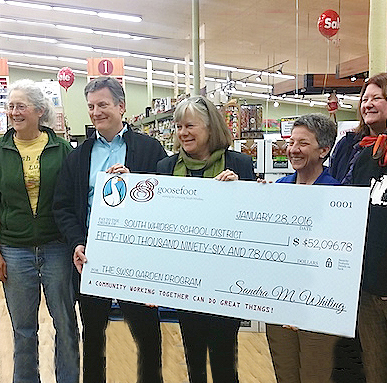
So it was no wonder that a large group of planters and sowers—the many volunteers who helped with teaching, curriculum development, building the School Farm infrastructure—gathered at the Goose Grocer on Thursday to celebrate the presentation of the second big check—this time in the amount of $52,000—to the South Whidbey School District Garden Program, the little sprout that could!
Garden program partners hold up the big check (photo by Lis David)
A big whoopee greeted the big check. Children would continue their collective love affair with the earth and its bounty. Students would continue to feel the pride of farmers who were raising food for their school as well as extra produce to donate to the food bank. Kids would still be able to pull on their garden gloves and pick up their trowels to spend time in the garden during recess.
The whoopin’ and hollerin’ was followed by some eatin’ of a big cake that boasted a frosting photograph of a plate of fresh vegetables and letters in shades of orange (to match the carrots in the photograph), green (think lettuce), yellow (squash, anyone?).
The big cake (photo by Lis David)
By the way, the cake turned out to be everything a cake should be: gooey, sugary, chocolatey—a wonderfully bad cake to celebrate a wonderfully good achievement by wonderfully dedicated people.
* * *
To read the feature Big wHOOP from November click here.
Donations to the School Garden Project can be sent to Goosefoot, PO Box 114, Langley WA 98260. You may also donate online at www.goosefoot.org; be sure to make your contribution to the School Garden Program. Questions? Call 360-321-4232.
Dianna MacLeod holds a degree in journalism from the University of Michigan. An alumna of Hedgebrook, she moved to the island in October of 2011 to complete a novel—and never left.
WLM stories and blogs are copyrighted and all rights are reserved. Linking is permitted. To request permission to use or reprint content from this site, email info@whidbeylifemagazine.org.
BY DIANNA MACLEOD Whidbey Life Magazine Contributor November 25, 2015
A showing of the film “Big Joy” earlier this month at Langley’s Clyde Theatre—a fundraiser to help with the medical expenses of island resident Charlie Murphy—also turned out to be a showing of solidarity, support and safekeeping, island style.
The audience for a showing of “Big Joy” to benefit the healing fund of island resident Charlie Murphy (photo by the author)
For many years, Charlie—following his calling as a mentor—has traveled the world on behalf of Partners for Youth Empowerment (PYE), a global organization he co-founded with Peggy Taylor that seeks to unleash the potential of young people worldwide through creative facilitation training for adults and creative camps for youth. A talented songwriter, musician and performer with a background in social change theory and practice, Charlie is ideally suited for this work.
But when he learned a year or so ago that he was suffering from an aggressive form of Amyotrophic Lateral Sclerosis (ALS), Charlie had no choice but to cancel his travel plans and redirect his commitment and energy to seeking treatment. In the fall, he and husband Eric Mulholland—actor and PYE theatre artist—traveled to China in search of herbal remedies they hoped would slow the onset of the disease. The pair returned after a few months, convinced that their Whidbey Island home and friends would offer the best medicine of all in meeting the challenges of ALS, which by then included symptoms of slurred speech, difficulty swallowing and loss of motor control…and that they anticipated would someday include paralysis and respiratory failure.
Charlie and Eric returned home in late October to a network of support: a team of friends in the medical profession that investigates and recommends possible treatments to slow or arrest the debilitating, and eventually fatal, symptoms of ALS. A finance team that considers ways to help Charlie pay for treatments and ways for Eric to take time off from earning income to give Charlie the care he needs. The sustenance team that prepares and delivers food—especially blended soups—now that Charlie has difficulty swallowing.
ALS is a pitiless, wasting disease. What joy, big or small, can be found anywhere near it? Even to look for joy in these circumstances might be considered audacious.
But it can be found. It can be found in the audacious life of James Broughton, the subject of the film “Big Joy.” Broughton (who died in 1999 at his home in Port Townsend) was an exemplar of exuberance who had a quirky genius for combining poetry with filmmaking to achieve “poetic cinema.” His zest for life was immense and his curiosity unquenchable; he was described as “forever liberating people”—a description that just as easily fits Charlie, who became friends with Broughton in the early eighties.
Broughton’s life was an example of how making art can sustain hope…exactly the theme of Charlie’s life work. Broughton courageously explored both his androgyny and his attraction to men in a time when queerness equaled social deviancy. Charlie, through his example and his involvement with men’s music and spirituality, has been inspiring others to accept their own selves.
Joy can also be found in the soundtrack to the film, composed and performed by Jami Sieber (together with Evan Schiller). According to Jami, who attended the showing, “James held the dark and the light so deeply in his life that, for me as an artist, composing music to reflect that was a challenge and a delight.” Jami and Charlie have known each other since 1980 when they performed together as a duo and later in the Seattle-based band, Rumors of the Big Wave. As well as composing music for films, Jami records CDs and tours the country playing acoustic and electric cello.
The personal and musical connection Charlie and Jami forged 35 years ago has endured. “The community up here is really committed to helping Charlie live fully in the moment. I admire the support that has poured in to make their lives easier and more real,” Jami said.
Eric Mulholland and Jami Sieber at a reception held at Ott & Murphy (photo by the author)
Joy can also be found in a phrase coined by James Broughton, “Follow your own weird.” The film’s director Stephen Silha prefers the original meaning of “weird,” a Celtic word meaning “fate” or “destiny.” Present at the showing, Stephen observed, “Being weird is being true to your core; being on your creative edge.” Stephen followed his own weird in order to make “Big Joy,” a process that required several Kickstarter and Indiegogo campaigns to raise the funds and took over four years to shoot and edit. The film has been shown at more than 45 festivals. According to Stephen, who has sat through many screenings of the film with many audiences, the reaction of the audience at the Clyde was special. “People responded, they really listened. They caught the nuances, the subtleties, that many audiences miss. That was gratifying for me.”
Stephen’s history with Charlie is almost as long as Jami’s; the two met in 1982 when Stephen interviewed Charlie for an article on the men’s music movement for the Christian Science Monitor. Since then, they have collaborated on projects and vacationed together. Charlie introduced Stephen to James Broughton in 1989.
Musician Jami Sieber and “Big Joy” director Stephen Silha on stage at the Clyde (photo by the author)
During my interview with Stephen, I commented on the multi-colored velour shirt and maroon beret he wore. It turns out that both once belonged to Broughton (and both made an appearance in the film). Stephen also pointed to a small silver bell hanging around his neck. The bell was crafted by his partner, a jewelry maker on Vashon Island, and engraved with the words to Broughton’s poem “This Is It.”
This is it
This is really it
This is all there is
And it’s perfect as it is
There is nowhere to go
but Here
There is nothing here
but Now
There is nothing now
but this
And this is it
This is really it
This is all there is
And it’s perfect as it is
Film director Stephen Silha expressing his version of Big Joy (photo by the author)
Much of Broughton’s particular genius, his weird, was due to his ability to live in the moment, earning him the nickname “Big Joy.” Like James Broughton, Charlie Murphy has found much joy in his life, and he has helped others to find it in theirs. But now, in his 62nd year, Charlie is also becoming acquainted with the sorrow, shock, and dread that follows a diagnosis of ALS.
Sitting a few rows in front of him in the darkened theatre, I imagined what Charlie might have been thinking and feeling: flanked by adopted family and artistic collaborators Jami and Stephen, clasping hands with his life partner Eric, watching old friend James Broughton romping on the big screen, surrounded by his Whidbey Island neighbors in space donated by The Clyde’s owners, knowing that all ticket revenues were pledged to his care, anticipating the reception that awaited him across the street at Ott & Murphy (space donated and drink revenues earmarked for his healing fund). I imagined what he might have thought and felt as he left the dark theatre and stepped out into the sunlight to find a rainbow spanning the sky.
Charlie Murphy (also shown at top)
I don’t really know. But I do know that, if there’s anyone who can hold the light and the darkness simultaneously, it’s Charlie. If there’s anyone who can humbly accept gifts from others, knowing he has given plenty of gifts of his own, it’s Charlie. If there’s anyone who can appreciate the beauty and grace of human compassion, and allow the safety net of community concern to hold him, it’s Charlie.
And aren’t we, every one of us, invited to share in that Big Joy?
____________________
A staged reading of “Tuesdays with Morrie” will be held at the Whidbey Island Center for the Arts at 3 p.m. on Jan. 17 as a benefit for Charlie Murphy. Watch our Community News section for updates and more information about other benefits, and follow these links to find out more about:
Dianna MacLeod met Charlie Murphy in 1977 when they both lived in an intentional community that taught social change skills. She sought out Jami Sieber in 1978 for a cello lesson when she thought that following her own weird meant taking up that instrument. She met Eric Mullholland in 2013 when she interviewed him for a Whidbey Life Magazine article on Island Shakespeare Festival’s Classic Conservatory for Young Adults. She met Stephen Silha wearing his sixties garb and his poetry bell just this month. All of which has led her to the irrefutable conclusion that Big Joy never really ends.
WLM stories and blogs are copyrighted and all rights are reserved. Linking is permitted. To request permission to use or reprint content from this site, email info@whidbeylifemagazine.org.
Hedgebrook, a writing retreat for women located on the south end of Whidbey Island, held its annual open house on a recent Saturday. The event pleases everybody: alumnae who revisit the place that’s nurtured and encouraged them, islanders who tour a few of the 48 acres and glimpse the handcrafted cottages where writers work their magic on the page and staff who host a celebration of all things Hedgebrookian.
Hedgebrook springs from the mind and heart of Nancy Nordhoff, local philanthropist and Langley resident. Once the land suggested itself to her as a haven for women writers, she began creating the kind of paradise she thought would inspire them. Some of the elements of her mind/heart quest included: gently-cultivated nature that shielded one dwelling from another for privacy; a distant horizon that included a contemplative view (of Useless Bay); healthy, tasty, locally-sourced food; simple, beautiful, functional dwellings; the camaraderie of other writers over one shared meal every day.
Nordhoff’s ambitions coalesced around, and eventually emerged as, the notion of “radical hospitality.” Accordingly, Hedgebrook’s huge garden provides vegetables and fruit from which produce is canned in the golden light of summer and served to writers in the blue light of winter. Routines have been streamlined to minimize interruptions to the work of writers. The crew has figured out ways to care for the acreage by eliminating certain utopian features that turned out to be problematic or worked against the grain of the land.
Although Hedgebrook is rural and offers peace and privacy free from distractions, it knows it lives in the modern age of technology-driven lives and, consequently, has had to choose the best of both worlds, both for the writers in residence and for itself. Contemplation is necessary to creativity, yes. But computers make writing the next draft easier and faster; the internet delivers research to the doorstep. At the open house, this creative tension was artfully expressed by a video about Hedgebrook looping on the latest edition of an Apple computer nestled into a wood cookstove (cold, for the moment) manufactured around 1922. Technology meets hospitality…meets humor.
More than 1,500 writers have dwelt at Hedgebrook over the last 26 years for residencies lasting from two to six weeks. During this time, the focus of Nordhoff, the board and staff has increasingly shifted to what is truly essential: the mission to support women writers so they, in turn, can tell the stories and communicate the ideas that shape our culture through novels, poems, plays, songs, screenplays, graphic novels and memoirs.
The notion of Hedgebrook has expanded from a place to a state of mind through salons, master classes, festivals, lectures and other events held periodically—on Whidbey Island, in Seattle and further afield. Through these offerings, the public is invited to participate in the intellectual and emotional life of Hedgebrook.
Hedgebrook has local roots but international influence. Alumnae have received prestigious fellowships, prizes and awards. Prominent female authors and thinkers speak glowingly of the importance of a residency to their own work and to the concept of Hedgebrook as a “nest” and “a haven of deep grace.”
But lest things become too heady, the Hedgebrook cookbook—zucchini bisque, ginger pumpkin bread, smoked salmon cheesecake—brings it all down to earth, back to the land that was so very central to Nancy Nordhoff at the beginning.
The open house at Hedgebrook was a celebration of the spirit and promise of the place and its people. And so, of course, I wish you were here.
WLM stories and blogs are copyrighted and all rights are reserved. Linking is permitted. To request permission to use or reprint content from this site, email info@whidbeylifemagazine.org.
If you’ve ever wanted to hear “auctionese” spoken fluently, Saturday night at Whidbey Island Center for the Arts (WICA) was the place to be. It was the place to be for other reasons, too, judging by the enthusiasm of the attendees at WICA’s annual gala designed to fund a 20th season of performances.
Around lushly-adorned tables in colors of pink and silver, 120 guests congregated for a gourmet dinner prepared by Orchard Kitchen and served by waiters, many of whom were actually actors playing waiters. These folks—the same folks we see often on our local stages—were lending a hand (well, two hands) as part of a group of volunteers working behind the scenes to make the evening seem like a well-rehearsed production.
In a wonderful reversal of things-as-usual, the tables were placed under the bright lights of the stage, overlooked by the empty seats of the darkened theatre. For one night, the audience was indeed the main event, and what a show they provided.
Indeed, “Passion” lived up to its name. The skill of the auctioneer was matched by the fervor of those bidding for the 50 or so auction items…even after they had already placed silent bids on the 100 items displayed in adjoining Zech Hall. The widespread support for WICA was evidenced by the number and variety of the items donated by local painters, woodworkers, authors, chefs, yogis, weavers, photographers, jewelry makers, potters and more. And there’s no doubt that a large part of the fundraising success of the gala was due to those who, wishing to express their esteem for the late Paul Schell, opened their wallets to join the producers circle named in his honor.
No postcard description of the event would be complete without mention of the Dessert Desire. A dozen gorgeous confections were on display in the lobby before dinner, priming the collective sweet tooth. I was one of two Dessert Desire “debutantes,” (“guards” might be more apt, although, honestly, I almost required a guard myself). Our disappointment at being denied a taste of the apple tart with pine nut ice cream, the blueberry custard pie, the Kahlua-poppy seed bundt cake was almost—almost— exceeded by our pleasure at watching folks trying to select their favorite. One dessert per table, high-bid table has first pick. Nothing motivates quite like sugar—a fact clearly understood by the four committee co-chairs.
As glamorous and entertaining as the gala proved to be, it became clear that what really bound together those in the room—servers and served, volunteers and ticket holders, artists and patrons—was a mutual passion for live theatre, music, dance and storytelling in all its varied forms. This past season, 11,000 tickets were sold to more than 100 performances at WICA. How would we experience the wonder and worth of live performance without a venue in which to do it?
WICA’s logo—realized in metal by artist Tim Leonard—makes a promise. Deliberately off center, larger than life, gleaming flashily yet made of enduring stuff, it is a proclamation on the outside of the building about what to expect on the inside. Big, bold passion.
The success of Saturday night’s gala—over $200,000 in revenues—shows that WICA’s 20th season is off to a passionate start.
WLM stories and blogs are copyrighted and all rights are reserved. Linking is permitted. To request permission to use or reprint content from this site, email info@whidbeylifemagazine.org.
Is your reaction the same as mine? Tentative, if not downright skeptical?
Who would waste good butter and sugar and flour making a cobbler crust only to sprinkle it on the humble, bland, and frequently oversized zucchini?
Kathy Floyd, that’s who…as her entry in Slow Food Whidbey Island’s summer cooking contest this past Friday.
And, by the way, she didn’t waste a bit of butter. The zucchini in her cobbler tasted like essence of apple, pear, vanilla, lemon and something unidentifiable but delicious. In the spirit of investigative journalism, I ate one, two, three pieces trying to detect just what. And I grilled Kathy relentlessly: hadn’t she snuck in an apple? Hadn’t a pear made its way from orchard to cutting board? Hadn’t something more exotic, more difficult to detect, migrated in? A quince? A handful of gooseberries? Hadn’t something been mashed beyond recognition and stirred into the so-called zucchini?
She swore (as much as Kathy swears, which I’m guessing isn’t much) that her cobbler contained zucchini and only zucchini. She has a very honest face.
Still, the zucchini is a troublesome vegetable from almost any perspective. Does it contain a double “c,” a double “n” or both? To get around the tricky spelling, and to enhance its appeal, the Brits call the cucumber-shaped-squash-with-smooth-skin a courgette.
Courgette Cobbler. Yep, I’m liking the sound of that. And there’s no denying I liked the taste.
The Courgette Cobbler wasn’t the only interesting dish on the menu. The “Root-to-Stalk” prize was awarded to Jim Hicken for a jelly made from the bits of pears and apples he removed before drying the rest of the fruit. This core-and-peel concoction glowed a lovely deep pink color and was nicely and naturally firm (the pectins come prepackaged in the peels).
But it was local writer Vicki Robin (“Blessing the Hands that Feed Us” is her most recent book) who walked away with the big prize, a heaping basket of vegetables, in recognition of her…zucchini relish. (Yes, the Z; it’s last in the alphabet but first on the ingredient list, at least at this time of year.) I’m told that recipes from the potluck can be found on the organization’s Facebook page.
Among the wonders and pleasures of dinnertime with the Slow Food folks was a chance to meet and hear from some of the young farmers working our island’s acres. (They also acted as judges, handing out chef’s hats to winners.) Present were six of the up-and-comers, some apprenticing at the Rosehip Farm in Coupeville, others at Greenbank Farm’s Organic Farm School.
I enjoyed (one could say “relished”) hearing them—average age, 25—singing the praises of kale. (At 25, I’d never tasted kale; that pleasure arrived sometime in my fifties.) And don’t get these farmers started on kohlrabi! (Peel, slice into medallions, dip in hummus! Or, for kohlrabi chips, slice thinly and bake!)
As the Slow Foodie Farmers shared their discoveries, their recipes, their enthusiasm, I noticed the older folks in the room smiling in a particular way; I think of it as the nostalgia smile, the smile of people who grew up on farms, whose parents had gardens, who learned to use what was on hand and find a way to preserve the excess for leaner times.
Indeed, who wouldn’t admire the fervor and the sheer physical stamina that propelled these young farmers to attend a potluck after a day of bending and picking, plucking and hauling? Who wouldn’t admire Amber’s tattoo; her arm from shoulder to elbow covered with a tomato plant twined with a pea vine? It’s her unique, clever and utterly endearing way of wearing her heart on her sleeve.
So, thanks to Slow Food Whidbey for featuring the next generation of farmers…and for showing me that zucchini can be a sweet treat, kohlrabi can be a thin chip and my upper arm can be a garden.
As always, wish you were here.
Dianna
Image at the beginning of the article: Dianna in her summer hat (photo by Martha McCartney)
Dianna MacLeod holds a journalism degree from the University of Michigan and has worked as a writer and editor for individuals and nonprofit organizations. An alumna of Hedgebrook. She moved to the Isle of Whidbey in 2011 to complete a novel—and never left.
__________________
CLICK HERE to read more WLM stories and blogs. Have a great story idea? Let us know at info@whidbeylifemagazine.org.
WLM stories and blogs are copyrighted and all rights are reserved. Linking is permitted. To request permission to use or reprint content from this site, email info@whidbeylifemagazine.org.
She was born under the cloudy skies of the Pacific Northwest, but she’s lived most of her life beneath a blistering Florida sun. As a youngster, she roamed 100 miles a day in the Salish Sea; for the last 40 years, she’s inhabited a watery cage a mere one-and-a-half times her size.
An intelligent and curious creature that thrives on stimulation, she’s encircled by barren concrete walls. Originally part of a close-knit family, she lives in isolation. Once wild, she now performs tricks twice a day for tourists. Among 45 of her kind caught between 1965 and 1973, she’s the last survivor.
The very last.
This orca whale has two names: Lolita is one. Tokitae—Chinook for “nice day, pretty colors”—is the other.
To mark (or mourn) the 45th anniversary of the capture of members of the Southern Resident pod of whales in Penn Cove on Aug. 8, 1970, the Orca Network held a day of education and activities.At a waterside ceremony on the Coupeville wharf, representatives from the Samish Nation offered up a cedar plank, cedar boughs, kelp and a salmon—along with a prayer for Tokitae’s return to her home waters, where her pod still swims and her mother, thought to be 87 years old, still calls for her. Vern Olsen of the Shifty Sailors performed his song, “Come Home, Lolita.” Musician Jim Marcotte sang “Better Days,” a hopeful look toward the future.
At the Coupeville Recreation Hall, items for a silent auction were displayed: orca-themed embroidered scarves, jewelry, the documentary DVD “Blackfish,” felted whales.
There was even whale ale for sale. Nearly everyone in attendance wore a message tee-shirt featuring an orca.
Authors Sandra Pollard (“Puget Sound Whales for Sale”), David Neiwert (“Of Orcas and Men”), and John Hargrove (“Beneath the Surface”) described the remarkable nature of this species, the evolutionary advantage of empathy, and our ethical obligations as humans. Hargrove, a former whale handler for SeaWorld, revealed the cruel practices of the marine circus industry: “Pure exploitation and greed disguised as education and conservation,” he said.
The Derik Nelson family—siblings Dalten, Riana, Derik—performed their song “Lolita.” If heartfelt words and ethereal music could magically bring about the release of Tokitae, these surely would. But there’s no doubt they contribute to a growing movement for her release; the Orca Network hopes the next event will be a welcome home party.
Leaving the Hall at the close of a day of ancient prayers and insider insights, tales of whales in song and story, I was stopped in my tracks by a rainbow stretching the length of Penn Cove. Although that rainbow might be only a mixture of light and mist, prism and refraction, I chose to see it as a sign that Lolita/Tokitae might one day swim beneath its mysterious, marvelous banner.
As always, wish you were here.
Dianna
To learn more about the orcas of Penn Cove, visit www.orcanetwork.org and any of the authors’ websites. To learn more about the Shifty Sailors, visit www.shiftysailors.net. To see a video of the Nelson family performing their ode to an orca, visit www.deriknelson.com. For a sensory experience, pay a real (versus virtual) visit to the Langley Whale Center at 117 Anthes, from 11 a.m. to 5 p.m, Thursdays through Sundays.
Dianna MacLeod holds a journalism degree from the University of Michigan and has worked as a writer and editor for individuals and nonprofit organizations. An alumna of Hedgebrook. She moved to the Isle of Whidbey in 2011 to complete a novel—and never left.
WLM stories and blogs are copyrighted and all rights are reserved. Linking is permitted. To request permission to use or reprint content from this site, email info@whidbeylifemagazine.org.