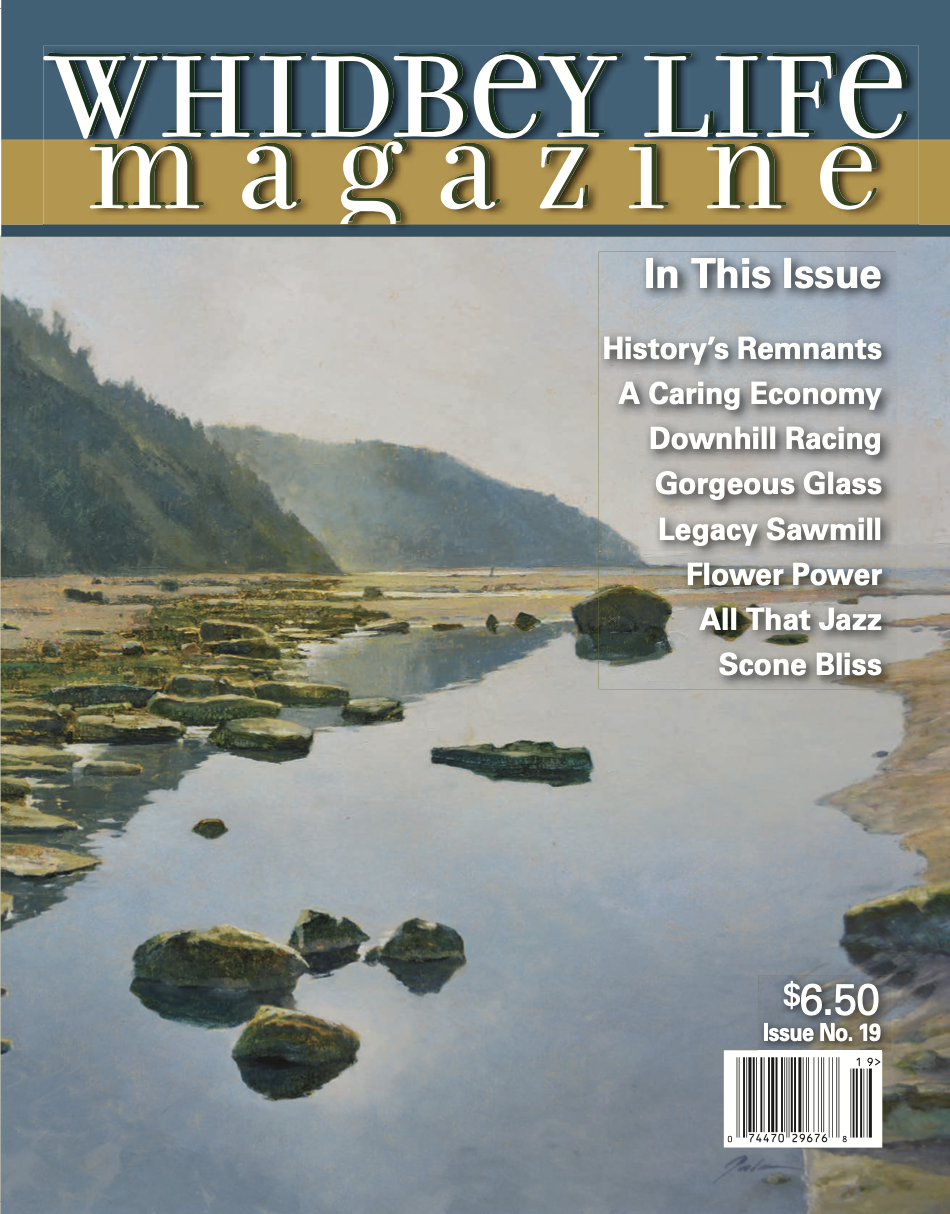
Featuring the people, places, and products of Whidbey Island, Washington, is now available at local retailers.
Category: What’s up
-

The End of an Online Era || Changes at Whidbey Life Magazine

Tom Lindsay blowing bubbles at Langley Marina at sunrise. (Photo by David Welton) After five years of continuous publication, Whidbey Life Magazine will no longer publish weekly articles to its website and will cease the distribution of its weekly newsletter.
Those familiar with the evolution of Whidbey Life Magazine (WLM) know that it began in 2013 as an online magazine focused on the arts. In 2014, publisher Sue Taves broadened the scope to portray Whidbey Island in all its glorious diversity, volunteering countless hours to publish new content every week. That year, with the help of Claire Moore as graphic designer and Dianna MacLeod as editor, Taves published the first print edition of WLM, a 38-page glossy that featured stories about the people, places, and products of Whidbey Island. That first issue was followed by five more, the largest of which totaled 68 pages.
Near the end of 2016, Taves—in anticipation of her eventual retirement—asked Petra Martin to edit the free online magazine and asked Deborah Nedelman to assume the role of publisher and editor-in-chief. Moore and MacLeod remained focused on the biannual print editions.
When Taves officially retired in January, Moore and MacLeod joined with Nedelman and Martin to form Whidbey Life Media. Together, they produced a seventh print magazine and continued to offer readers fresh features online.
As architects of the online and print publications, the team set its sights on two goals: 1) maintaining high journalistic/graphic standards, and 2) compensating writers, editors, and eventually photographers for their time and talents.
Nine months later, the members of Whidbey Life Media have concluded that these goals—high standards and fair compensation—cannot be achieved for both publications. WLM has not been able to generate sufficient advertising income to sustain its online magazine. In light of these publishing realities, the team has recognized the need to consolidate roles, simplify operations, and suspend the online magazine in its present form.
Martin and Nedelman will both step down, while Moore and MacLeod will continue to publish the print magazine. A Fall/Winter issue is currently in production and will be available in October, both by subscription and in retail outlets across the island. Planning for a Spring/Summer 2018 issue is underway. At whidbeylifemagazine.org, readers will continue to have access to the archived stories published online over the last five years, some stories from past print issues, and the occasional new story, all 100 percent home-grown and locally sourced.
We’re honored to have played a part, week in and week out, in uniting our community through stories and images. We’re inspired by the writers and photographers who sought out and brought forth stories and by the bloggers who shared their thoughts and opened their hearts. We are especially grateful to donors, sponsors, advertisers, and readers for their enthusiasm for our online platform.
Thanks to all who put the “Life” in Whidbey Life Magazine online.
 Petra Martin, Managing Editor of Whidbey Life Magazine Online, Signs Off
You know that scene in the Wizard of Oz, in which Toto pulls back a curtain and reveals the little man behind the great and powerful Oz? That’s how I’ve felt since October of 2016, projecting stories and newsletters onto the screen of your computer or device. In my case, the great and powerful ones that I projected were the writers and photographers who demonstrated over and over that there’s no place like home here on Whidbey Island.
I’ve lived on Whidbey since 2001 and didn’t think I could love it more. But with each story I’ve edited over the past 10 months, I’ve fallen more deeply in love with this magical place, and I honestly didn’t think that was possible.
My German mother often repeated this saying: “Geteiltes Leid ist halbes Leid – geteilte Freude ist doppelte Freude.” Shared sorrow is half the sorrow, shared joy is double the joy. The sorrow I must share with you is that the online magazine and newsletter ceased publication on August 31. (More about what that means follows.)
The joy I share is the time we’ve spent together. Bringing these stories to you has doubled my delight in Whidbey Island and in my fellow islanders. I can’t thank you enough for that.
Aufwiedersehen,
Petra Martin
Former Managing Editor
Whidbey Life Magazine Online
 Deborah Nedelman, Editor-in-Chief of Whidbey Life Magazine, Bids a Fond Farewell
Whidbey Life Magazine is a beautiful gift to our community. It celebrates our island in a way that nothing else does. I have loved being part of this platform for local writers and photographers to tell the many fascinating stories of this place and our people.
When I began my tenure with the magazine, I knew what a gem this enterprise was, but I was a bit naïve about the realities of publishing today. We’ve done our best, as a team, to keep our online magazine alive and full of content that informs, surprises, and motivates. Petra has pulled many a rabbit out of a hat to maintain and improve a website that had grown somewhat haphazardly over the years. Our team of writers, bloggers, and photographers have consistently given us stories we’ve been proud to publish. We all have held on to hope that we might find a way to make this whole enterprise financially sustainable, but we have been forced to acknowledge that, for the time being at least, producing a weekly online magazine of the caliber we have been is simply not financially possible, nor is it cost effective for me to continue in the role of editor-in-chief. By concentrating our resources on the print magazine, we are optimistic about preserving Whidbey Life Magazine into the future.
It’s been an intense journey over the last nine months, and I am grateful to every one of you, to all our talented writers and photographers, to the amazing staff at Whidbey Life Media, and to the generous folks who have provided financial support. The creativity and energetic spirit of this community deserves to be celebrated and Whidbey Life Magazine plans to continue to do so. Keep an eye out for the Fall/Winter issue coming up – it’s going to be another winner!
All my best,
Former Publisher and Editor-in-ChiefWhidbey Life Magazine
Questions and Answers
Q: Will the whidbeylifemagazine.org website come down?
A: No. You’ll still be able to find all the stories we’ve published in the past, but no new content will be posted. Use the Search box in the upper right corner to find published stories.
Q: Will I still be able to post events to the calendar?
A: No. The calendar will no longer be maintained and will therefore go offline.
Q: Will I still be able to submit community news articles?
A: No. That will no longer be possible.
Q: Will I still get a newsletter?
A: No. The newsletter was simply a summary of the new stories that were posted online that week. Because there will be no new stories, there will also be no more newsletter.
Q: Will the print magazine continue?
A: Yes. The Fall/Winter issue is in the works now.
Roll Credits
Although many writers, photographers, and illustrators contributed to Whidbey Life Magazine online over the years, I (Petra) cannot adequately express how grateful I am to the ones with whom I’ve had the deep privilege of working directly and through whom I’ve met interesting people, learned new things, and seen Whidbey Island in entirely different ways. You can continue to enjoy their archived stories by typing their names into the Search box in the upper right corner of this page.
Writers
- Cameron Castle
- Christy Korrow
- Deb Crager
- Deborah Nedelman
- Dianna MacLeod
- Jenny Goff
- Kate Poss
- Leckey Harrison
- Lis David
- Marian Blue
- Mark Forman
- Patrick Craig
- Robert Waterman
- Shawn Berit
- Tom Trimbath
- Wendy Jones
- William Walker
Bloggers
- Anne Belov
- Erik Christensen
- Harry Anderson
- Holly Chadwick
- Joni Takanikos
- Judith Walcutt
- Stephanie Barbé Hammer
- Suzanne Kelman
Photographers
- David Stern
- David Welton
- Don Wodjenski
- Jeff Jackson
- Kyle Richardson
- Marsha Morgan
- Susan Scott
Guests
- Chris Spencer
- Jess Dowdell
- Tom Fisher
-
Letterpress Printing: Something to Crow About
BY SHAWN BERIT
Whidbey Life Magazine Contributor
July 26, 2017An old-world rhythm softly floats down the halls at the Ken’s Korner Shopping Plaza. It’s the sound of spinning wheels, smoothly moving belts, handmade machinery, and craftsmanship. The printing presses of Crow’s Nest Press are living history.
Video courtesy of WhidbeyTV Productions
In 1439, Johannes Gutenberg changed the world with one of history’s most influential inventions: a printing press that used movable type. This made the mass production of books possible and led to improvements in literacy—and education in general—for larger populations. Books, once the privilege of only the wealthy, were now available to the masses. Gutenberg’s invention also led to the introduction of mass media. To say it changed the world is an understatement.
As technology marched forward to other methods of printing, the original printing presses became obsolete but were not forgotten. “I’ve been interested in printing my entire adult life,” says Marq Dean, owner and operator of Crow’s Nest Press, “I was in the newspaper business right out of college.”

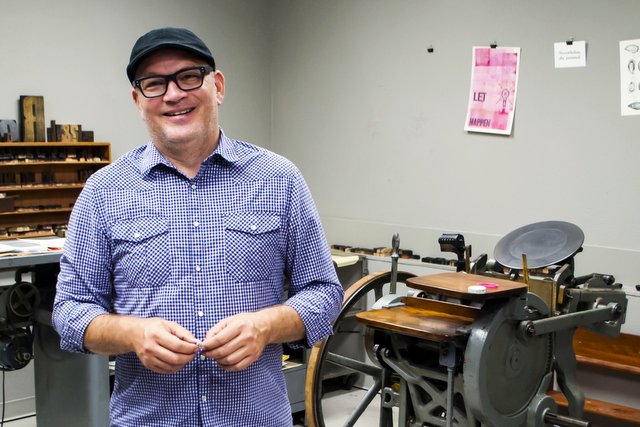
Marq Dean and his 1917 Chandler and Price jobbing press in his studio at Crows Nest Press (Photo by Shawn Berit) “About 10 years ago,” Dean continues, “I had the opportunity to restore a press.” That restoration served to grow his passion for letterpress and led to the opportunity to buy an entire print shop. As his print collection grew, he acquired something ideal for Whidbey’s equestrian enthusiasts: the elements once used for a Seattle saddle catalog, including images of their products. A vast library of other images and logos now fills Dean’s storage drawers. There is truly something for everyone and every season.
For Crow’s Nest Press, Whidbey Island is the perfect place to call home. Dean’s business model was never intended to be a mass-production shop, but rather a place of learning and artistic collaboration with both established artists and those interested in being part of the creative process for their own printed items.

Cuts (anything that’s graphical, such as drawings and logos) waiting their turn on the printing press (Photo by Shawn Berit) “The creative energy and spirit of Whidbey Island is unique,” Dean says, “It’s why we’re here.” He and his family have been on the island a little more than two years, but they have truly found their home in this community of creative people, “We’re just excited to be a part of it,” he says.
Dean sees his business as an opportunity to preserve the equipment and plates he uses along with preserving a connection to a form of craftsmanship that is worthy of preservation. “With the maker movement and people getting back to craft and learning the old ways, it’s a good time for letterpress.” People are rediscovering it, Dean says. “There’s a direct line from my equipment and materials back to medieval times and Gutenberg.”

Smaller type in the typecase (Photo by Shawn Berit) Ultimately, Crow’s Nest Press is about art, community, craftsmanship, and providing people with an experience that goes beyond the final product. Dean offers classes, seminars, and custom opportunities for people to learn the printing process and how to use the equipment. He has customers, such as a recent couple who made their own wedding invitations, who work with him and create their own printed items. “They leave with something they made themselves,” he says. They get the product, but they also have a wonderful memory that will last a lifetime.
Coming this winter, Dean has a Christmas card workshop planned. He will be teaching basics of using the press, creating the cards, and then helping with printing. Participants will be able to select from his many pre-made Christmas image cuts. Not only will they leave with beautiful cards, but also the bragging rights that they made the cards themselves.

Dean shows this collection of cuts (Photo by Shawn Berit) Marq Dean came to Whidbey Island to provide an experience that’s available to everyone. Whether you’re an artist, an author, a graphic designer, a history buff, or just someone who would like to be involved in creating your own hand-printed items, you, too, can experience history coming to life at Crow’s Nest Press.
Shawn Berit lives near Maxwelton Beach on the south end of Whidbey Island. He freelances as a social media manager and marketing consultant for churches and spiritual groups, organizations, artists and musicians, and occasionally small businesses. He is a father of three and an all-around creative. Berit is a painter and drawer (acrylics and pastels) of mystical scenery, story illustrations, and science fiction concept art; a nature photographer; a vocalist wanting to start a band; a science fiction writer working on his first novel; and a television and voice-over actor wishing the island had a radio station. Follow him and learn more on Facebook.
Read the other stories published this week
- Enjoy the Sights, Sounds, and Smells of the Whidbey Island Fair
- 100-Word Story: Managing Tough Times
__________________
 Enjoy more articles in the print edition of Whidbey Life Magazine, which you can purchase at local and off-island retailers or receive in the mail via subscription.
WLM stories and blogs are copyrighted and all rights are reserved. You may link to this story. To request permission to use or reprint content from this site, please contact us.
-
Welsh Shearer Shows Whidbey How It’s Done
BY DIANNA MACLEOD
Whidbey Life Magazine Contributor
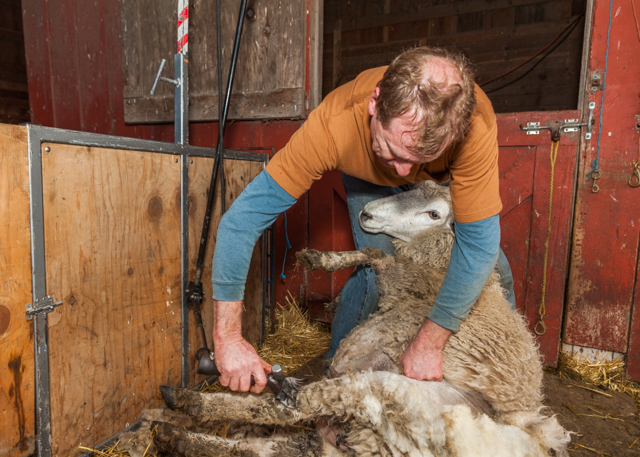
March 15, 2017When Welsh sheep farmer Eifion Morgan visited the Island County Fair in 2004 with his Whidbey-born wife, Jane Clyde, it was natural for him to make his way to the livestock area to mingle with island sheep farmers. They talked breeds, quality of fleece, and other matters of mutual interest. When it came to the subject of shearing, the talk turned to quantity; most farmers said they managed six sheep per hour. When asked how many sheep he could shear in an hour, Morgan cited a number most listeners assumed was an exaggeration: 20. To position a sheep and remove the fleece in three minutes seemed, well, unbelievable. And to do it without ceasing, one 175-pound animal after another, for a total of 20 an hour? Farfetched, surely.

Master shearer Eifion Morgan before the hard work begins. (Photo by jim carroll – jshuimages.coml) That conversation gave Eifion (pronounced I-vee-on) Morgan something to ponder. Since visits to the island to see Clyde’s family were a yearly event, he knew he would be back in 2005 — and every year after. He decided to advertise his services to islanders via the internet, and folks began signing up. Soon, Morgan had confirmed a shearing schedule for his next visit. When he arrived on Whidbey Island in the spring of 2005, 167 sheep of various breeds — Southdown, Black Welsh Mountain, Icelandic, Shetland, Corriedale — awaited him. To general surprise and admiration, he made good on his word, shearing, on average, a sheep every three minutes, continuously.

The flock at Shauna Lundstrom’s 5LRanch in Oak Harbor contained in the holding pen. (Photo by jim carroll – jshuimages.com) That bit of self-promotion was the first and last Morgan ever had to do. “From then on, it was all word of mouth. Sheep people here on the island talk and blog, so word spreads,” he says. “Farmers back home don’t blog; they just chat in the market.”
In 2006, during an extended, leisurely visit to the Clyde family, Morgan made unhurried visits to farms, deepening his knowledge of Whidbey farmers and shearing 400 sheep during his six-week stay. Increased demand for his services caused him to purchase miscellaneous supplies (hoof trimmers, wormers, inoculates), electric shears (mounted on a panel), portable metal railings (for an impromptu holding pen), and a pickup truck (kept parked at the Clyde family home). He’s logged considerable miles on that truck every spring since, regularly driving as far north as Linden, as far south as Elma, as far east as Carnation, as far west as Quilcene.

The right tool for the job: electric shears. (Photo by jim carroll – jshuimages.com) Morgan’s clients consult him as they would a veterinarian. He’s also become somewhat of a sheep broker; he knows what his clients want to acquire, sell, trade. Many of his customers have become more than acquaintances. “They are loyal to me, and I’m loyal to them. They are genuine friends,” he said. “Some have visited Jane and me in Great Britain.”
As it has turned out, Jane Clyde’s trip to Wales in 1979 on a pony-trekking expedition, and her subsequent marriage to Morgan in 1981, was a stroke of luck, albeit several years deferred, for Pacific Northwest sheep farmers.
Although his shearing pace seems jaw-droppingly fast to island sheep farmers, it elicits shrugs in the Aber Valley, where Morgan and Clyde reside. Among Welsh sheep farmers, shearing is organized for efficiency. “Five shearers lined up in a row handle 4,000 sheep in three days while helpers remove the wool as fast as it comes off the animals. It’s an assembly line,” Morgan says.

Morgan is a pro at calming the ewe during shearing. (Photo by jim carroll – jshuimages.com) When it comes to sheep, Morgan has observed other differences between Wales and Whidbey. There are more breeds on the island than is typical in Morgan’s part of the world. “In Wales, I deal mostly with Welsh Cross Cheviots,” he observes.
Morgan also finds that Whidbey Island sheep tend to be an older crowd. “Here, I’m shearing sheep that are 14 years old. They’ve become family pets. Back home, a sheep would be long gone by that age.”
That’s because Welsh farmers can’t afford to be sentimental about their animals; in order to make a viable living from a farm in Wales, it must support 800 to 1,000 sheep and at least 50 head of cattle. Morgan himself learned to shear sheep at the age of 13. It was expected in the same way that completing chores before going to school was expected.

A shorn ewe adjusts to the chilly air. (Photo by jim carroll – jshuimages.com) Through his own training and 44 years of experience, Morgan has learned the qualities that make a good shearer: strength, endurance, patience, and confidence. “You have to be confident to push that blade through the wool without damaging the skin,” he says. Tolerance for mess and dirt are also high on the list. “You’re not going to want to wear the same clothes tomorrow that you sheared in today.”
Although the size of Morgan’s own flock has diminished from a one-time high of 400 breeding ewes, he derives additional income from the land in other ways. He makes and sells cider under the label Aber Valley Apple Juice. For several years, Jane managed a bed-and-breakfast based in the couple’s 400-year-old farmhouse located in Brecon Beacons National Park. The 60-acre farm, which belonged to Morgan’s father, is ideally situated in a landscape of escarpments and cirques, peaks and valleys carved out by glaciers.

The mother and child reunion. (Photo by jim carroll – jshuimages.com) Although raising his own sheep is less of an occupation for Morgan these days, he knows his sheep statistics backward and forward. He keeps meticulous records in a small notebook: 80 clients this trip; 1,500 sheep sheared. He cites the record time clocked at The Golden Shears international competition: 40 seconds. His own personal best is 400 sheep sheared in a day, achieved several years before he reached his present age of 57. He looks forward to the day shearing is included in the Olympics. If and when it is, there’s no doubt who Whidbey’s sheep farmers will be betting on.
“No, I won’t be a competitor,” Morgan says. “I’m still a good shearer, but I’m semi-retired.”

A blue-eyed ewe waits her turn. (Photo by jim carroll – jshuimages.com) 
Separated from their mothers, lambs huddle together. (Photo by jim carroll – jshuimages.com) 
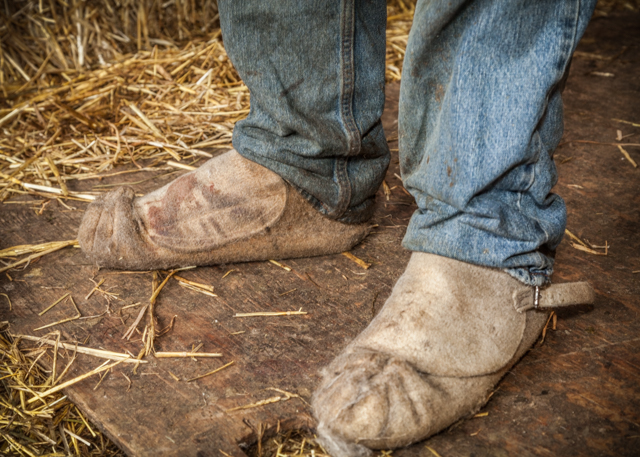
Morgan’s preferred footwear: Australian moccasins. (Photo by jim carroll – jshuimages.com) 
Shearer Morgan and farmer Shauna Lundstrom. (Photo by jim carroll – jshuimages.com) Dianna MacLeod developed a fondness for sheep during her extended stays in rural Cornwall, where she observed the rhythms of sheep and farmers in the fields around her various rental cottages, sampled the many ways lamb is prepared, and attended numerous county fairs at which a variety of breeds were shown.
__________________
Have a great story idea? Let us know at info@whidbeylifemagazine.org.
WLM stories and blogs are copyrighted and all rights are reserved. You may link to this story. To request permission to use or reprint content from this site, email info@whidbeylifemagazine.org.
-
The Faces of 2016 | Through the Lens of David Welton
BY DAVID WELTON
Whidbey Life Magazine Contributor
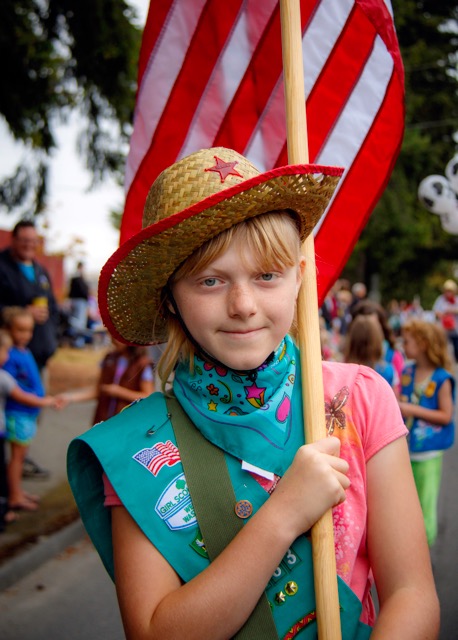
December 28, 2016There seems to be a national trend of polarization and pessimism that, at times, threatens to infect us here on Whidbey Island. I’ve chosen to focus on the generosity, unity, and joy that we share, despite our diverse views and backgrounds. This collection of environmental portraits from local happenings throughout 2016 offers visual proof of our ability to see through our differences. I hope it inspires us to seek underlying goodness and commonality during the coming year.

Jim Freeman, the “Conductor of Fun,” leads the charge at the Welcome the Whales parade in April.

A toddler shares his bounty of curly fries at the Whidbey Island Area Fair.

At age 95, Peter Lawlor races down 1st Street in the 24th annual Soup Box Derby in Langley in August.

A game of hide and seek amidst the endangered big trees at South Whidbey State Park is called “Eagle Eye” by the kids.

Filmmaker Drew Christie demonstrates a “flip box” or mutoscope, which is featured in his film “The Emperor of Time” a live action short film that was shown at the Sundance Film Festival in 2016.

Boxer Steve Burr gets in some chin ups during the fitness boxing class developed for people with Parkinson’s disease.

Cassie (human), Rowdy, and Midori (parrots) at the south-end avian rescue operation that gives sanctuary to displaced parrots, who fly freely—even during cold January weather.

Even the bunnies come out the promote Mystery Weekend in Langley every February.

The Machine Shop arcade game gallery, a new place to hang out with friends, opened in Langley this summer.

Characters from “The Nutcracker Suite” dance down 1st Street for the Langley Holiday Parade.

Halloween events throughout the island, including Spooktacular Langley, encouraged community spirit.

Aspiring actress Carol Wisman prepares for her first appearance at a vaudeville revue with Whidbey Island performers.

After a story about the volunteer firefighters who save our homes and lives was published in July, 15 new volunteers stepped forward.

Local brewmaster Bob Hodges reveals all (okay, maybe some) secrets of his home brew in “Raising a Glass to Whidbey’s Home Brewers,” which was published in the Spring/Summer 2016 issue of the print version of Whidbey Life Magazine. You can subscribe to the print magazine here.

Kevin Lungren, Mr. South Whidbey, accepts his trophy. The annual pageant, presented by the non-profit Friends of Friends Medical Support Fund, raised more than $29,000 in one night to assist those in need with unexpected medical bills.

Tibetan artist Kalsang Ghongpa shares her smile and colorful necklaces at the Whidbey Island Area Fair.

Patriotism is evident at the Maxwelton Fourth of July Parade. This year, Korean War Veteran Herbert Weissblum, of the Whidbey Island Marine Corps League Color Guard, led the parade.

Whidbey Islanders like to dance! Debra Waterman celebrates life at one of many street dance opportunities.
David Welton is a retired cardiologist and a Whidbey Life Magazine photographer.
__________________
To read more WLM stories and blogs, click here. Have a great story idea? Let us know at info@whidbeylifemagazine.org.
WLM stories and blogs are copyrighted and all rights are reserved. You may link to this story. To request permission to use or reprint content from this site, email info@whidbeylifemagazine.org.
-
For Some, Tattoos Heal From the Outside In
BY WENDY JONES
Whidbey Life Magazine Contributor
Dec. 14, 2016Hayden Hixon’s mother is always with him. All he has to do is look to his right, and she is there in flesh and blood. In a way, at least.
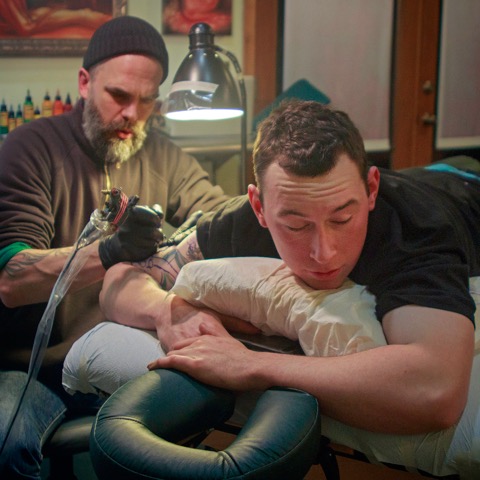
“This is for my mother,” he said as he was lying down on his stomach one Friday evening on a massage table in tattoo artist Eric Tunnell’s Dig It tattoo studio, located in downtown Langley.

Hixon’s in-progress mermaid composition is one of three tattoos he has commissioned from Tunnell. Each is different, but all represent his life thus far. His mermaid is a direct reference to his mother. “She doesn’t really like tattoos, but she loves that it’s about her,” he says. (Photo by David Welton) Hixon, a 20-year-old Clinton resident, got a warm look on his face as he gestured toward the raven-haired mermaid on his right shoulder.
“She loves mermaids. They remind me of her, and also remind me of time we spent at my family’s beach house. So it’s part of my history, too.” Hixon said.
By the end of the night, he would have black outlines of the next stage of the design that he and Eric had planned, a large, rather handsy octopus to encircle his bicep and keep his mermaid-mother company forever.
Tattoos mean many things to many people and have a shifting history in terms of public opinion. At times, they have been used to mark royalty. Other times, they have designated someone as property. Some periods of history have seen tattoos as pure rebellion, while other times it has been a mark of the pious. But in their earliest form, their utility might surprise some people: a protocol for healing.
Tattoo origin stories cannot be 100 percent proven, but if they’re true, it would seem that everything old is new again. Tunnell has seen transformations beyond the cosmetic after his clients come in for an ink session at Dig It.
Tunnell is an artist who works in many types of media, such as the canvas on the wall behind him and wood/metal sculpture. Many artists can claim mastery of more than one material or format, but the number who can also claim skin as a medium is undoubtedly small. (Photo by David Welton) “I call people who come to me ‘patients,’ because that is really what they are. It isn’t just the medical nature of what I am doing. The work creates a human connection that is something special. A lot of times, it can be like a six-hour therapy session, depending on why someone is here,” Tunnell said.
Maybe it isn’t the most sound and tested form of healing protocols, but tattoo artists have seen people walk into their studios broken and beat by things life has handed to them, and then standing taller and walking lighter on their way out.
It could be said that the motorized whir of a tattoo gun is capable of stitching up a soul as its needle strikes through layers of skin. When the needle is lifted, it leaves behind a marked path and patterns that become permanent evidence of whatever life-changing incident, discovery of self, statement of truth (or vain desire) drove his clientele to seek healing, according to Tunnell.
To date, tattoos found on an elderly man, whose body was found preserved in the mountains forming the Austrian-Italian border, are the earliest example of the practice itself. Iceman, as our early adopter of tattooing was dubbed, is believed to have lived in about 3,000 B.C. He stood about 5 feet 5 inches tall, with brown hair and a matching beard. When food and bacteria found in his stomach and physical patterns of both injuries and health are compared, Iceman seems to have lived a shepherd’s life in the mountains, where his mummified remains were unearthed in 1991.
Iceman’s skin is punctuated with small tattoos dotting areas of his body that researchers determined to be likely sites of injury or arthritis. Some of these tattoos are found in spots that he could not have reached himself, and they match treatment patterns used in acupuncture (which, as a therapeutic practice, was not widely adopted until at least one to two thousand years after the good shepherd was alive).

Tunnell is meticulous in applying an ink rendering of the next phase of “patient” Hixon’s tattoo. Tunnell sketched the image by hand on plastic wrap in advance, and then placed the original design around Hixon’s bicep. (Photo by David Welton) For Iceman, tattoos might have been just what the doctor ordered. And while a lot has changed between Iceman’s death and his recent rebirth into mummified fame, tattoos remain a go-to method for some to heal themselves from bumps and bruises to heart and soul. Others turn to tattoos out of vanity as some people turn to aesthetic medicine.
It isn’t just the life experience of getting the tattoo that heals, according to Tunnell. The physical and spiritual aspects of tattooing wield a pretty hefty healing punch as well.
“There’s something that happens to people when they’re getting a tattoo,” he says. “It can move someone into a different place. It can be like meditation or an awakening. Sometimes it looks like someone is trading one kind of pain for pain of a different sort. It’s almost like the physical pain helps burn off the emotional pain, and the emotional pain dissipates.”

The artist’s level of concentration is deeply apparent in his facial
expressions while he tattoos, even more apparent in the precision of his motions and, then clearly displayed in his final product.(Photo by David Welton)Visual cues of all kinds speak volumes without a single syllable being spoken. At times, though, a tattoo can leave room for people to speak directly about their own journey through life by moving others to ask questions that the inked images raise. Questions from others that are sparked by the tattoo open the door for talk therapy of a sort, and healing comes as part of those momentary connections, as well.
Tattoo artist Andrew Schultz knows well how a visible tattoo leads to healing. His Greenbank studio, Black Mast Tattoo Company, has been serving up tattoos for about two years. His love of tattoos reaches back about 10 years, when he was getting his own ink. A tattoo on his neck is quite significant, placed in that visible spot in remembrance of his brother, who passed away when Andrew was about 17.
“When I first got it, I wanted to be able to spread around the person my brother was. I wanted to have a chance to tell people what an amazing person he was. I didn’t want him to be forgotten.” Schultz says.
“Now, I get a funny response to my answers when people ask about the tattoo. They say ‘Oh, I’m so sorry’ and I say, ‘I’m fine now.’ People look at me like I’m a horrible person, but the reality is that I really needed that tattoo after it happened because it helped me talk about it. That isn’t how I answered people a long time ago, but the tattoo helped me get to the place where I’m actually able to say that I’m OK,” Schultz says.
In addition to driving conversation between strangers, the artists say the ties that bind them to their clients are truly unique. For Tunnell, that role brings a unique benefit to his own life experience. By his own account, the artist is not always the most outgoing chap in the room, and he enjoys the opportunity to join with other people in a way that is fruitful for all involved.

While the level of precision can be stressful on the artist, and the level of pain can be outlandish for the patient, the shared discomfort builds a uniquely healing connection between both parties. (Photo by David Welton) “It’s a luxury for me to be able to talk with people like this. I have a huge appreciation for these chances for me to share experiences with other people. We all have our own journeys and all of them are different. Human connection is rare (in present times) and I think I’m lucky to be part of a person’s life in this way.” Tunnell says.
Tattoos are a personal choice, for people who to get them, create them, and judge them. Love them or hate them, their place in history is long and as permanent as the ink used to make them.
Whether the year is 3000 BC or nearly 2017, though, it would seem that there is evidence to support the humanness of tattooing, as well as proof of the ways tattoos might bring people together in dialogue. And that quality is both right on time and timeless.
Wendy Jones cut her professional teeth in print newsrooms, writing for a major metropolitan daily a couple time zones away. After too many years of chasing police cars and defense attorneys (and witnessing horrible examples of human suffering), she shifted into advanced marketing strategy. She is pleased to be writing on Whidbey Island, where she finds her car filled with notepads, index cards, and pens again, just as it should be.
__________________
To read more WLM stories and blogs, click here. Have a great story idea? Let us know at info@whidbeylifemagazine.org.
WLM stories and blogs are copyrighted and all rights are reserved. You may link to this story. To request permission to use or reprint content from this site, email info@whidbeylifemagazine.org.
-
An Infinite Tower Connecting Heaven and Earth
BY KATE POSS
Whidbey Life Magazine Contributor
November 17, 2016Last week’s election news gave rise to emotional swirls and storms that left some of us searching for solid ground amid the chaos of opposing perspectives. Perhaps one way to make sense of the shadow and light within our country is by visiting the Infinite Tower, unveiled at the Earth Sanctuary late last month.

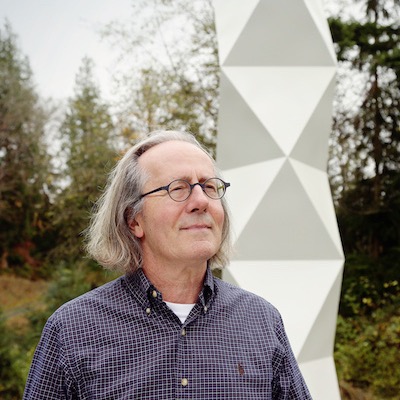
Chuck Pettis says his infinite tower symbolizes the link between heaven and earth (Photo by Michael Stadler stadlerstudio.com) The newest addition to the 72-acre Buddhist-inspired nature reserve and sculpture garden is a modern sculpture similar in shape to an obelisk, only one containing triangle-shaped facets.
“I conceived the idea of the Infinite Tower less than a year ago, when I printed polyhedra and started stacking them,” says Chuck Pettis, an innovative entrepreneur and author of “Secrets of Sacred Space.” The tower was unveiled to guests on Oct. 29, just after the sun came out on an otherwise rainy day. “I brought together some smart and talented people, and there you go. You can’t do great things without great people.”
Pettis worked with Matthew Swett of Taproot Architects to create a blueprint detailing a 24-foot column of interlocking equilateral triangles that create a deceptively fluid visual effect. Metal artist Tim Leonard of Heavy Metal Works fabricated and built the tower, which includes an interior mast for strength.
“What struck me was how fun it was to work with everyone on this,” says Leonard. “They (Pettis and Swett) came to me with a plastic model and asked me to make it in metal. It was a big project, one of the largest I’ve done. I bought a tent to hold it all. I’ve never said no to a project.”
Pettis said the symbolism within the design includes: creating a connection between earth and sky; white as the color of clarity and purity (which reflects shadows and shapes on the sculpture); honoring the nearby trees and snags, which join the earth and sky; and incorporating the number eight (eight triangles in each octahedron) and the number seven (seven stacked octahedrons), which, in numerology, symbolizes harmony and spirituality.

Leonard and crew install the sculpture at the Earth Sanctuary (Photo by Sarah Birger) Picasso took apart the universe and reconstructed it in geometric art forms. Pettis looks at the world in terms of basic shapes and how they influence us, says Claudia Pettis, Chuck’s wife. “Working with triangles connects him to the cosmos,” she says. “We can know the power of the infinite column; it connects earth to sky.”
Influenced, in part, by the works of Constantin Brancusi, considered one of the most important sculptors of the 20th Century, Pettis found inspiration in the sculptor’s “Endless Column,“ which was built in 1918. Pettis’ ingenuity in creating the tower was further sparked by a visit to the Storm King Art Center, located in the lower Hudson Valley of New York State. Some have described the 500 acres filled with art as being “heaven for sculpture.”
“I like what they did at Storm King and thought, ‘What could I do on a small scale?’” says Pettis.
On a September afternoon, when a towering crane lowered the 25-foot tower into place, Pettis, Swett, Leonard, and the crew grinned like boys having their ultimate adventure.
Freeland novelist and artist Fred Bixby, who is a legally blind, visited the tower that same afternoon. Swett’s wife, Sarah Birger, who was there for the tower’s installation, guided him to the sculpture where he could touch it with his hands.
“Maybe because of my lousy vision, every panel looked slightly different in color, even though I know it’s all white,” said Bixby. “I love the total smoothness of the metal. I really tried to find where Tim, the artist, joined the sections, where there were cracks and seams. I never found any. I will try again, though. Next time you’re there, go up close and listen hard.”
Chuck Pettis’ intention for the Earth Sanctuary is that it inspire a sense of well-being and spiritual uplift for years to come. To this end, he has created a 500-year trust that ensures the sustainability of the property. To date, more than 3,000 trees and 15,000 kinds of vegetation have been planted that are expected to last through our earth’s climate change into the year 2500. He imagines the sculptures will last at least that long, too.

It takes a village to build a tower. From left, Chuck Pettis, Tim Leonard, Duran Laframboise, Brendan McHugh, Matthew Swett, Jacob Rose, and Ryan Wright (Photo by Sarah Birger) Kate Poss worked as a library assistant at the Langley Library until last June. She was thrilled to work for three summers as a chef aboard a small Alaskan tour boat from 2008 to 2010. She was a newspaper reporter in Los Angeles for many years before moving to Whidbey Island where she likes “talking story,’” hiking, hosting salons, and writing her novel.
__________________
To read more WLM stories and blogs, CLICK HERE. Have a great story idea? Let us know at info@whidbeylifemagazine.org.
WLM stories and blogs are copyrighted and all rights are reserved. You may link to this story. To request permission to use or reprint content from this site, email info@whidbeylifemagazine.org.
-

Guardian Trees: Ragged Remnants of the Great Coastal Forests that Used to Be
BY KATE POSS
Whidbey Life Magazine Contributor
June 22, 2016 (corrected 6/24/16)We can time-travel here on Whidbey Island. A visit to the guardian trees, which protect our coastal old-growth woods, becomes a walk with elders who are hundreds of years old.
Guardian trees form a barrier line to defend their brothers and sisters behind them. Grizzled veterans that bear the brunt of wind, saltwater, sun, rain and snow, these trees become gnarled and sculpted over the many seasons during which they stand guard. Walking through a forest of these old giants along Ebey’s Bluff trail or in the Admiralty Inlet Preserve in Coupeville, one can imagine being a hobbit walking in the Fangorn Forest of “Lord of the Rings.” The trees have a supernatural quality about them.

Twisted guardian trees protect their forest brethren behind them. (photo by Jamie Whitaker) “The branches of the old-growth Douglas fir trees twist and turn making their way under and around each other,” Whidbey Camano Land Trust’s website notes. “At over four feet in diameter and 250 years old, you can tell these trees have weathered many coastal storms.”

A signboard illustrates Golden Indian Paintbrush. (photo by Kate Poss) Admiralty Inlet Preserve was bought three years ago for $3.3 million by the Land Trust (WCLT) from Seattle Pacific University. The 46-acre site was once considered for expansion by the university, which proposed building additional cabins for its retreats. However, following a campaign waged by the Whidbey Environmental Action Network for protection of the heritage forest, the school eventually sold its holdings and used the proceeds to upgrade its existing Camp Casey facilities. An endangered plant, the yellow Indian Paintbrush grows in the Naas Prairie, adjacent to the preserve.
Support for this $3.3 million project came from WCLT member donations and public grants, Endangered Species funding from the U.S. Fish and Wildlife Service and an urban wildlife grant from Washington Wildlife and Recreation Program. Additional funds, secured by former Senator Mary Margaret Haugen and current Representative Norma Smith, completed the purchase.

Supernaturally shaped-limbs of an old Douglas fir at Admiralty Inlet Preserve (photo by Kate Poss) While the west coast of Coupeville hosts spectacular guardian trees along its bluffs, there are other stands of the old trees as well.

Admiralty Inlet Preserve was acquired three years ago by the Whidbey Camano Land Trust. (photo by Kate Poss) “They are everywhere,” said Whidbey environmental consultant Elliott Menashe. “Scatchet Head, Possession Point and Double Bluff on the south end, at West Beach, throughout North Whidbey, Deception Pass, Fidalgo Island, Lummi Island, the San Juans, the Strait of Juan de Fuca—anywhere there are strong prevailing winds and [adjacency to] fetch. The ones at Ebey’s are the best and most classically developed forms because the forest is largely intact. Mostly all we have left, any more, are ragged remnants of the great coastal barrier forests that used to be.”
The trees that used to be. Once upon a time, between 7,000 to 10,000 years ago, Douglas firs were giants that grew in abundance on Whidbey Island, with a height of 245 to 330 feet and diameters of five to seven feet. With the European discovery of Whidbey Island in the 1790s, early sailors remarked on the lush forests Black bear, wolves and red fox once lived in the great forests, but were later hunted to extinction. When Europeans began arriving to homestead land in the 1860s, the old trees were logged and have not achieved the same size since.

Thigmomorphogenesis shapes guardian trees. (photo by Elliott Menashe, Greenbelt Consulting) In our current times, Menashe noted, it pays to be mindful about maintaining guardian trees on private property.
“It’s important for people who ‘live on the edge’ to be aware of the importance of these trees,” he added. “Folks who build their permanent homes in temporary locations like Puget Sound shorelines need to pay more attention to their management practices. It’s unfortunate that many landowners, in their efforts to ‘improve’ their views, unwittingly damage their shore land by removing these unique and beneficial trees.”
Local hikers at Admiralty Inlet Preserve said they were heartened that the trees were preserved for the public to enjoy and admire for all time.
“I call them Grandpa trees,” said Kathy Sivertsen, while stopping to chat on a walk with the neighbor’s Golden Retriever, Sandy.

“Barrier forest” is another name for guardian trees at Ebey’s Bluff (photo by Elliott Menashe) Coupeville resident Yvonne Guida was struck by the power the trees had on her, “I had the feeling that these trees were saying, ‘Welcome to our home, the forest, and we surround you with love and light.’ These trees gave me a strong sense of feeling rooted and connected to the earth…a great feeling of peace and tranquility.”
The trees of Ebey’s Bluff and Admiralty Inlet Preserve are part of Ebey’s Landing Natural Historical Reserve, comprising nearly 20,000 acres. The reserve is an active farming community that operates in a partnership between the town of Coupeville, Island County, Washington State Parks and the National Park Service.
For more information on the natural history of the island, visit https://archive.org/stream/historicresource00evan/historicresource00evan_djvu.txt.
Whidbey Camano Land Trust’s website for the Admiralty Inlet Preserve: http://www.wclt.org/projects/admiralty-inlet-preserve/

A quote by Rachel Carson on a placard at Admiralty Inlet preserve (photo by Kate Poss) Image at top: Mr. Majestic perches on a guardian tree branch along Ebey’s Bluff trail (photo by Jamie Whitaker)
Kate Poss recently retired from her job as a library assistant at the Langley Library. She was thrilled to work for three summers as a chef aboard a small Alaskan tour boat from 2008 to 2010. She was a newspaper reporter in Los Angeles for many years before moving to Whidbey Island where she likes ‘talking story,’ hiking, hosting salons and writing her novel.
__________________
CLICK HERE to read more WLM stories and blogs. Have a great story idea? Let us know at info@whidbeylifemagazine.org.
WLM stories and blogs are copyrighted and all rights are reserved. Linking is permitted. To request permission to use or reprint content from this site, email info@whidbeylifemagazine.org.
-

Cultivating Connections to the Past and the Land at Whidbey Island Waldorf School
BY KATE POSS
Whidbey Life Magazine Contributor
June 8, 2016One way to learn history is by studying the culture and stories of the people who made it. An annual “potlatch,” hosted each May by the Whidbey Island Waldorf School, brings indigenous traditions to life when students meet and learn from Native American elders.
The potlatch is a traditional, ceremonial gift-giving feast practiced by indigenous peoples of the Pacific Northwest Coast.

Waldorf teacher Angela Lindstrom hosts and directs annual potlatches. (photo by Norma Fickel) Honoring the tradition of our coastal Native Americans, Angela Lindstrom directs and hosts the event each year for fourth grade students in Waldorf schools from Bellingham to Olympia. A teacher at the Whidbey Island Waldorf School, her cultural background includes Ojibwa and Cherokee ancestry. Over the years Lindstrom has cultivated a cadre of Native American elders who teach skills and traditions that leave the students awed in the end.
The elders include:
• Angeles Peña, a Navajo, who acts as master of ceremonies. Peña is a storyteller as well and has taught students how to make walking staffs
• Bonnie Pemberton, or Soaring Eagle Woman, who has come each year to teach students how to create drums
• Paul “Che oke ten” Wagner, an award-winning Native American flutist and Coast Salish member
• Sondra Simone Segundo, a Haida artist, singer and author
• Julie Pigott, an honorary elder who teaches Native American games
Paul “Che oke ten” Wagner, an award-winning Native American flutist, shares his music with Waldorf students. (photo by Norma Fickel) “These elders become like rock stars to the students,” Lindstrom said. “In fourth grade curriculum, students study the history of their state. It is wonderful that they study our Native Americans. The benefit of a potlatch is that the people are alive [and bring their traditions with them] today. If you just read about history, you don’t get a chance to meet these wonderful people. We hope that by understanding other cultures, our students come away with a way to look at different people with understanding and without judgment.”
Students were asked to escort the elders and served them during meals. In return, they learned to carve, play flutes, make drums, and play traditional games.
It was clear, while the students talked immediately following the potlatch, that their enthusiasm ran high.

Students learning to carve staffs as taught by Angeles Peña (photo by Norma Fickel) “Being with the elders and serving them was fun,” said Priscilla. “I found the potlatch special—it felt like I made lots of new friends when we waited in line for our food and played games. Our class was the last to get food because we were the hosts.”
Hazel added: “I liked it. It was both fun and really interesting to see the ways of all the cultures. I liked seeing the elders. I liked serving the elders.”

Staffs carved by students (photo by Norma Fickel) Many of the students raved about the food prepared by Chef Christyn Johnson, who prepares healthy meals, often locally sourced, for the Whidbey Institute.
“I very much liked the food,” said Sterling. “I also liked carving…everything. I met a new friend.”
During potlatch, students were assigned to different clans—wolf, bear, eagle, raven and orca. Adults were assigned to the salmon clan. Segundo taught students how to draw their clan animals and they showed them proudly after the event.
“I really liked the paintings,” said Ruari.”

Sondra Simone Segundo teaches students how to create clan animals. (photo by Norma Fickel) 
WIWS fourth grade students and their clan animal (photo by Kate Poss) 
More clan animal drawings by WIWS fourth grade (photo by Kate Poss) Susan Jones, whose fourth grade hosted the potlatch, has taught at other Waldorf schools in the Bay area and said she originally came to Whidbey Island to retire, but was asked to take this year’s class.
“I hadn’t heard of potlatch and did not know what to expect,” Jones, a veteran teacher, said. “I was able to experience the reverence, beauty and sincerity of the elders who brought a depth of spirit. Sharing their spiritual path…this was a once in a lifetime experience. I think we all came away better.”

Bonnie Pemberton, “Soaring Eagle Woman,” teaches students to make drums. (photo by Norma Fickel) Norma Fickel, whose daughter Amber is in Susan Jones’ fourth grade, volunteered at the event and said she was impressed by what Waldorf education can bring to families. “This beautiful way of teaching helps children grow. The elders gave wisdom through their stories.”
Meanwhile, the Whidbey Island Waldorf School is hosting two Summer Camps; the first is from June 20 to 24 and the second from June 27 to July 1. The deadline for registering is this Friday, June 10. Geared for students from age seven to 13, students will learn outdoor education skills, environmental awareness, writing and dance. To register for the camp, contact Robin Jacobs at 360-341-5686.

WIWS student drums made at Potlatch (photo by Kate Poss) • • •
Europeans used the word potlatch to refer to the Nootkan word p’alshit’ which means “to give.” Northwest coastal tribes hold potlatches each year to share their wealth, feast, dance and tell stories. Coastal tribes include Haida, Nuxalk, Tlingit, Tsimshian, Nuu-chah-nulth (Nootka), Kwakwaka’wakw (Kwakiutl), and Coast Salish. Their region extends from the coast of Alaska to British Columbia and Washington.
For more information on potlatches, go to nativeamericannetroots.net/diary/631.

Robin Jacobs and Alea Robertson will facilitate this summer’s camps at Whidbey Island Waldorf School. (photo by Kate Poss) Kate Poss worked as a library assistant at the Langley Library and recently retired from that post. She was thrilled to work for three summers as a chef aboard a small Alaskan tour boat from 2008 to 2010 and continues working now as a personal chef. She was a newspaper reporter in Los Angeles for many years before moving to Whidbey Island where she likes ‘talking story,’ hiking, hosting salons and writing her novel.
__________________
CLICK HERE to read more WLM stories and blogs. Have a great story idea? Let us know at info@whidbeylifemagazine.org.
WLM stories and blogs are copyrighted and all rights are reserved. Linking is permitted. To request permission to use or reprint content from this site, email info@whidbeylifemagazine.org.
-

‘Music for the Eyes’ Brings the World to Whidbey Island
BY PENNY WEBB
Whidbey Life Magazine Contributor
April 1, 2015Sharon and Fred Lundahl have circled the world, many times. Both retired diplomats, they each spent 30 years in the foreign service—the last 10 of it together in central Asia. When they retired to Whidbey 11 years ago, they decided to open a store that would allow them to keep up their travels, make a few bucks and do good in the world.
Music for the Eyes on First Street in Langley is that store.

Sharon and Fred Lundahl (photo by Marsha Morgan) “I like to call it our ‘pretend’ store,” Fred explained. “It’s really just an excuse for us to travel.”
And travel they have. From Pakistan to Tibet to Argentina (this year’s journey), Fred and Sharon love to visit other cultures, make connections and help where they can.
“I think you are born with a certain amount of volunteerism you must spend,” Fred said. “Since I had spent most of my life moving every two or three years, I’d spend a little here, a little there, but I knew I had to spend it all by the end of my life. Since we washed up on Whidbey Island with pretty much all our volunteerism yet to spend, we’ve been making up for lost time.”

Walk into Music for the Eyes and you see colors and textures in every direction. (photo by Marsha Morgan) They have done that in a number of ways—first, by becoming indispensable figures in the local community. Fred has been president of the Langley Chamber of Commerce, helped found the Langley Main Street Association and is a driving force in the Langley Whale Center. Secondly, they contract with artisans from all over the world to create unique rugs, jewelry and gifts for their store and, in so doing, provide a livelihood for these artists and craftspeople.
Because the Lundhals work directly with artisans, they can sell their treasures very inexpensively. “There is no middle man,” Sharon explained. “When you purchase from us, you know your money is directly benefitting these artists.”
One such contract stands out as especially inspirational.
While working in Islamabad, Sharon met Didar Ali, a businessman and liberal Muslim from the Hunza Valley in Pakistan. The Hunza region of Northern Pakistan is a remote, beautiful place with eight of the world’s highest mountains. Didar owned a workshop in his village where women created wool needlepoint cushions made from natural dyes. Sharon and Fred began purchasing these lovely pieces from Didar Ali to stock their new store. Soon the relationship grew to include hand dyed rugs, which Sharon helped design.
“Now there are 250 women weavers, creating rugs for Music for the Eyes,” Sharon said.

A very few of the many choices of rugs in the store. (photo by Marsha Morgan) “The rugs we commission are replicas of either antique rugs or my own designs. And, because they are new, they are a fraction of the cost of our antique rugs, but made with the same wool and cotton that will wear wonderfully for decades.”
When asked by a customer how to care for a rug, Sharon said, “Just soak them like you would a wool sweater.” When the customer balked, Sharon responded, “These women make these rugs to last!”
To help support their friends in Hunza, the Lundhals send books for the local schools. “The Hunza are very liberal and very literate,” Fred said. “Education is very important to the Hunza people. We’re pleased we can help support their education and their economy.”

Schoolchildren in Hunza with books sent by the Lundahls (photo by Didar Ali) Besides rugs, a visitor to Music for the Eyes will find the whimsical and wonderful.
“We have a very large hat selection,” Fred said. “Each country has its official hat, so we’ve got dervish hats from Turkey, priest hats from Georgia, embroidered hats from Turkmenistan, folding hats from Uzbekistan.” Fred pulled out a huge fuzzy sheepskin hat from Russia. “This would look great on anybody!”

Hats, slippers, mittens, scarves and more (photo by Marsha Morgan) Fred then picked up a boiled wool slipper shaped like a mouse. “We had these for the kids and so many adults wanted them we now have our artisans making grown-up sizes!” Same thing with monster mittens. “People love these.”
An extensive bead collection fills the back of the store. “I started out making my own jewelry,” Sharon said. “Whatever beads I had left over I’d put out to sell. They’d be gone so quickly, I decided to bring in more stock.” The plethora of colors and variety is visually stunning and a beader’s dream.

(photo by Marsha Morgan) Art, textiles, antiques, artifacts, scarves, jewelry… Music for the Eyes is an international symphony, led by two world-traveling conductors. Stop in for a virtual tour around the world, today.
Music for the Eyes is located at 301 First Street in Langley and is open every day of the year, including holidays, 11a.m. to 5 p.m. daily and 10 a.m. to 6 p.m. on Saturdays. Phone them at 360-221-4525 for further information. Or check their webpage at http://musicfortheeyes.com/

(photo by Marsha Morgan) For a link to the Music for the Eyes blog post about the Hunza project, click here.
Image at top: The entrance to Music to the Eyes at 301 First Street in Langley. (photo by Marsha Morgan)
Penny Webb is a writer, musician, mom, and gardener. She is currently rewriting her story.

(photo by Marsha Morgan) __________________
CLICK HERE to read more WLM stories and blogs. Have a great story idea? Let us know at info@whidbeylifemagazine.org.
WLM stories and blogs are copyrighted and all rights are reserved. Linking is permitted. To request permission to use or reprint content from this site, email info@whidbeylifemagazine.org.