Author: Kate Poss

  • How Can I Keep from Singing? Peggy Taylor and the Open Circle Singers

    How Can I Keep from Singing? Peggy Taylor and the Open Circle Singers

    BY KATE POSS
    Whidbey Life Magazine Contributor
    December 21, 2016

    On a dark blustery Monday evening last week, while many of us sat snug in our homes listening to the litany of nightly news, a group of men and women gathered at a potluck dinner in the Fellowship Hall of the Langley Methodist Church, celebrating the concert they performed in the night before and the music that brings them together.

    Members of the Open Circle Singers chatted and laughed. The atmosphere felt inclusive and welcome. Indeed, all singers are welcome.

    Peggy Taylor (photo courtesy of Power of Hope)

    “There are two kinds of choirs,” says Peggy Taylor, who created the Open Circle Singers more than a dozen years ago. “One is more traditional and can be pretty challenging; the other is formed for the joy of singing and doesn’t need an audition. We’re not as ambitious as other choirs may be. We learn some songs from written music, but others we learn by ear. We spend some time at each rehearsal singing short four-part songs over and over so we get to bathe in the beauty of the harmony. It’s like taking a sound sauna!”

    Taylor says her inspiration for creating the embracing group of about 80 or so, who sing for the joy and connectiveness it brings, began with Shivon Robinsong, a friend who leads a choir in Victoria, British Columbia. Robinsong and Taylor, along with 15 others, cofounded the Hollyhock Retreat Center on Cortes Island in British Columbia, where music is but one of many retreats one can attend to expand the mind, body, and soul.

    “Shivon calls her group the ‘Gettin’ Higher Choir,’ says Taylor, laughing. “She claims we all need a big dose of vitamin H—harmony—in our lives. What better way to get that than through singing?”

    That 300-voice choir is described as “come as you are,” where even the shyest of voices can rediscover the joy of singing.

    Many of the Gettin’ Higher Choir’s concerts benefit the Power of Hope, a nonprofit that Taylor and the late Charlie Murphy founded in 1996 with the belief that all young people can be tapped for their creativity, leadership, and contribution to bring about positive social change. Its model has grown to include camps in California, Canada, Uganda, and India.

    The Open Circle Singers was formed on a similar and inclusive notion that singing promotes well-being and a sense of belonging. Taylor says “Too many people are told as children to ‘just mouth the words’ because their singing isn’t perfect. Sadly, they never sing again.” She aims to remedy that by welcoming all.

    choir singing
    The Open Circle Singers performing at the Whidbey Island Center for the Arts last May. (Photo courtesy of Peggy Taylor)

    “What connected my mother with me as a young child was her harmony singing,” Taylor recalls. “I learned it in my bones. I was sad to discover later how many adults haven’t had this joy. It’s a vibrational experience. For people who’ve turned off their singing voice, reconnecting with the voice they lost track of is so enjoyable.”

    Indeed, Petra Martin, managing editor of Whidbey Life Magazine online,  sings tenor in the Open Circle Singers and feels the good vibration. Performing at the Dec. 11 holiday concert at the Whidbey Institute, the choir sang seasonal songs and an homage to the late Leonard Cohen — his “Hallelujah.”

    “There were times I couldn’t sing because I was near tears, especially when the entire audience joined in.” Martin says. “The music was so beautiful.”

    Soprano Gail Ptacek used to sing in a quartet, but when that group broke up, she didn’t sing for five years and missed the experience.

    “This has brought my voice back,” she said. “It’s a heart-warming gift. Peggy has a true sparkle in her eye when she directs us. She chooses wonderful selections.”

    After the potluck was over, alto Nicole Luce tapped her glass to catch everyone’s attention. She toasted Taylor for her enthusiasm and can-do attitude.

    “I view you as an amazing weaver,” said alto Pam Engler. “You bring out the best in us.”

    The crowd stood spontaneously in applause, which inspired Taylor to invite everyone to sing.

    “When the choir sings, I feel like I’m walking on air,” Taylor says. “The sound heals me—and all of us—from the inside out.”

    Choir singing
    Another view of the Open Circle Singers performing at the Whidbey Island Center for the Arts last May. (Photo courtesy of Peggy Taylor)

    A circle formed, loosely organized into sopranos, altos, tenors, and basses.

    During a somber song about the winter solstice, the choir sang, “Let me come in and share your light for I’m without a friend tonight. Let me come in and share your light and a warm place by your fire.” A bearded homeless man dressed in winter clothes walked through the door, having heard the music, and sat down. A choir member left the circle to bring him a plate of food.

    “I loved it,” the man said, his eyes alight. “It’s beautiful. It draws me in. I knew I needed Jesus and I walked in. God was calling me, and I knew…”

    Taylor says one of the social missions of the choir is to bring music to the community by singing when asked to. The choir has performed at Hearts and Hammers events, the Clyde Theater, farmers markets, and various community benefit concerts. Proceeds from the recent concert at the Whidbey Institute benefitted the South Whidbey Homeless Coalition.

    The final song after the potluck was a revisit of Leonard Cohen’s “Hallelujah.” I was invited to sing along and, like Martin, found my voice choked with tears at the emotion I felt at that moment. There is something powerful about singing in a welcoming atmosphere such as this.

    All are invited to join the Open Circle Singers, who resume practice on Monday, Jan. 9, in the Little Theater at South Whidbey High School on Maxwelton Road from 7 to 9 p.m. For more information, contact Peggy Taylor at peggy@whidbey.com.

    Kate Poss worked as a library assistant at the Langley Library until last June. She was thrilled to work for three summers as a chef aboard a small Alaskan tour boat from 2008 to 2010. She was a newspaper reporter in Los Angeles for many years before moving to Whidbey Island, where she likes “talking story,” hiking, hosting salons, and writing her novel.

    __________________

    To read more WLM stories and blogs, click here. Have a great story idea? Let us know at info@whidbeylifemagazine.org.

    WLM stories and blogs are copyrighted and all rights are reserved. You may link to this story. To request permission to use or reprint content from this site, email info@whidbeylifemagazine.org.

  • Whidbey Island Threshold Singers Bring Comfort

    Whidbey Island Threshold Singers Bring Comfort

    BY KATE POSS
    Whidbey Life Magazine Contributor
    December 14, 2016

    The Whidbey Island Threshold Singers provide gentle harmony at the bedside of the dying and those in need of loving lullabies, creating a sense of peace and calm. They sing for those who are in hospice, those who are dying or ill, or those who simply enjoy their company, such as Dorothy Lepisto, who lives in Langley.

    Lepisto was under hospice care a few years ago, but instead of passing away, she continues to enjoy life at the age of 96. One of the gifts she took away from her hospice experience was the soothing music of the Threshold Singers. A small group continues to visit her each week, singing her favorite songs. During the Christmas season, they will sing her favorite Christmas carols, along with some favorite Threshold tunes that are printed in songbooks at Lepisto’s home.

    Three women singing to a fourth
    Whidbey Island Threshold Singers Gaea Van Brede, Effie Brown, and Christa Straub singing to Dorothy Lepisto. (Photo courtesy of Whidbey Island Threshold Singers)

    The singers don’t just sing at bedsides. On All Soul’s Eve, Nov. 1, visitors to the Langley Woodmen Cemetery heard their soothing tones while the wind blew through the tall firs and sent black clouds flying across the moon. For a moment, their song and the weather connected visitors to those who have passed on.

    The Whidbey Island Threshold Singers are a branch of the Threshold Choir, an international community that sings soothing and heartfelt songs, many of which were written by the original choir’s creators. With its first performance in 2000 in El Cerrito, California, the seed planted by Kate Munger, who created the first Threshold Choir, has blossomed to include more than 150 choirs worldwide. You can view and listen to examples of Threshold singing here.

    Anne Zontine, a member of the Whidbey Island Threshold Singers for the past six years, says that singing and blending harmonies with others is a transcending experience that is shared with those they sing for.

    “It is all about the vibration of love flowing through us,” says Zontine, whose sister passed away a few weeks ago. “I was with her the day before she died. The following day, I was on the ferry, and I could feel her presence. I was singing for her and with her.”

    Zontine recalls a time when the singers sang for a dying person who was agitated. She and her sister singers sat nearby and sang softly in calming tones.

    “The person who was dying was calmer and so was the family,” Zontine says.

    At another time Threshold Singers arrived a few minutes after a family member died.

    “We asked the family if it was okay that we sing, and they said we could,” says Zontine. “It was a tremendous experience. The family appreciated us and I experienced the sense of an angelic presence.”

    The Whidbey Island Threshold Singers are comprised of about a dozen women, most of whom are 50 or older.

    “It takes a certain willingness to work with death and dying and sickness,” says Christa Straub, a long-time member who helps coordinate singers’ visits and rehearsals. “Our work makes you aware of your own mortality. Seeing people at the end of their lives makes you think of your life and how you wish to live the rest of it.”


    Two women singing
    Christa Straub, left and Effie Brown sing with Dorothy Lepisto of Langley. (Photo by Raymond Poss)

    While the aim of Threshold Singers is to provide a loving and calming experience to those who need it, their harmonic singing is a curative to some of the members as well.

    Linda Schrock, a nurse of 30-plus years who moved to the Coupeville area with her husband a few years ago, found that joining the Threshold Choir actually relieved chronic pain.

    At the time, she suffered from chronic back pain and thought she would need surgery. She consulted an orthopedic surgeon, David Hanscom, who said that before he would perform surgery, she needed to practice pain management techniques. Schrock read Hanscom’s book, “Back in Control: A Spine Surgeon’s Roadmap Out of Chronic Pain,” which recommends that one way to break out of the vicious cycle of pain, the anxiety and anger it causes, and the way anxiety and anger exacerbate pain, is to do something that makes you happy.

    “I thought what really appeals to me? I grew up with Amish Mennonites in Indiana and sang in an a cappella choir. What a thrill that was. I did a search of a cappella choirs on Whidbey Island and found the Threshold Singers. Singing with these deep and soulful women every week at practice, I found that my back healed, and I never did need surgery.”

    Schrock works with the Careage of Whidbey activity director and arranges for Threshold Singers to comfort various residents with song once a month.

    “I get more out of this than I give,” Schrock says. “We make a point of tuning in to each other’s voices. It is powerful to have loving eye contact and deep personal connection with those we sing for. It’s been a real blessing!”

    To receive the gift of the Threshold Singers’ soothing song, or to visit a Tuesday rehearsal, visit their website, call 360-331-7633 or 208-870-5325, or send  email to WhidbeyIsland@thresholdchoir.org. You can purchase CDs of Threshold Choir music here.

    Kate Poss worked as a library assistant at the Langley Library until last June. She was thrilled to work for three summers as a chef aboard a small Alaskan tour boat from 2008 to 2010. She was a newspaper reporter in Los Angeles for many years before moving to Whidbey Island, where she likes “talking story,” hiking, hosting salons, and writing her novel.

    __________________

    To read more WLM stories and blogs, click here. Have a great story idea? Let us know at info@whidbeylifemagazine.org.

    WLM stories and blogs are copyrighted and all rights are reserved. You may link to this story. To request permission to use or reprint content from this site, email info@whidbeylifemagazine.org.

  • Sarungano – Lighting up the Season With Mbira Music From Zimbabwe

    Sarungano – Lighting up the Season With Mbira Music From Zimbabwe

    BY KATE POSS
    Whidbey Life Magazine Contributor
    December 7, 2016

    Listening to the songs of “Sarungano,” a CD made by local Whidbey Island women singing and playing traditional Zimbabwean mbira (pronounced em-ˈbir-ə) music, generates a refreshing sense of well-being and calm.

    Sarungano means storyteller in the Shona language, which is widely spoken throughout the southern African country of more than 14 million people. The group’s members are Dana Moffett, Dyanne Harshman, Leslie Breeden, and Donita Crosby, who perform at Zimfests, Northwest Folklife, WICA (Whidbey Island Center for the Arts), the Bayview Farmer’s Market, Blooms Tasting Room, and at Ott and Murphy in Langley. In the video below, you can hear them performing at WOW (Women on Whidbey) in 2013.

    Video courtesy of Seriously Fun Productions and WhidbeyTV Productions

    Mbira (both the music and the instrument) holds a deep appeal for these talented Whidbey Island singers and musicians. They feel called to play, sing, and let the music flow through them out to the world in harmonic synergy. Audiences and listeners feel the love of the Zimbabwean people, who have shared their sincere friendship and deeply spiritual culture with Sarungano.

    “One of my friends has a saying, ‘We meet to part; we part to meet’ and that is what keeps the connection going until we’re together again,” says Moffett, who formed Sarungano in 2011. Founder of the Rubatano Center, Moffett is also the inspiration behind Whidbey Island marimba bands past and present.

    Members of Sarungano and their mbiras from left: Leslie Breeden, Dyanne Harshman, Dana Moffett, and Donita Crosby (Photo by Bill Poss)
    Members of Sarungano and their mbiras from left: Leslie Breeden, Dyanne Harshman, Dana Moffett, and Donita Crosby (Photo by Bill Poss)

    Traditional mbira music is considered a sacred link to the spirit world by the people of Zimbabwe and Mozambique.  It vibrates in the heart and is thought to create a sense of peaceful mind and strong life force. Moffett first heard the music in Seattle in 1995 and was so taken with its uplifting energy that she shared it with Whidbey Islanders and found a way to give back to the people who had influenced her.

    “I was blown away with their music and wanted a way to play it,” Moffett said. “The instruments led to starting a group here, classes, and performances.”

    Moffett has traveled to Zimbabwe nine times over the years, and each time she goes, her bonds with its people increase. Some of the proceeds from CD sales and marimba classes go toward the purchase of traditional instruments and teaching the music to students.

    Jacob Mafuleni, far right, teaches mbira on instruments donated by Sarungano to students at Child Future Africa in Zimbabwe (Photo courtesy of Sarungano)
    Jacob Mafuleni, far right, teaches mbira on instruments donated by Sarungano to students at Child Future Africa in Zimbabwe (Photo courtesy of Sarungano)

    On their last visit to Zimbabwe, in spring of 2015, members of Sarungano sang for a friends’ wedding and worked with Jacob Mafuleni, an inspired mbira teacher and friend, to start a music program for “Child Future Africa,” an orphanage in the Mt. Darwin area, northeast of the capital city Harare. The instruments were funded in part by Rubatano Marimba musicians and the marimba community.

    Although mbira was traditionally performed by men, Jacob’s wife Martha Thom helped forge a new culture by starting a women’s mbira band. Like her friend Martha Thom, Moffett created an all-women mbira group on Whidbey Island. The women continue to be energized in their performance through their connection with Zimbabwean teachers in the greater Seattle area. Moffett plans to visit Zimbabwe again in June 2017 to gather more inspiration and bring it back to Whidbey.

    Their CD is a light during our winter season and can be purchased by emailing sarungano@whidbey.com.

    Kate Poss worked as a library assistant at the Langley Library until last June. She was thrilled to work for three summers as a chef aboard a small Alaskan tour boat from 2008 to 2010. She was a newspaper reporter in Los Angeles for many years before moving to Whidbey Island, where she likes “talking story,’”hiking, hosting salons and writing her novel.

    __________________

    To read more WLM stories and blogs, click here. Have a great story idea? Let us know at info@whidbeylifemagazine.org.

    WLM stories and blogs are copyrighted and all rights are reserved. You may link to this story. To request permission to use or reprint content from this site, email info@whidbeylifemagazine.org.

  • An Infinite Tower Connecting Heaven and Earth

    An Infinite Tower Connecting Heaven and Earth

    BY KATE POSS
    Whidbey Life Magazine Contributor
    November 17, 2016

    Last week’s election news gave rise to emotional swirls and storms that left some of us searching for solid ground amid the chaos of opposing perspectives. Perhaps one way to make sense of the shadow and light within our country is by visiting the Infinite Tower, unveiled at the Earth Sanctuary late last month.

    6-tower-stadler-1500-px
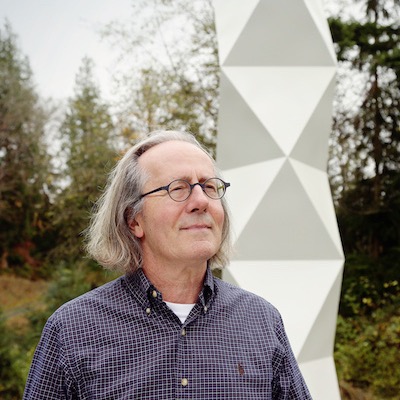
    Chuck Pettis says his infinite tower symbolizes the link between heaven and earth (Photo by Michael Stadler stadlerstudio.com)

    The newest addition to the 72-acre Buddhist-inspired nature reserve and sculpture garden is a modern sculpture similar in shape to an obelisk, only one containing triangle-shaped facets.

    “I conceived the idea of the Infinite Tower less than a year ago, when I printed polyhedra and started stacking them,” says Chuck Pettis, an innovative entrepreneur and author of “Secrets of Sacred Space.” The tower was unveiled to guests on Oct. 29, just after the sun came out on an otherwise rainy day. “I brought together some smart and talented people, and there you go. You can’t do great things without great people.”

    Pettis worked with Matthew Swett of Taproot Architects to create a blueprint detailing a 24-foot column of interlocking equilateral triangles that create a deceptively fluid visual effect. Metal artist Tim Leonard of Heavy Metal Works fabricated and built the tower, which includes an interior mast for strength.

    “What struck me was how fun it was to work with everyone on this,” says Leonard. “They (Pettis and Swett) came to me with a plastic model and asked me to make it in metal. It was a big project, one of the largest I’ve done. I bought a tent to hold it all. I’ve never said no to a project.”

    Pettis said the symbolism within the design includes: creating a connection between earth and sky; white as the color of clarity and purity (which reflects shadows and shapes on the sculpture); honoring the nearby trees and snags, which join the earth and sky; and incorporating the number eight (eight triangles in each octahedron) and the number seven (seven stacked octahedrons), which, in numerology, symbolizes harmony and spirituality.

    tower-being-installed-1500-px-from-taproot-architects
    Leonard and crew install the sculpture at the Earth Sanctuary (Photo by Sarah Birger)

    Picasso took apart the universe and reconstructed it in geometric art forms. Pettis looks at the world in terms of basic shapes and how they influence us, says Claudia Pettis, Chuck’s wife. “Working with triangles connects him to the cosmos,” she says. “We can know the power of the infinite column; it connects earth to sky.”

    Influenced, in part, by the works of Constantin Brancusi, considered one of the most important sculptors of the 20th Century, Pettis found inspiration in the sculptor’s “Endless Column,“ which was built in 1918. Pettis’ ingenuity in creating the tower was further sparked by a visit to the Storm King Art Center, located in the lower Hudson Valley of New York State. Some have described the 500 acres filled with art as being “heaven for sculpture.”

    “I like what they did at Storm King and thought, ‘What could I do on a small scale?’” says Pettis.

    On a September afternoon, when a towering crane lowered the 25-foot tower into place, Pettis, Swett, Leonard, and the crew grinned like boys having their ultimate adventure.

    Freeland novelist and artist Fred Bixby, who is a legally blind, visited the tower that same afternoon. Swett’s wife, Sarah Birger, who was there for the tower’s installation, guided him to the sculpture where he could touch it with his hands.

    “Maybe because of my lousy vision, every panel looked slightly different in color, even though I know it’s all white,” said Bixby. “I love the total smoothness of the metal. I really tried to find where Tim, the artist, joined the sections, where there were cracks and seams. I never found any. I will try again, though. Next time you’re there, go up close and listen hard.”

    Chuck Pettis’ intention for the Earth Sanctuary is that it inspire a sense of well-being and spiritual uplift for years to come. To this end, he has created a 500-year trust that ensures the sustainability of the property. To date, more than 3,000 trees and 15,000 kinds of vegetation have been planted that are expected to last through our earth’s climate change into the year 2500. He imagines the sculptures will last at least that long, too.

    5-earth-sanctuary-team-1500-px
    It takes a village to build a tower. From left, Chuck Pettis, Tim Leonard, Duran Laframboise, Brendan McHugh, Matthew Swett, Jacob Rose, and Ryan Wright (Photo by Sarah Birger)

    Kate Poss worked as a library assistant at the Langley Library until last June. She was thrilled to work for three summers as a chef aboard a small Alaskan tour boat from 2008 to 2010. She was a newspaper reporter in Los Angeles for many years before moving to Whidbey Island where she likes “talking story,’” hiking, hosting salons, and writing her novel.

    __________________

    To read more WLM stories and blogs, CLICK HERE. Have a great story idea? Let us know at info@whidbeylifemagazine.org.

    WLM stories and blogs are copyrighted and all rights are reserved. You may link to this story. To request permission to use or reprint content from this site, email info@whidbeylifemagazine.org.

  • View and Bid on Inuit Art

    View and Bid on Inuit Art

    BY KATE POSS
    Whidbey Life Magazine Contributor
    November 9, 2016

    Thanks to a donation of First Nation limited edition prints to the Freeland Library, you can view and bid on Cape Dorset Inuit art that’s on display this month. The art depicts life and its connection to the Arctic in images of polar bears, walruses, a kayaker, and musk oxen, among others.

    Cape Dorset, known as “Kinngait” in the Inuit language, is a tiny island hamlet in the recently-formed Canadian territory of Nunavut, once a part of the Northwest Territories. The indigenous Inuit, whose traceable culture and art dates as far back as 1000 B.C., learned printmaking techniques in the 1950s. A white man, James Huston, encouraged the artists to print multiple images of their drawings using stone carving, lithograph, and stencil techniques. A cooperative workshop formed, and the hamlet developed a reputation as being the “Capital of Inuit Art.”

    Bannister and Margaret Farquhar (Photo from Amanda Hopkins)
    Bannister and Margaret Farquhar (Photo courtesy of Amanda Hopkins)

    Former Greenbank residents Bannister and Margaret Farquhar collected 10 signed and numbered prints by various Inuit artists who created their work between 1976 and 2003. When the Farquhar’s health deteriorated, and they relocated to Houston to be closer to family, the couple’s long-time friend and estate executor David Norton donated the prints to the Freeland Library per the Farquhar’s request.

    “Panniq,” and “Playful Cubs,” both stonecuts by artist Kananginak. (photo by Don Wodjenski)
    “Panniq” and “Playful Cubs,” both stonecuts by artist Kananginak. (Photo by Don Wodjenski)

    Because the bequest came with no restrictions on the prints’ use, Friends of Freeland Library chose to keep one and auction the other nine pieces as a fundraiser for a project that has not yet been specified.

    “The gift was completely unexpected,” says Betsy Arand, manager of the Freeland Library. The library is not big enough to display all the pieces, so they will keep one of them, “On the Lookout,” which depicts three owls. It will become part of the permanent art collection of the Freeland Library.

    “Kayaker’s Reflection,” stonecut by artist Kananginak (Photo by Kate Poss)
    “Kayaker’s Reflection,” stonecut by artist Kananginak (Photo by Kate Poss)

    “Owls are associated with knowledge, and we’re always on the lookout for helping customers use the library,” says Arand. The artist of the work, Kananginak, was instrumental in forming the West Baffin Eskimo Cooperative and was a member of the Royal Canadian Academy. He was one of the original artists whose work was included in the first cataloged collection of Cape Dorset prints in 1959.

    Bannister Farquhar and Norton were old friends from Texas who earned their doctorates together in rocket propulsion. Later, Bannister moved to Washington and worked as an engineer with Boeing. His wife Margaret, who earned a doctorate in biology, worked at the University of Washington. The couple moved to Whidbey Island in the 1970s, living first on the south end and later in a home they built in Greenbank. They traveled to Canada and collected art, sometimes with the Nortons.

    “Protecting the Herd,” stonecut and stencil by artist Kananginak; “The Lineup,” lithograph by artist Ohotaq. (Photo by Don Wodjenski)
    “Protecting the Herd,” stonecut and stencil by artist Kananginak; “The Lineup,” lithograph by artist Ohotaq. (Photo by Don Wodjenski)

    Norton’s wife Connie recalled Whidbey visits. “We’ve all been friends since 1964,” she says. “When Bann and Margaret found their land on Whidbey, they called it a piece of paradise. We visited them once a year. Bann loved to go crabbing with the neighbors. They were wonderful people. When they started having health problems five years ago, they asked David to act as their power of attorney and executor of the estate.”

    Art lovers can purchase the prints outright at their assessed value or bid on them for a minimum of 75 percent of their assessment. The library has received several bids and so far, the favorite of patrons is the kayaker print.

    To view these works, visit the Freeland library. You can purchase or bid on your favorites by 7 p.m. on Friday, Dec. 2, at which time the Friends of the Freeland Library will celebrate the end of the auction and announce the winners at a soiree. The library is located at 5495 Harbor Avenue in Freeland and is open daily.

    More information

    Kate Poss worked as a library assistant at the Langley Library until last June. She was thrilled to work for three summers as a chef aboard a small Alaskan tour boat from 2008 to 2010. She was a newspaper reporter in Los Angeles for many years before moving to Whidbey Island where she likes “talking story,’” hiking, hosting salons, and writing her novel.

    __________________

    To read more WLM stories and blogs, CLICK HERE. Have a great story idea? Let us know at info@whidbeylifemagazine.org.

    WLM stories and blogs are copyrighted and all rights are reserved. You may link to this story. To request permission to use or reprint content from this site, email info@whidbeylifemagazine.org.

  • “Cultivating Kids” Film at the Clyde Theatre November 6

    “Cultivating Kids” Film at the Clyde Theatre November 6

    BY KATE POSS
    Whidbey Life Magazine Contributor
    October 26, 2016

    While parents have long wondered how to get kids to eat their veggies, Cary Peterson has cultivated a simple solution that has students clamoring for “garden tacos” that they grow themselves in their school’s backyard.

    A once-neglected half-acre of rubble behind the South Whidbey Elementary School now grows tidy rows of veggies, including kale and French sorrel, pumpkins, tomatoes, field peas, nasturtium, sunflowers, and ground cherries—sweet little globes wrapped in a papery skin that taste like tomatoes, pineapple, and mangos all in one. Students from kindergarten through fifth grade enjoy working the garden and harvesting the fruit of their labor in a program pioneered by Peterson,  a master at creating community through the land.

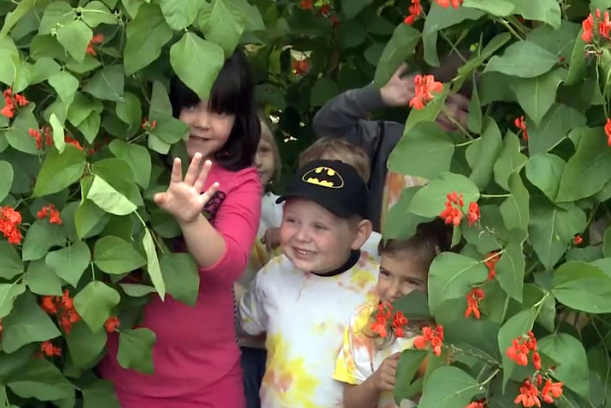
    Students wave from a teepee of scarlet runner beans in their school garden. (from the film "Cultivating Kids" by Mark Dworkin and Melissa Young)
    Students wave from a teepee of scarlet runner beans in their school garden. (from the film “Cultivating Kids” by Mark Dworkin and Melissa Young)

    Local filmmakers Melissa Young and Mark Dworkin were so inspired by the garden’s success that they made a documentary, “Cultivating Kids,” which shows at the Clyde Theatre, Sunday, November 6, at 2 p.m. The event is free, but donations are welcome and will go toward matching a $30,000 grant provided by Goosefoot, a South Whidbey nonprofit dedicated to building community, preserving rural traditions, adding to the local economy, and creating a sustainable future.

    Matching grant funds come from profits made by The Goose Community Grocer, which works with Goosefoot. The school garden received nearly $45,000 in funding in 2014, more than $52,000 in 2015, and has a goal of $60,000 for 2016. The funds pay for garden materials and the salaries of Peterson and her team: a curriculum coordinator and two apprentices. Goosefoot made a three-year commitment to the project, and future funding needs to come from the community. So far, the garden program has received grants from Whole Foods, proceeds from the South Whidbey Garden tour, community donations, and volunteer hours.

    “We heard about the farm and went to visit it,” said Young. “We were totally entranced.” Dworkin has worked as a projectionist at the Clyde for more than 40 years. He and Young have made more than 20 notable documentaries, which have been shown on PBS and distributed internationally. Young, a long-time gardener herself, said that she and Dworkin are interested in broad issues of social justice and sustainability. Such themes are reflected in their films, which include “Shift Change,” a documentary about employee-owned businesses. “Good Food,” which aired on PBS in 2010, celebrates the comeback of the family farm and the importance of eating local produce. “Cultivating Kids” is one of their latest films.

    “There are a lot of problems in the world,” Young said, “If we’re going to make it a better place, we need to look at what makes a difference.”

    The couple began filming in 2015 during the growing season. They filmed students working in the garden through spring, summer, and fall, culminating in a Thanksgiving feast.

    Kids in garden writing in notebooks.
    Middle schoolers use math skills when working in the garden. (photo courtesy of movingimages.org)

    The film is already attracting praise, such as that from Lauren Howe, director of the Slow Gardens program for Slow Food USA. “Cultivating Kids is the ideal film to show all stakeholders that are either considering a school garden or have an existing garden that is needing an infusion of excitement,” she says. “The South Whidbey Island (Washington) project shows how school gardens connect to all aspects of a school day to support academic success, healthy eating habits, and connections to nature. Parents, teachers, school administrators, and community members will all find a special connection in this film that will motivate them to support a garden program for their school. The students are the real stars. A must see!”

    On a recent visit to the garden on a cool misty afternoon, Peterson pointed out rows of squash and pumpkins curing in a greenhouse, awaiting a student Thanksgiving feast November 17. “The pumpkins were planted by last year’s third graders, and this year’s fourth graders harvested them for pies,” Peterson explained. “The potatoes pulled by this year’s third graders were planted by the children last spring when they were second graders.”

    Mark Dworkin and Melissa Young at their dining room table.
    Mark Dworkin and Melissa Young created the film, “Cultivating Kids,” which will be shown at the Clyde Theatre November 6. (photo by David Welton)

    Planting and harvest compliment student studies in math and science, Peterson explained. “We hold a picture of ‘Big Ideas’ for each grade.” The big ideas fostered for the elementary school students are like a foundation that gains strength as the children mature:

    • Kindergarten and first grade: We connect to the living world
    • Second grade: Soil nourishes life
    • Third grade: Life thrives through its diversity
    • Fourth grade: Our actions can support life
    • Fifth grade: All life is interconnected

    Peterson’s big ideas for linking community and locally-grown food were founded in the creation of the Good Cheer food bank garden and the community garden at the Whidbey Institute. That work evolved to include working with students at the Bayview Alternative High School to restore their garden. When the school moved to the old primary school site and became the South Whidbey Academy, Peterson was asked to get a garden going there. She thought it was essential to serve the produce grown in the garden to students in the South Whidbey School District.

    Carey Peterson, a master at creating community and self-sufficiencey through gardening (from the film Cultivating Kids by Mark Dworkin and Melissa Young)
    Cary Peterson, advocate for the Earth, community, and locally grown food is in her element in the school garden. (from the film Cultivating Kids by Mark Dworkin and Melissa Young)

    Peterson consulted Chartwells, a corporate provider of school lunches nationwide, and together, they created protocols to ensure food safety. Now, South Whidbey School Farm and Gardens, sells its produce to Chartwells, which serves it at all schools in the South Whidbey School District. The student-grown produce also supplies Whidbey Island Nourishes, a nonprofit that provides food for needy students.

    Meanwhile, a snack garden, which will provide healthy easy-to-pick veggies for the students’ snacks, is getting ready for spring. “The thing that distinguishes this garden, is that children can grow and eat their own food,” says Peterson. “This program happens due to the 150 percent support of the school and Goosefoot. What’s amazing is that these children know what a delicious carrot tastes like. That changes the system—to serve food that is delicious. It’s their benchmark. I think it’s a very powerful thing when it ripples out.”

    More information:

    Kate Poss worked as a library assistant at the Langley Library until last June. She was thrilled to work for three summers as a chef aboard a small Alaskan tour boat from 2008 to 2010. She was a newspaper reporter in Los Angeles for many years before moving to Whidbey Island where she likes “talking story,” hiking, hosting salons, and writing her novel.

    Related stories

    __________________

    To read more WLM stories and blogs, CLICK HERE. Have a great story idea? Let us know at info@whidbeylifemagazine.org.

    WLM stories and blogs are copyrighted and all rights are reserved. You may link to this story. To request permission to use or reprint content from this site, email info@whidbeylifemagazine.org.
  • Tracking Whidbey’s Seasons with the Birds

    Tracking Whidbey’s Seasons with the Birds

    BY KATE POSS
    Whidbey Life Magazine Contributor
    September 28, 2016

    These are the days of cool and crisp weather, yellow-orange leaves, and apples red and green. Autumn calls some birds to travel south while others remain and prepare for winter weather.

    278774
    Frances Wood’s book “Brushed by Feathers” commemorates a season of birds in the West (watercolor image by Frances Wood)

    Naturalist Frances Wood observes bird migration to track the seasons. To mark the shift from summer to fall, Wood and her like-minded friend Linda Beeman waxed poetic to friends and admirers two days after the autumn equinox. Beeman read excerpts from her chapbook “Our Whidbey Year,” and Wood read from her book “Brushed by Feathers: A Year of Birdwatching in the West.”

    “When I read her poetry, I thought she was a kindred spirit,” Woods said of Beeman’s way with words. “We’re both observers.”

    “We thought we would begin in this most golden current season, the brink between late summer and early fall, when Gravensteins get turned into cider,” Beeman said.

    During September, Wood notes, songbirds stop singing. “During the non-breeding season the section of a songbirds’ brain actually shrinks, making it impossible to sing, even if the urge arose,” she wrote. Swallows and warblers quietly fly south.

    12-swallows
    Swallows have already left for warmer climates (watercolor image by Frances Wood)

    Wood noted that this time of year our regal great blue heron’s loose flight feathers show “gaps in its outstretched wings reminding me of a five-year-old’s toothless grin.”

    Meanwhile, loons are arriving from Alaska and western Canada. They were sighted in Useless Bay and at Doublebluff Beach on the Equinox, according to Whidbey Audubon reports. In “Brushed by Feathers,” Wood notes that many of these large diving ducks known for their haunting calls stay through November before heading further south and that some remain all winter.

    “For Thoreau, the loon’s call made ‘the woods ring with its wild laughter,’” Woods wrote in an October entry of her book. “Hearing the loon’s call makes me feel that all is right with the world, at least for the day. Like an overture setting the tone for an opera, the loon’s call announces the fall arrival of hundreds of ducks and seabirds into our bay.”

    11-american-robin
    American robins enjoy autumn apples and pyracantha berries (watercolor image by Frances Wood)

    For Beeman, autumn means that “banana slug trails reflected/in afternoon sunlight/track to their underground hibernations.” She writes of a robin that met its sudden end: “late season robin that mistook/my front door for sky/fatal error that rendered/an elegiac offering.”

    Wood noted that the autumn apples attract robins, Steller’s jays, dark-eyed juncos, white-crowned sparrows, northern flickers, and even pileated woodpeckers to her backyard trees, where deer also arrive to stand on their hind legs to pick higher fruit. Quail forage under her Nootka rose bushes.

    Since Whidbey Island is located in the Pacific Flyway, migrant visitors arriving in late September from the north include wigeons, ducks, coots, and “forty species of waterfowl,” along with red-tailed hawks, which join our resident birds.

    As the cool, wet, windy weather moves in, we take comfort in warm soups, Beeman observes in her poem “Wind Storm”:

    “lichen-furred alder limbs/hit the roof shot sounds/startle soup makers within/who stir wind moans/into their vegetable broths.”

    In addition to her books, Wood has designed Collectable Bird Cards, newly printed and packaged. She said that her husband’s baseball card collection featuring a photo of the player on one side and statistics about the player on the reverse side had triggered the idea for her cards. As a former elementary teacher and now grandmother, Wood said she is on the lookout for ways to connect kids with nature, and her Collectable Bird Cards meet that need. One side features her watercolor drawings; the reverse contains bird facts with boxes to check if the bird is seen or heard. One of the birds depicted is an American goldfinch, Washington’s state bird. While a bright yellow during breeding season, it molts and morphs to a dull olive color during fall and winter. Wood’s goal is to create cards for the top sixty of our area’s common birds.

    8-goldfinch-1
    The American goldfinch is our state bird. It loses its bright plumage in the fall (watercolor image by Frances Wood)

    When asked about her favorite bird, Wood said, “it’s whichever one is in front of my binoculars.” But the truth is she is really into the island’s pigeon guillemot population.

    “They are the only seabird that regularly breeds in the Puget Sound,” she said. “We have 26 colonies of about 1,000 birds. They are noted for their bright fire-engine red feet and mouth lining. They are entertaining to watch. Their eggs are laid in bluff burrows.”

    Wood has organized a cadre of citizen scientists who regularly observe the black sea birds and complete weekly surveys of their observations. For more information visit www.pigeonguillemot.org.

    Wood
    Artist and Naturalist Frances Wood (photo courtesy of Frances Wood Web page)

    To learn more about the many hats of Frances Wood, visit her Web page at www.franceswood.net. Her growing collection of bird portraits can be viewed at the Rob Schouten Gallery in Freeland and at www.robschoutengallery.com/frances-wood.

    2-linda-beeman
    Poet Linda Beeman (photo by Lorraine Healy)

    Besides her work as a realtor at Windermere Real Estate/South Whidbey, Linda Beeman is an award-winning poet and author of “Wallace, Idaho,” a chapbook describing the gritty life in the small silver-mining town where she grew up. For more about her, visit her amazon page here.

    Image at the top: Pigeon guillemots have bright red feet and nest in bluff hollows (watercolor image by Frances Wood)

    Kate Poss worked as a library assistant at the Langley Library until last June. She was thrilled to work for three summers as a chef aboard a small Alaskan tour boat from 2008 to 2010. She was a newspaper reporter in Los Angeles for many years before moving to Whidbey Island where she likes “talking story,” hiking, hosting salons, and writing her novel.

    __________________

    CLICK HERE to read more WLM stories and blogs. Have a great story idea? Let us know at info@whidbeylifemagazine.org.

    WLM stories and blogs are copyrighted and all rights are reserved. Linking is permitted. To request permission to use or reprint content from this site, email info@whidbeylifemagazine.org.

  • ‘Come Curious and Leave Inspired’ by Visiting Whidbey’s Working Artists

    ‘Come Curious and Leave Inspired’ by Visiting Whidbey’s Working Artists

    BY KATE POSS
    Whidbey Life Magazine Contributor
    August 17, 2016

    The end of August on Whidbey Island evokes a sense of bittersweet that comes with knowing the long summer days and sunshine we enjoy will give way to a cycle of cool and misty weather in the months to come.

    One way to charge our creative batteries this time of year and absorb our island’s natural beauty is by taking a drive and meandering along the self-guided Summer Open Studio Tour of the Whidbey Working Artists on Saturday and Sunday, August 27 and 28.

    “Come Curious and Leave Inspired” is this year’s theme, with a showcase of more than three dozen artists who will open their studios—free to the public—from 10 a.m. to 5 p.m. each day.

    Francy Blumhagen’s mixed media/collage and printmaking art is an homage to the natural world. (photo courtesy of Francy Blumhagen)
    Francy Blumhagen’s mixed media/collage and printmaking art is an homage to the natural world.   (photo courtesy of Francy Blumhagen)

    Two of the artists helping to shepherd the annual event are Coupeville residents Kay Parsons, a watercolor painter of the natural world, and Janet Lewis, a luthier whose passion is woodworking, creating fine guitars, ukuleles and furniture.

    We all met up at Ciao in Coupeville to chat about the island’s penchant for attracting independent, authentic and talented artists of all stripes. While modest about talking about themselves, Lewis and Parsons spoke instead about how this tour displays the talents of their fellow artists and celebrates the sponsors of the event, including Front Street Realty, Whidbey Island Arts Council and Whidbey Life Magazine, to name a few.

    Buffy Cribs said her art is often inspired by “letting the kindergarten of her mind out to play.” (photo courtesy of Buffy Cribbs)
    Buffy Cribbs said her art is often inspired by “letting the kindergarten of her mind out to play.”   (photo courtesy of Buffy Cribbs)

    “The tour is all about understanding the environment that the artists create in,” said Parsons, whose voice still carries its soft Georgia drawl. “This is all about experiencing how artists see their world. For me personally, it’s about my connection with the land and watching things grow. As you go around to the studios you see the character of the artist.”

    Lewis said that visitors to her studio are surprised by its neatness and “ding me because I don’t have great wads of sawdust. I do have a NICE shop. I’m spoiled. It is set up for teaching in the future.”

    Local business and libraries throughout the island carry the tour’s colorful catalogues, which are filled with photos of participating artists’ work, directions to their studios and a guide map near the back that identifies artists’ locations by their catalogue number. The catalogue can also be downloaded as an 8 mg PDF file at http://www.whidbeyworkingartists.com/catalogue.html. The guide to the artists’ tour begins in the north with No. 1: Jerry Pike, a “ceramic archaeologist” in Oak Harbor, and ends in Clinton where one can visit No. 37: Blueschool Arts and Zia Gipson. Visitors to the tour can, of course, make up their own personal tour order as they prefer.

    Robert Adamson and his wife Janis Swalwell have been creating hand-blown glass art for nearly 50 years. (photo courtesy of Island Art Glass)
    Robert Adamson and his wife Janis Swalwell have been creating hand-blown glass art for nearly 50 years.   (photo courtesy of Island Art Glass)

    Parsons, for instance, is listed as No. 4—Looking Glass Cottage Studio—and her website, phone number, email and address are included along the edge of her page.

    Lewis, No. 10 on the tour, moved to the island four years ago from the Laguna Beach art enclave, and said she is impressed by the caliber of artists she’s met so far.

    “This isn’t your cookie-cutter kind of art,” Lewis said. “There is a unique voice here.”

    WWA-4. Jordan Jones
    Jordan Jones likes making functional pottery with lively and playful animals.   (photo courtesy of Jordan Jones Pottery)

    Lewis said she already feels part of the family of artists who live here. She takes inspiration from fellow artists such as Mary Ellen O’Connor, No. 13 on the tour. O’Connor creates jewelry and etched glass pieces and is also a primary organizer with Whidbey Working Artists.

    Both Parsons and Lewis praised Sue Taves, No. 23 on the tour, whose sculptures in basalt and other stone are well known.

    “Sue’s belief in the arts is a progressive value and shows how a community can be crafted,” said Parsons. “She busts her back end for us. It doesn’t just happen. Sue has changed the arts community in a profound way. She has created a vehicle for the world to realize what we have in the Whidbey Island artists.”

    Janet Lewis enjoys woodworking and creating beautiful instruments. (photo courtesy of Janet Lewis)
    Janet Lewis enjoys woodworking and creating beautiful instruments.   (photo courtesy of Janet Lewis)

    Mark Laska, chef/owner of Ciao, stopped by to say hello. When asked about the diverse and connected arts community here on Whidbey, he said, “The community is remarkably layered. We hold hands in so many ways.”

    Talking about holding hands, Whidbey Working Artists is part of Whidbey Island Arts Council, which assists local artists and cultural groups with advice, financial aid and sponsorship. For more about this artistically-minded non-profit, visit their webpage at islandartscouncil.org.

    Whidbey Working Artists was formed in 2004 as a vehicle for promoting the visual arts and artists of central and north Whidbey Island. Since then WWA has hosted annual tours and expanded its scope to include artists from the entire island. Its members wish to share their passion about creativity and promote the beauty of art.

    Visit WWA’s webpage, whidbeyworkingartists.com/artists.html, and hover the curser above an image; the artist’s name will appear and take the viewer to further information about the artist. The webpage photos are organized to correspond with the numbers on the self-guided map in the catalogue.


    Mary Ellen O’Connor’s jewelry and etched glass reflects her natural world. (photo courtesy of Willow Pond Studio)
    Mary Ellen O’Connor’s jewelry and etched glass reflects her natural world.   (photo courtesy of Willow Pond Studio)


    Jim Short rescues homeless wood and gives it a new identity. He likes the character that knots, stains and other blemishes give each piece. (photo courtesy of Jim Short)
    Jim Short rescues homeless wood and gives it a new identity. He likes the character that knots, stains and other blemishes give each piece.   (photo courtesy of Jim Short)


    Teresa Saia’s pastels and oils radiate rich color with layers of texture. (photo courtesy of Teresa Saia
    Teresa Saia’s pastels and oils radiate rich color with layers of texture.   (photo courtesy of Teresa Saia


    Sue Taves says each stone has its own story to tell and her job is to discover that story through carving. (photo courtesy of Sue Taves)
    Sue Taves says each stone has its own story to tell and her job is to discover that story through carving.   (photo courtesy of Sue Taves)


    Lisbeth Cort’s vibrant work mixes watercolor, wax, pastels, gouache and ink. (photo courtesy of Lisbeth Cort)
    Lisbeth Cort’s vibrant work mixes watercolor, wax, pastels, gouache and ink.   (photo courtesy of Lisbeth Cort)


    Dan and Joi Lachaussee produce freehand sculpted glass art as a team. (photo courtesy of Lachaussee Glass)
    Dan and Joi Lachaussee produce freehand sculpted glass art as a team.   (photo courtesy of Lachaussee Glass)

    Kate Poss recently retired from her job as a library assistant at the Langley Library. She worked for three summers as a chef aboard a small Alaskan tour boat from 2008 to 2010. She was a newspaper reporter in Los Angeles for many years before moving to Whidbey Island where she likes ‘talking story,’ hiking, hosting salons and writing her novel.

    __________________

    CLICK HERE to read more WLM stories and blogs. Have a great story idea? Let us know at info@whidbeylifemagazine.org.

    WLM stories and blogs are copyrighted and all rights are reserved. Linking is permitted. To request permission to use or reprint content from this site, email info@whidbeylifemagazine.org.

  • Whidbey Island’s Pursuer of the Night Skies

    Whidbey Island’s Pursuer of the Night Skies

    BY KATE POSS
    Whidbey Life Magazine Contributor
    July 27, 2016

    Remember the extraordinary Northern Lights on Whidbey Island last Mother’s Day? Well, Holly Davison—a self-proclaimed science weather geek and star chaser—was outside that night, capturing the colors painted by Nature between midnight and the early morning hours.

    “During Mother’s Day we had one of the biggest solar storms we’ve had in a while,” said Davison, who reads solar storm forecasts the way many of us read weather reports. Solar storms occur frequently, but not always with the same results; another solar storm occurred on July 20, but the full moon cancelled out the color that would have normally appeared.

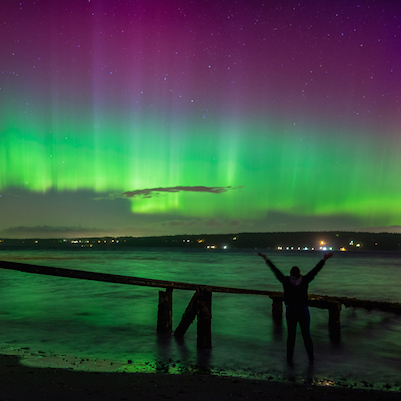
    Northern Lights on the Langley waterfront last May (photo by Holly Davison)
    Northern Lights on the Langley waterfront last May   (photo by Holly Davison)

    While one might imagine curtains of light appearing high in the night sky, the pattern of the Northern Lights are different on Whidbey Island. “We get pillars and spikes here, low on the horizon,” Davison said. “In Alaska or Iceland, though, they get the curtains.”

    Spending time with the Milky Way and the Aurora Borealis, Davison said, opens a gateway to her soul. In the midst of raising and home-schooling three active and curious boys who are eight, six and three, she heeds the calling of the night sky when her husband, Brent, is home sleeping with the boys. Sometimes Brent is called to volunteer for his local fire department and Holly is called home from her time with the evening stars. Other times she’ll pile her brood in the camper and head out to see the glories of the Milky Way at Mt. Baker.

    Davison’s love of the natural world began at age four when her parents moved to Whidbey Island. She recalls family camping trips to the La Push and the Hoh River on the Olympic Peninsula and Mt. Baker in the Cascade Mountains.

    2. Langley May 2016
    Changing colors of Northern Lights at the Langley waterfront     (photo by Holly Davison)

    After graduating from South Whidbey High, Davison found work with the National Forest Service on a trail maintenance crew on Mt. Baker. One of her most memorable events, she said, was her eight-day trek to the High Divide between Mt. Baker and the Canadian border to clear a portion of the Welcome Pass trail blocked by an avalanche.

    “On that trip I learned it wasn’t necessary to have clean socks and undergarments,” Davison said. “Thankfully we had a beautiful pack mule named July. I hung onto her tail as she pulled me up the last steep part of the trail. We filtered our water from a stream [and] hung our food from a tree; there was a black bear nearby. We used pick axes to move stones and it rained. We were a muddy sopping mess. We watched the sun set over Mt. Baker. It was the hardest and most rewarding work I’ve ever done [and] very fulfilling.”

    Nowadays when she hikes Welcome Pass at Mt. Baker, she gives thanks to July, the trusted mule, and recalls the spirit of adventure that infused her at the age of 19.

    Mt. Baker’s night sky, a favorite place to visit (photo by Holly Davison)
    Mt. Baker’s night sky, a favorite place to visit   (photo by Holly Davison)

    Davison took another adventurous leap when she earned a Special Education teaching degree and ran a contained-learning classroom for elementary school students who lived with various challenges, from behavior disorders to autism. In a contained-learning classroom, students with special needs are taught according to their particular learning style. Davison said she also coached mainstream teachers on how to best work with her students. Teaching brought out her inner actor, she recalled, requiring her to deliver her best performance, day after day, to a challenging audience.

    After teaching in Mukilteo for almost 10 years, Davison married Brent, who works at Boeing and is a volunteer EMT in Clinton. When her sons began to arrive, she decided to devote her attention to being a mom. Looking for outlets to channel her creative energy took her to the photography of Eddie Murdock, who captures, among other things, the night sky.

    “It snowballed,” Davison recalled. “I saw his photos and was awestruck; I reached out to him and now I help manage his Facebook page about Northern Lights.” She is hooked, she said, on the awe she feels looking at the heavens and now wants to share that feeling through her photos.

    4.Mount Rainier
    Milky Way at Mt. Rainier     (photo by Holly Davison)

    As Davison immersed herself in photographing the night sky’s moods, she learned about the International Dark Sky Association. The worldwide organization advocates for the reduction of light pollution and seeks to spread the word about the necessity of night skies for the health of sentient beings. The group also lists interactive maps that show the places on Earth with the least light pollution. In Washington State, for instance, they’ve determined that the best place for seeing stars is located in south-central Washington in the small community of Goldendale.

    The Association’s website validates Davison’s mission of sharing the awe of looking at the heavens. “Experiencing the night sky,” she said” “provides perspective and inspiration and leads us to reflect on our humanity and place in the universe. The history of scientific discovery and even human curiosity itself is indebted to the natural night sky.”

    Wild beaches at La Push coastline, a childhood favorite place to visit (photo by Holly Davison)
    Wild beaches at La Push coastline, a childhood favorite place to visit   (photo by Holly Davison)

    Taking heed of the IDSA’s information, cities and counties throughout Washington State have adapted ordinances to reduce light pollution. Island County Planning passed a light pollution ordinance in 2005, which specifically targets vapor lights that shine directly upward. Overly bright lights are banned as well. The Planning Department has published a brochure: “Working Together to Preserve Rural Character and the Night Sky,” which is available at the County Planning Department and through the Island County Astronomical Society of Washington. Click here for further information on preserving night sky viewing.

    Mike Thompson, a board member of the Island County Astronomical Society of Washington, is a passionate viewer of night skies. The society, he noted hosts monthly meetings as well as star parties. What members have in common is a collective appreciation of the universe as seen at night

    The Coupeville resident said he gets irritated about the spread of light pollution coming from all directions. “I’ve been observing the Ebey overlook since 2003,” he said. “I can say it’s very difficult to see what I used to see. I used to go out on a moonlit night and the stars would pop out. When you look toward Mt. Vernon and Everett, it’s horrible.”

    Thompson acknowledges that a lot of people have not learned about light pollution. “They go to bed, they go to work,” he said. “They don’t think about how light pollution has grown.” His mission is to raise awareness about viewing the night sky. To that end, he’s spoken at astronomy societies throughout the state. He suggested watching the film, “City Dark,” (available as a free-streaming video through Sno-Isle Libraries: http://sno-isle.org/.) Among other things, the film points out how light pollution affects animals and their ability to navigate. Birds, for instance, get lost in cities because they use the stars to navigate and are confused by city lights. Sea turtles, born in the sand, rely on the reflection of stars in the water to guide them to the ocean, but the glow of city lights now leads them in the wrong direction.

    Davison, a "sweatshirt and flip-flops kind of gal' who goes out and finds inspiration in photographing night skies—with her boys (l-r), Joel, 3; Zach, 8 and Shaun 6 (photo by Kate Poss.)
    Davison, a “sweatshirt and flip-flops kind of gal,” goes out and finds inspiration in photographing night skies—sometimes with her boys (l-r), Joel, 3; Zach, 8 and Shaun 6 (photo by Kate Poss.)

    Meanwhile, if our clouds part in early August, we should get to see an extraordinary show of meteor showers, known as the Perseids. Thompson estimates there are about 60 meteors falling per hour then but, in light-polluted areas, only the brightest will be seen. These days he likes to take his telescope out to a farm in Coupeville to maximize the darkness. He also visits Sunnyside Cemetery in Coupeville with his star charts to view beloved galaxies, star cluster and nebulas—111 heavenly bodies that were identified by earlier astronomers. He enjoys star parties and advocates giving the winter night skies a look.

    Winter star gazing isn’t Davison’s cup of tea, however; she considers herself a “sweatshirt and flip-flops kind of gal.” Plus, she said, it’s too cold to go car camping with the boys when the outside temperature drops.

    Davison uses a Nikon D60010 and processes the raw images into the ones shown on her website: and Facebook page. Some of her favorite places to shoot are the Clinton ferry dock and Langley Marina. Her delight in what she does can be contagious; instead of watching TV tonight, consider stepping outside and looking at the sky.

    Kate Poss worked as a library assistant at the Langley Library and retired in May of this year. She was thrilled to work for three summers as a chef aboard a small Alaskan tour boat from 2008 to 2010. She worked as a newspaper reporter in Los Angeles for many years before moving to Whidbey Island where she enjoys ‘talking story,’ hiking, cooking, hosting salons and writing her novel.

    __________________

    CLICK HERE to read more WLM stories and blogs. Have a great story idea? Let us know at info@whidbeylifemagazine.org.

    WLM stories and blogs are copyrighted and all rights are reserved. Linking is permitted. To request permission to use or reprint content from this site, email info@whidbeylifemagazine.org.

  • ‘A Bird in the Hand’ Gathering to be held this Sunday, Sept. 18

    ‘A Bird in the Hand’ Gathering to be held this Sunday, Sept. 18

    BY KATE POSS
    Whidbey Life Magazine Contributor
    September 13, 2016

    Celebrate Whidbey’s winged nation from noon to 3 p.m. this Sunday, Sept. 18, at Whidbey Audubon’s “A Bird in the Hand” event at Bayview Farm and Garden. 

    Featuring specimens of the island’s birds, this unique avian library provides hands-on education to a public that typically sees them from a distance or in motion.

    Watercolorist and avid birder Frances Wood hosts a past Bird in the Hand (photo by Julie Dougherty Winger)
    Watercolorist and avid birder Frances Wood hosted a past “Bird in the Hand” event. (photo by Julie Dougherty Winger)

    This popular event has inspired visitors to appreciate our feathered brothers and sisters.

    “The doors open and the magic of curiosity fills the room,” said Judy Feldman, a past visitor to Bird in the Hand. “It’s so wonderful to watch people be awestruck by the complex beauty of the wings and feathers and feet. It’s especially exciting to watch faces of small children as they get closer to birds than they’ve ever been.”

    While there are more than 450 Audubon chapters nationwide that promote bird watching and preservation, our island Audubon branch has a rare collection of preserved birds that the public can hold and view close up.

    Bird skulls of vireos and warblers are part of the collection (photo by Kate Poss)
    Bird skulls of vireos and warblers are part of the collection. (photo by Kate Poss)

    A gift to the Whidbey Audubon Society, these birds were once collected to identify the remains of birds that had collided with Navy planes, also known as Bird Aircraft Strike Hazards or BASH. 

    Matt Klope, an Oak Harbor biologist and taxidermist, worked for years as a coordinator with the Navy on preventing bird strikes. He started a collection around 30 years ago and used it to identify birds that routinely flew into planes. Once identified, Klope explained, the Navy could discourage those populations’ attraction to naval airspace.

    “I’ve been working on birds since high school,” he said. “It’s a lifelong thing. The Navy needed someone to coordinate the bird strike program. When you strike a bird it is important to know what kind of a bird it was. We used forensic science developed by the Smithsonian to help us. They do feather comparisons, which are much cheaper than DNA analysis. They have close to 800,000 species from all over the world.”

    Whidbey Audubon’s bird collection curators cut custom-shapes in foam to cushion bird specimens. Each bird is labeled and then stored in a box that is catalogued into a library system (photo by Kate Poss)
    Whidbey Audubon’s bird collection curators cut custom-shapes in foam to cushion bird specimens. Each bird is labeled and then stored in a box that is catalogued into a library system.  (photo by Kate Poss)

    When Klope retired from the Navy, he donated the collection to the local Audubon chapter. He continues to preserve birds that have met their demise and educates Audubon volunteers on his specialized techniques. Look for Klope at the Bird in Hand event to learn more about his skills.

    Some of Klope’s animals are posed so naturally that one immediately feels Klope’s respect for them in their preserved form. It’s fascinating, for instance, to see the work he’s done preserving owls.

    Owls, unfortunately, are routinely hit by cars,” said Robin Llewellyn, librarian for the Whidbey Audubon bird collection and co-chair of A Bird in the Hand this year.

    A saw-whet owl preserved and used in education programs: the owl lives in island woods and is only six to seven inches tall (photo by Kate Poss)
    A saw-whet owl, preserved and used in education programs: the owl lives in island woods and is only six to seven inches tall.   (photo by Kate Poss)

    “We get lots of owls; when they see prey, they look at it with total focus and don’t pay attention to cars,” Llewellyn said. Look for at least two owls on display at Sunday’s A Bird in Hand: a tiny saw-whet owl and a barred owl. Their feathers are remarkably soft. Llewellyn said that owl feathers are designed to promote quiet flight and stealth to aid owls catching their prey.

    The Audubon chapter continues to accept certain birds for its collection.

    “If you find a dead bird in good condition, call to see if we need it,” said Llewellyn, providing her number, 360-678-5403. “Wrap it in a newspaper and put it in a re-sealable plastic bag and squeeze the air out. Include your name, contact information, locality and date it was found and put it in the freezer.”

    On a recent afternoon Llewellyn visited Klope’s Oak Harbor taxidermy studio with two birds she pulled from a cooler packed with ice. One was a sharp-shinned hawk, a small raptor that hunts other birds. Klope thought it might have been in the freezer too long and wasn’t sure he could restore it to its former glory, but, unfazed at his reticence, Llewellyn suggested he use the wings and tail for a future display. She also showed him a crow which she had recently picked up, mentioning that it can be added to the corvid collection.

    Matt Klope’s talent with preserving birds such as this barred owl, are considered museum quality by the Whidbey Audubon Society (photo by Kate Poss)
    Matt Klope’s talent with preserving birds, such as this barred owl, are considered museum quality by the Whidbey Audubon Society.   (photo by Kate Poss)

    The Audubon Society was created in the late 1800s originally to protect water fowl such as herons and egrets that were hunted to near extinction for feathers on popular ladies’ hats. One might imagine that wildlife artist John James Audubon created the society that bears his name, but it was one of his wife’s students who did the honors: George Bird Grinnell, one of three founders of the early Audubon Society in the late 1800s. Knowing Audubon’s passion for depicting the natural world, Grinnell chose Audubon as the name for the enduring preservation society, whose symbol is a great egret. Nowadays one of Audubon’s primary missions is to protect avian populations threatened by climate change and habitat loss.

    The Whidbey Audubon Society’s collection, containing more than 500 birds, has been catalogued and permitted and is used in elementary schools and outdoor classrooms for education. A Bird in the Hand was created in 2008 and has been held biennially ever since, becoming more popular through the years. This Sunday’s event, held in the Bayview Farm and Garden’s Greenhouse, will host live raptors for the public to meet as well. Visitors can learn about and buy landscape materials that attract birds, as well. For information on everything about birds, look for Steve Ellis, the Whidbey Audubon’s “answer man,” who has been answering questions about birds for decades.

    For more information, visit the Whidbey Audubon Society Web page at http://www.whidbeyaudubon.org/ or contact program chairs Robin Llewellyn (soaringridge@broadstripe.net or 360-678-5403) or Sharon Gauthier (sharongauthier88@gmail.com or  360-682-5149).

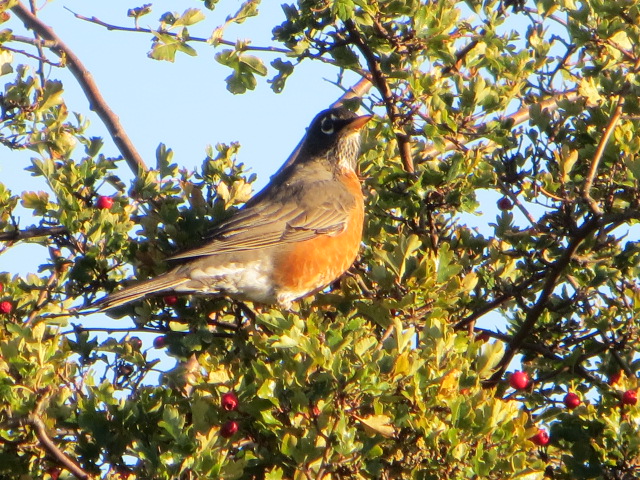
    Image at top: American robins fiercely defend their nests, often ganging up to drive predators away.  (photo by Jamie Whitaker)

    Kate Poss worked as a library assistant at the Langley Library until last June. She was thrilled to work for three summers as a chef aboard a small Alaskan tour boat from 2008 to 2010. She was a newspaper reporter in Los Angeles for many years before moving to Whidbey Island where she likes “talking story,” hiking, hosting salons, and writing her novel.

    __________________

    CLICK HERE to read more WLM stories and blogs. Have a great story idea? Let us know at info@whidbeylifemagazine.org.

    WLM stories and blogs are copyrighted and all rights are reserved. Linking is permitted. To request permission to use or reprint content from this site, email info@whidbeylifemagazine.org.