Author: Kate Poss

  • The Final Act: Lucinda Herring Helps Families Care for Their Dead

    The Final Act: Lucinda Herring Helps Families Care for Their Dead

    BY KATE POSS
    Whidbey Life Magazine Contributor
    April 19, 2017

    Hardly anyone likes thinking or talking about death, yet planning our final act can be a gift we give our loved ones. Lucinda Herring, an ordained minister, licensed funeral director, and after-death care consultant helps people reclaim their right to care for their own deceased loved ones.  She creates funeral rituals that can provide greater closure and healing for the person who has died and for the families and communities left behind.

    Sitting in Herring’s cozy cottage, with the afternoon sun shining behind her, we sip tea and our talk turns toward how removed from death we are in our Western culture; how the habit of having “someone else” care for our dead has become the norm, so we often don’t know what to do or how to be when our loved one passes on.

    Herring plants flowers for the Lepisto family in the green burial area of Langley-Woodmen Cemetery. (Photo by David Welton)

    “We give the power to the funeral industry and don’t know of the alternatives,” Herring says. “There is a huge cost — financially, spiritually, and emotionally — when we give that sacred task over to strangers. My work has shown me how healing and helpful it can be for families to remain connected to their loved one during the dying and after-death process. As a culture, we’re no longer in direct relationship with the dead. Hospice helps. Yet there’s an important gap time between dying and disposition of the body that we’ve forgotten today.”

    This gap time, as practiced in other cultures and available in ours, Herring says, is a sacred time, just like birth is.

    “In some spiritual traditions, the sense of being with the body for three days is important,” Herring says. Such traditions, which include esoteric Christianity and Buddhism, hold that it can take up to three days for the etheric or life forces and the soul and spirit to fully leave the physical body. In this view, the process of death is more fluid, and isn’t considered complete at the time of the last breath, as modern medical science believes.”

    Herring stands beside a green burial site in the Langley-Woodmen Cemetary. (Photo by David Welton)

    It is important to know that loved ones can legally spend time in vigil for up to three days, Herring says. She has helped families make arrangements to be with the one who has passed, without the unwanted interruption of the body being taken away shortly after death. This way, a person who has died has more time to depart, survivors have time to adjust to the passing, and loved ones can prepare the departed for cremation or burial.

    “The time immediately after a death is a precious opportunity,” Herring explains. “An intimate relationship exists between the person and his/her body for a time after death. It can be profoundly helpful for the deceased to lie in state in a peaceful and supportive environment for this time out of time. Family and friends can keep watch and accompany the deceased for this vigil time, saying prayers, reading to them, singing or making music. The presence and support of loved ones is of immense help and comfort to the departing soul.”

    Before he died, Jake, pictured, encouraged Herring to use his photo as an example of the power and beauty of green burial. (Photo courtesy of Lucinda Herring)

    One of Herring’s earliest vigils involved holding sacred space for a husband and father who died eight years ago. At that time, men in his community built a simple pine box. In his home, before a window that looked out into his wooded yard, the man was placed on dry ice and surrounded by greens that were picked from the forest and gardens around his home. His children’s school friends painted flowers, butterflies, and angels on the lid of his box. His face was serene as family and friends visited him, telling him how much he meant to them. His favorite music was played, and the guests danced with abandon.

    Herring directed the event with sensitivity. Family members placed the lid on the box while a friend played a Native American flute, and then the guests walked out in procession. The man’s friends carried the box into a waiting station wagon and took him to be cremated. It was a beautiful, sacred event, which I attended and remains clear in my memory.

    Langley resident Janice O’Mahony recently attended a vigil and funeral for a friend, directed by Herring.

    “It was so human and so intimate,” O’Mahony recalls. “It was my first experience with something like this, and it was a wonderful experience.”

    Jeanne Lepisto and her family held a three-day home funeral vigil for her father after he died. “There was no pressure concerning the timing of others,” she says. “There was freedom to be uniquely ourselves and express grief, caring, and love as needed in the moment. Time for the family members to have alone time with Dad to say goodbye. Time for memories to come and be explored with other family members. Time to cry together. Time to get real with death and to take back responsibilities we have given away because we might think it will be less painful if we let someone else do death for us. Experiencing the reality, death is part of life.”

    Lepisto adds, “I love you, Dad, and celebrating you in this way has brought great healing to our relationship.”

    As an alternative, Herring helps families and communities have both home funeral vigils and green burials. Green burial means the simple, natural burial of a body that has not been embalmed in a container that is biodegradable — either cardboard, untreated wood, or simply a shroud. There are no concrete vaults and no caskets of steel, metal, or endangered species of wood. Compost and biomass are placed in the grave with the body to accelerate the natural decomposition process. People who choose green burial do so because they want their bodies to be “recycled,” so they serve as a source of nourishment to the earth when they die.

    Green burials mean a body is placed in the earth in a shroud or biodegradable container and returns to the earth naturally, without embalming or the use of concrete vaults. (Photo courtesy of Lucinda Herring)

    Home funeral vigils and green burial go hand-in-hand, Herring says. They allow families to actively engage in caring for their loved one — both right after death and during the disposition. Also, in green burial, it often takes a few days to complete the necessary paperwork before a person can be buried. Having a person simply remain at home during this process, rather than being transported to a funeral home and then transported again to the cemetery makes a lot of sense. Families can transport a loved one from the home to the cemetery themselves, in ways that are more natural, creative, and healing for all.

    “There is no one way to do this. I meet with families and get a sense of who they are and their dynamics,” Herring says of her custom approach to compassionately working with families. “If possible, I ask the dying what their wishes are. I listen deeply to what they want. Some of the gifts that result from my work are that people can be themselves and grieve easily. Being more present with the dead can bring comfort and solace and a greater acceptance. As someone who does ceremony naturally, I can gently suggest bringing nature to the experience. Death is fierce no matter what. I want to bring in the healing life forces and softness of nature, flowers, mementos of a person’s life. In my mind, to “green a death” is to bring these elements of art, beauty and creativity, creating circles of wholeness rather than separation.”

    Video courtesy of Seriously Fun Productions and WhidbeyTV Productions

    Herring is passionate about helping others get their after-death care plans in place, especially if they want alternative options such as home funerals and green burial. She helped form and is a member of the National Home Funeral Alliance, which supports educating people about home funerals and the legal rights involved.

    “In many ways, I would say life has chosen me for death work rather than the other way around,” says Herring. “Perhaps it’s because I’m not afraid of standing at the threshold or edge of the unknown with others. Perhaps it’s because I see death as a natural and even beautiful part of life, no matter what the circumstances. I’m committed to helping others change the heavy thought forms of avoidance, denial, and fear we all carry about death today. I’m also committed to finding more ecological and sustainable after-death practices that care for the earth while caring for others. The home funeral and green burial work is doing much to transform our relationship to death. It’s this possibility of transformation and healing that keeps me saying ‘yes’ to this work.”

    Kate Poss worked as a library assistant at the Langley Library until last June, when she retired. She worked for three summers as a chef aboard a small Alaskan tour boat from 2008 to 2010. Kate was a newspaper reporter in Los Angeles for many years before moving to Whidbey Island, where she likes cooking for new and old friends, hiking, reading great fiction, and writing her second novel with her friend Fred Bixby.

    David Welton is a retired physician who has been a staff photographer for  Whidbey Life Magazine since its early days.  His work has also appeared in museums, art galleries, newspapers, regional and national magazines, books, non-profit publicity, and the back of the Whidbey Sea-Tac shuttle!

    __________________

    Enjoy more articles in the print edition of Whidbey Life Magazine, which you can purchase at local and off-island retailers or receive in the mail via subscription.

    WLM stories and blogs are copyrighted and all rights are reserved. You may link to this story. To request permission to use or reprint content from this site, please contact us.
  • Students Create Artwork Inspired by Social Justice

    Students Create Artwork Inspired by Social Justice

    BY KATE POSS
    Whidbey Life Magazine Contributor
    April 5, 2017

    During Whidbey Earth and Ocean Month, students all over Whidbey Island were invited to participate in an art show. This year, young people chose social justice as their theme, and the resulting entries will be on display at the Bayview Cash Store from April 8 through May 29.

    Sam Mirkovich is in his third year of teaching art classes at South Whidbey High School, following time spent teaching high school art in Croatia. He let students know about this year’s contest, and more than a dozen chose to enter, hoping to win prizes including $150 for the best overall piece. During “studio time,” when students work on their own pieces, they created art inspired by a spectrum of ideas ranging from the death penalty to unequal pay for women.

    South Whidbey High School art teacher Sam Mirkovich has more than a dozen of his students participating in this year’s Climate Arts Project sponsored by Goosefoot. (Photo by David Welton)

    The following students from South Whidbey High School participated:

    Sophie Hamer, a sophomore, created a watercolor and pastel drawing depicting inequality in pay for women, who tend to earn 80 cents for every dollar men earn. “I am inspired by political things and wonder why women aren’t paid enough,” she said.

    In her work for the show, Sophie Hamer focused on equal pay for women. (Photo by Sam Mirkovich)

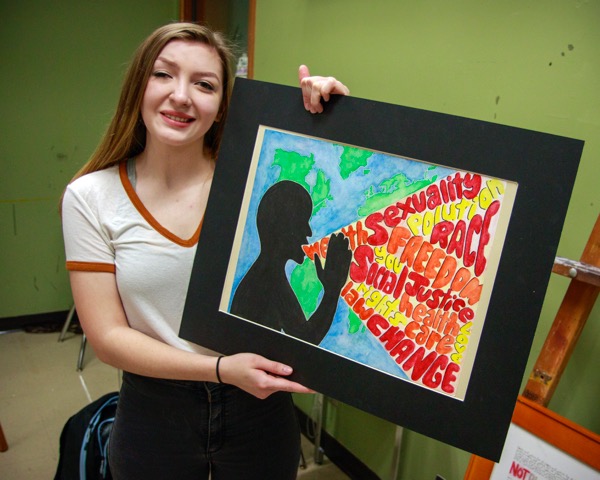
    Kyah Nelson, a sophomore, took the approach of featuring a silhouette of a man broadcasting social issues such as wealth, sexuality, race, and healthcare depicted on the background of a world map. “There are problems all over,” she said, adding that her inspiration for social justice comes from her grandpa, Jon Nelson, a former soldier who fought in Viet Nam.

    Kyah Nelson’s art shows social justice issues that need attention. (Photo by David Welton)

    Libby Hawkins, a junior, said her piece was based on the Pledge of Allegiance and its final phrase, “with liberty and justice for all,” which struck her as not equally practiced in our country. Her large piece contains the word “not” before words such as “blacks,” “LGBTQ,” “Muslims,” “immigrants,” “homeless,” “women,” “poor,” and “refugees.” “I got the idea for making this immediately after this year’s election,” she said.

    Libby Hawkins’ piece illustrates that “with liberty and justice for all” still excludes many Americans. (Photo by David Welton)

    Bethany Justus, a senior, drew a black-and-white portrait of Martin Luther King framed by his “I Have a Dream” speech. “His message is true and valuable today,” Justus said. “It has a positive ring to it.” Her inspiration is her English teacher, Miss Cave, who practices inclusivity with her students.

    Bethany Justus remembers Martin Luther King’s ‘I Have a Dream’ speech in her work about human rights. (Photo by David Welton)

    Alejandro Fredrickson, a sophomore, said transgender issues are important to him and created art depicting the prejudice of separate bathrooms for whites and people of color as compared to today, where transgender teens are singled out and segregated, much as blacks and whites were in the 1960s. “Trans rights are human rights,” he said.

    Alejandro Fredrickson’s piece compares segregation by color in the past with segregation by gender in modern days. (Photo by David Welton)

    Miki Lundy, a junior, made a piece featuring a woman’s face surrounded by harsh words, yet around her eyes and lips are words that she is loved. “The words outside are what people are calling her, yet inside she knows she is loved and worth more than she’ll ever know,” she says.

    Miki Lundy illustrates the need to be strong in the face of bullying words. (Photo by David Welton)

    Dakota Williams, a senior, painted a watercolor with the statement, “Illegal is not a noun,” illustrating her objection to calling people “illegal aliens.” “People need to be knowledgeable when they shout their opinions,” she said.

    Dakota Williams’ piece is about taking the time to use words with integrity and thought. (Photo by David Welton)

    Kareena DeClercq, a sophomore, said what is important to her is “What’s in your heart. I feel right now there’s a lot of discrimination against people, especially Muslims. Islam is a misunderstood religion.” In DeClercq’s piece, one face is illustrated with pupils depicting the Twin Towers and another with a brain depicting a nuclear war, both ways people from Muslim countries can be erroneously seen. At the bottom of the piece is a Muslim woman in a hijab surrounded by rainbows with a radiant heart.

    Looking at Muslim people as humans with hearts instead of as terrorists is depicted in Kareena DeClercq’s art. (Photo by David Welton)

    Lila Stach, a junior, drew an hourglass, with pieces of the earth trickling through over cities. “It is a slow trickle of what’s happening, pollution, water levels rising, global warming,” she said.

    Time is running out for the earth if we don’t act, is student Lila Stach’s statement for social justice. (Photo by David Welton)

    Carmen Warwick, a senior, chose human trafficking as the subject for her piece, “Not for Sale,” depicting a black and white drawing of a woman with a blank expression, conveying the numbness of the victim. “When I thought about social justice, this idea was brought to light in my head,” she said.

    Carmen Warwick chose the subject of human trafficking for her art theme. (Photo by David Welton)

    Anthony Murtha, a junior, drew a tree with a rope hanging from it. Death by hanging is still legal in this country and Murtha takes issue with the practice saying it is inhumane. His idea for the piece came from a family friend who was on death row in Texas and hanged.

    Anthony Murtha’s art depicts his opposition to legalized hanging. (Photo by David Welton)

    Mary Zisette, a sophomore, drew on the adage, “The rich get richer and the poor get poorer,” and featured a tearful man holding a sign. “Our problems are getting worse,” she said. “Here on the island we’re really lucky that people can get help.”

    Mary Zisette’s art depicts the theme “Equal Work for Equal Pay.” (Photo by David Welton)

    Emmalee Norris, a freshman, looked at uneven pay between men and woman and her piece depicts a man sitting on a higher tower of coins than the woman facing him. “I interviewed my mom, who works hard and doesn’t get paid as well as men do,” Norris said. “She’s lived with it. If women were paid as much as men were, poverty among working single mothers would drop.”

    Emmalee Norris advocates for equal pay for women. (Photo by David Welton)

    Expanding on Lila Stach’s theme of time running out for the Earth’s climate, the students later attended an assembly featuring Xiuhtezcatl (pronounced shoo-tez-cat) Martinez, a teen speaking about climate change. Sponsored in part by Sno-Isle Libraries and Humanities Washington, Martinez, an internationally known 16-year-old climate activist from Colorado and leader of Earth Guardians, spoke about the importance of caring for the Earth.

    “I used to think that climate change was a privileged older white people’s concern,” the indigenous young man, originally from Mexico, said. “But it is our responsibility to care for the earth as well. People have fallen out of love with the world.” Martinez received a community service award from President Obama and has been featured on HBO, ABC, Showtime, and PBS. He talked about the need to reconnect to the earth and to each other.

    With teens such as Martinez rallying students, Julie Glover is enthused by the growing interest in climate change and social justice island-wide. She met with South Whidbey High School’s drama club and green team last year and proposed using art as a means of educating young people about climate change issues. The collaboration has come to be known as CAP (the Climate Arts Project). 

    This year, CAP is designing and running the Earth Day activities at the high school as well as participating in an island-wide art show and also presenting a showcase performance at the Bayview Cash Store on April 19 on the subject of climate change.

    “You can see how much these young people have to offer, both through their art and through their conversation,” Glover says. Her aspiration is for youth to share their voices with the larger community, with many more teen art shows and performances in the future.

    “They are so worth listening to!” she says. “This is a real opportunity to celebrate the accomplishments of our young people, as well as to engage in a unique youth/adult exploration around the youth perspective on social justice issues. I can’t wait to see what they come up with this year.”

    Kate Poss worked as a library assistant at the Langley Library until last June when she retired. She worked for three summers as a chef aboard a small Alaskan tour boat from 2008 to 2010. She was a newspaper reporter in Los Angeles for many years before moving to Whidbey Island, where she likes cooking for new and old friends, hiking, reading great fiction, and writing her second novel with her superhero friend Fred Bixby.

    David Welton is a retired physician who has been a staff photographer for  Whidbey Life Magazine since its early days.  His work has also appeared in museums, art galleries, newspapers, regional and national magazines, books, non-profit publicity, and the back of the Whidbey Sea-Tac shuttle!

    __________________

    Have a great story idea? Let us know at info@whidbeylifemagazine.org.

    WLM stories and blogs are copyrighted and all rights are reserved. You may link to this story. To request permission to use or reprint content from this site, email info@whidbeylifemagazine.org.

  • The Floating Forest of South Whidbey

    The Floating Forest of South Whidbey

    BY KATE POSS
    Whidbey Life Magazine Contributor
    March 29, 2017

    An old-growth forest in balance is a rare gift worth preserving and celebrating, says Elliot Menashe, an environmental consultant who believes in working with nature instead of against it.

    Old-growth, forests, such as this one at South Whidbey State Park, help prevent soil erosion and clean the water used for drinking, says Elliott Menashe, an advocate of using existing natural landscape to maintain the integrity of the land. (Photo by David Welton)

    Menashe, a forestry graduate from UC Berkeley, now runs Greenbelt Consulting to educate clients in environmental management along with land assessment, mitigation, and restoration. On a rainy March morning, while walking the Wilbert Trail at South Whidbey State Park, Menashe gestures to a “floating forest” with his arms wide open. The woods capture his enthusiasm as much as the Seahawks capture football fans. This part of the park is composed of the interwoven roots of trees, some 300 to 1,000 years old, floating above a wetland.

    “The interconnection of laterally-growing roots protects the whole stand,” Menashe says. “If this were a cleared area, we’d have 30 times the amount of runoff you see now. With the kind of rain we’ve had, there would be a mud hole and a flash flood. The gentle creeks moderate the flow of water to slowly percolate into the aquifer.”

    Using a probe to measure the depth of water beneath the floating forest at South Whidbey State Park, Elliott Menashe explains that such forests are rare in modern days. (Photo by David Welton)

    The forest was saved from being clear-cut in 1977 when activists formed Save Our Trees and rallied, placing themselves between Department of Natural Resources chainsaws and the old growth trees. Save Our Trees raised private funds and, together with public money, eventually purchased the land and added it to South Whidbey State Park. Menashe says the very best of the old trees were logged years ago to rebuild San Francisco in the wake of the 1849 fire and to build ship masts. Yet old titan trees remain, towering over the forest, their lateral roots, growing on top of fallen ancestors, weaving together a carpet of moss, cones, needles, sticks and dirt that float above the wetland, which is lit by yellow and green swamp lanterns this time of year. Educational signs line the trail and describe the role of the floating forest and the interconnectedness of the land and fauna.

    Swamp lanterns, also known as skunk cabbage, are a sure sign of wetlands. Wetlands are protected on Whidbey Island and help keep our drinking water clean. (Photo by David Welton)

    “There is a whole world under our feet that we don’t consider,” Menashe says, taking a metal probe and inserting it into the forest duff between the lateral roots of a giant Sitka spruce. He reports that water is flowing within a few feet of the seemingly solid ground he is standing on. “That’s why you need to slow down and really look at what we have here. The trees communicate through an underground symbiotic and mutualistic soil relationship.” That relationship, Menashe says, helps ensure clean water, prevents erosion, and creates a balanced forest community. (To better understand how trees communicate with each other and cooperate with their environment, view Suzanne’s Simard’s TED talk.)

    “Fresh water, forested, mature old growth — there is almost none left in the Puget Sound lowlands,” Menashe says. “How much money does this cost society by not preserving them? It could take a thousand years to rebuild this if it were taken down.” Menashe says the trees, plants, and moss act as a sponge to prevent damage from storm water runoff. Plants absorb toxins and clean the water that flows into the aquifers that provide drinking water to much of South Whidbey.

    Students at the Calyx Community Arts School, a nature-based classroom in the former ranger’s home across the street from the floating forest, learn the importance of maintaining healthy forests and living in balance with nature.

    Lisa Kois founded Calyx following her work in South Asia as a human rights lawyer, writer, and documentary filmmaker. She uses the 347-acre classroom at South Whidbey State Park to teach the transformative powers of nature and the arts to students from ages five to 10.

    Lisa Kois, creator of the Calyx Community Arts School in South Whidbey State Park, believes in the power of nature as a classroom. (Photo by David Welton)

    Richard Louv, author of “Last Child in the Woods” and “The Nature Principle” documents the benefits that time spent in nature has on the development of the human brain. “Connection with nature and the multi-sensory experience that time outdoors provides opens neural pathways and facilitates learning of all kinds,” Kois writes on the Calyx website. “Time in nature helps children succeed in all areas of their lives and development — whether it’s learning to read or write or play a musical instrument or chart the phases of the moon.”

    A student at the Calyx Community Arts School takes part in the school’s outdoor classroom at South Whidbey State Park. (Photo by David Welton)

    Menashe says hope for the future lies in understanding the need to preserve our heritage forests, such as the floating forest of South Whidbey State Park. “When short-term economic gain is considered, the long-term ecosystem services that save society millions of dollars in restoration suffer. With preservation, we get clean water, lack of floods, and an aquifer recharge.”

    As Earth elders such as Menashe wonder whom to pass the torch of advocacy to, it’s a comfort to know that all they have to do is cross the street to Calyx.

    Kate Poss worked as a library assistant at the Langley Library until last June when she retired. She worked for three summers as a chef aboard a small Alaskan tour boat from 2008 to 2010. She was a newspaper reporter in Los Angeles for many years before moving to Whidbey Island, where she likes cooking for new and old friends, hiking, reading great fiction, and writing her second novel with her superhero friend Fred Bixby.

    __________________

    Have a great story idea? Let us know at info@whidbeylifemagazine.org.

    WLM stories and blogs are copyrighted and all rights are reserved. You may link to this story. To request permission to use or reprint content from this site, email info@whidbeylifemagazine.org.

  • Common People Doing Uncommon Work for the Common Good

    Common People Doing Uncommon Work for the Common Good

    BY KATE POSS
    Whidbey Life Magazine Contributor
    March 22, 2017

    International social artist Tannur Ali performs. A powerful line from one of her poems: “Our babies weren’t made in vain.” (Photo by David Welton)

    There are people who see problems in their communities and say, “Somebody should DO something about that!” And then there are people who roll up their sleeves and come up with solutions. The sixth annual Thriving Communities gathering at the Whidbey Institute last week was a celebration of problem-solvers who prove that community needs are best met by community members themselves.

    The theme this year was “Communities Poised on the Edge” and featured films and speakers addressing issues such as affordable housing, food security, local investing, diversity, mentoring new mothers, supporting people in their healing, and aging in place. In between presentations, guests were treated to performances by Tannur Ali, a powerful and distinctive social artistry poet who founded iLogic (Institute for the Love of Genius in Communities).

    Thriving Communities’ new films highlighted the Organic Farm School, Mother Mentors, and Healing Circles on South Whidbey, along with Portland entrepreneur, Franklin Jones’ B-Line Sustainable Urban Delivery, a robust sustainable delivery service that has found a growing niche.

    Judy Feldman, executive director of the Organic Farm School, talked about the need to teach farmers how to survive and thrive. She recalled when the program was on the edge: when grants ran out and land used for the classroom was no longer available. Thriving Communities’ Jerry Millhon connected her with Ron Sher, founder and CEO of Sher Partners, a family real estate and investment firm known for Third Place Books. Sher happens to own land in the Maxwelton Valley that became the home of the Organic Farm School.

    “After each wall we hit, I asked if we were still relevant,” Feldman said. “Thanks to Ron and Eva, and to Jerry, who did a video on us, now we have a phenomenal place and an eight-month-long program.”

    https://vimeo.com/207933014

    Thriving Communities is shepherded by Jerry Millhon, former director of the Whidbey Institute. A beloved elvish-like grandfather figure, Millhon connects those who have needs with those who can help.

    “The thing that we do best is find people (usually women) in communities that see a need and fill that need with the work they do,” says Millhon. “The story that is important is how they have used community capital (not financial capital) to bring a passion into fruition. And that is the story that opens up others to copy that in other communities. We think there are about 45 to 50 community members who have copied some aspect of the work and rooted it in their own community.”

    Jerry Millhon, right, left his post as executive director at the Whidbey Institute to shepherd Thriving Communities. (Photo courtesy of the Whidbey Institute)

    In addition to the Organic Farm School, the following organizations presented.

    Healing Circles in Langley was created by Diana and Kelly Lindsay and is associated with Commonweal Cancer Help Program, a national leader in cancer support. It provides low- to no-cost service that offers a safe sanctuary, social support, classes and conversation on a variety of topics from care for caregivers to a book group devoted to reading “A Year to Live: How to Live This Year as if It Were Your Last,” by Stephen and Ondrea Levine. “We are a lab whose idea is spreading across the country,” Diana Lindsay says.

    Mother Mentors of Whidbey Island was founded in 2009 by Kristin Lasher, a grandmother who saw the need for mothers to find ways out of isolation and connect with other moms and their children. Providing mentoring for moms and Playscape programs for children, the program has expanded to Oak Harbor. “Parents can have adult conversations, get their basic needs of support met, and learn the basic knowledge of parenting,” says Kate Grossman McVay, executive director for Mother Mentors.

    Other presenters included:

    Lynn Willeford, front, a ‘serial starter-upper’ talked about her latest project, South Whidbey at Home. She sits with Pam Schell, of the Inn at Langley, who is active in providing support for community non-profits. (Photo by David Welton)
    • Judy Alexander, of 2020 in Port Townsend, and Katie Raines, of GRuB in Olympia, who spoke about food security.
    • Steve Shapiro, of Whidbey Island Local Lending (WILL), who spoke about local investing.
    • Andrea Caupain, of Centerstone in Seattle, and Victoria Santos, of Young Women Empowered, also in Seattle, who spoke about the challenges and opportunities in communities of diversity.
    Katie Raines, executive director of Olympia’s GRuB, talks about the community-creating, farm and food program. (Photo by David Welton)

    Year by year, the Thriving Communities gathering yields more videos and stories about inspirational organizations that bring healing and resilience to their communities. It showcases the best in us — inspiring the rest of us.

    Kate Poss worked as a library assistant at the Langley Library until last June when she retired. She worked for three summers as a chef aboard a small Alaskan tour boat from 2008 to 2010. She was a newspaper reporter in Los Angeles for many years before moving to Whidbey Island, where she likes cooking for new and old friends, hiking, reading great fiction, and writing her second novel with her superhero friend Fred Bixby.

    __________________

    Have a great story idea? Let us know at info@whidbeylifemagazine.org.

    WLM stories and blogs are copyrighted and all rights are reserved. You may link to this story. To request permission to use or reprint content from this site, email info@whidbeylifemagazine.org.

  • Spreading the Joy of Music in Oak Harbor

    Spreading the Joy of Music in Oak Harbor

    BY KATE POSS
    Whidbey Life Magazine Contributor
    March 8, 2017

    Inside a petite New Zealander is a whole lot of joy in music-making that she shares with other moms, their ukuleles, and the Oak Harbor community.

    Mary Clarity, here in Oak Harbor with her Navy husband and family for a while, is from Hawks Bay in New Zealand. Her accented voice adds to the natural appeal and energy that flows easily into her friendly chatter and can-do-ness.

    Mary Clarity and her daughter. Mary is the driving force behind the Ukuladies of Oak Harbor. (Photo by Kara Chappell)

    On Mondays, she and a group of “Ukuladies” gather to practice music, get their kids together, and drink coffee.

    We meet at Aisha Mayfield’s cozy home. Preschoolers run around playing with trucks. As we walk in, Mayfield announces that her mom’s scones are fresh from the oven and walks out of the kitchen with a plate of them. Buttery, flaky, warm. When Elizabeth Westfall walks in, Mayfield says, “You want your usual?” and Westfall does — a butter pecan iced coffee.

    Elizabeth Westfall and Aisha Mayfield sing harmony while playing “Hallelujah.” (Photo by Kate Poss)

    “Aisha’s got an awesome coffee machine,” Clarity says.

    “This will change your life,” Westfall agrees, sipping her coffee.

    “We’re all mums who enjoy getting together,” says Clarity. “It all began as a bit of a joke. You can’t get kicked out. We play our music for the joy of it. We throw cheese sticks and raisin boxes to the kids to keep them happy. We just started collecting songs, and now we’ve got a whole volume of them. There are creative people in our group and we naturally find the harmony.”

    After coffee, scones, and greetings the ladies sit cross-legged on the floor, on couches, and chairs. They play “I’ll Fly Away,” and Mayfield’s dad Oliver joins in the singing while leaning against the kitchen doorway. Next, they sing Leonard Cohen’s “Hallelujah,” and the preschoolers who were playing come and sit with their moms.

    Mayfield sings high harmony while playing her ukulele, which is etched with spirals for the word peace in different languages.

    https://vimeo.com/200834285

    Playing ukulele together naturally creates friendships in this easy group and as a result, the ladies gather at Whidbey Island Coffee, the Roller Barn, and the Terrace Wine Bar and Bistro to play. “Every couple of months, we go to the wine bar and play and cackle and have the best interactions with the customers,” Clarity says.

    Since she and her fellow Ukuladies have such a good time together, Clarity thought, why not make a video? “I get ideas, and they seem ridiculous and preposterous,” Clarity says. “My friend Amy Madson took the video.”

    It’s called “Oak Harbor Love Song,” and is an ode to the whales, eagles, water, and friends having a good time, despite the fact that it takes a while to drive to Target and Costco. 

    Along with having fun, Clarity says, the goal of the Ukuladies is to teach parents to make music with their kids.

    Jen Collins says that, although she went to college for vocal performance, after becoming a mom, she lost track of singing until joining the Ukuladies. The musical inspiration clicked, and she and Clarity collaborated to teach a parent and preschooler class, along with an intergenerational music class on Fridays at a retirement community in Oak Harbor called “Music Together.”

    Jen Collins, a Ukuladies member, teaches an intergenerational class to share music with people of all ages. (Photo by David Welton)

    Gathered around the fireplace last Friday were a dozen or so senior citizens waiting for the music to begin. They were soon joined by parents who walked in with their preschool children. Collins hosted the morning, playing her ukulele and singing good morning to the families and the gathered residents.

    When the bell bracelets were brought out and the little people handed them to the seniors to join in, Telael Sibertang, a staff member at the retirement community said, “This is my favorite part. It gets the residents engaged.”

    Children hand bell bracelets to residents, so they can participate in the music (Photo by David Welton)

    Indeed. The singing and interaction with parents, toddlers and seniors was catching. After the bell song was over, Collins handed out colorful scarves and played a recording of “Twist and Shout.” Children and their parents danced with abandon and seniors raised their hands over their heads, grooving to the music.

    Everyone sang to resident Linda du Brae to celebrate her birthday. “I love this,” she said.

    At the end of each song, Collins sang about putting the instruments back in their boxes and baskets and gathered maracas, tambourines, and egg shakers for “When the Saints Go Marching In.” All were caught up in singing and playing and two residents sitting together on the couch tapped their maracas together in time to the music.

    Staff member Telael Sibertang (standing) says she likes Music Together because it engages residents. (Photo by David Welton)

    The 45 minutes passed quickly, and Collins ended the class by singing goodbye to everyone until the following week. A little boy named Oliver hugged her.

    Resident Victoria “Tori” Hayden said she liked the music so much that she had to play some for herself and walked to the piano where she sat down and played some old tunes from her time.

    “She reminds me of my grandma,” Collins said, watching Hayden play with abandon and certainty.

    Another resident, Janice McCaffery, said she enjoys the visits each week. “Life gets away from us if we don’t take time to enjoy it,” she added.

    Residents click maracas together during a Music Together intergenerational class created by Ukuladies Mary Clarity and Jen Collins. (Photo by David Welton)

    Afterward, Collins said she uses songs from the seniors’ generation, 1940s songs, and some rock and roll thrown in when playing at the retirement community in Oak Harbor and at other senior centers in Anacortes.

    “The residents are great,” she adds. “So many studies talk about the benefits of integrating preschool children and seniors. I grew up in the church, and have respect for the older generation. Mary is the epitome of a lovely free spirit, and I’m excited about what we do. You can do the Music Together curriculum for years and never repeat a song. It’s a wonderful world program.”

    Kate Poss worked as a library assistant at the Langley Library until last June. She was thrilled to work for three summers as a chef aboard a small Alaskan tour boat from 2008 to 2010. She was a newspaper reporter in Los Angeles for many years before moving to Whidbey Island, where she likes “talking story,” hiking, hosting salons, and writing her novel.

    __________________

    Have a great story idea? Let us know at info@whidbeylifemagazine.org.

    WLM stories and blogs are copyrighted and all rights are reserved. You may link to this story. To request permission to use or reprint content from this site, email info@whidbeylifemagazine.org.

  • An ‘Un-Conventional’ Mystery

    An ‘Un-Conventional’ Mystery

    BY KATE POSS
    Whidbey Life Magazine Contributor
    February 22, 2017

    It’s a lot of fun to have coffee with Loretta Martin, the writer behind the mysteries of Langley’s Mystery Weekend. Who wouldn’t enjoy it? Writing mysteries for Langley’s Mystery Weekend each year, and seeing them brought to life by improv actors, makes her happy.

    Dare to solve the murder with other amateur detectives Feb. 25 and 26 for Langley’s 33rd annual “Mystery Weekend: An ‘Un-Conventional’ Murder.” There are 34 characters this year, some of them posing as science fiction conventioneers — “members” of the International Society of Science Fiction Arts and Technology or ISSFAT. These characters are behind-the-scenes folks who operate the cameras, act as engineers, do makeup, and design costumes in the sci-fi world.

    “I have worked behind the camera,” says Martin, who has a background in creating and producing local television shows.

    In character as a police officer, Loretta Martin calls in a clue for Mystery Weekend (Photo by David Welton)

    The sci-fi convention arrives nearly two months after a “sighting” of a Sasquatch in the Saratoga Woods on New Year’s Day, so the story goes. The tween who “saw” the local Bigfoot reports it on Facebook, and the story goes viral, drawing hunters and protectors of the hairy mystery-beast. The weekend’s remaining actors are those who are either Bigfoot Friends, those who wish to see the Sasquatch stuffed as a trophy, and the regular cast of characters including: I.B. Fuzz, her cousin Hagetha Kisstea, Gussie and Gus Gruesome, and the 49ers, a zany band of codgers always looking to make a quick buck — this year on “Sasquatch Sausage” and root beer made of Sasquatch scat for an “earthy” taste. A hairy gorilla-type creature is found dead behind the Saratoga Inn, and this is where the sleuthing begins.

    Annie Horton, who has performed in most of the Mystery Weekends, plays the character of Shari Fissure this year, the widow of the murdered character. As an homage to Carrie Fisher, who died Dec. 27, Horton’s character models Fisher’s Princess Leia of “Star Wars.” Shari Fissure, though, wears a hairdo of actual cinnamon buns on the sides of her head.

    “I predict the phrase of the weekend will be, ‘Love your buns,’” Horton says.

    Some of this year’s actors in Mystery Weekend featuring Sasquatch friends and enemies, science fiction conventioneers, and other characters. (Photo by Sharon Lundahl)

    While many of the actors return again and again, there are new faces adding to Mystery Weekend this year.

    Lilly van Gerbig, co-owner of Langley’s Fair Trade Outfitters, along with her husband Barry, is acting for the first time.

    “I’m playing Lilly Landtree, an animal lover and a good friend to Bigfoot Friends,” van Gerbig said. “Our store is a sanctuary for Bigfoot Friends. I’m a little eccentric and I wear charms and necklaces. I am a staunch protector of Bigfoot. I think it’s really fun. I’m excited to do it.”

    Van Gerbig said, while she’s “not theatrical,” she does enjoy interacting with customers in her store. Last year Fair Trade Outfitters provided a clue in solving “Much Ado About Murder: A Hare-Raising Tale.”

    The 49ers Men’s Club have a get-rich scheme this year, including selling Sasquatch sausage and Sasquatch rootbeer, known for its secret ingredient (Photo by Sharon Lundahl)

    The way Mystery Weekend works is that local businesses pay a small fee to the Langley Chamber to offer a clue. Visitors buy a $10 ticket from the chamber, which includes a map and locations of all the available clues, along with a copy of the “Langley Gazette.” Sleuths visit the businesses, collect clues, and guess who the culprit was at a 5 p.m. gathering Sunday afternoon at the Langley Middle School.

    “Josh (Hauser of Moonraker Books) said I should be a character, this year,” van Gerbig says. “I love being with my customers, so I thought, what can you lose? It was fun last year, just seeing the excitement and meeting people who have done this for years. It is amazing to me. They’re bringing their children and grandchildren. No one knows who the murderer is. Everyone is a suspect. You have to play like you might be one or should be one. I think Loretta is a genius. I love her.”

    Even the actors who play the characters don’t know who the murderer is until it’s revealed on Sunday evening. It’s the only part that’s scripted.

    Annie Horton has performed in nearly every Mystery Weekend over the past 33 years. (Photo by Sharon Lundahl)

    “We tell people that, when interviewing the suspects, they shouldn’t believe everyone, because one is the murderer and has (every) reason to lie,” says Martin. “The mystery is solved by getting clues, interacting with the suspects, and reading the story in “The Langley Gazette.”

    Josh Hauser, owner of the Moonraker bookstore in Langley, has been a character in every mystery weekend but one. This year, she is cast as a bookstore owner. She recalled one of her favorite roles from days gone by.

    “It was my best costume year. I had set up a business of ill repute upstairs,” Hauser says. “I found a red taffeta strapless evening gown. I’ve committed the murder twice. One day (during a previous Mystery Weekend), I was across the street and there were people walking by with signs to save our slugs. Someone thought it was a real small-town protest.”

    “Officer” Loretta Martin”says suspects are “arrested” by Langley police on Langley Mystery Weekend (Photo by David Welton)

    The first mystery Martin wrote was 18 years ago, when she worked as director for the Langley Chamber.

    “It was an homage to the Titanic, and we called ours ‘The Wreck of the Calista,’ based on a boat that wrecked, here” Martin says. She described a jewel she loved at Wayward Sons, then, and used it as a device to help steer the story. “It was a $3,000 brooch, that had a large blue opal with rose gold vines and peridot and pink topaz. It would have looked good on a big girl like me. I had a long-time Langley resident play the part of an opera singer who wore the pin and is murdered by a spear-gun. The actor had to be off island that weekend, so I suggested we use the photo we already had of her as the photo of the “victim” opera singer in the mystery. We both thought that would be fine. I used her photo in the obituary, with the (Mystery Weekend) headline: “Opera Singer Murdered.” I got a call from her mother asking, ‘What happened to my daughter?’ The ‘Mystery’ newspaper is usally inserted in the real newspaper, and her mom started getting calls asking what happened to her daughter.”

    Since then, Martin said the victims have always been fictitious and not part of the cast.

    Barbara MacCallum, a Langley bed and breakfast owner, used to work with Martin at the chamber during the “Heads in Beds” campaign to entice visitors to the island during the winter. She recalls previous Mystery Weekends in which the Mosquito Fleet transported sleuths from Seattle to the Langley marina (and guests were told who the murderer was on the way home), bed and breakfast baking contests, cookbooks; all ways to bring out-of-towners to the island during the dark days of February. “Loretta’s imagination is phenomenal,” MacCallum says. “She comes up with clues, creates the characters, and the solution.”

    Martin moved to Whidbey Island, a place she had visited since she was a child, to heal from complications due to a back surgery nearly 20 years ago.

    “When I was diagnosed (and had to take months of antibiotic treatment as a result), I was so weak,” Martin recalls. “My mom and dad said I should move to their house on Mutiny Bay. I feel there’s a healing energy on Whidbey Island. I’ve always felt it. When we moved here, my husband Dewey landed a job in his field (construction). I worked at Whidbey General Hospital and wrote “The Pulse,” the hospital’s magazine. Then I landed the job at the chamber. The connections I’ve made are so important. Just keeping in touch means so much to me. It’s all about networking, especially with women. It’s why I support the Soroptimists.”

    Regarding creating stories for Mystery Weekend, Martin says, “When I’m writing, it’s my favorite time of the year. The most fun thing is that it is not a linear (or scripted) story, but one that is done in improv by the actors. They bring the story to life in new ways I couldn’t imagine. When I see them in costume, (it’s like) J.K. Rowling might feel when she sees her characters come to life in a ‘Harry Potter’ movie. I’m so lucky that way.”

    Michaleen McGarry, executive director of the Langley chamber of commerce, designed this retro poster advertising this year’s Mystery Weekend Feb. 25 and 26. (Photo by David Welton)

    A couple of local businesses will carry Mystery Weekend-related merchandise. Sprinklz Ice Cream Parlor and Coffee Shop in Langley and Casey’s Crafts, on Hwy 525 near Bayview Road, now carry Sasquatch-themed items. Laurie Davenport, who owns Casey’s, said she will host a Bigfoot treasure hunt throughout the store as well.

    Sharpen your Sasquatch-sighting skills the night before Mystery Weekend at the Langley Library, which will host David George Gordon, author of “The Sasquatch Seeker’s Field Manual: Using Citizen Science to Uncover North America’s Most Elusive Creature,” on Friday, Feb. 24, at 6:30 p.m.

    Betty Freeman, visitor center representative for the Langley chamber of commerce, suggests buying tickets ahead of time. The chamber almost sold out of tickets last year and did sell out of 2016 Mystery Weekend T-shirts and sweatshirts. Order early. T-shirts are $20 and hoodies are $35. They are adorned with the vintage Sci-Fi logo seen on posters around town.

    Kate Poss worked as a library assistant at the Langley Library until last June when she retired. She worked for three summers as a chef aboard a small Alaskan tour boat from 2008 to 2010. She was a newspaper reporter in Los Angeles for many years before moving to Whidbey Island where she likes cooking for new and hold friends,’hiking, reading great fiction and writing her novel.

    __________________

    CLICK HERE to read more WLM stories and blogs. Have a great story idea? Let us know at info@whidbeylifemagazine.org.

    WLM stories and blogs are copyrighted and all rights are reserved. Linking is permitted. To request permission to use or reprint content from this site, email info@whidbeylifemagazine.org.

  • Building Bridges of Understanding

    Building Bridges of Understanding

    BY KATE POSS
    Whidbey Life Magazine Contributor
    February 15, 2017

    These days, deciding whether to smile on our brother or to turn away seems more difficult. At the Northwest Language and Cultural Center in Langley, kindergarteners are learning to smile on their brothers and sisters, even though they may look different or do things another way.

    On a very rainy Thursday in Langley last week, five- and six-year-olds were learning simple Chinese words, such as ni hao for hello, laoshi for teacher, and xiexie for thank you. They sampled comforting Chinese rice porridge made by a kindly Chinese chef and learned to make sticky rice balls and lanterns, celebrating Lunar New Year. The Year of the Rooster began Jan. 28.

    Students learn how to say simple Chinese words such as hello, teacher, and thank you. (Photo by David Welton)

    The idea of bridging cultures has found form through Josette Hendrix, founder and director of the Northwest Language and Cultural Center. The guesthouse and center have celebrated viva la difference for the past 20 years, hosting families from other countries, teaching English immersion and culture, and an appreciation of the natural beauty of Whidbey Island. During the past two years, the center has opened its doors via the Global Culture Experience program to Langley Middle School students and, as of last September, to kindergartners from South Whidbey Elementary School.

    “The concept, at its core idea, is to present, in face-to-face settings, a way that allows students to have a primary experience with a native culture,” Hendrix said on a bustling day when nearly 80 kindergartners, along with parent volunteers and teachers, rotated between Chinese culture games, crafts, movement, music, storytelling, and cooking. “The students can form a relationship to others and understand each other as human beings.”

    Chef Andre Liu enjoys teaching kindergartners how to make Chinese comfort food. (Photo by David Welton)

    To that end, Justine Boren, a kindergartner, said, that her favorite class was, “Cooking!”

    It’s easy to understand Boren’s enthusiasm when meeting Andrei Liu, who drives from Anacortes to cook for the little people and teaches them how to make comfort food from Northern China. Liu’s warmth and heartfelt cooking can permeate his rice, spinach, mushroom, ginger, and tofu porridge. He taught students how to make sticky rice balls in celebration of the new year.

    “This is very simple and healthy and makes the stomach feel good,” Liu said, his voice flavored with a Chinese accent. “Things [about teaching children to cook] move me. One of the kids hugged me, a natural love. They ask me if they can have more, and some parents use my recipes. I believe cooking is an art. If you rush, rush, food is no good.”

    Liu, who manages an art gallery in Anacortes, said he once worked as a cook in San Francisco restaurants. The porridge recipe is his mother’s, who is nearly 90 and healthy, due, in part, to her cooking.

    South Whidbey kindergartners learn how to make sticky rice balls in celebration of the Year of the Rooster. (Photo by David Welton)

    Suzanne Wong-Scollon, who is of Chinese descent, moved to Whidbey Island a year ago, after visiting the island off and on over the past 50 years. On this Thursday morning, she played guitar for the kindergartners, leading them in a song written by Maria Ellis, a Russian-born teacher who helps Hendrix run the center. Around an inflated globe on the covered porch, the children sang Ellis’ Global Cultures song:

    We go around the globe
    Discovering its wonders
    Everywhere we meet new friends.
    In the south, north, east, west
    We’ll find out what is best.
    In heart we are all the same.
    We go around the globe
    Discovering its wonders.
    Everywhere we meet new friends.
    Spanish, Kenyan, Chinese, Japanese and Lebanese…
    In heart we are all the same.”

    “We promote hands-on participation with native speakers, Ellis said. “I’m amazed at how quickly the kids pick up the accent and pronunciation. I speak five languages and cannot speak Chinese as well as these students can.”

    Rene Neff, a former South Whidbey Elementary school teacher, volunteers for her granddaughter’s class. (Photo by David Welton)

    Rene Neff, a retired and beloved teacher from South Whidbey, now accompanies her granddaughter Ophebia to the weekly Thursday cultural immersion.

    “I think this is a great program,” Neff said. “The children get a lot of exposure to different cultures. It’s a lot of fun.”

    After lunch, a regal CeCe Hier, originally from Bejing and now a resident of Maple Valley on the mainland, hosts a rambunctious group of kindergartners and teaches them about the traditions of Lunar New Year. She folded her hands together under her chin and said that is a Chinese version of a hug. Later, she showed students how the new year is celebrated with Chinese families. In the Chinese culture, lanterns with riddles on them are lit and float away in the night sky. There are gods to pray to for wealth in the coming year. There are sweet rice balls to make and eat.

    Students learn the Chinese art of fan dancing (Photo by David Welton)

    “Today, we believe that people need to interact with each other much more, human to human, heart to heart,” Hendrix wrote in a Feb. 3 blog post for NWLACC. “Through such cultural exchanges, there can be greater understanding that other values and norms are as valid as our own, often containing sides to the truth that we may have lost or forgotten.”

    With public schools’ funding deficits, the program is carried by NWLACC, which is seeking grants and donations to continue funding it. For more information, contact the Northwest Language and Cultural Center.

    Kate Poss worked as a library assistant at the Langley Library until last June. She was thrilled to work for three summers as a chef aboard a small Alaskan tour boat from 2008 to 2010. She was a newspaper reporter in Los Angeles for many years before moving to Whidbey Island, where she likes “talking story,” hiking, hosting salons, and writing her novel.

    __________________

    To read more WLM stories and blogs, click here. Have a great story idea? Let us know at info@whidbeylifemagazine.org.

    WLM stories and blogs are copyrighted and all rights are reserved. You may link to this story. To request permission to use or reprint content from this site, email info@whidbeylifemagazine.org.

  • A Place to Call Your Own

    A Place to Call Your Own

    BY KATE POSS
    Whidbey Life Magazine Contributor
    February 9, 2017

    Ever dream about having a place to call your own? Drive around the island, and you’ll find workshops, barns, and studios that house creative tinkerers, writers, artists, and gardeners. Scattered like fairytale flowers among them are whimsical sheds, chicken coops, and garden houses built by Bob Bowling, of Bob Bowling Rustics on Bayview Road in Langley. Few can resist a tiny shingled beauty with antique windows on three sides, French doors, and a weathervane perched on a tin roof. Bowling has been filling custom orders for playhouses and other small structures for the past eight years.

    Alan and Charlene Cohen asked Bob Bowling to design this custom garden house that adds a sense of place to their backyard. (Photo by Kate Poss)

    Alan and Charlene Cohen of Langley fell in love with the charm of Bowling’s tiny garden houses at the Bayview Farmer’s Market some five years ago. Wanting to create a sense of place in their backyard, the Cohens worked with Bowling to design and build a custom beauty with red shingles, the same shade as their house, French doors, awnings, and antique windows that opened out from the bottom.

    “Ever since he put it in the back yard, it felt like it has always belonged here,” says Charlene Cohen, gazing out through the winter mist last week at the fairy-tale cottage in her backyard. “It’s too nice to be a shed, so we call it a garden house. Initially, we’d sit inside and look out the French doors during afternoon cocktails. It has a more practical use now, as a garden shed for tools and garden soil.”

    Cohen says it was impressive to watch delivery of the little garden house in her alley above Saratoga Passage. It arrived one day on the flatbed of a Hanson’s Building Supply delivery truck and was lifted by crane into their backyard.

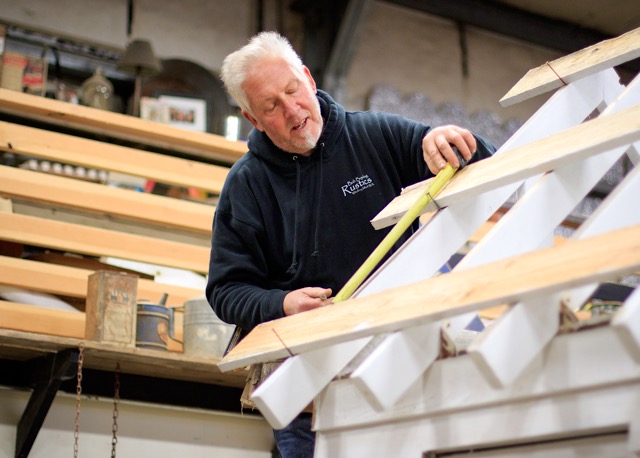
    Bob Bowling works to complete whimsical tiny garden houses for the upcoming Northwest Garden Show in Seattle, Feb. 22 to 26. (Photo by David Welton)

    These days, Bowling is working around the clock, getting ready for the upcoming Northwest Garden Show at the Seattle Convention Center Feb. 22 to 26. There, he will join more than 300 exhibitors at one of the premier garden shows in the state. He’s found it to be a good venue to inspire future business. Located in Booth 302, one of Bowling’s stars of this year’s show is a rustic beauty perched on top of a vintage truck bed graced with an antique sink and yellow fenders.

    “I step it up,” Bowling says of how he works with his wife Julie Spangler to add pretty details such as fresh flowers, lamps and books to the tiny houses that feature Julie’s handmade linen pinafores on display “It’ll be a parade of trucks going to Seattle with the fully-decorated houses on board. We’re the first ones in and last one out. In the past, we’ve won Best of Show awards and Best Presentation. It’s a matter of personal pride to get the houses just right. It’s a lot of work. Last year, I built four houses in five weeks for the show.”

    Using a vintage truck bed as a base, Bowling adds a rustic cabin. It will be one of his models at the Northwest Garden Show. (Photo by David Welton)

    A lifestyle change brought Bowling to Whidbey Island in 2004. The former flooring contractor became an artist, designer, and builder of whimsical birdhouses and garden houses made of recycled and reclaimed material.

    “If you had asked me 20 years ago if I’d be living on an island one day, I wouldn’t have believed it,” he says. “When I arrived here, I rented a barn from Sandy Whiting of Goosefoot to work in. Good people. A little over two years ago, I moved to my location here (at 5789 Bayview Road). Goosefoot did the lighting and remodeled it. It’s beautiful with the light coming in.

    Foraging for material at Island Recycling, Bowling finds old windows and doors, antique coffee cans, restaurant vents, and loads of other castoff things. Using his imagination and construction expertise, he fashions the treasures into weather vanes, birdhouses, and bric-a-brac to adorn the facade and interiors of the garden houses or chicken coops.

    While the house accessories are typically made of recycled and reclaimed material, the framework is comprised of new lumber. “We want them to hold up in the weather,” Bowling says.

    Birdhouses made of vintage coffee cans and repurposed material. Bowling often finds treasures at Island Recycling. (Photo by David Welton)

    Many of Bowling’s customers are women, some wanting a “little chapel” others wanting a cozy place of their own. “They’ll tell me, ‘My husband says he’ll build me one someday,’ and I tell them they can have one in no time,” Bowling says. “It’s a space to decorate.”

    One of Bowling’s buildings is a dreamy, storybook tea house installed at a farmhouse on Bayview Road owned by the Gabelein family. It was featured as one of the highlighted gardens on the 2016 Whidbey Island Garden Tour

    The tea house at the Gabelein farmhouse (Photo by David Welton)

    “It’s fun work,” Bowling says. “I like making a little rooftop cupola out of an old funnel. It’s the cherry on the top.”

    Kate Poss worked as a library assistant at the Langley Library until last June. She was thrilled to work for three summers as a chef aboard a small Alaskan tour boat from 2008 to 2010. She was a newspaper reporter in Los Angeles for many years before moving to Whidbey Island, where she likes “talking story,” hiking, hosting salons, and writing her novel.

    __________________

    To read more WLM stories and blogs, click here. Have a great story idea? Let us know at info@whidbeylifemagazine.org.

    WLM stories and blogs are copyrighted and all rights are reserved. You may link to this story. To request permission to use or reprint content from this site, email info@whidbeylifemagazine.org.

  • Practicing the Fine Art of Bricolage

    Practicing the Fine Art of Bricolage

    BY KATE POSS
    Whidbey Life Magazine Contributor
    January 25, 2017

    Tom Lindsay, known to many as the Bubble Man, has another life, one of a bricoleur.

    Lindsay likes using the French word to describe himself, which means a tinkerer or someone who makes things from available material. His latest bricolage is an outdoor playscape for children of the Fifth Street Commons in Langley, where Lindsay lives.

    Ideas arise in Lindsay as easily as most of us breathe, and the playscape he imagined, designed, and built with fellow commoners, is a place of wood, metal, and quirky functional castoffs built on a peninsula that’s surrounded by the community rain garden. Lindsay hopes it will be the place for children to let their imagination roam by day and adults to toast each other with spirits by night.

    Tom Lindsay celebrates the completion of the play structure. The metal rings that support the tower walls behind him are from old cable reels donated by Whidbey Telecom. (Photo by David Welton)

    The basis for the playscape was a backyard project created by a Renton firefighter for his grandchildren. Its central component was a silo that had been turned upside down and converted into rocket ship. Lindsay found it on Craig’s List and, along with fellow commoners, disassembled it and brought it home to Whidbey Island.

    The complete playscape. Note the prow of the old Bush Point Resort row boat on the bridge (Photo by Ross Chapin)

    Using the components of one play structure as the basis for another was a collaborative effort, Lindsay says, and adds, “I must mention the enormous contribution that Robert Scully made. He’s an associate member of the Fifth Street Commons who lives in SeaTac. He spent three full weekends welding much of the metal structure together. The Bridge Tower would not have been possible without his pro-bono help, and I’d love to express our gratitude to him.”

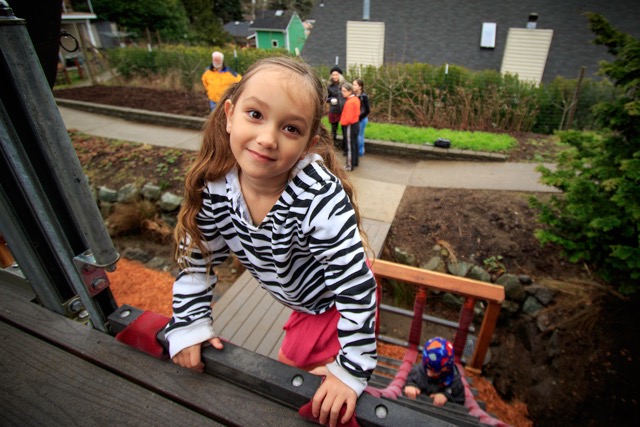
    Rose Hess and friend climb a ladder made of old fire hoses and salvaged composite lumber from Island Recycling (Photo by David Welton)

    Imagine, if you will, a section of Langley’s Castle Park play structure, cloned and transplanted to this intentional community and given a total makeover with Lindsay’s treasures. People can drive a 1940s-era Dodge truck using a vintage Chevrolet steering wheel, and opposite that, they can use an antique ship’s wheel to pilot an original rental row boat that was used at Bush Point Resort back in the ‘60s. An antique fire bucket on a Chinese windlass will soon allow treasures to be cranked up to the second story from below without crashing back down, and old fire hoses become vertical blinds that create a secret hideout in a tower made from metal cable spools donated by Whidbey Telecom. This is what bricolage is all about.

    Teresa Hess drives the Dodge. Behind her is the ship’s wheel and old row boat from Bush Point Resort. The roof of the tower above Hess’ head is the top of a grain silo. (Photo by David Welton)

    The end result, still in the making, is a design pleasing to the eye. “All of my aesthetics are checked with a neighbor who stares down at the structure,” Lindsay says. “The devil is in the details.”

    Lindsay’s playful design sense comes from his years of creating children’s exhibits at museums, notably his work as director of exhibits at the Children’s Discovery Museum in San Jose, California, and most recently at the Hands On Children’s Museum in Olympia, Washington.

    Combining a kids’ sense of play with design engineering expertise earned at Stanford, Lindsay enjoys scrounging for treasures. He’s found a goldmine at Island Recycling in Freeland, and excitedly shows cast-off building materials, such as metal support beams, that he found there and used in the playscape.

    Cooper Zachritz prepares to jump through the fire hose ladder. (Photo by David Welton)

    The Fifth Street Commons began as the Northwind Apartments in 1996 and is made up of 16 one- and two-bedroom units. It was purchased in 2012 and converted into co-housing built on the intention stated on the association’s website: “Rather than merely seeking shelter, we come to be part of caring and sharing community.” There’s a sense of can-do-ness and right feeling there.

    “People are awesome here,” Lindsay said, coming out of the cold on a mid-January afternoon into the Common House, wearing a Dijon-mustard-colored Carhartt thermal coverall. “What works here are the different skills and interests people have. After moving here, I got excited about building something for the kids.

    Cooper Zachritz and Fiona Hess on the slide that came from the original salvaged play structure. The black disk that the top of the slide is mounted to is one side of a cable spool donated by Whidbey Telecom. (Photo by David Welton)

    Teresa Hess, who sees the playscape outside the sliding glass door of her living room, says, “The playscape is a work of art! Tom used a variety of materials, and each element (boat, car, fire hose, silo, etc.) has a story behind it — where it came from, what it was used for previously, who helped transform it to be used on the playscape — and all the elements combine to make a unique, beautiful, and imaginative creation. And, most importantly: the kids love it! The playscape is a fantastic contribution to our community.”

    Gina Diamond takes advantage of features that were built in for use by the community’s grown-ups. (Photo by David Welton)

    Fifth Street Commons children were first invited to play on the playscape at 2:30 on Sunday, January 22. That evening, Teresa’s husband Cory Hess, sent an email message to the entire Commons community, saying that their 10-year-old daughter Rose and her 12-year-old friend played on the structure for hours in the cold and dark.

    Rose’s 5-year-old sister Fiona shares her enthusiasm. When she climbed the firehose ladder for the first time, and then went down the slide, she headed back to the ladder and said, “I’m going to be doing this a LOT.”

    Roul McDowell reaches for a toy grader that Tom Lindsay played with as a child. (David Welton)

    Kate Poss worked as a library assistant at the Langley Library until last June. She was thrilled to work for three summers as a chef aboard a small Alaskan tour boat from 2008 to 2010. She was a newspaper reporter in Los Angeles for many years before moving to Whidbey Island, where she likes “talking story,” hiking, hosting salons, and writing her novel.

    __________________

    To read more WLM stories and blogs, click here. Have a great story idea? Let us know at info@whidbeylifemagazine.org.

    WLM stories and blogs are copyrighted and all rights are reserved. You may link to this story. To request permission to use or reprint content from this site, email info@whidbeylifemagazine.org.

  • Saying Goodbye to a Langley Legacy

    Saying Goodbye to a Langley Legacy

    BY KATE POSS
    Whidbey Life Magazine Contributor
    December 27, 2016

    Cafe Langley served its last dinners on Friday Dec. 23, ending an era of a beloved restaurant owned by the brothers Garibyan.

    Shant and Archie Garibyan opened Cafe Langley a little over 27 years ago and introduced islanders and visitors to Mediterranean fare — even though they were told that a regular “meat and potatoes” place was what everyone in town wanted.

    “They told us no one eats lamb here,” recalls Archie Garibyan of the first months the cafe was open and the brothers served up a menu of lamb and chicken kabobs, hummus, dolmas, and spanakopita.

    One of the classic city images is of Cafe Langley diners seated inside the glowing windows, looking out at the water, toasting each other, enjoying island fare such as crab cakes and Penn Cove mussels, which the Garibyan brothers featured in a variety of dishes.

    Street view of Langley Cafe. (Photo by David Welton)

    The Armenian brothers left Istanbul when they were in their late teens and moved to California during the 1970s, where they worked for a cousin in the Los Angeles area in the waste management business. There, they met members of the Karamanyan family, whose brother Zaven had an upholstery business in Langley.

    “They came numerous times to visit,” says Karamanyan, of Karaman Custom Furniture. “Archie told me he’d buy property here if they had the money, and later they did.”

    The brothers saved their money and bought a barber/beauty shop on First Street, next to the Star Store, in 1988, and by the following year had turned it into a restaurant that coincided with the opening of the Inn at Langley down the street. Despite the naysayers who doubted such exotic food as Armenian-influenced Mediterranean fare would appeal to the public, the public flocked to the new restaurant and the brothers were up until the wee hours cleaning up and getting ready for the next day’s business. Through prosperity and lean times alike, the restaurant stayed open for nearly three decades. Last week, members of the community showed up to enjoy good meals and to reminisce.

    Archie’s daughter Katya, who has been running the restaurant on her own with a skeleton crew for the past few months, says she had to buy more lamb to serve all the regular diners wanting Cafe Langley’s delicious lamb chops and lamb kabobs one last time.

    Katya and her father Archie Garibyan during the last few days before Cafe Langley closed. (Photo by David Welton)

    “People are coming in and sharing their memories,” a busy, but still gracious, Katya says, taking a brief break to talk in between lunch and dinner guests last week. “It’s been chaos this week, but I love it. It’s been a fun run.”

    Katya has worked with her father and uncle for years, starting out bussing tables and waitressing and recently learning how to cook and learning how to manage the small family business.

    Shant’s wife Carrie says that Whidbey Island reminded her late husband of the Princes’ Islands, off the coast of Istanbul, where his family used to vacation. The brothers’ family owned an Armenian deli in the Istanbul area, which planted the seed for her husband and brother-in-law’s future restaurant.

    The Garibyan deli in Istanbul. (Photo courtesy of the Garibyan family)

    Like her cousin Katya, Amara (Shant and Carrie’s daughter), says she’s been a part of the restaurant for as long as she can remember.

    “I helped my dad with lots of chores and did odd jobs,” Amara says. “I rolled coins. Later I helped with bussing and hostessing. My favorite dish was pasta with onion, tomatoes, and chicken. Our comfort food. ”

    Long-time friends and Langley residents, Frank and Janet Ploof were early and regular visitors to Cafe Langley. Archie says that before one of the couple’s visits to Turkey, they asked what souvenir they should bring back.

    “I told them to bring me a Turkish chef,” Archie says. “They talked a man into leaving his job as a hotel chef, and he ended up working for us for four years.  He developed a huge menu, with seven to eight specials a day.”

    Later, the brothers Garibyan hired Pat Powers as the main chef. She has worked with them for the past twenty years and oversaw final preparation of meals last Friday night.

    “Much of our staff are like family to us,” Archie says, recalling that children of their original employees worked at the restaurant over the years.

    Cafe Langley staff: Julie Roberts, Jenna Alexander, Sativsh Gilbertson, Archie Garibyan, Marlee Quintasket, Pat Towers, and Katya Garibyan. (Photo by David Welton)

    The brothers often gave young people a leg up in the working world as well. One such young woman was Cherese Taggart, whose first job was at Cafe Langley about a decade ago. She later became a professional chef, worked on cruise ships, earned her boat captain’s license, traveled the world, and now lives in Portland.

    “It was my first real job,” Taggart says. “I started out washing dishes, but they noticed my eagerness to learn and soon taught me the salad station and everything else I wanted to know. Pat was especially helpful and encouraging.  I spent just shy of three years there. It was a great place to start and learn about the restaurant industry.”

    On a rainy Friday night, Cafe Langley was brightly lit and smelled deliciously of savory food. The atmosphere was festive, with friends dining on delicious fare and drinking wine.

    Langley residents Sharen Heath and her husband Simon Frazer joined diners last Friday to celebrate Cafe Langley’s legacy and to say goodbye to their old friends.

    “For Simon and me, Cafe Langley has always been a trusted go-to place,” Heath says. “Brothers Shant and Archie created one of those cozy cafes where we never doubted that we’d enjoy delicious food and wine, exchange a fun chat with friendly and familiar staff, feel the warmth of its seaside ambiance, and be confident that we were getting good value. For that reason, we never hesitated recommending Cafe Langley to our guests. And we especially loved those nights when the two of us would be lucky enough to sit in the front window. We’d watch friends walk by, feeling like we had front row seats in the charming life of Langley. For all these reasons, we shall dearly miss Cafe Langley and thank them for all these years.”

    On the night of the “Last Supper,” as some of the diners called it, Cafe Langley was packed with well-wishers. Fred and Sharon Lundahl of Music for the Eyes sat at a table with friends. After dinner, Fred brought his harmonica out and walked over to a table where Archie sat with Katya. Fred asked the crowd to join him in singing “Auld Lang Syne” and “For He’s a Jolly Good Fellow.” Diners raised their glasses and sang. Katya and Archie wiped tears from their eyes, but the feeling was festive and upbeat and poignant.

    This week, the family hosts an estate sale at the restaurant. While some of the beautiful pieces of furniture and restaurant signs were purchased by friends wanting to keep a piece of history, there are other items for sale Dec. 28 and 29. For more information, visit their website.

    Kate Poss worked as a library assistant at the Langley Library until last June. She was thrilled to work for three summers as a chef aboard a small Alaskan tour boat from 2008 to 2010. She was a newspaper reporter in Los Angeles for many years before moving to Whidbey Island, where she likes “talking story,” hiking, hosting salons, and writing her novel.

    __________________

    To read more WLM stories and blogs, click here. Have a great story idea? Let us know at info@whidbeylifemagazine.org.

    WLM stories and blogs are copyrighted and all rights are reserved. You may link to this story. To request permission to use or reprint content from this site, email info@whidbeylifemagazine.org.