OK, I admit it. I’m old. Even by Whidbey Island standards. I’m not a millennial, or a Gen Y’er or a Gen X’er, or even a Baby Boomer.
I’m a War Baby. No, not the one in Iraq and Afghanistan, not the Gulf War, not Vietnam, not Korea, nor any of the other military mis-adventures through which I’ve lived. I’m talking the Big One. Dubya-Dubya-Eye-Eye. The Greatest Generation and so forth.
But enough of this. No reason to tell you my exact birthdate; Social Security and Medicare already know it.
What got me started on this age rant was some fascinating demographic information about our beloved Rock that I’ve examined recently as part of my seemingly endless quest for occasionally useful information. Much of what follows comes from a very good website called city-data.com.
Of Whidbey’s estimated population of about 78,500, the median age (half above, half below) is 43.2 years. For Washington State it’s 36.4 years and for the entire United States it’s 36.8. Dig a little deeper and it gets even more interesting.
LANGLEY
Mirror, mirror on the wall: Which Whidbey town is grayest of all? It’s Langley (aka 98260), of course, with a median age of 57. But Langley insists 57 isn’t old – it’s a good time, vigorous, still very active, productive, engaged. Believe it! No wonder so many Baby Boomers who were career-downsized in the past decade have fled to Langley to reinvent themselves and to find the creative bliss and passion of the second half of their lives.
COUPEVILLE
Coupeville (aka 98239) is our second-grayest town, with a median age of 51—a very limber, still-toned and hike-loving time of life. Believe that, too!
OAK HARBOR
And, no surprise at all, our Rock “baby” is Oak Harbor (aka 98277) with a peach-fuzz median age of just 29. That’s what happens when the sailors hit town.
Youth tips the scales on the north end of Whidbey. In Langley, just 15 percent of the population is under age 20; it’s no wonder that South Whidbey has empty schoolrooms. Coupeville isn’t much better with a bit over 18 percent who are under 20 years old. But Oak Harbor—bursting with kids and very short of schoolrooms—has a whopping 31 percent under 20.
At the gray end of the scale, a smidgen more than 42 percent of Langley’s population is over 60 years old and more than 9 percent is over 80. Coupeville’s over-60 crowd represents just over 36 percent of the total population and almost 11 percent is over 80. (Yes, the Careage of Whidbey nursing home skews that last number somewhat, but Coupeville still wins the geezer sweepstakes.)
In diaper-covered Oak Harbor, just under 14 percent of the population is over 60 and only 3 percent is over 80. (Those must mostly be the aging vets that hang out for coffee and war stories at the Navy Exchange every morning.)
There are benefits to having so many shades of gray on our Rock. Thanks to still-dependable pensions, our poverty rate is lower than the state average. In North and Central Whidbey, the number of people living below the poverty level is about 8 percent, and in South Whidbey it’s 6.7 percent. The state figure is 10.6 percent.
Langley, thanks in part to so many well-off retirees, has a higher median home value ($341,599) than the state as a whole ($287,700). Clearly, Coupeville ($256,969) and Oak Harbor ($246,050) will need to recruit more deep-pocket oldsters if they want to catch up.
Our Rock economy is also bolstered by older people who are still working. Almost 28 percent of the island workforce (not counting active-duty military) is older than 55, compared with almost 23 percent statewide.
And here may be the most intriguing element of all: More than 57 percent of our civilian workforce is female, a figure that has grown steadily in recent years. We all know that women live longer. Apparently, on the Rock, they also work longer.
Once upon a time, Harry Anderson made an honest living as a reporter, editor and columnist at the Los Angeles Times.He now lives in central Whidbey, where he spends his time gardening and ruminating on things that interest him.
WLM stories and blogs are copyrighted and all rights are reserved. Linking is permitted. To request permission to use or reprint content from this site, email info@whidbeylifemagazine.org.
BY HARRY ANDERSON
Whidbey Life Magazine Contributor
January 20, 2016
Nancy Conard first came to Coupeville when she was a year and a half old; her dad was in the Navy. That was in 1953, and she proves it by showing a picture of herself as a tow-headed toddler playing on the beach at Ebey’s Landing. What’s remarkable is that, except for a brief stretch after high school, she’s never lived any place else.
Toddler Nancy Conard at Ebey’s Landing, 1955 (photo furnished by Nancy Conard)
“I feel so fortunate to live where I grew up,” she said “It’s comfortable to be around the memories of your whole life in a very nurturing environment. And being able to contribute some in public service is kind of my pay back.”
“Contribute some” is a modest understatement, a typical posture for Nancy Conard. She retired the first of this year after serving 20 years as mayor of Coupeville, with four years before that on the town council. In the past couple of months, she has received numerous tributes from Whidbey and the state for her achievements and her people-pleasing disposition.
As she talked about her life and public service, the memories began to pour out. Coupeville’s population was less than 400 when her family moved to town but, by 1960, it had almost doubled to 740, much of it due to growth at the Navy base in neighboring Oak Harbor. (The town population in 2014, per the latest Census Bureau estimate, was 1,860.)
Conard with her younger sister, Maureen, outside their Coupeville home, 1955 (photo furnished by Nancy Conard)
“Coupeville was a small town but we had a lot of kids,” Conard said. “We lived right across the street from a playground where we all congregated, unsupervised by adults. We made up games and built play forts. There was a well house in one corner and one of the maintenance men attached his rock polisher to the pump and he let us go pull out agates while they were polishing. I’ve been fascinated by agates ever since.”
She and all the kids walked unescorted up the sometimes-muddy path along Main Street to Coupeville Elementary School. No need to wait for the famous Coupeville stoplight; it didn’t exist because Highway 20 wasn’t built until the 1960s.
The Conards lived next door to Polly Harpole’s Maternity Home on Haller Street, a local institution where many babies were born before Whidbey General Hospital opened in 1970. Conard and her sister Maureen, two years younger, were excited when Polly let them come over and see the babies through the window.
“It was the Baby Boom and there were lots of babies being born,” she said. “At Polly’s they used to make bracelets to identify the babies, with their names in little cube letters. Polly let my sister and me put the letters together.”
At Coupeville High School, Conard was a good student and a classic over-achiever. She was treasurer; class vice president and sergeant at arms; on the honor roll; editor of the Wolves Howl; a member of the drama, pep and girls clubs; a sports team manager and a performer in the school plays.
Conard’s Coupeville High School graduation picture, class of 1970 (photo furnished by Nancy Conard)
“I think there were 36 kids in my graduating class of 1970,” she said, “and at least 24 of us had been together since kindergarten.”
After high school, she headed off to America—actually, it was Shoreline Community College—where she studied to be a dental hygienist. “But we had a fairly dysfunctional family and, after a year, I ended up feeling like I needed to come home and help my mom with some stuff.”
That turn of events, which might have depressed a less positive person, actually proved to be a launching pad for Nancy Conard. Through an early 1970s job-training program, she landed a job at the Coupeville School District as a part-time office clerk and part-time lunchroom helper. “By then my mom had moved and I was a young adult living on my own, and the school cooks really nurtured and took care of me. I still have their recipe for hamburger gravy, and today it’s (her husband) Gordon’s absolute favorite meal.”
From there she gradually climbed the ladder at the school district, first as a secretary and then as assistant to the superintendent. Impressed by her business and people skills, the superintendent took a leap of faith in 1977 and promoted her to district business manager, responsible for such things as accounting, financial reporting and negotiating contracts. It was a job she held for 27 years, until she retired in 2004.
In that position, Conard won accolades and eventually became president of the Washington State Association of School Business Officials, the first representative of a small district to serve in the position. And it drew her notices at home, as well; friends urged to run for Coupeville Town Council when openings come up in 1992.
“I was blessed with a good work ethic and, maybe because the oldest child of alcoholic parents, I’m just naturally prone to be a workaholic and a people pleaser,” she said.
All her skills were put to the test almost from the minute she was elected. There was tension in the town over growth issues, with newcomers pitted against long-time residents. The election of 1992 was virtually a clean sweep, bringing in three new council members and a new mayor.
“I ran because I was so devoted to my hometown and I gravitated toward wanting to be a leader,” she recalled.
The leadership challenges were growing; the times were changing. The town population more than doubled between 1970 and 1990. Whidbey General Hospital was built. The new high school and middle school were constructed. The county jail and administration offices were expanded. Two mobile home parks were opened. The Ebey’s Landing National Historical Reserve was created. And—creating a fair portion of the tension between newcomers and long-timers—several apartment buildings and multi-family residences sprang up in a town that had rarely seen them before.
In addition, tourism was becoming a huge part of the local economy and that changed the town. “Tourism has been good for Coupeville because it has made it possible to make a decent living with a business in our historic buildings. Front Street today is geared for tourists, but when I grew up it was where you went for everything, including food, the Post Office and several gas stations.”
In 1995, the mayor’s position was open and Conard ran unopposed. “I saw some changes I wanted to make,” she said, in her understated manner. The first was to fire the police chief, with whom she had major disagreements. “I tried to work with him and we had a mediation, but it failed.”
It was a painful episode for a natural people-pleaser. “We had public meetings and a lot of people were upset with me,” she recalled. “An angry man at one of the meetings actually stood up and yelled at me to ‘get back in the kitchen,’ which was awkward and insulting.”
In response, her sister Maureen wrote a letter to the editor of the local newspaper in which she said “[Nancy] doesn’t belong in the kitchen because she doesn’t cook that well” and “what she’s doing is what she does well.”
Conard, dressed as Frosty The Snowman, in the annual “Greening of Coupeville Parade.” (photo by Megan Hansen, The Whidbey Examiner)
Twenty years later, the firing of the police chief and the aftermath still remains with her as the hardest thing she’s handled as mayor. But the next few years became a “golden time,” with the hiring of the new police chief, a clerk-treasurer and a town planner all about the same time. “We were all people who wanted to get things done,” she said. “We thought up things and we got them done. It was a fun, productive time.”
But in the early 2000s, things got difficult again. “We had a rather nasty time with more growth tension, especially over subdividing property. So the old tension with the status quo versus growth came back with a vengeance. I’ve lived through several cycles of it,” she added. When the economy nosedived in 2008, growth—and therefore the tension it brought—slowed dramatically.
Then, on New Year’s Eve 2009, the mayor’s personal life changed drastically. At a party, she met Gordon McMillan, a widower with a home on Snakelum Point just outside the town limits of Coupeville. A whirlwind courtship ensued and they married in July 2011; the two are currently raising Gordon’s granddaughter, Madison, at their home. “I had been thinking about retiring anyway when my term ended in 2015, but marriage and a granddaughter to help raise made the decision easier.”
As she looks back, she’s generally pleased at what she sees. “In the past 20 or 30 years, it has been really cool for me to see the diversity of people who have moved to Coupeville and what they’ve brought. It’s added so much more depth and richness to our community. And the nice part is that I think the community’s personality hasn’t been spoiled, or changed that much. People come because of what they see here, and they know it’s up to them to perpetuate that.”
But she’s also a frank realist. “Coupeville is not a place to be if you have a lot of problems or have very low income and are pulling yourself up by your bootstraps,” she said. “We just don’t have a lot to offer. This is a community that supports our neighbors through thick and thin. But that’s not the case if you move here needing a lot.”
Conard, husband Gordon McMillan and their granddaughter Madison, leaving for a cruise to Mexico in late December (photo furnished by Nancy Conard)
As the clock ticked down to her term’s end last month, she worried a bit about having “withdrawals” from a job that has required her full attention for a very long time. But she already has her eye on several projects in which she plans to get involved.
And, to ease her transition, Nancy, Gordon and Madison left just before Christmas on a cruise to Mexico. That was something Her Honor, the Mayor, never had time for.
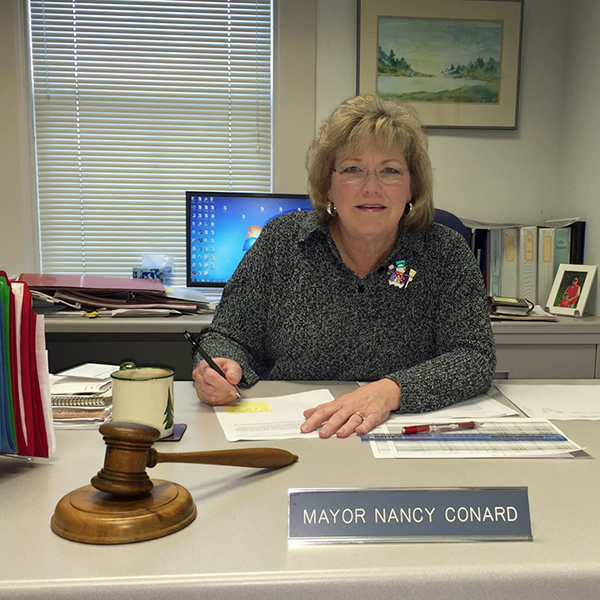
Image at top: Mayor Conard at her desk, a week before she retired (photo by Harry Anderson)
Once upon a time, Harry Anderson made an honest living as a reporter, editor and columnist at the Los Angeles Times. He now lives in central Whidbey, where he spends his time gardening and ruminating on things that interest him.
WLM stories and blogs are copyrighted and all rights are reserved. Linking is permitted. To request permission to use or reprint content from this site, email info@whidbeylifemagazine.org.
It was dark and dank outside, one of those January days on our Rock when I wish we really had bought that condo in Palm Springs, locked up and flown south, like most birds have the good sense to do. But, as I gazed out my window at the wet desolation, my mind would not stop pondering my vegetable garden.
Ah, that wonderful, fertile, 20-foot-by-40-foot space where I spent such happy hours with the sun overhead and my hands in the dirt in spring, summer and fall. Oh, the tomatoes! And the sweet Walla Walla onions! And the Yukon Gold potatoes! And the zucchini, snow peas, beets, cauliflower and cucumbers! All just fond memories now, of course, though some remain embalmed in Mason jars and freezer bags.
I bundled up in flannel, fleece and wool, pulled on the waterproof boots and strolled out to the muddy, half-frozen garden. The winter wind and rain had not been kind. Half stuck in the mud lay the forlorn little ceramic plaque that had been tossed off the post where it once had proudly hung. “God bless this garden and all who enter in,” it reads. Indeed, divine blessings are needed now more than ever.
Over in the corner, I spotted the broken fan blade of the cute garden whirligig that had succumbed after five nasty, windy Whidbey winters. The old sailor in the little red rowboat, so salty with his white beard and pipe and his yellow Nor’easter hat and coat, had pulled his last oar.
I saw the gray, lifeless remnants of the three zucchini plants that kept producing squash even as frost encroached. I blamed myself for not uprooting them and giving them a proper burial in the compost pile, as I had with all the other vegetable plants. I looked in amazement at the many weeds that had sprouted, despite the cold weather, since last I applied the hoe. Why is it that these weeds can grow so heartily even when everything else is dead or dormant?
In the other corner, I saw the plastic basket I had used to harvest the garden’s abundance and cart it into the house. I had forgotten to take it in, so it filled with rainwater during December’s deluge and then froze into a solid block of ice.
Even as I surveyed the devastation, however, something in me began to stir. Next year, I’ll plan more potatoes and fewer beans. More carrots, fewer zucchini. Yes, and maybe I’ll add a raised bed or two, and some drip irrigation hoses. Something about a garden always makes hope spring eternal.
But first things first, I thought. Send the lawn mowers out to get serviced. If you don’t book that service early on the Rock, you may have hay before your mower is ready. Prune the fruit trees now. The hard frost has made them dormant, but who knows how long that will last given the changing climate. And if you don’t prune, your apples may be the size of prunes.
Put on the gloves and get out there and pull those weeds, then add some compost and till that soil. It’s never too early or too cold. You want a good harvest? Get off your lazy winter butt and get started.
Ah, all that day-dreaming really felt good. It’s so hard to get motivated during this dreary time of year. I feel so much better now. I’m eager for spring to be sprung.
Once upon a time, Harry Anderson made an honest living as a reporter, editor and columnist at the Los Angeles Times.He now lives in central Whidbey, where he spends his time gardening and ruminating on things that interest him. (photos by the author)
WLM stories and blogs are copyrighted and all rights are reserved. Linking is permitted. To request permission to use or reprint content from this site, email info@whidbeylifemagazine.org.
This is the time of year we hear a lot about religion. Mostly about Christianity because of Christmas, but also about Judaism because of Hanukkah. There are also significant days this month for Muslims, Buddhists, Zoroastrians and pagans. And there are spiritual overtones for many African Americans who celebrate Kwanzaa as a festival of family, community and culture.
There is even more religious noise this year, sadly, because of the recent terror attacks in Paris and San Bernardino linked to followers of radical Islam. There’s been a lot of nasty talk against Muslims, hand-wringing about God forsaking America, and broadcast praise of God— but usually only the one preferred by Christians, especially Evangelicals. Some even complain about a so-called “War on Christmas,” citing coffee cups as evidence.
Much has been said about our nation’s deeply held Judeo-Christian “values.” But here on our Rock, at least, most of us seem to be agnostic about religion. The other day I perused some fascinating statistics compiled by something called the U.S. Religion Census, which gathers information from the federal census as well as a variety of religious sources.
Here’s what it shows: Almost 77 percent of us in Island County say we have no religious affiliation at all. That’s right, more than three-quarters of us. The other 23 percent break down as Evangelical Protestants (9.6 percent), mainline Protestants (6.6 percent), Catholics (3.8 percent) and Others (3.2 percent).
The census also shows that the “None” category actually increased a hefty 18 percent from 2000 to 2010 to a whopping 60,245 islanders. Adherents of Evangelical Protestantism rose by an astonishing 51 percent to 7,546 during that period. Meanwhile, Mainline Protestant membership dropped by a bit more than one percent to 5,207 and Catholic membership fell almost 60 percent to just 2,962. “Other”—a catch-all that includes Jews, Hindus, Unitarians and every other faith—jumped 53 percent to 2,546.
All this teaches me a variety of things. First, based on these numbers, I have to believe that most of those who proclaim Judeo-Christian values don’t have a very deep grasp of the source material. They have probably absorbed it second- or third-hand, but most haven’t been to a church or synagogue since they were taken to one in childhood. Except maybe for those rare visits on Easter or Yom Kippur, if dragged by someone near and dear.
Second, the growth of Evangelical Protestantism on our Rock explains the huge number of storefront, oddly named churches that have sprung up all around us in recent years. (Not sure if we, as yet, have things like “Church of the Eternal Bedspring of Life” or “Tabernacle of Universal Ecstasy,” but just wait. There are lots of empty storefronts available.)
Third, when I talk with some in the “None” category, I often hear the same refrain: “I’m a spiritual person but I’m just not religious.” When I ask why, the answer is usually a version of “church isn’t relevant to me; it doesn’t grab me.”
And finally, I am really troubled by how some forms of religion have overtaken our political dialogue in recent years. From abortion to terrorism to gay rights—loud, conservative religious voices seem to have a stranglehold that prevents political compromise. Since “None” is the largest religious affiliation we have around here, I wish that huge majority would flex its muscles and demand a return to separation of church and state.
Truth in publishing: I am a fervent Mainline Protestant (hopefully that’s not an oxymoron). I am a proud member of an Episcopal church, and I attend services almost every Sunday. But my faith doesn’t require yelling. Thank God!
Once upon a time, Harry Anderson made an honest living as a reporter, editor and columnist at the Los Angeles Times. He now lives in central Whidbey, where he spends his time gardening and ruminating on things that interest him.
WLM stories and blogs are copyrighted and all rights are reserved. Linking is permitted. To request permission to use or reprint content from this site, email info@whidbeylifemagazine.org.
BY HARRY ANDERSON Whidbey Life Magazine Contributor
November 18, 2015
Halloween’s come and gone, but I’m still scared half out of my wits. It was bad enough to be confronted by all manner of vampires, goblins, witches and Caitlyn Jenner look-alikes at those parties on Oct. 31. But the real horror began after midnight—at 2 a.m. on Nov. 1, to be exact.
That marked the annual “fall back” to Standard Time. Until then, it had been getting dark around 6:30 p.m., but that Sunday afternoon it started getting dark at 5:30 p.m. And, in about a month, it will be pitch black not much later than 4:30 p.m. That can be terrifying everywhere, but much more so here on the Rock.
Why is it worse on Whidbey? Three words: Driving after dark. Ask anyone who drives down Saratoga Road to Langley at night. Or Maxwelton Road. Or West Beach Road. Or Jones Road, east of Hwy. 20, north of Dugualla Bay. Or Lone Lake Road or Goss Lake Road.
Or even our beloved, if spooky, Hwy. 525/20.
When I lived in big cities like Los Angeles and Dallas, driving after dark was no big deal. Lots of big mercury vapor lamps all over the place made it bright as day pretty much everywhere. But as soon as I moved to Whidbey, I starting hearing people say, “Oh my no, I never drive after dark. It scares me to death!” Of course, like any newcomer, I thought they were all a bunch of wimps. Who’s afraid of the dark? Grow up, people!
But in relatively short order, I learned why it is that so many people here make dinner reservations at 5:30 and prefer afternoon matinees at The Clyde. Yikes! It gets really dark! And the few road lamps you see along our country byways seem to have 25-watt bulbs in them.
And can we talk about high-beam headlights? Everybody on this Rock is so small-town polite and civil when you meet them at the market or on a hike. So careful not to offend. But why is it that some of us become rude, inconsiderate Big City jerks when it comes to high beams?
The other night I was heading south on the curve by the Navy’s Outlying Field near Coupeville. First, I was blinded in my rearview mirror by a set of those LED lamps that surround headlights on some new cars. I thought I was being pursued by a warlock from Hogwarts. Fortunately, the warlock turned left on Welcher Road, an area notorious for witchcraft.
But then I was caught in the oncoming glare of some high beams so intense that I thought I was having a Close Encounter of the Third Kind and was about to be abducted by aliens. I gritted my teeth and let out a progressive’s howl at what I assumed was a big tractor-trailer driven by some thoughtless off-island Teamster on his way to deliver a bunch of stuff made in China to some big-box store in Oak Harbor.
Imagine my chagrin when I saw that the giant coming at me in the other lane was actually a Prius driven by an elderly woman. I thought high beams were illegal on a Prius. Don’t they violate that whole hybrid, use-less-energy, greener-than-thou narrative?
That experience left me simmering with very unkind, very un-Whidbey thoughts. I knew I had to change how I live. Want to meet at Prima Bistro for dinner? Let’s make it 5:30. I’ll call for a reservation!
Once upon a time, Harry Anderson made an honest living as a reporter, editor and columnist at the Los Angeles Times.He now lives in central Whidbey, where he spends his time gardening and ruminating on things that interest him.
WLM stories and blogs are copyrighted and all rights are reserved. Linking is permitted. To request permission to use or reprint content from this site, email info@whidbeylifemagazine.org.
Are you spending sleepless nights fretting about the Really Big One? Not me. I prefer to enjoy this beautiful, sunny summer in blissful and purposeful denial.
By now, I expect that you—as just about every other human being west of the Cascades—are aware of Kathryn Schulz’s terrifying piece in the July 20 issue of The New Yorker magazine about the catastrophic earthquake that will hit the Pacific Northwest any day now. The best of our world’s geologic minds have determined that our gorgeous corner of the earth lies on a gigantic tectonic fault line that has suffered an earthquake of magnitude 9.0 or greater, on average every 243 years. And we are currently 72 years overdue. Yikes! Lions and tigers and bears, oh my!
The last Really Big One—these brilliant minds have determined—occurred about 9 p.m. on Jan. 26, 1700. The tsunami that followed swamped everything from modern-day Forks to Mount Vernon with a 100-foot tidal wave. Oral traditions from about that time among some native peoples in Neah Bay and Vancouver Island recall the drowning of a whole village, with their canoes left hanging in trees. That Really Big One also left a souvenir still visible today: a “ghost forest” of red cedars killed by sea water several miles inland along the banks of the Copalis River.
With the insensitive bedside manner of a truly arrogant brain surgeon, our regional director of FEMA is quoted as making this statement, sure to fray everyone’s nerves: “Our operating assumption is that everything west of Interstate 5 will be toast.” Yikes! Raptors and pterodactyls and tyrannosaurus rexes, oh my!
Think about what this means.
Buh-bye to Skagit Head and Useless Bay Colony and Keystone and Fort Casey and the Deception Pass Bridge. Not to mention Bayview Nursery, the Star Store, the Goose, Whidbey Pies and Fraser’s Gourmet Hideaway, to name a few. No need to keep waiting impatiently for The Dog House to reopen in Langley; it won’t. And why bother preserving historic structures like Jacob Ebey’s House or the Greenbank Barn or the Seaplane Hangar in Oak Harbor? They’ll be driftwood soon.
It also means our farmers will quit worrying about drought and start learning about hydroponics. Or perhaps, if the tsunami subsides enough, their farms will become seaside resorts with scuba-diving adventures thrown in. The controversy over Navy jet noise will be over; Outlying Field in Coupeville will be a brackish lake. Perhaps Oak Harbor’s Naval Air Station will become a submarine training center. Aquarium tours will replace farmers’ markets. Whidbey Grown labels will be wrapped around bunches of seaweed instead of radishes. Boat-to-table will replace farm-to-table.
It’s all just too much to think about. I choose not to let it trouble my pretty little head. When the Really Big One happens, we’ll make the best of it. We’ll clamor aboard our RV and head to the Okanogan country. Hopefully the RV will stay afloat long enough for us to row it to dry land somewhere near Sedro-Woolley.
Even though we’re 72 years overdue for The Really Big One, I will not let it spoil this moment. Until we become toast, I’ll simply enjoy some toast—preferably slathered with lots of jam made with the Bell’s Farm strawberries I picked last June.
Once upon a time, Harry Anderson made an honest living as a reporter, editor and columnist at the Los Angeles Times. He now lives in central Whidbey, where he spends his time gardening and ruminating on things that interest him.
WLM stories and blogs are copyrighted and all rights are reserved. Linking is permitted. To request permission to use or reprint content from this site, email info@whidbeylifemagazine.org.
For most of my life, I lived in big cities and drove crowded freeways with aplomb. In Los Angeles, I could maneuver my sensible, four-cylinder Volvo sedan on the insanely congested I-405 with the skill of a Maserati owner. I stuck to the inside lane of the I-10 and made it from my Santa Monica apartment to my job in downtown El Lay in half an hour. (That, sadly, is no longer possible, given today’s gridlock.)
After I moved to Dallas, I followed the advice of native-born Texans and stuck to the toll roads whenever possible. Drunks and the uninsured make the Lone Star State’s “free”-ways a free-for-all, I was warned. (Texans likes to brag about their low taxes, but they neglect to mention that they really soak you with tolls on their “un-free” ways.) On the toll roads you can go as fast as your Texas swagger desires, dodging in and out of Hummers, Lexuses, Escalades and Mercedes along the way. Scary but fun.
Since I moved to Whidbey Island six years ago, however, I have celebrated our delightful absence of freeways with loud hosannas. And today, whenever I must travel to America I feel my sphincter muscles tighten the moment I exit this beloved Rock on my way to the dreaded I-5.
The joy of seeing and hearing “The Divine Miss M” makes the trip off Whidbey worth the effort.
The worst I have to deal with on our two-lane Highway 525 (which, for no discernible purpose, changes its name to Highway 20 mid-island) is getting behind a 40-foot RV driven by an 80-year-old Canadian doing a leisurely 45 miles per hour while I’m hoping to get from Coupeville to the Bayview Farmers Market before noon.
Actually there is one thing worse than that: Having my bumper hugged by a tourist couple in a rented convertible, fresh from a romantic, bed-and-breakfast sojourn, anxiously egging me to do the 75 miles per hour they need in order to make the Clinton ferry, which boards in 10 minutes. Thanks so much for visiting our beautiful island! Slow down and feel the bliss!
Those agonies are quickly forgotten, however, when confronted by the sheer terror a Rock dweller faces in mainland crowds, traffic and congestion. Earlier this month, my spouse and I attended a concert by Bette Midler—the Divine Miss M herself—at the Key Arena in Seattle. The performance was supposed to start at 8 p.m. Figuring that we ought to give ourselves lots of time, we left our mid-island home at 3 p.m. We sped down our island highway and caught the 4 p.m. ferry. Things ground to a halt on the (misnamed) Mukilteo Speedway. Traffic on the I-5 was surprisingly light for a weekday afternoon until we hit the University District: gridlock and exhaust fumes all the way to the well-named Mercer Mess.
If you like people, Key Arena, with a “full house,” is the place to be.
We had been advised to park in one of the parking structures near Seattle Center. For a Rock dweller unused to anything other than the free lot next to the Red Apple, it was painful to pay $10 and spend 15 minutes to find an open space on the fourth level.
I must admit that it was exhilarating to be among the urban hoard flooding into the Key Arena, gawking at the overpriced Bette souvenirs, drinking a $7 beer and finding our seats among the sea of humanity. Being polite Rock dwellers, we took our seats 15 minutes before show time. How naively non-urban of us. Latecomers, undoubtedly rushing in from some Skyped meeting that ran late at their high-tech, six-figure jobs, were still streaming in at 8:15, and the show didn’t start until 8:20. By then the tiny amount of leg space was giving me cramps.
The only reason for this much Stage Lighting would be to see a star like Bette Midler
Miss M did not disappoint, however. We felt almost as young as we were when we saw her the first time in 1976. For two hours, we were transported out of the urban jungle to Bette’s unique corner of the universe. How good to know that some things really don’t change.
Then reality returned.
As soon as Bette sang the last, sweet, candle-lit note of “From a Distance,” all 15,000 of us jumped from our seats and rushed for our cars—desperate to be among the first to get the hell out of there. It made me ponder what God must actually think as she watches us “from a distance.”
Unfortunately, parked on the fourth level of the Mercer Garage, getting the hell out quickly was not part of the God’s plan. Lots of bad urban behavior ensued: cutting in line, horn-honking, middle-finger waving. Being Rock dwellers, we controlled ourselves with simple teeth-gnashing and mind visions of Ebey’s Landing, as the interminable line of cars half-inched forward.
It took 45 minutes to go one mile from the garage to the I-5 on-ramp. Then we began our anxiety ridden race to Mukilteo, praying that we’d make the last ferry. I kept a wary eye out for the state patrol as my spouse seriously exceeded the speed limit. For somebody from Whidbey, there is no dread worse than missing the last ferry and facing the long, dark-of-night drive north and back over Deception Pass.
The serenity outside the Arena ended abruptly with Bette’s final note.
We made it to the ferry dock just as cars were loading. I fumbled for the fare as we waited impatiently for a woman in a van in front of us to finish a long, loud conversation with the only fare-taker at that hour. We were next-to-last aboard, stuck on the upper deck incline, but we didn’t care. The minute our car’s engine was turned off, we both fell asleep.
Once back on Whidbey, we exhaled twice and then inhaled deeply. A nice, quiet drive on the deserted highway quickly brought us home. Ah, it felt so good to be safely back on the Rock.
Next time we may just download Bette’s CD and hope that HBO will eventually show the concert video.
Once upon a time, Harry Anderson made an honest living as a reporter, editor and columnist at the Los Angeles Times. He now lives in central Whidbey, where he spends his time gardening and ruminating on things that interest him.
WLM stories and blogs are copyrighted and all rights are reserved. Linking is permitted. To request permission to use or reprint content from this site, email info@whidbeylifemagazine.org.
Since I moved to Whidbey Island six years ago, a strange but wonderful phenomenon has overtaken me. I am becoming my grandpa.
To some extent, it’s understandable. I recently celebrated a birthday with a zero in it. The one they call “the new 50.” Hear me chuckle about that, as my knees hurt and my shoulders ache and I fall asleep in my chair at 9 p.m.
I remember my grandpa as being old, very old, and always “retired.” But he was always busy, always doing something. Washing and waxing his 1962 Chevrolet Impala, which he sometimes did weekly—at least in summer. Building or expanding shelves to hold my grandmother’s prolific home canning in their cellar. Pruning his magnificent roses. Tending his beautiful tomatoes, beans and carrots in his 10-by-20-foot garden plot next to the garage. Fixing the same leaky faucet he’d fixed a hundred times, unsuccessfully.
My grandpa stands with my grandma Esther and two of their three sons in 1922. My dad is on the right, his brother Ken on the left. (photo courtesy of the author)
Taking an annual drive with my grandmother to Reno so she could play the slot machines. Drinking a pot of black coffee and smoking a pack of Pall Malls every day. Talking back to the nightly news on his 16-inch black-and-white television. “World’s gone to hell in a hand basket,” was one of his favorite comebacks.
Harry Waldemar Anderson was born in Marquette, Michigan, on Nov. 3, 1890. His mother died when he was two years old and his father soon remarried a woman who, according to him, didn’t think much of her new stepson. As he told it, she ordered him out of her sight from 7 a.m. until dusk. He sold morning newspapers on the trolley cars to make pocket money, went to school, sold afternoon newspapers on the trolley cars, then dozed in the atrium of a bank building until it was dark enough to go home.
By the time he was 14, he had left home for good. For a while, he slept in the back room of a local saloon and earned cash by cleaning spittoons. A couple years later, he and a friend briefly tried their hands as vaudeville song-and-dance men. Then he drove a hay wagon.
After he met my grandmother Esther, he hired on as a railroad bookkeeper and they eloped to Minneapolis in 1916. They raised three sons and had seven grandchildren. They moved first to Montana, and then to Tacoma. Harry retired from the Chicago, St. Paul, Milwaukee & Pacific Railroad after 40 years, and he died peacefully in 1977 at the home in Tacoma that he and Esther had shared for more than 50 years.
Before Whidbey, my life was not much like my Grandpa Harry’s, especially not his Dickensian childhood. I grew up in an Ozzie-and-Harriet environment with mom, dad, sister, brother and picket fence. I moved around a lot, living in Washington, California, Oklahoma and Texas. I had an all-expenses-paid year in Vietnam and Japan, courtesy of the Army. I spent my working years in journalism and public relations. (Grandpa Harry liked to brag about his journalist grandson; he said I reminded him of how much he enjoyed being editor of the railroad employee newsletter back in the 1940s.)
My grandpa in 1964, as I remember him best (photo courtesy of the author)
But now, retired and living blissfully on this beautiful island, I have come to understand why my grandpa seemed to enjoy his old age so much. He knew how fortunate he was to have survived so long with good health. He learned a trick that too few seem to learn: Life is simpler and sweeter when you’re older, but you have to figure it out.
And Whidbey is a sensational spot to grow old. It’s an active place where your days fill up with good works and interesting people. Before you know it, you volunteer to clean up roads, help the less fortunate, serve on a County board or assist at a local food bank. Or else you’re attending a local history lecture, hanging out with neighbors at the farmer’s market, indulging in the artist expressions you never had time for, or even writing a blog for Whidbey Life Magazine.
Unlike my grandpa, I don’t wash my car every week or take annual trips to Reno. But I am as inept as he was at plumbing, and I do love to talk back to the television, especially those annoying talking heads on cable news.
My Whidbey garden is every bit as lush as Grandpa Harry’s garage-side plot in Tacoma. Like him, I harvest enough food to last us well into the winter months. My canning abilities, though not as exemplary as Grandma Esther’s, have come along nicely. I am particularly proud of my pickled beets.
Time has a different meaning on this island. It’s not slower but it’s less rushed, more reverently passed. Whidbey sometimes has a feeling less like 2015 and more like 1955, the year my grandpa retired. That’s especially true once the TV, Wi-Fi and cell phone are ignored. Six hours of pulling weeds here brings a unique sense of satisfaction that is amplified by not competing with five other things that must be “multi-tasked” simultaneously.
Fast food drive-throughs and cheap eats are scarce here, so we cook at home most of the time. We even eat together. There are only four indoor movie screens on Whidbey (a rather sad three-screen multiplex in Oak Harbor and the nostalgic Clyde in Langley). That limits our away-from-home filmed entertainment options, except for the wonderful Blue Fox Drive-In where 1955 lives in glory. Touring Broadway musicals don’t stop here, but WICA and the Whidbey Playhouse give us a chance to see our friends gallantly emoting and singing.
Like my grandpa, I also manage to live decently on what’s euphemistically called a “fixed income.” Lower cost of living is another great benefit of Rock dwelling.
So, thanks Whidbey Island, for making my Golden Years comfortable and fulfilling. And thanks, Grandpa Harry, for showing me how to live long and prosper.
Once upon a time, Harry Anderson made an honest living as a reporter, editor and columnist at the Los Angeles Times. He now lives in central Whidbey, where he spends his time gardening and ruminating on things that interest him.
WLM stories and blogs are copyrighted and all rights are reserved. Linking is permitted. To request permission to use or reprint content from this site, email info@whidbeylifemagazine.org.
When a Whidbey tourist sweetly asks me what kind of people live here, I usually give a standard “Kumbaya” answer I hear others spout. “…Lovely, caring, environmentally conscious, giving, artsy folk…devoted to our island’s sustainable, natural, local life style.”
OK, if pressed, I will go beyond what’s in the glossy tri-fold on the ferry, and I will also admit that we’re mostly older and whiter than the rest of the America, but so what? We’re also politically as far apart as Oak Harbor and Langley. And many of us came here either to enjoy our pensions or buy-outs, or to start new mid-life, downsized, work-at-home or hands-in-dirt careers. If it’s the latter, it’s got to be entrepreneurial, of course, and absolutely non-corporate. Unless Kickstarter counts.
The other day I wondered what I’d discover if I had some real demographic information to back up these assertions I am so blasé in making. So I turned to that fount of knowledge, the United States Census Bureau, which maintains a dizzying amount of statistics about us. And I turned up some pretty interesting stuff I didn’t know about our beloved island home.
While the population of the rest of Washington grew by 5 percent to just over seven million from 2010 (when the last formal census was taken) through 2014, Island County grew by just 0.4 percent to 78,801. So much for the early-2000s myth that rich Baby Boomers would transform the island into a geezer paradise of assisted-living condos. That idea seems to have died with the financial collapse of 2008.
Although Island County includes both Whidbey and Camano, Whidbey has the lion’s share of the population, including the largest town, Oak Harbor, which represents 28 percent of the total. (As I write that, I hear knuckle-biting from some in Langley and Clinton, but it’s a simple truth not to be ignored.)
We are split 50-50 between females and males. So much for the myth that the male-dominated military swamps us. And here’s something that really surprised me: As of 2012, the latest year in which statistics are available, women made up almost 58 percent of those with a paying, non-government job on the island. Statewide, that percentage is just under 50 percent.
What accounts for this? In part, it results from the collapse of the island’s construction industry during the financial crisis. Many men who worked in construction trades either left the island or were unemployed. Women, meantime, were able to find or keep jobs in hospitality, retail, health care, finance and insurance businesses.
Overall civilian employment in Island County fell to just over 30,000 in 2013, down from almost 33,000 at its peak in 2008. Our unemployment rate is actually down to about six percent today from a high of 11 percent in 2010, but the overall decline in jobs suggests that some have quit looking for a job or have moved away.
With that employment picture, it’s easy to see why our population skews older and entrepreneurial. In Washington State, the percentage of people 65 and older is just under 14 percent. In Island County, it’s just under 22 percent. In the state, the percentage of people 18 and under is about 30 percent. In Island County, it’s about 25 percent.
The idea that we’re better off financially than others in the state or country also seems to be a myth. Per capita income in Island County last year was $41,350 compared to $46,045 in the state and $43,735 in the United States. (That’s income from all sources, including wages, pensions, government programs, investments, etc.)
That doesn’t translate to a greater amount of poverty, however. The percentage of people in Island County living below the federal poverty line was 9.6 percent last year compared with 14 percent in Washington State. The percentage living without health insurance here was just over 13 percent compared with just over 16 percent in the state.
We’re also slightly better educated than the rest of the state, with almost 95 percent of the adults saying they are high school graduates compared with 90 percent in all of Washington.
Ethnically, we’re not very diverse. Nearly 87 percent of us identify as white compared with 81 percent in the state. Just 2.7 percent identify as African-American (4 percent in the state), 6.7 percent as Hispanic (11.9 percent in the state), 5.3 percent as Asian (8.6 percent in the state), 4.4 percent as mixed race (same as in the state) and 1 percent as Native American (1.9 percent in the state). Not much of a Rainbow Coalition here.
When I add it all up, I stand by my Kumbaya descriptions. No matter how you look at us, we’re a patchwork crazy quilt—slightly paler and older maybe, but our patches are fascinating!
Once upon a time, Harry Anderson made an honest living as a reporter, editor and columnist at the Los Angeles Times. He now lives in Central Whidbey, where he spends his time gardening and ruminating on things that interest him.
WLM stories and blogs are copyrighted and all rights are reserved. Linking is permitted. To request permission to use or reprint content from this site, email info@whidbeylifemagazine.org

 Of Whidbey’s estimated population of about 78,500, the median age (half above, half below) is 43.2 years. For Washington State it’s 36.4 years and for the entire United States it’s 36.8. Dig a little deeper and it gets even more interesting.
 At the gray end of the scale, a smidgen more than 42 percent of Langley’s population is over 60 years old and more than 9 percent is over 80. Coupeville’s over-60 crowd represents just over 36 percent of the total population and almost 11 percent is over 80. (Yes, the Careage of Whidbey nursing home skews that last number somewhat, but Coupeville still wins the geezer sweepstakes.)