Author: Harry Anderson

  • Rock Bottom Line || Visiting and Eating – How We Spend Our Summers on Whidbey

    Rock Bottom Line || Visiting and Eating – How We Spend Our Summers on Whidbey

    BY HARRY ANDERSON
    August 9, 2017

    Mid-summer is the best time to live on Whidbey Island — but often also the busiest. My spouse and I have now completed the first two of four visits by out-of-state friends fleeing hot weather and seeking cool experiences on our Rock. I do love catching up and sharing time with these dear friends and being their tour guide, even if it sometimes cuts short my afternoon nap and patio reading time.

    Of course, our half dozen friends make up less than a tiny fraction of the huge number of visitors expected on Whidbey this summer. By one estimate, we may see as many as a million folks from April through October — including the growing number of day-trippers from nearby “America” looking for a brief escape from rush-rush life and gridlock.

    Gathered with friends for brunch at the Compass Rose in Coupeville (Photo by Harry Anderson)

    Tourism isn’t the biggest industry on Whidbey, but it’s what drives our growing reputation as a beautiful, peaceful, rural, amazing, wonderful (insert your own superlative here) place. According to recent economic data, only about 15 percent of jobs on the Rock are related to hospitality and leisure businesses. (The military and civilian governments are by far the largest employers.)

    But the two-percent hotel/motel tax we charge our guests will generate about $250,000 for Island County this year, and my calculator tells me that will be drawn from about $12.5 million paid by overnight visitors. Not too shabby. And the county is budgeting a nifty 13 percent increase in the sales tax it expects to receive this year to $16.7 million. That, my calculator says, will be drawn from taxable sales of almost $188 million. Since a goodly share of those sales is made to visitors, that’s also not too shabby.

    The Pavlova at the Compass Rose (Photo by Harry Anderson)

    What’s remarkable about those numbers is that they are generated by generally very small, private businesses in the state’s second smallest county (San Juan is the smallest). They show that we have a diverse and growing economy. And they also show that there’s a lot for visitors to do and buy while they’re here.

    Through the years, we have taken our visitors on the jet boat tour under Deception Pass Bridge, on whale-watching tours in Admiralty Inlet, to the Kite Festival and the Shakespeare Festival, to the Whidbey Island Fair, the MusselFest, Penn Cove Water Festival, Oak Harbor Music Festival, Coupeville Arts and Craft Festival, and gone-but-not-forgotten Choochokam.

    With friends from Texas at the Orchard Kitchen (Photo by Harry Anderson)

    We’ve also gone on memorable hikes and beach walks. And we have eaten unforgettable meals. Ah, yes. The foodie experience! That’s what we concentrated on with our friends Lynn and Knick from Dallas last month. Incredible food. We began on a beautiful July evening at Orchard Kitchen, the wonderful “field-to-fork” dining experience run by Vincent and Tyla Nattress in Bayview. We got tickets for one of their infrequent “farm field” dinners, where we joined 40 or 50 other folks from on and off the Rock at one long table surrounded on all sides by fields of growing corn, tomatoes, lettuce, and squash.

    Before dinner, we enjoyed a guided tour of the three-acre organic farm that produced many of the vegetables we later ate. We watched as a whole hog roasted on an open grill, soon to be carved for our dinner. Then we sat down to four courses, beginning with a salad topped with edible flowers and capped by a dessert of freshly harvested Northwest berries of almost every variety.

    The roast pig at the Orchard Kitchen (Photo by Harry Anderson)

    The next day, we took our guests and four other friends to an equally special treat—a champagne brunch at the Compass Rose, the beautiful Victorian bed-and-breakfast inn run by Marshall and Jan Bronson in Coupeville. We bid on and won this matchless meal at a fundraising auction for the Island County Historical Museum. (In my years on Whidbey, I have learned a wonderful secret. The most treasured and unique things to do on this island are often the things you can bid on at fundraiser auctions—and there are lot of fundraisers on Whidbey.)

    Marshall and Jan are classic Rock “second acters” —folks who landed on Whidbey at midlife to begin a new chapter. Marshall is a retired Navy captain and foreign service attaché, and he and Jan have lived all over the world. They moved to Coupeville more than two decades ago, bringing with them Jan’s collection of Victoriana. The Compass Rose is chock-a-block full of antique stuff with fascinating stories behind all of it. Hold something up, and Jan and Marshall will tell you what it is and where it’s from. Before brunch, we needed some time—and a couple glasses of champagne—just to absorb the Compass Rose surroundings.

    The salad at the Orchard Kitchen (Photo by Harry Anderson)

    Then came the salad (locally grown, of course), the eggs Benedict (from chickens nearby and on home-baked muffins) and finally, the pièce de résistance: Jan’s stunning Pavlova meringue dessert topped with local berries. We all needed a nap after that meal.

    Orchard Kitchen and Compass Rose were our show-stopping foodie experiences last month. But, never ones to turn down a meal, we also savored the famous Mel’s Scramble breakfast at Knead and Feed, the Island’s best fish and chips with a glass of Parrot Red ale at Toby’s, and a couple of barbecues with Three Sisters beef at our home. All of us gained a little weight in those five days, but it was worth every new ounce we now squeeze into our jeans.

    Now it’s back to fat-free yogurt and veggies from my garden until the next set of friends arrives. Summer may be busy on the Rock, but it really is the best time to eat, drink, and be merry!

    Once upon a time, Harry Anderson made an honest living as a reporter, editor, and columnist at the Los Angeles Times. He now lives in central Whidbey where he spends his time gardening and ruminating on things that interest him.

    Read the other stories published this week

    __________________

    Enjoy more articles in the print edition of Whidbey Life Magazine, which you can purchase at local and off-island retailers or receive in the mail via subscription.

    WLM stories and blogs are copyrighted and all rights are reserved. You may link to this story. To request permission to use or reprint content from this site, please contact us.

  • Rock Bottom Line | Penn Cove Water Festival: Celebrating What’s Here and What No Longer Is

    Rock Bottom Line | Penn Cove Water Festival: Celebrating What’s Here and What No Longer Is

    BY HARRY ANDERSON
    May 24, 2017

    It was as perfect a spring day as we could hope for in Coupeville. Azure sky, a light breeze on Penn Cove, temperature about 70 degrees, Mount Baker looming regally in the distance. Weather so sweet that you just want to smile, whistle a happy tune, and hug the person next to you.

    That’s how it felt last Saturday at the Penn Cove Water Festival, the 25th annual occurrence since the festival was revived in 1992. I sometimes avoid the big touristy events we hold here on the Rock; I much prefer home gardening to crowds and traffic.

    But the Water Festival is different, and that’s why I never miss it. It’s a wonderful reflection of Whidbey’s diverse culture today, while at the same time offering a lovely, if perhaps wistful, salute to cultures that used to be here. Granted, local merchants created the original festival in 1930 mostly as a way to draw more tourists and their automobiles to Coupeville in the spring, and its revived version still draws a big crowd. Several thousand people showed up Saturday.

    But the main attraction of the festival has always been the dozens of Native Americans from Northwest Washington tribes – some of whose ancestors once lived on Penn Cove – who come to talk about their heritage and race their canoes on the cove.

    Opening blessing (Photo by Harry Anderson)

    I arrived just as a young woman was singing the opening blessing in the language of the Salish peoples. Then Water Festival President Vicky Reyes offered a welcome in English to the gathered tourists and locals outside the Island County Historical Museum.

    “Today is a celebration of the many cultures that are here today; we are from many backgrounds and cultures,” she said. “But most of all it’s a celebration of the original cultures of Penn Cove and Whidbey Island.”

    I thought that was a great way to describe the Water Festival. I stood next to a man in a Buddhist robe with two small children. Not far away was an African-American family from Naval Air Station Whidbey Island. And in the back was a priest wearing a clergy collar talking with an Asian-American family.

    As I listened to the singing, which seeks a blessing from the Salish peoples’ creator, and then waited for the canoe races to begin, I let my mind wander back to what it may have been like here a couple centuries ago – before the European explorers sailed into Puget Sound in the late 1700s and the white settlers staked their land claims beginning in the mid-1800s.

    Racers carrying their canoe to the water (Photo courtesy of Penn Cove Water Festival)

    At least four Salish nations once shared our Rock: Skagit tribes in the central and north, Snohomish in the south. Food was abundant from the sea, the beach, and the land, and that helped the nations here build villages with strong social orders. These were not nomadic or marauding peoples. Land, water, fishing, and hunting rights were highly developed.  By the time George Vancouver arrived in 1792, there may have been several thousand people living on the Rock – which Skagits called Tschakolecy, or land of abundance. It’s estimated that as many as 1,000 canoes plied the waters around Whidbey Island.

    As young Native Americans raced their modern canoes on Penn Cove Saturday in tribute to their ancestors, I could feel a real sense of pride in keeping their traditions alive. I imagined that a potlatch held 250 years ago on these same waters likely had the same positive energy and spirit.

    Racers from local tribes on the water in Penn Cove (Photo courtesy of Penn Cove Water Festival)

    But then I realized, with more than a little sadness, that none of those young people in canoes racing on Saturday actually live on Whidbey. They had come from all over the region, but most had no relatives here to greet them or any other connection with this place. Within 125 years of the European exploration, virtually all the native peoples who lived on the Rock were gone. Many succumbed to smallpox, influenza, syphilis, and other diseases brought by the Europeans.

    By 1870, the Washington territorial government had signed treaties relocating most Puget Sound native peoples to reservations. Most of the relatively small number of surviving Skagits in central and northern Whidbey eventually moved to the Swinomish reservation near La Conner – which is ironic, since they had not even been invited to the talks between the territorial government and mainland Skagits that led to the Point Elliott Treaty of 1855, which created the reservations.

    Even with the hustle-bustle of the vendor booths, food carts, musical performances, and canoe races at the festival Saturday, I did feel something of the gentle hovering spirit of those first people – the ones who may have lived here 5,000 years or more before they were “contacted” by Europeans, who have been here for less than 250 years.

    And I realized that a culture gone but still celebrated is a culture not forgotten.

    The early days of the Penn Cove Water Festival (Photo courtesy of Penn Cove Water Festival)


    Gatherings of boats for other reasons eventually led to races. (Photo courtesy of the Penn Cove Water Festival)

    Once upon a time, Harry Anderson made an honest living as a reporter, editor, and columnist at the Los Angeles Times. He now lives in central Whidbey where he spends his time gardening and ruminating on things that interest him.

    __________________

    Enjoy more articles in the print edition of Whidbey Life Magazine, which you can purchase at local and off-island retailers or receive in the mail via subscription.

    WLM stories and blogs are copyrighted and all rights are reserved. You may link to this story. To request permission to use or reprint content from this site, please contact us.

  • Rock Bottom Line || Taxed by Taxes: Who Pays How Much on Whidbey?

    Rock Bottom Line || Taxed by Taxes: Who Pays How Much on Whidbey?

    BY HARRY ANDERSON
    March 29, 2017

    I’m not one to complain about the cost of our county government here on the Rock. In fact, I think it’s just short of amazing how much our government does for the relatively small amount of tax dollars it receives.

    Island County is the second-smallest county in the state of Washington. Latest population estimate: about 80,500. Approved county budget for 2017: $85.7 million. Do the math. That’s about $1,065 for every person who lives here, and it has to cover public safety and law enforcement, roads and bridges, county courts, public health, parks and recreation, and a host of other services we all take for granted.

    Compare that with our Lilliputian neighbor to the north, San Juan County — the state’s smallest county — with current population of about 16,250 and an annual budget this year of $23.3 million, or about $1,400 per resident. Or look at King County — the state’s largest county — with a current population of about 2.2 million and an annual budget this year of $1.6 billion, or $728 per resident. (Urgent plea to King County residents: Please don’t move here just to cash in on that $338 per person in county spending you don’t get. Come visit us and spend your tourist dollars; we’ll show you a really good time.)

    The main sources of general income for our county government are property and sales taxes. Having lived in California and Texas and paid much more than I do here, I have been pleasantly surprised by how reasonable our local taxes are. I know others might disagree, but I’d suggest you do a little research before you whine about how “high” or unfair our local taxes are.

    I also was surprised recently by a kerfuffle over whether some communities on Whidbey contribute more to the county budget — and, by implication, whether others get a free ride or at least an undeserved bargain. A couple of our esteemed county commissioners recently cast aspersions on Coupeville for not supporting “the economic driver” of the island, which to them, of course, has to be Oak Harbor with its huge naval air station pumping big defense dollars into the economy. Those impolite sentiments from Commissioners Jill Johnson and Rick Hannold came in the context of the smoldering debate over jet noise, so I’ll chalk them up to Johnson and Hannold’s own smoldering.

    To be sure, Oak Harbor does have about 27 percent of the county’s population and it’s growing faster than other areas, thanks to the Navy. But, leaving aside the jet noise hot potato, the supposition that it’s our “economic driver” made me want to understand better where the collected sales and property tax revenues come from on our island. To find out, I did a little digging into arcane databases and spreadsheets.

    Let’s start with sales tax for the third quarter of 2016, the latest available. Countywide, $273.1 million was collected — a healthy increase of almost 16 percent from the year before. Praise the Lord, our economy is growing! But where did that tax revenue come from? Langley, $13.4 million; Coupeville, $18.1 million; Oak Harbor, $105.5 million; and — drum roll, please — all the unincorporated areas of the county, $136.1 million. No question that Oak Harbor is a rock star in sales tax but the biggest sales tax star on the rock is actually “unincorporated.” Who knew?

    Property tax is a bit more complicated but the broader picture is clear. Again, “unincorporated” generates the most revenue, almost twice what Oak Harbor generates. But to see if some get soaked while others skate, I decided to look at it in a different way to see where the burden falls. I divided the reported property tax revenue collected in each county area by that area’s estimated population.

    Here’s what I learned: Oak Harbor pays about $79 per person in property taxes. What a bargain! That’s the lowest rate in the county by far, and it’s undoubtedly because Oak Harbor has many more children and more people living under one roof than most other areas. Meanwhile, “unincorporated” pays about $106 per person. Coupeville pays about $148 per person.

    And — another drum roll, please — Langley pays a whopping $248 per person in annual property tax. That’s more than three times the per-person rate in Oak Harbor. Why? It’s simple. Homes in Langley tend to be much more valuable than those in Oak Harbor and, because the South End population tends to be older, there are fewer people living under each roof there.

    I realize that numbers can be made to say just about anything you want. Arguments over who pays too much and who doesn’t pay enough are endless. And the numbers I cited don’t include taxes for schools, libraries, and hospitals, which is a whole separate column.

    But my bottom line is this: Every one of us gets a lot for what we pay to our county government on Whidbey Island, no matter where we live.

    Remember that on your next trip to America, while stuck in traffic on I-5 next to all those King County folks who get less from their county than you do.

    Once upon a time, Harry Anderson made an honest living as a reporter, editor, and columnist at the Los Angeles Times. He now lives in central Whidbey where he spends his time gardening and ruminating on things that interest him.

    __________________

    The views, opinions, and positions expressed by Whidbey Life Magazine bloggers, as well as those of the people who comment on their blog posts, are theirs alone and do not necessarily reflect the views, opinions, or positions of Whidbey Life Magazine. 

    __________________

    Have a great story idea? Let us know at info@whidbeylifemagazine.org.

    WLM stories and blogs are copyrighted and all rights are reserved. You may link to this story. To request permission to use or reprint content from this site, email info@whidbeylifemagazine.org.

  • Rock Bottom Line || Election Result Gives ‘Cocooning’ a Deeper Meaning

    Rock Bottom Line || Election Result Gives ‘Cocooning’ a Deeper Meaning

    BY HARRY ANDERSON
    December 7, 2016

    Is there a soul here on the Rock who isn’t whining about last month’s election results? The “End of the World” wails of despondent Hillary supporters on the South End can be heard all the way to Deception Pass. And the “Shut Up, You Elitist Sore Losers” carping of Trump supporters on the North End disturbs the peace at Scatchet Head. It’s enough to make you afraid to catch the Clinton ferry for fear of bumping into somebody who’ll give you heartburn.

    I wanted to understand this phenomenon better, so I decided to apply some basic data-mining techniques, which I learned a long time ago as an economics writer, to the presidential election results on Whidbey Island.

    Here’s what you may know already: Hillary Clinton won Island County with 20,960 votes, or about 49 percent to Donald Trump’s 18,465 votes, or about 43 percent. But when I subtracted the totals for Camano Island, which Trump won by more than 1,000 votes, Clinton’s victory on Whidbey was more lopsided; on the Rock, she got about 5,000 votes more than Trump and won by almost nine percentage points.

    Anybody who has been around our island for a while has a pretty good sense of our political divide. The South End is deep blue, fades to pastel around Coupeville, turns red in Oak Harbor and glows neon crimson by the time you approach the Deception Pass Bridge. It helps explain why some people in Langley avoid driving north of Greenbank unless absolutely necessary and some people in Oak Harbor prefer to drive the long way around when going to America.

    Map of Whidbey Island

    When I dug deeper and examined the presidential vote on Whidbey by precinct, I began to see that divide in starker relief, and I understood it better. Although Hillary Clinton walloped Trump on Whidbey overall, she won just 17 of the island’s precincts. Trump won 20 precincts. She won Langley by a whopping 667 votes to just 103 for Trump – more than six-to-one. She won Coupeville 667 votes to Trump’s 370, a margin of about 55 percent.

    But in Oak Harbor, our biggest town, Trump got 4,125 votes to Clinton’s 2,991, a margin of more than 72 percent. (He won all but one of Oak Harbor’s six precincts.)

    Despite the lopsided Oak Harbor result, Clinton won the Rock overall because her margins in South Whidbey were much greater than Trump’s margins in most of North Whidbey. For instance, the East Harbor/Saratoga Road/Baby Island precinct near Freeland went for Clinton by more than two-to-one, as did the precinct that runs from south of Langley to Clinton.

    By contrast, most of the North Whidbey precincts went for Trump by margins of 25 to 40 percent – still sizable but not as overwhelming.

    What conclusions do I draw from all this? The traditional political divide on our island was exacerbated by this intense, nasty presidential election. It has also been made worse by the obvious fact, based on these precinct and town totals, that most of us now live in cocoons inhabited mostly by people we agree with. We don’t have political arguments with neighbors over our backyard fences anymore; we just pop champagne corks or hold pity parties with like-minded people.

    So, as we all continue to wail or carp, here’s a modest idea. Folks on South Whidbey: turn off MSNBC. Folks on North Whidbey: turn off Fox News. Instead, break out of your cocoons and drive into alien territory.  If you’re from Oak Harbor, go enjoy a latte and a conversation with somebody at Useless Bay Coffee in Langley. If you’re from Clinton, go have a caramel macchiato and a conversation with somebody at Whidbey Coffee on Pioneer Way in Oak Harbor.

    Mix it up a little. We’ll all feel better. That’s why the first nations people who were on Whidbey Island for centuries before us went to potlatches to set aside their differences, at least for a while. Can’t we do the same?

    Once upon a time, Harry Anderson made an honest living as a reporter, editor, and columnist at the Los Angeles Times. He now lives in central Whidbey where he spends his time gardening and ruminating on things that interest him.

    __________________

    The views, opinions, and positions expressed by Whidbey Life Magazine bloggers, as well as those of the people who comment on their blog posts, are theirs alone and do not necessarily reflect the views, opinions, or positions of Whidbey Life Magazine. 

    __________________

    To read more WLM stories and blogs, click here. Have a great story idea? Let us know at info@whidbeylifemagazine.org.

    WLM stories and blogs are copyrighted and all rights are reserved. You may link to this story. To request permission to use or reprint content from this site, email info@whidbeylifemagazine.org.


  • Rock Bottom Line  ||  Kathy Baxter’s Vision Becomes Historic Reality

    Rock Bottom Line || Kathy Baxter’s Vision Becomes Historic Reality

    BY HARRY ANDERSON
    October 26, 2016

    My friend Kathy Baxter is a very spiritual person. In fact, she made her living until recently as a spiritual coach, helping people overcome physical and emotional issues to find their own wisdom and truth with a variety of healing modalities.

    So it’s no surprise that she uses meditation and visioning in her own life. In 2012, living in a rented cottage in Freeland while gradually winding down her practice in Seattle, she spent time imagining where her journey would now take her.

    “I meditated a lot,” Kathy said, “and a vision came to me—a small farmhouse on a little piece of land on a prairie with a sweeping view. I invested in that vision and waited.”

    Kathy Baxter’s house before restoration (photo courtesy of Friends of Ebey’s)
    Kathy Baxter’s house before restoration   (photo courtesy of Friends of Ebey’s)

    She didn’t wait long. Within days she opened a Whidbey real estate website and saw the exact picture she had in her vision. And what has happened since then has taken her on quite a journey.

    The house for sale was on Ebey Road just outside Coupeville, almost exactly in the center of Ebey’s Prairie. It was a two-story, 1890 farmhouse on an acre of land with a squash barn and a horse barn.

    ______________________________

    OPEN HOUSE
    Historic Perkins House
    Sat. Oct 29, 1 to 3 p.m.

    1405 Ebey Road near Coupeville
    Sponsored by the Friends of Ebey’s
    and its Ebey’s Forever grant program

    No charge but donations accepted
    for the Ebey’s Forever fund.
    ______________________________

    But the house was a wreck, written off as a teardown by most potential buyers and their contractors. It had been terribly “remuddled” in the 1950s; its old vertical double-hung wooden windows were replaced with horizontal sliders, a “modern” front door was added, its clapboard siding was covered over with cedar shakes, and its original yellow exterior paint color was changed to pale lavender. “They tried to turn it into a ’50s ranch house,” Kathy said. Also, every room was filled with stuff: boxes of junk, old furniture, kitchen bric-a-brac, etc.

    Baxter’s house after restoration. (photo courtesy of Friends of Ebey’s)
    Baxter’s house after restoration (photo courtesy of Friends of Ebey’s)

    But the price was certainly right—$135,000. By the time Kathy made her offer the property already had an accepted offer with four backup offers, many from buyers who expected to tear it down and build a new house. But, true to her vision, Kathy waited and, one by one, all the other offers fell out. She struggled for several months to find a bank that would lend on such a dilapidated house. But finally, on Christmas Eve, 2012, the house was hers.

    “I had blind faith that I could do this,” she said. “I had been told there were no ‘little properties’ on Ebey’s Prairie like the one in my vision, that nothing was for sale anyway, and that I likely couldn’t afford a house there even if one did come up.”

    She didn’t know how it could happen, only that she believed it could. “Every step along the way has been an unlikely long shot. I just decided to keep taking forward steps until I couldn’t.”

    Shakes removed from front and new cedar shingle roof installed (photo courtesy of Friends of Ebey’s)
    Shakes removed from front and new cedar shingle roof installed (photo courtesy of Friends of Ebey’s)

    Things began to fall into place. Her vision was to restore the house as much as possible to its original look and configuration as a prairie farmhouse. After one large contractor flatly turned her down, she found a small contractor on Whidbey who was absolutely sure it could be restored, and who really wanted the work. Staff members at the Ebey’s Landing National Historical Reserve office were enthusiastic supporters and helped her find many resources to make the restoration as accurate as possible. (The staff maintains the inventory of contributing historic structures in the Reserve that now includes 426 buildings—including Kathy Baxter’s house.)

    With help from the Reserve office and long-time prairie residents, Kathy has pieced together a bit of the history of her house. An unknown owner built the four-room house in 1890; a local farmer may have used it as a home for his seasonal farm workers. A dining room and kitchen were added around 1900, but it had no indoor plumbing. By 1915, ownership had passed to the family of Sabine Abbott, a Whidbey homesteader in the 1860s who returned to the island late in life after working in Seattle.

    In the late 1920s, the house passed to Abbott’s granddaughter, Thirza Cawsey. She never lived in it but rented it for much of the ’30s to a branch of the Sherman family, pioneer farmers on Ebey’s Prairie.  The Shermans bought the place in the ’40s and divided the original five acres among themselves except for the acre with the house and barns. In 1950, the Shermans sold the property for $1,000 to the Smith family, who still operate the nearby Willowood Farm.  The Smiths did a major remodel, adding the house’s first indoor bathroom and a laundry porch.

    A Navy captain bought the property in the early ’60s and added perhaps its most unique feature: an above-ground nuclear fall-out shelter in the horse barn with concrete walls two feet thick.

    Edwin Perkins and his family, operators of a chainsaw and lawnmower repair shop in Oak Harbor, purchased the house in the ’80s and lived there until Edwin died in 2011.

    All that history made Kathy even more determined to give the house back its “old dignity.” But it took a lot of work. She organized volunteer groups to help rip off the shakes and expose the original clapboard siding; I happily joined that rigorous effort one Saturday morning in 2013, earning blisters on my hands in the process.

    5-old-front-door-spot-discovered
    Boarded-up frame of the original front door (photo courtesy of Friends of Ebey’s)

    Then came a very lucky break. The non-profit organization, Friends of Ebey’s, had been founded in 2011 to raise funds that would help property owners preserve and restore historic structures in the Reserve. Kathy applied for and received an $11,000 matching grant that paid for a new cedar shingle roof like the one the house had in 1890 as well as clapboard siding that was milled to match the original and used to replace rotted sections.

    “I doubt I could ever have afforded those expensive things without the Friends of Ebey’s grant,” she said. “These grants are an accelerator that take a restoration from ‘serviceable’ to accurate. They preserve historic integrity in a way that nobody else is doing.”

    Once the shakes were removed, architectural discoveries were made. The openings of the original double-hung windows were found. And the biggest surprise was the boarded-up frame of the original front door on the north corner of the front wall. Kathy has installed newly milled double-hung windows where the originals once were and she found, in a South Whidbey barn, a front door at least 100 years old that was exactly the right size for the original doorframe.

    The restoration took nearly two years but today Kathy is proud to show off her beautiful home, which she will do this Saturday (Oct. 29) from 1 p.m. to 3 p.m. during a public Open House sponsored by the Friends of Ebey’s.

    And, being the spiritual person she is, Kathy is aware that this space has been shared by many before her. A friend of hers who she describes as a shaman, or spiritualist and healer, visited her not long after she moved into her historic home. He immediately sensed that there were “a lot of spirits here,” Kathy said. Four of them, he believed, were Native Americans who had lived on the prairie long ago and loved it so much that they stayed around to “guard the land.”

    “That explained so much to me,” Kathy said. “It tells me why people love this place and families have stayed here for decades or more, and maybe it’s even why we created the Ebey’s Landing National Historical Reserve.”

    Image at top: Kathy Baxter and her completed “new” home  (photo by Harry Anderson)

    Once upon a time, Harry Anderson made an honest living as a reporter, editor, and columnist at the Los Angeles Times. He now lives in central Whidbey where he spends his time gardening and ruminating on things that interest him.

    __________________

    CLICK HERE to read more WLM stories and blogsHave a great story idea? Let us know at info@whidbeylifemagazine.org.

    WLM stories and blogs are copyrighted and all rights are reserved. Linking is permitted. To request permission to use or reprint content from this site, email info@whidbeylifemagazine.org.

  • Rock Bottom Line || Time to Break Out the Whidbey Fall Uniform

    Rock Bottom Line || Time to Break Out the Whidbey Fall Uniform

    BY HARRY ANDERSON
    September 28, 2016

    My loving spouse and I ventured out to The Clyde Theatre on a recent Monday evening to enjoy Meryl Streep as she magnificently mangled some classical music in “Florence Foster Jenkins.” It’s a fabulous film* and The Clyde was packed.

    It was your typical Rock crowd, average age about 60 and, as always, almost everybody got there early to get good seats. A few millennials with tattoos did straggle in with popcorn just as the movie started, but they had to sit way down in front.

    I had on my typical jeans and polo shirt even though my spouse had warned me it might get chilly. I, being stubborn and well past 60, shrugged it off.

    falluniformAs soon as we entered the auditorium, I immediately felt embarrassed. I was out of uniform. Virtually everyone in the place was smart enough to know it was mid-September and fall was just around the corner. They were wearing what Rock dwellers are supposed to wear at this time of year. Flannel and fleece over denim. No substitutions. Depending on the outdoor temperature, wool socks (multi-colored stripes are best), head-hugging beanie hat (preferably North Face) and wool (but never leather!) gloves also may be added.

    There is a beautiful simplicity about this Rock uniform we wear during cold weather. Men and women have on exactly the same thing. And, since many Rock women wear their hair short to ward off the effects of wind and dampness and many Rock men are folically challenged, the sexes often look interchangeable around here. Confusing, perhaps, but never boring.

    And, one real advantage of our Rock uniform is that nobody ever feels under-dressed, even at weddings, funerals, public meetings and church services. Maybe in the summertime a Whidbey restaurant will occasionally tell you to wear shoes and a shirt to get service. But I doubt anybody has ever been turned away this time of year for not being properly dressed. Flannel and fleece over denim fits in anywhere.

    And of course another advantage is how little of your income you have to spend on a Rock wardrobe. Most of the clothes I wear come from Costco. A pair of Kirkland jeans may cost as little as $14.99 if you get there on a coupon day. A heavy-duty flannel shirt may be $8.99. Six pairs of wool socks may run $7.99. And the beauty of this kind of wardrobe is that I may very well wear out before it does. In fact, the more faded the flannel and denim become the more fashionable they look.

    I admit that I do splurge on my fleece items like a Land’s End grey vest ($49.95) and a North Face beanie hat that covers my head and ears ($29.99). I am a brand snob in that regard.

    hatsocksglovesMeanwhile, however, all those suits, dress shirts and ties on which I spent so much money during my years in America sit idle and attract dust and moths in the closet. I would give them to the thrift store but I doubt anyone here would buy them.

    I realize some folks not from this beautiful island may poke fun at our dress code. To them, maybe we look like North Koreans all dressed alike while saluting Kim Jong-un. But they haven’t experienced a Whidbey fall or winter, and we have. Let them keep their dressy sweaters, topcoats, dresses and wool slacks while stuck in traffic on the I-5. I’d rather stay warm in my uniform while cruising up the Scenic Isle Way.

    There is one item, however, you will never find in a proper Whidbey fall uniform: an umbrella. The Rock wind will flip one of those things inside out in an instant, and the rain is usually over before you remember where you put it. Besides, flannel and fleece over denim dry quickly as you sit next to a warm fire at home.

    *Editor’s Note: For those who missed “Florence Foster Jenkins” the first time around, The Clyde is planning to bring it back as a “Second Chance” movie sometime in early October. Check The Clyde’s website for information.

    Once upon a time, Harry Anderson made an honest living as a reporter, editor and columnist at the Los Angeles Times. He now lives in central Whidbey, where he spends his time gardening and ruminating on things that interest him.

    __________________

    CLICK HERE to read more WLM stories and blogsHave a great story idea? Let us know at info@whidbeylifemagazine.org.

    WLM stories and blogs are copyrighted and all rights are reserved. Linking is permitted. To request permission to use or reprint content from this site, email info@whidbeylifemagazine.org.


  • Rock Bottom Line || Handbasket to Heaven: Bell’s strawberries Take You There

    Rock Bottom Line || Handbasket to Heaven: Bell’s strawberries Take You There

    BY HARRY ANDERSON
    July 13, 2016

    StrawberriesThe handbasket into which the world is rapidly going to hell seems to grow more dangerous by the minute. At such a rotten instant, it’s only natural for souls like me to seek other baskets going to better places. I’m relieved to have found mine over the past several weeks. In truth, I found not one but 12 baskets; they made up a delectable flat of Bell’s Farm strawberries. The contents of those containers have taken me from the earthly abyss to gustatory heaven.

    For the non-cognoscenti, Bell’s Farm sits on 65 acres of beautiful farmland on West Beach Road just north of Libbey Road. It’s been owned and operated by the family of Jesse and Margaret Bell for 70 years, since they moved to Whidbey Island from Wapato in Eastern Washington. Jesse and Margaret’s grandchildren and great-grandchildren still own and work the farm today.

    Ever since they started growing strawberries on Whidbey in 1946, the Bells have hired local kids as soon as school lets out in June to harvest the crop. At first, the entire harvest was taken to a Skagit cannery. But then, beginning in the 1970s, they began selling fresh berries in local stores. In the 1980s, as farmers’ markets in Coupeville and elsewhere became increasingly popular, Bell’s berries were a smash hit among freshness seekers. (Everybody in Coupeville today knows; if you want some Bell’s Farm berries at the Saturday Farmers’ Market during the short harvest in June, you’d better get there early or you’ll miss out.)

    Since the 1970s, the Bells have also set aside a portion of their fields for those who want to pick their own berries. Bell’s “u-pick” has become a Whidbey cultural phenomenon that brings out entire families—including grandparents and kids as young as two or three—for a morning or afternoon of berry-picking and familial bonding. It turns “farm-to-table” into a tangible experience.

    pickingWhat makes Bell’s strawberries so special? Ah, that is truly beyond my words. Only taste will tell you. I am old enough to remember when strawberries we bought in supermarkets were brilliant red and the size of a thumbnail. The shortcakes of my youth are still a sweet memory for me. But you had to get the berries home and eat or preserve them right away; they spoiled quickly.

    That’s why our corporate food industry worked hard over the past 20 years to develop a fresh strawberry with long shelf life, capable of being grown in hothouses from Alberta to Chile, then shipped worldwide and able to sit for several days or more on the rack in the produce section.

    What we get in our supermarkets today are pale imitations, often pallid in reddish color and gigantic in size—as big as four thumbs. Three or four modern Goliath strawberries are usually enough for an individual shortcake, but they’re hardly worth the effort to chop them up. They have a long shelf life but they have no taste. Chewing one is almost like chewing the recycled paper or plastic basket it came it.

    Eating a strawberryThe Bell’s Farm strawberry season is so very short, usually no more than three weeks. But while it lasted this year, I was able to indulge my senses and my imagination in a pleasure without guilt. Shortcake every night. Berries on my cereal every morning. Fresh (not canned) jam on an English muffin with a latte in the afternoon. Strawberries mixed with fresh spinach with dinner. A berry or two popped in the mouth before bedtime. And, of course, a fresh strawberry in a glass of champagne with friends.

    I did freeze four of the 12 baskets from the flat I bought. They are waiting for me whenever I need them. With that for reassurance, who cares where the hand basket is taking the rest of the world.

    Once upon a time, Harry Anderson made an honest living as a reporter, editor and columnist at the Los Angeles Times. He now lives in central Whidbey, where he spends his time gardening and ruminating on things that interest him.

    __________________

    CLICK HERE to read more WLM stories and blogsHave a great story idea? Let us know at info@whidbeylifemagazine.org.

    WLM stories and blogs are copyrighted and all rights are reserved. Linking is permitted. To request permission to use or reprint content from this site, email info@whidbeylifemagazine.org.


  • Rock Bottom Line || A Modest Proposal to Disarm a Dangerous Moment

    Rock Bottom Line || A Modest Proposal to Disarm a Dangerous Moment

    BY HARRY ANDERSON
    June 15, 2016

    So I wonder. The Orlando massacre. Could four-dozen people be mowed down in five minutes by a deranged, hate-inspired individual with a military assault rifle on Whidbey? Here, on this peaceful, blissful, beautiful, slow-paced, placid, agreeable, mild-mannered Rock where arguments are usually resolved over a cup of coffee?

    I’ve been wrestling with that since I awoke Sunday to news of the slaughter at a crowded Florida gay bar at closing time. The too-easy answer to my question is, “No, of course not!” We’re too small, too far away from crazy troublemakers. And besides, we don’t have crowded gay bars and we go to bed long before last call for alcohol. We also don’t have deranged, hate-filled individuals running around with assault rifles . . . do we.

    But take a read of the crime reports in our three island newspapers. Murder. Assault. Threats of violence. Robbery. Alcohol and drug-induced rage. Meth labs in the woods. Semi-automatic gun practice near homes where children play. Then take a look at the online comments sections in those papers or on social media. People write scary, sometimes threatening things with strong and nasty words they’d never say out loud in public.

    People who don’t like Navy jet noise are called traitors and told to shut up and get the hell out. Navy supporters are branded as warmongers who want to militarize the entire island. Conservationists are job killers; foresters are habitat destroyers.

    There are other worrisome things. A Bernie Sanders sign at Highway 20 at Arnold Road is defaced with angry symbols not once but twice. A portrait of President Obama doctored to make him look like Hitler is proudly displayed by political protesters on a sidewalk by the Coupeville Post Office. Gun advocates bring their weapons to an Oak Harbor city council meeting to demand the right to carry those guns in public parks and playgrounds, all in order to “protect” themselves and us from somebody, anybody else.

    Are we really as polite and peaceful as we think we are on this Rock? Judging by the evidence, I’d say no. We kid ourselves if we pretend otherwise. The bumper-sticker, 140-character Twitter universe in which our entire planet now exists has infected even sweet, bucolic Whidbey. It has truncated and coarsened our public dialogue. Even our local churches are at odds and won’t even talk with each other about gay marriage and women priests, among other things.

    All this threatens one of our most precious attributes on Whidbey: our sense of community. It really is much easier here than in a big to city to cocoon ourselves, withdraw among our tall trees and gardens, talk only to those we like and tune out what we don’t agree with. Before tweets, posts and online comments overtook us, we trusted a few resources to tell us the truth. But now we don’t know whom to trust, so we don’t trust anybody.

    This is no way to live in our beautiful place, so I will make a modest proposal. Starting tomorrow, each of us will pledge to ignore or not send an angry tweet, snarky remark on Facebook or nasty online comment. Instead, each of us will call someone and ask them to have coffee and talk about something controversial or difficult. Let there be peace on Whidbey, and let it begin with me!

    Once upon a time, Harry Anderson made an honest living as a reporter, editor and columnist at the Los Angeles Times. He now lives in central Whidbey, where he spends his time gardening and ruminating on things that interest him.

    __________________

    CLICK HERE to read more WLM stories and blogsHave a great story idea? Let us know at info@whidbeylifemagazine.org.

    WLM stories and blogs are copyrighted and all rights are reserved. Linking is permitted. To request permission to use or reprint content from this site, email info@whidbeylifemagazine.org.

  • Rock Bottom Line || Apples, Pears, Crabapples and John Deere—A Reverie

    Rock Bottom Line || Apples, Pears, Crabapples and John Deere—A Reverie

    BY HARRY ANDERSON
    April 6, 2016

    My seventh anniversary of living on Whidbey Island is coming up soon. I remember it all as if it were yesterday.

    My spouse Terry, our two Bassett hounds and I were bedraggled and sick of fast food after driving four days and three nights from Dallas in order to beat the gigantic moving van before it rumbled across the Deception Pass bridge. The seemingly endless remodel of the “retirement” home we purchased on Penn Cove was seemingly finished. Well, almost. The contractor still had “a few things” to complete.

    The next chapter of our lives was finally about to begin, here on this gorgeous, friendly, quirky Rock, and we were more than ready for it. We spent a couple of anxious nights in an Oak Harbor motel waiting for our worldly goods, but then we were Rock dwellers at last! I will never forget sighing with delight and marveling to myself, breathing the fresh air as I sipped a glass of Chardonnay in our yard. But I was lying on a poolside chaise lounge chair we had hauled from Dallas that even then seemed out of place on Whidbey. It went to the thrift store within a month.

    It is amazing how fast we alien creatures adapt to life on Whidbey. I had spent my adult life both urban and urbane, accustomed to making reservations for dinner, not cooking. Whiling away the hours with smart conversation and reading, not weed-whacking. Rushing to the next meeting, not volunteering to save whales and trees.

    The Rock quickly changed our habits and perceptions. Within a week of our arrival in June 2009, we were confronted by a huge yard that needed mowing. The John Deere riding mower was soon delivered, and JD and I quickly formed a bromance that abides to this day. I can almost feel my testosterone level rise as JD and I mow our acreage.

    Deere 4

    I was amazed one rainy morning to see how beautiful Bartlett pears look while still growing on a tree. Previously, I only saw them stacked in perfect rows in the produce department at Trader Joe’s or Whole Foods. I began to understand how much work it is to pick the fruit, pack it carefully, ship it, store it and merchandise it.

    Pears after rain 8-11-09

    Next came the apple harvest, bucket after bucket of big and juicy Gravensteins from just two ancient trees that appeared to have been planted by Captain Vancouver. I, who thought applesauce came from a jar and apple pie from Sara Lee, learned to make both from scratch. I even learned how to can things in Mason jars; just make sure the boiling water bath lasts at least 10 minutes.

    apples 9-26-09 #2


    The piece de resistance of that first summer was, without question, the crabapple harvest from a tree even older than the Gravenstein trees. Plump little red crabapples by the hundreds filled our sink. But what on earth to do you do with them? Fortunately, one modern convenience we were not forced to live without on the Rock was a good Internet connection. A quick Google search provided a spectacular recipe for crabapple jelly, which—when held up to sunlight—has a remarkable rose hue. Google also gave us a recipe for crabapple liqueur, but we’re still acquiring a taste for that.

    Finished Jelly

    Of course, with all this food growing up right beside us, we became concerned about adding some pounds, and a riding lawnmower isn’t an urban gym’s elliptical machine. So from our very first days on the Rock we set out on hikes and beach walks to explore and work off locally grown calories.

    One of my favorite spots on the island is Libbey Beach, hidden away off the highway at the end of Libbey Road. A favorite photo of me is standing, arms folded on Libbey Beach, with the Straits of Juan de Fuca behind me. Beaches here don’t have beautiful white sand to run between your toes. Instead, they have big rocks, razor sharp barnacles and slippery seaweed designed to impede your gait. But that, I have learned, is the whole point of living here.

    HA Libbey Beach 7-19-09

    As I prepare to celebrate seven wonderful years on the Rock, I am proud that my gait has been impeded. Moving slower gives me more time to revel in things that matter more— apples, pears, crabapples and John Deere among them.

    Photos by Harry Anderson

    Once upon a time, Harry Anderson made an honest living as a reporter, editor and columnist at the Los Angeles Times. He now lives in central Whidbey, where he spends his time gardening and ruminating on things that interest him.

    __________________

    CLICK HERE to read more WLM stories and blogsHave a great story idea? Let us know at info@whidbeylifemagazine.org.

    WLM stories and blogs are copyrighted and all rights are reserved. Linking is permitted. To request permission to use or reprint content from this site, email info@whidbeylifemagazine.org.

  • Oak Harbor’s Playhouse, an Ensemble Effort

    Oak Harbor’s Playhouse, an Ensemble Effort

    BY HARRY ANDERSON
    Whidbey Life Magazine Contributor
    March 23, 2016

    This article was originally printed in Whidbey Life Magazine’s Fall/Winter 2015/2016 print issue.

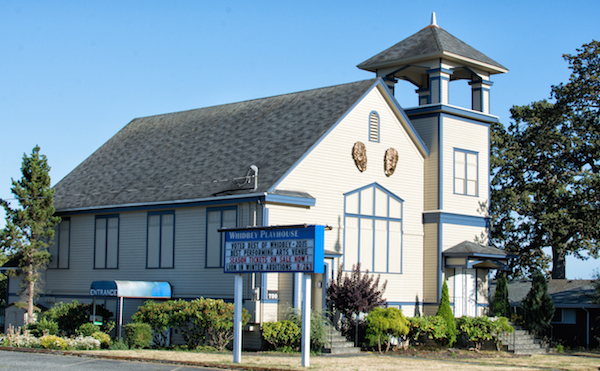
    It’s a warm evening in the dog days of summer, but things are jumping and sweat is glistening on enthusiastic bodies inside the 93-year-old Whidbey Playhouse building on Midway Boulevard in Oak Harbor.

    Sue and Jim Riney have been involved with the Playhouse for 35 years. (photo by Harry Anderson)
    Sue and Jim Riney have been involved with the Playhouse for 35 years. (photo by Harry Anderson)

    Director Allenda Jenkins is putting a troupe of actors through a vigorous rehearsal for “Godspell,” the 1971 musical that has been performed twice before at the Playhouse (in 1980 and 2004) and will be the opening production of the Oak Harbor community theater’s 50th season that runs September through June.

    “Remember to stay in your places and keep your energy way up,” orders Jenkins, a former professional actress and Playhouse veteran who has performed in four productions and directed four others.

    The troupe is running through the energetic “All for the Best” song-and-dance number from the now-classic “hippie musical” re-telling of the ministry of Jesus. Wollie Fowkes, a dynamic 14-year-old high school student from Oak Harbor, plays Jesus and, in an interesting bit of casting, his father John Fowkes plays Judas. Wollie’s mother Penny Fowkes is also in the ensemble cast.

    Families such as the Fowkes acting together has been a common occurrence at the Playhouse, says Janis Powell, the business manager. “We are truly a theater community.”

    ______________________

    Coming soon to the stage:

    “Lost in Yonkers,” April 2-17

    For more information about Whidbey Playhouse and their upcoming shows, auditions and ticket information, please go to: www.whidbeyplayhouse.com.

    ______________________

    Meanwhile, just across the parking lot in the Playhouse’s Star Studio rehearsal space, a casting call is going on for would-be Henry IIs and Eleanors of Aquitaine in “The Lion in Winter,” the second production of the upcoming season and one that has also been done before—41 years ago, in October 1974.

    “Because this is our 50th season, we bringing back some of the most popular favorites from the past five decades,” Powell says. The balance of the 2015-16 season will include “A Dickens’ Christmas Carol” (produced in 1997), “Moon Over Buffalo” (produced in 1998), “Lost in Yonkers” (produced in 1996) and “South Pacific” (produced in 1980 and 1988).

    The day-and-night bustle at the Playhouse now is a far cry from its humble beginnings. Indeed, it has survived many ups-and-downs, shifting cultural tastes, actors and audiences that come and go with the Navy, a perpetual shortage of funds and even a devastating fire.  And that makes its 50th season, after 294 productions and more than 2,500 performances, all the more remarkable.

    “Godspell” director Allenda Jenkins, putting her actors through a vigorous rehearsal. (photo by Marsha Morgan)
    “Godspell” director Allenda Jenkins, putting her actors through a vigorous rehearsal. (photo by Marsha Morgan)

    It began on a wintry evening in February 1966, as nine Oak Harbor residents gathered at Kathryn Johnson’s School of Dance on Midway Boulevard to discuss starting a local theater company. Most had been involved in church or school productions, but they dreamed of a community-supported theater of their own. They called themselves the Whidbey Players, and that June they put on two one-act comedies at Kathryn’s dance studio:  “His First Shave” and “Madam President.”  Tickets were free in advance, 25 cents at the door.

    That fall they moved to the Oak Harbor High School auditorium for their first full-length play, “Everybody Loves Opal.”  On opening night, a cat on stage in the first act was supposed to die in the second act, but the uncooperative feline continued to howl loudly backstage, eliciting unanticipated laughs.

    Over the next several years, the Whidbey Players performed in schools, the basement of a credit union, a movie theater on the nearby Navy base and anywhere else that would have them.  In the late 1960s, they leased an unused church auditorium, converted it to a theater and renamed it—and themselves—the Whidbey Playhouse. Then catastrophe struck:  a suspected arson fire in 1973 destroyed the building and all the props, sets and costumes inside. Back to square one.

    But then the “community” really did step in. A group of civic leaders, led by long-time Whidbey News-Times Publisher Wallie Funk, believed in the value of the Playhouse and decided that the old Christian Reformed Church building on Midway Boulevard, empty and for sale, could be a theater. The price was an astronomical (for the time) $249,000, which was even more astounding given the extensive repairs and remodeling needed at the church, built in 1922.

    An offer was made in 1979. Frantic fundraising and anxiety ensued, but Funk’s connections and arm-twisting eventually succeeded. The debt was paid off in August 1983, after just four years, thanks to hundreds of private and corporate contributions. Funk’s News-Times trumpeted “The Miracle on Midway” on its front page, and the Playhouse finally had a home.

    Father and son John Fowkes (left) and Wolly Fowkes played Judas and Jesus in "Godspell." (photo by Marsha Morgan)
    John Fowkes (left) and Wolly Fowkes, father and son, rehearse as Judas and Jesus in “Godspell.” (photo by Marsha Morgan)

    Jim and Sue Riney proudly remember that moment and many others; they have been part of the Playhouse for 35 of its 50 years.  Jim, then a Navy photographer’s mate, was transferred to Oak Harbor in October 1980, and the couple arrived here as newlyweds.  Both had been involved in school or community theaters elsewhere.

    “We saw a performance of ‘South Pacific’ a month after we got here,” Sue recalls. “After that, I immediately auditioned for their next production, ‘Finian’s Rainbow,’ and I volunteered Jim to do the lighting.”

    The Rineys have now been involved with 82 productions, most recently as director/producers of the Monty Python musical “Spamalot,” a smash hit last fall. Sue served as the Playhouse’s executive director for 25 years until 2009, and Jim continues to serve on the board. Sue will co-produce the upcoming season’s production of “Lost in Yonkers” next April.

    They remember the rough days, right after the Playhouse moved into the old church building. The stage—formerly the altar space—was considerably smaller.  (Today, it’s eight feet wider.) There were 220 narrow, un-upholstered seats. “Peoples’ butts were smaller then,” Sue says. (Today, there are 128 wider, padded seats.)  And, most inconveniently, the two restrooms could accommodate just one person at a time. “We had very long intermissions,” Jim says.  (They have since been greatly enlarged.)

    The Rineys and others recall the humorous gaffes and near disasters that have become Playhouse legend.

    • In a 1981 melodrama, the villain tied up the damsel in distress and laid her on a table. The table leg collapsed and dumped the damsel into the lap of a one-legged man in the audience. He picked her up and lifted her back on stage.
    • In “Guys and Dolls,” the actor playing a cop who breaks up the illegal dice game in act two decided to grab a beer at the nearby Oak Harbor Tavern before his entrance.  But he didn’t get back in time, so director Jim Riney grabbed a cop hat and went on for him.
    • In “Oklahoma,” the actor playing Jud Fry developed pneumonia the day the musical was to open. The director was about to cancel the performance when a young Navy sailor came in to buy a ticket. He happened to have played Jud in high school.  They rehearsed all afternoon, taped the script of his spoken lines to a table in one key scene, and he went on successfully for several performances.

    “These things happen in community theater,” Sue Riney says.

    As a Navy town, Oak Harbor has a somewhat transient population, which both helps and hinders the Playhouse.  Talent comes and goes, and so do audiences.  Just last fall, one of the leads in “Spamalot” was transferred by the Navy in the middle of the show’s run.

    Oak Harbor also has a reputation for being politically and socially conservative, which has some effect on what the Playhouse does.

    “In the 1980s, if we did a play with cursing we’d get letters and cancellations,” Jim Riney says.  “In one drama, the lead actress came on stage in a slip and some people walked out.”

    But attitudes and tastes change over time, and Oak Harbor has changed with them. The zany antics in “Spamalot” included dancing orthodox Jews and a gay wedding.  “We didn’t get a single complaint,” Sue Riney says. The Playhouse has not avoided challenging material for amateur performers—from Stephen Sondheim lyrics to Gilbert and Sullivan operettas.  In 2013, it produced its first full-length Shakespeare play, “A Midsummer Night’s Dream.”

    But musicals and comedies are what Oak Harbor audiences seem to want most.  Dramas—unless they are well-known, such as “To Kill a Mockingbird”—don’t do as well. Older audiences want stories and music they know. Younger audiences are attracted to things with an edge and technological wizardry.  For a community theater, it’s a delicate balancing act.

    The Playhouse is trying to keep up with better lighting, sound and stage effects.  It has an ongoing capital campaign to expand its lobby, green room and offices. It knows it’s competing for audiences with the Internet, malls, multiplexes and smart phones – none of which were around 50 years ago. And it knows it’s competing for donor dollars with several hundred other Whidbey non-profit organizations that didn’t exist in 1966.

    For those involved, however, the play’s still the thing. “Godspell” director Allenda Jenkins is thrilled to have the Whidbey Playhouse as an outlet for her creative energies.

    “I love what live performance gives me,” she says. “I feel almost like I’m preaching here. It makes a difference. It can change people’s attitudes and lives.”

    Harry Anderson spent his 40-year career in journalism and corporate public relations. He worked for the Los Angeles Times, Paramount Pictures and Tenet Healthcare. Today, he gardens and writes for the sheer joy of it for the Whidbey Life Magazine and the Whidbey Examiner. 

    __________________

    CLICK HERE to read more WLM stories and blogs. Have a great story idea? Let us know at info@whidbeylifemagazine.org.

    WLM stories and blogs are copyrighted and all rights are reserved. Linking is permitted. To request permission to use or reprint content from this site, email info@whidbeylifemagazine.org.