Welcome to the ninth edition of Whidbey Life Magazine, a publication that celebrates the people, places, and products that make Whidbey wonderful.
This year, Ebey’s Landing National Historical Reserve marks its 40th anniversary as a unique public-private partnership. These 17,000 acres of fields and farms, and the homesteaders’ descendants who cultivate them, represent a living history of the island. Our scenic photographs and historical snapshots honor the accomplishment of those who acted in time to preserve this iconic landscape.
We have an abundance of jewelry makers on the island; some of them specialize in silver. What does silver demand as a material? Why are some people drawn to working with it? What are their sources of inspiration? Learn more about why silversmiths have an ongoing love affair with this precious metal.
Photo by David Welton
We islanders have our unique ways of celebrating holidays—and creating some of our own. Every month seems to bring at least one parade or festival that calls us into the streets, waters, and parks to cheer, march, or strut. Read the observations of one island philosopher and one “Conductor of Fun” on the relationship of celebration to community…and relive some of Whidbey’s best events through photographs that capture the spirit of islanders who know how to throw a better party.
Photo by Marcia Wesley
The county fair at the height of summer is a prime time for young people involved in 4-H to show theiranimals. But preparing for the big event involves months of daily care of four-footed and two-winged contestants. What does getting ready for the fair mean to the youngsters who tend, groom, and train their animals? Learn from them why 4-H occupies “first place” in the life of our rural youth.
Photo by Marcia Wesley
With its beaches, inland lakes, and shoreline access, Whidbey Island offers numerous opportunities for water recreation. Whether you prefer skim boarding, swimming, diving, kite surfing, kite boarding, paddle boarding, rowing, kayaking, or sailing, Whidbey is a water lover’s paradise where you’ll find your favorite way to float.
Photo by Marcia Wesley
A surprising number of artists who work in various mediums also make dolls—the variety of which reflect diverse makers and involve various materials. The personalities of these figures have little in common with the mass-produced dolls that sit on store shelves; in fact, each is distinctly different. Find out why the passion for dolls is alive and well for Whidbey’s doll makers.
Photo by Marcia Wesley
It’s inevitable that the creative folks who build homes on Whidbey would design and build structures that are anything but ordinary. In this article on unusual homes, the personalities and aspirations of homeowners are revealed in the very rooms they inhabit. Although these houses hail from different eras, they have one thing in common: the vision and determination of those who built them.
Photo courtesy of WhidbeyHealth
Those who cycle Whidbey agree it’s a bikers’ island, from the splendid scenery around every turn to the well-maintained roads to the plethora of cafes, coffee shops, and restaurants available to serve the hungry pedaler. Experienced cyclists pass along their wisdom to the rest of us and encourage us to jump on the saddle and take to the road.
Rhubarb is the culinary herald of the warm-weather season. How do our local chefs, bakers, jam makers, and vintners use the sturdy red stalk in their creations? You may be surprised to learn the many uses of this plant that may have grown in your grandmother’s garden. (Hint: some of our nursery folks love it simply for its looks—and it’s deer proof!)
In this eighth issue we celebrate the spirit of Whidbey islanders. As it turns out (an accident of geography? the laws of attraction?) our friends and neighbors are endowed with an array of skills, an abundance of talent, and an excess of imagination in extraordinary quantities.
Photo by Marsha Wesley
Among Whidbey’s most creative and not-afraid-to-show-it folks are our island’s actors. But who works tirelessly behind the scenes to design and make the costumes that grace our stages? You’re invited backstage with three costume designers for a look at what inspires them and how they work their magic.
Photo by Marsha Morgan
While most of us feel gratitude for the productivity of our lands and waters, some islanders feel it on a daily basis as they pick, pluck, scoop, dig, and snip delicacies from the natural world. Meet the foragers who seek out the bounty offered by nature. The many varieties of edibles on and around Whidbey will surprise you, and the perspective offered by these foragers will remain with you.
Photo by Michael Stadler
Whether or not the slow and deliberate practice of basket making has anything to do with our preference for “island time” is hard to know. While some local artists have innovated using basketry techniques—achieving national recognition—others practice this ancient craft in a solitary way using traditional materials. The diversity and range of their work might start you on your own journey—as a creator or a collector.
Photo by Marsha Wesley
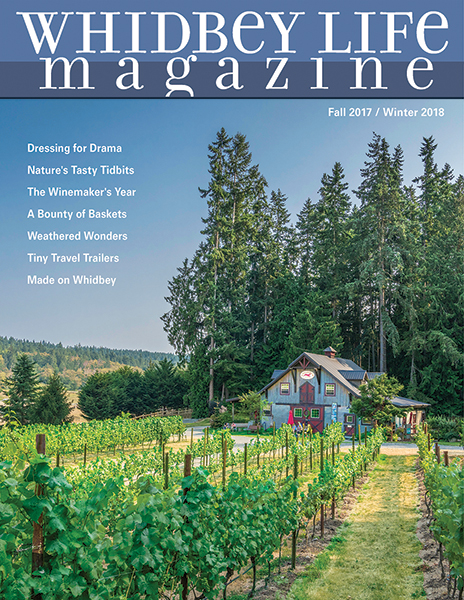
In the cultivated landscape, is there anything more pleasing than rolling hills covered by rows of grape vines? The sight evokes a feeling of satisfaction, of tradition, of “all’s right with the world.” But what are the challenges and rewards of growing grapes and turning them into wine here in our Pacific Northwest climate? Three local winemakers—farmer vintners—share their stories of putting down roots in the soil of Whidbey Island.
Photo by Julie Boyd
The eye of the photographer is trained to see what other eyes might miss. In our photo essay entitled “Second Sight,” four of our island photographers visited the local recycling center to shoot, up close and personal, an array of discarded objects. These images are entrancing—and certain to have you free associating.
Photo by Marsha Wesley
“Artisan manufacturers” is an apt way to describe several of Whidbey’s entrepreneurs who produce durable goods in small quantities. These makers supply customers both on and off island with products ranging from rolling pins to shoes, from clay cookware to all things metal. Inspired by the quality and individuality of home-grown items, two of these makers have opened a store that features products made on the island. Learn about manufacturing, Whidbey-style.
Photo by Marsha Morgan
Vintage trailers, symbols of a nomadic way of life, have ardent fans here on Whidbey. These vintage trailer restorers exercise their engineering and decorating skills while preserving a heritage that honors the great outdoors. Their color schemes and vintage themes will amuse and delight you…and perhaps make you long for your own little house on wheels.
Whether you live on the island or love it from a distance, you can continue meeting the people, seeing the places, and learning about the products that make Whidbey wonderful.
BY DEBORAH NEDELMAN
Whidbey Life Magazine Contributor
August 23, 2017
What does a trip to a Whidbey Island beach mean to you? Do you think of wriggling your toes in the sand, of poking through driftwood looking for treasures, or wading into the chilly water? Do you enjoy walking along the shore or throwing sticks out into the waves for your dog to retrieve? Or perhaps your joy comes from a sitting on a log sketching the scene around you, reading, or simply contemplating life where the land and the water meet.
Most people can take advantage of the many points of beach access available to the public on Whidbey Island (Public Beach Access Map). But if you’re mobility challenged, what’s labeled “public beach access” doesn’t mean access for you.
Those who can maneuver over uneven terrain, climb over driftwood, and maintain their balance in soft sand may never think about what it’s like to be confined to the parking lot because a wheelchair or crutches can’t go any farther.
The early stages of creating a pathway through the driftwood (Photo by Kyle Richardson)
Mel Trenor was motivated to find a solution to that problem. He’s a member of Island Beach Access (IBA), a nonprofit group dedicated to “identifying, mapping, signing, and preserving access to the public shorelines of Island County for the legal and rightful use of its citizens, for future generations.”
In 2015, Greg Richardson, whose adult son Kyle relies on a wheelchair, approached IBA to express his frustration over the fact that people who are mobility challenged cannot take advantage of public access to the beach. Members of IBA recognized the need for expanding their mission: “Our community prides itself on being welcoming and inclusive,” says Trenor. “The mobility-challenged have not benefited from that.”
Mel Trenor at work (Photo by Kyle Richardson)
Trenor’s gym buddy, Frank Ruggiero, is an experienced fisherman, and when he offered to share his knowledge, Trenor took him up on it. The two men met at a beach near Keystone. Ruggiero, who was rehabbing from a spinal injury that left him relying on crutches, got his fishing pole out, leaned his crutches against the side of his pickup, lowered himself to the ground, and crawled to the water’s edge. With Ruggiero sitting on the sand instructing him, Trenor got a lesson in fishing and in what life is like when you can’t walk where you want to go.
Research into how other beach communities have handled this issue led Trenor to make a trip to Boundary Bay Provincial Park in British Columbia. There, the wide sandy beach beckons people out to the water, but the majority of them, able-bodied or not, choose to get from the parking lot to the beach by walking or rolling on a thick blue mat that stretches across the sand. It is like a plastic boardwalk—firm and solid. Folks in wheelchairs, parents pushing strollers, kids pulling wagons, seniors with canes, and young, agile teenagers all make their way down to the shore on it. AccessMat® accessibility mats have changed the way most park visitors enjoy the beach. And, in fact, mats like them are used up and down the East Coast, in Europe, and in South America to provide a path for everyone to cross the sand.
Greg Richardson volunteered countless hours and wore out several pairs of gloves in the process. (Photo by Kyle Richardson)
Once Trenor and IBA learned that there was a solution, they looked for a beach where other obstacles—like too steep a slope, too narrow or long a trail from the parking area to the sand, or lack of space for disabled parking—wouldn’t complicate accessibility. There were a few candidates, but Clinton Beach Park had the added advantage of being easy to get to for both islanders and visitors who may not know about many of the other public beaches. A beach popular with summer crabbers and many who walk their dogs and bring their kids to play, Clinton Beach Park is at the northwest corner of the ferry landing. The park draws locals and visitors with its picnic tables under a “living roof,” a gazebo with bathrooms, and art by local artists. It offered a good location, a manageable size, and a relatively flat shoreline.
But it quickly became clear that, if disabled people were going to come to this beach, they would need a better parking situation. That would mean expanding the small parking lot to make room for more disabled parking spots. Another issue was the driftwood that created a barrier between the concrete and the sand. The environmental impact of altering the parking lot and of moving the logs that had piled up over the years needed to be considered. Permits were required for all of this work and, of course, money was needed.
Jeanie McElwain, Greg Richardson, Mel Trenor, and Paul McElwain lay out the access mats. (Photo by Kyle Richardson)
Clinton Beach Park is the property of the Port of South Whidbey, whose mission is “to enhance the economic well-being of the community and improve public access to marine areas while respecting the unique rural character and environment of South Whidbey Island.” Trenor’s first step was to ask the port for its cooperation and for financial help to make the project a reality.
The port supported the project enthusiastically. As Curt Gordon, commissioner for District 3 said, “Probably the most important aspect of the universal access project at Clinton beach is that it shows that the port and the people of Clinton and South Whidbey intend our facilities to be all-inclusive.”
Luke Shantz, ready to roll (Photo by Kyle Richardson)
Once the Port was on board, additional money and assistance were needed to make the plan a reality. At the port commissioner’s meeting, where Trenor made his first pitch for money, a woman in the audience handed him a check. Dawn Pucci, of Island County Department of Natural Resources, volunteered her time to complete the environmental impact statement so a permit could be secured. The Rotary Club of South Whidbey and faith-based groups such as St. Augustine’s in the Woods brought Trenor to speak to them and added their donations to the pot. South Whidbey firefighters and the Navy both offered their help. “It took Mel and IBA to remind us of the need, but all players stepped up to the table,” says Gordon. “Volunteers and monetary contributors made this possible, allowing the port to leverage modest public funds to create a truly unique accessible facility.”
The project is not yet complete, but thanks to many hands and strong backs, the parking lot has been repaved to create two ADA-compliant parking spots, driftwood has been moved, and plants have been relocated. The trail to the sand has been delineated and the first section of access matting has been laid. Last week, Ryan Murphy, an adult confined to a wheelchair, was able to go to the beach for the first time since he was 6 years old. Murphy lives across the water and visits his parents on the island every weekend. The family has a home with beach access, but not the kind of access that Ryan can take advantage of. Now, there’s a beach on Whidbey where Murphy feels welcome.
Volunteers Greg and Kyle Richardson, Jeanie and Paul McElwain, and Mel Trenor (Photo by Kyle Richardson)
Kyle Richardson, who took the photos for this article says, “When this project is complete, and folks in chairs or who are mobility-challenged in one way or another can get down into the sand or in a beach chair, it will change their lives. I know each time I’m able to do the things that I used to love, and were my passions, a piece of me is put back into place. This project and other mobility challenges I’ve overcome get me back into the state of mind that ‘I can.’”
IBA needs funds to extend the access mats all the way to the sand. They’ve created a Go Fund Me campaign, to which you can contribute by clicking here.
The blue mats make the path visible to visually impaired, but funding is needed to bring them the rest of the way to the water. (Photo by Kyle Richardson)
Deborah Nedelman, Ph.D., M.F.A., has been married to Mel Trenor for 43 years. After retiring from her first career as a clinical psychologist and raising two children, she moved to the island where she devotes herself to working with words. A published author, she writes, edits, runs writing groups, coaches writers, and is a member of the WLM team.
Kyle Richardson is a commercial photographer who specialized in photographing automobiles, still-lifes, and individuals north of Los Angeles. He built and managed a 6,000 square-foot studio there that supported a wide variety of still imaging, video production, and interactive and print design. He relocated to Whidbey Island for health reasons and is starting to take on small creative projects that he can do from the wheelchair here in the Pacific Northwest.
Enjoy more articles in the print edition of Whidbey Life Magazine, which you can purchase at local and off-island retailers or receive in the mail via subscription.
WLM stories and blogs are copyrighted and all rights are reserved. You may link to this story. To request permission to use or reprint content from this site, please contact us.
Welcome to the seventh print edition of Whibey Life Magazine. In this issue we celebrate two iconic places on Whidbey Island, one much older than the other.
Lavender Wind Farm is located on Ebey’s Reserve, its adjunct garden shop in historic Coupeville. These five acres of “lavender fields forever” were created by owner Sarah Richards to share her passion for this winsome but rugged plant. And writer Shawn Berit reveals one of the shop’s best-kept secrets. (Hint: it’s of the edible kind.)
An eight-foot high acre of land floating in the mouth of a harbor might not sound like much of a destination, but Tom Trimbath’s exploration of Baby Island will have you longing to walk its clamshell-strewn beaches. This small bit of land, which can be accessed on foot when the tides are right, has a long and storied history in which rum-running, poker, and impossible schemes play a part. Even if you never manage to set foot on Baby Island, our spectacular scenic photographs and historical snapshots will bring it to your doorstep.
The agricultural history of Whidbey combined with our affinity for animals has produced a flourishing population of horses, cows, sheep, goats, llamas, and other “four-footeds.” Writer Harry Anderson and photographer Marcia Wesley introduce you to the folks who care for our working animals, livestock, and barn-resident pets. The stories from our large-animal veterinarians will have you laughing…and perhaps nodding your head in recognition.
When artists apply their creative minds and skillful hands to what the rest of us might consider trash, the results can amaze. Join writer Kate Poss and photographer David Welton as they follow five artists on a scavenger hunt at that emporium of castoffs, Island Recycling. Along the way, meet the reigning couple of recycling; their perspective on “junque” is sure to amuse you.
Is there a style or type of house that represents the quintessential Whidbey Island home? Does the influence of place exert a unifying effect? Or any effect at all? Writer Tom Trimbath interviews four island architects—Stig Carlson, Ross Chapin, Mira Steinbrecher, Matthew Swett—about their notions of residential design and how the spirit of place shapes their aesthetic.
As we travel from one shore to another on our ferries, it’s easy to take for granted the sights along the way, to lapse into the habit of not seeing what’s all around us. So we’re especially grateful to our island photographers—their heightened sensitivity to details, angles, perspective, light—who help us refresh our vision and boost our appreciation. In a photo essay on crossing the water, they present our familiar and beloved ferries in a way you may never have noticed before.
With the Spring/Summer issue, we mark the first six months of our sixth year. Our print and online magazines, now unified under the name “Whidbey Life Media,” are more closely integrated—and complementary!—than ever before. While the stories in the twice yearly print magazines are chosen for their ability to endure over months, and even years, the stories in our weekly online magazine are selected for their timeliness. The content is fresh, and it’s free! Whether you live on Whidbey or love it from a distance, the depth and range of the online magazine will keep you supplied with a steady infusion of the people, locales, and events that make Whidbey wonderful.
Welcome to the sixth print edition of Whidbey Life Magazine.
As autumn turns to winter, and we retrieve our sweaters—from the back of a closet or the bottom of a drawer, it’s a fitting time to recognize the contributions of our domesticated livestock. Many of our fields and pastures on Whidbey are dotted with sheep, but few of us make the connection between these animals and the sweaters on our backs, the scarves around our necks, the mittens on our fingers. Lydia Christiansen, the founder of Abundant Earth Fiber Mill, has made that connection a way of life. Our story about her Clinton mill is a fascinating read; her operation is the essence of “locally sourced,” and Christiansen’s pioneering pluck lifts the heart.
The “Whidbey Way with Wool” theme continues in a story about islanders who create magic with their materials. Whidbey is graced with a large community of fabric artists—spinners, weavers, felters—and writer Natalie Olsen, herself a fiber artist, profiles three of them and their one-of-a-kind creations.
While sheep as a species serve a utilitarian purpose, artist Claudia Pettis shows us their individual personalities and endearing quirks. Her many years as a breeder and shepherd inform her portraits of sheep, and her abiding love infuses each with personality. In explaining her sources of inspiration, Pettis reflects on childhood summers spent in the company of a true islander with whom she discovered a deep affinity for Whidbey’s land and way of life.
We are thrilled to feature the work of several different photographers in a single story on Deception Pass Bridge. Depending on the season, the time of day, and the angle of the shot, the bridge can seem reassuringly solid or mysteriously ethereal. If you’re unfamiliar with the origins of this connecting link between Whidbey and Fidalgo Islands, some of the historical tidbits in our short essay may surprise you…and the portraits will certainly delight you.
Classical proportions, honest design, and native materials make the barn a beloved structure. Whidbey is fortunate to have more than its share of historic barns, but decay and loss of purpose threaten this icon of rural life. Writer Harry Anderson introduces you to the individuals and organizations that keep our island barns standing.
No issue of Whidbey Life Magazine is complete without at least one article about the food that is provided by our favored terroir and the chefs who are passionate about preparing it. Leslie Irish Evans takes us down to the beach to observe oyster gardeners planting, tending, and harvesting their crops. And writer Kate Poss bids us pull up chairs at the tables of Roaming Radish Gastropub in its new setting—a renovated airplane hangar where island favorites Jess and Jon-Paul Dowdell work their culinary wizardry.
Our emphasis on bigger and bolder photographs continues. Thanks are due to the many who contributed photos but especially to staff photographers Marsha Morgan and David Welton, who continue to chase down and capture the images that express the spirit of our stories.
Winter approaches. In this—as in every season—we continue to celebrate all things Whidbey.
BY DEBORAH NEDELMAN
Whidbey Life Magazine Publisher
January 5, 2017
As we enter the unknown of this fresh, new year, I am holding a picture in my mind of all of us, connected by our love of Whidbey, holding one another’s hands, offering support and a squeeze of eager encouragement as we step into the future together.
For the last month, all through the holiday season, our management team — Petra Martin, Claire Moore, Dianna MacLeod, and I — has been hard at work mapping out a new business structure for Whidbey Life Magazine. We’ve held many meetings, spent hours examining what excites us about this work, and questioned how we want to grow WLM. An early step in our process involved examining our mission statement and rewriting it to reflect our values and intention:
The mission of Whidbey Life Magazine is to support and enrich the culture of our community by telling the stories of life on Whidbey Island. By shining a light on the beauty of our landscape and the creative and inspiring people who live here, WLM hopes to facilitate connections across our island cultures.
Everything we do will be done in the spirit of fulfilling this mission. We want to be a vehicle for sharing the wonders of Whidbey Island with one another, those who live on its farms, in its towns, and in its forests; those who visit the island regularly; and those who are meeting it for the first time. We want to focus on the wonders of our island as points of connection across our many political, social, and economic differences. This is what we’re about, and we are full of enthusiasm for the tasks this mission sets out for us.
This year, as in years past, we are committed to bringing you two beautiful issues of our print magazine. We’re committed to adding new stories, blog posts, and photo essays to our weekly online magazine.
And we are committed to connecting with you. We’d love to hear your reactions to what we’re doing, what you want more of, and your ideas for new avenues we might explore.
We at Whidbey Life Magazine recognize the privilege of our position as ambassadors of this beautiful island and are grateful to take that on with your support as we step into 2017.
Before becoming publisher and editor-in-chief at Whidbey Life Magazine, Deborah Nedelman, Ph.D., MFA, spent most of her time writing, editing, coaching writers, leading writing groups, and collecting advanced degrees. There was even a time when she worked as a clinical psychologist and raised two kids. These days, she wakes earlier, gets to bed later, and has Whidbey Island on her mind most of the time.
WLM stories and blogs are copyrighted and all rights are reserved. You may link to this story. To request permission to use or reprint content from this site, email info@whidbeylifemagazine.org.
BY DEBORAH NEDELMAN
Whidbey Life Magazine Publisher
November 24, 2016
For more than 30 years, I lived in Mukilteo, in a house with windows looking out across the water to Columbia Beach and Possession Point. I loved that house, and Mukilteo worked for our family, but the magic of Whidbey called to me in a slow, seductive song for all those years. When I finally yielded, it felt like coming home.
Something similar, though far less prolonged, happened in my relationship with Whidbey Life Magazine. I had only known WLM as a reader when Sue Taves offered me the position of publisher. I’d been on the editorial team of Soundings Review, the literary magazine of the Northwest Institute of Literary Arts, for several years and was editor-in-chief when NILA, and consequently Soundings, died. I wasn’t really looking for a new gig. But Sue and the editorial team worked their own brand of magic on me and, before I knew it, I found myself jumping onto the moving train that is WLM.Now that I’ve taken the leap, I am thrilled to be on this journey with a talented and dedicated team to help me guide Whidbey Life Magazine into the future.
Many of you have been reading WLM since it began, and you’ve seen it morph from an online resource for local artists to a semi-annual glossy print magazine with a website where we publish new content every week. It began as a purely volunteer effort and is now a professional endeavor. As we look toward the future, our plans include expanding our distribution and fostering greater inclusion of voices from all parts of our island. We also hope to upgrade our website to make your reading experience more engaging and user-friendly. Stay tuned!
Whidbey Life Magazine is an organic, evolving enterprise dedicated to celebrating the treasures of art, culture, and people of our island. It has always been our intention to facilitate connections across our island community rather than to highlight divisions, and as we move forward, we are committed to maintaining the values on which the magazine was founded. While we have encouraged writers to share personal perspectives through their blogs, we have never been a platform for political issues. If you’re looking for controversy and divisiveness, look elsewhere.
Whidbey is a place full of its own brand of complex, surprising stories we are eager to share with you. Whether we are writing about Oak Harbor’s 50-year-old playhouse, folks who brew beer from nettles, fiddle players who farm, elegant wearable art made from flowers, or the life of our local bees, we are building bridges, shining light on beauty, and embracing the glory of our island life.
This is what we plan to keep doing, through dark times and when the sun returns. We hope you’ll come along for the ride.
As you read this, my house will be filling with Thanksgiving aromas and my heart with gratitude to be able to spend this holiday with loving family, to live on this beautiful island, and to be part of this community of inspiring, creative, caring people. I wish you all the greatest of blessings of the holiday!
Before becoming publisher and editor-in-chief at Whidbey Life Magazine, Deborah Nedelman, Ph.D., MFA, spent most of her time writing, editing, coaching writers, leading writing groups, and collecting advanced degrees. There was even a time when she worked as a clinical psychologist and raised two kids. These days, she wakes earlier, gets to bed later, and has Whidbey Island on her mind most of the time.
WLM stories and blogs are copyrighted and all rights are reserved. You may link to this story. To request permission to use or reprint content from this site, email info@whidbeylifemagazine.org.




 Enjoy more articles in the print edition of Whidbey Life Magazine, which you can purchase at

 Welcome to the seventh print edition of Whibey Life Magazine. In this issue we celebrate two iconic places on Whidbey Island, one much older than the other.

 Welcome to the sixth print edition of Whidbey Life Magazine.