Author: Dianna MacLeod

  • Issue No. 12 | Fall / Winter 2019

    Issue No. 12 | Fall / Winter 2019

    Fall 2019 | Issue No. 12

    Renewal. Regeneration. Rejuvenation. These are words we tend to associate with a specific season of the year. But, in truth, acts of renewal and restoration occur constantly. In this, the twelfth issue of Whidbey Life Magazine, we celebrate those acts—and the compassion and creativity they reveal.

    In Gimme Shelter, writer Patricia Herlevi and photographer Sarah Sanborn profile some of the people who rescue orphaned/unwanted animals of all sizes and types. From chipmunks to cows, our furred and feathered friends are revived by human compassion.

    A group of islanders are together fighting the debilitating effects of neurological diseases in a remarkable way. Their moving stories of rejuvenation are the heart and soul of On the Ropes, described in Steve Burr’s personal account and portrayed by Marsha Morgan in photographs that take you to a ringside seat.

    Our island’s farmers are in the vanguard of those who are restoring health to soils degraded by years of traditional farming practices reliant on pesticides and artificial fertilizers. Their efforts are chronicled by writer Sharon Betcher and caught on camera by photographer David Stern in Cultivating Hope, a story of regenerative agriculture. This issue’s cover honors that rejuvenation with images, taken by Julia Beck, of students and staff at Whidbey’s Organic Farm School.

    Islanders express our concern for a dwindling population of orca whales through advocacy and celebration. Regularly held events in our small towns reaffirm our relationship to the marine life around us. In Whale Worship the Whidbey Way, writer Nia Martin eloquently explains our collective love for these creatures—and the importance of returning one particular orca to her home waters—as David Stern captures in photos an annual parade to welcome the whales.

    The means by which discarded materials are collected and assembled by artist Zoe Osenbach combine reinvention with recycling. The effect is perfectly described by Lea Cramer in Reimagining Refuse.

    The metal sculptures of Jean Whitesavage and Nick Lyle are simultaneously rugged and romantic; their tools are no less so. Photographs by Lyle, taken in the forge, illustrate the moody allure of the sculptors’ repurposed equipment and retooled implements. In Forging Friends, Lea Cramer reveals their fascinating history.

    Certain people—often artists—have a talent for reinventing themselves, if only for a night. In Among the Bohemians, writer Kate Poss tells the story of just such a group here on Whidbey. Photographer Rich Yukubousky captures the revelry of the Island Bohemians at one of their rollicking gala balls.

    In these pages, we are pleased to recognize rescuers, restorers, and renovators. Their radiance, along with others like them, is what makes Whidbey a place of renewal for all.

    Dianna MacLeod, Editor & Publisher

  • Happy Trails to You

    Happy Trails to You

    Walking from the Clinton ferry to Deception Pass might not be on your to-do list, but finding routes to traverse that avoid busy roads appeals to nearly everyone. A new organization is finding ways to connect and map existing trails to make it easier to put one foot in front of the other for that “get-away feeling,” whether through a forest, on a beach, or alongside a field. Let us guide you to the happy trails of Whidbey Island.

    From Issue No. 11 | Spring/Summer 2019

  • Avian Art Takes Flight

    Avian Art Takes Flight

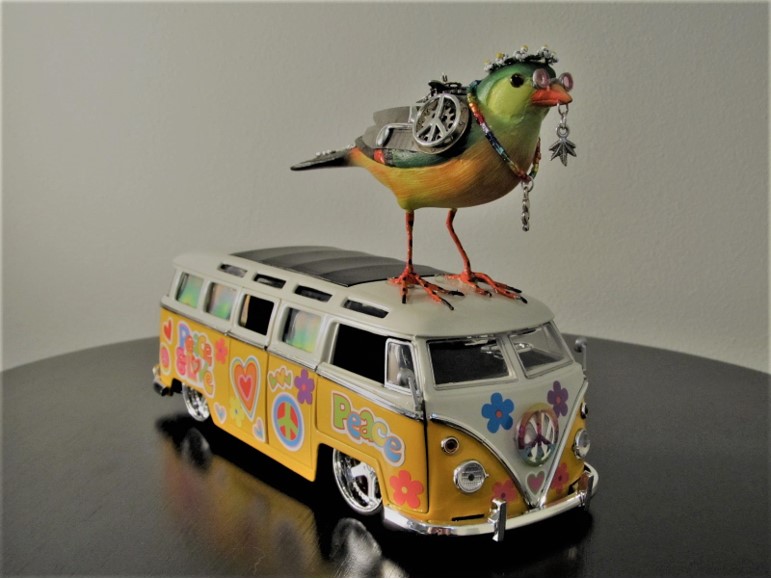
    The whimsical sculptures of a local mixed-media artist show birds in a new light: perched on a steampunk top hat, sporting rain boots and umbrella, hovering around a flute, smoking a tiny pipe atop a lantern. See several of these intriguing assemblages and learn more about the artist. Go birdwatching without ever leaving your chair.

    From Issue No. 11 | Spring/Summer 2019

  • Making Cider the Hard Way

    Making Cider the Hard Way

    When it comes to making spirits from home-grown fruit, this family proves that the apple doesn’t fall far from the tree. The story begins a century ago but came to “fruition” only recently. Learn more about the new (and only) hard-cider operation on Whidbey.

    From Issue No. 11 | Spring/Summer 2019

  • Flowers, Foliage, and Fun!

    Flowers, Foliage, and Fun!

    A visit to any of Whidbey’s destination nurseries is sure to beautify your day. To make sure you’ve covered the ground, so to speak, check out the list of destination nurseries on the island and read about three of them in detail. The lively and informative writing of “the bad back gardener” will add more than a dash of color to the experience.

    From Issue No. 11 | Spring/Summer 2019

  • Run, Whidbey, Run

    Run, Whidbey, Run

    With over 40 places to explore—from Deception Pass to Possession Point—Whidbey is a runner’s Eden. And Whidbey hosts some of the best running events in the Pacific Northwest. Island landscapes seem designed to elevate spirits, clear heads, and soothe souls. Learn more about where and when to run.

    From Issue No. 11 | Spring/Summer 2019

  • Praise for the Prairie

    Praise for the Prairie

    With its farms and barns, historic structures, and lush fields, Ebey’s Prairie is the source of Whidbey’s signature Rockwell beans and Hubbard squash…as well as a source of visual and recreational pleasure to locals and visitors alike. Farmers, advocates, and protectors raise their collective voice in praise of the prairie.

    From Issue No. 11 | Spring/Summer 2019

  • Sheltering Small

    Sheltering Small

    The “American dream house” is being redefined: scaled smaller, energy-efficient, closer to its neighbors, and leaving more of the land around it undisturbed. Whidbey Island is part of the trend to tiny. Local architects and homeowners reflect on what it means to “live small.”

    From Issue No. 11 | Spring/Summer 2019

  • Issue No. 11 | Spring / Summer 2019

    Issue No. 11 | Spring / Summer 2019

    Dirt. Soil. Both words contain four letters. But as a gardening friend reminds me, they are very different. Soil is what we prize because of its life-sustaining properties, the habitat it provides for insects, worms, microbes, and fungi that nurture the roots of plants.

    While the science of healthy soil has been neglected in recent decades, a movement known as “regenerative agriculture” is gaining attention for the possibilities it offers to produce more nutritious food, slow down erosion, and, of all things, mitigate climate change. It turns out that our soils are ‘keepers of carbon” that become “releasers of carbon” when misused and degraded. When soil becomes “dirt poor,” it’s bad news for our food system and for the environment; too much carbon dioxide in the atmosphere is one of the culprit of climate change.

    If there’s a theme for this issue of Whidbey life Magazine, it’s the earth we stand on and the footprints we leave.

    In her article, “Praise for the Prairie,” writer Susan Wenzel offers a look at Central Whidbey’s Ebey’s National Historical Reserve and the evolution and preservation of an agricultural way of life. In “Making Cider the Hard Way,” Steve Kilisky introduces us to a Whidbey family enterprise that depends on productive soil to grow the apples that produce their hard cider. The island nurseries featured by Penny Webb in her article, “Flowers, Foliage, and Fun,” are surely among the most ardent advocates of healthy soils, which produce healthy plants with minimal-to-no need for synthetic fertilizers or pesticides. In an article entitled, “Run, Whidbey, Run“, PJ Beaven investigates why and where people “get grounded” as they run-for exercise and camaraderie-through stunning island landscapes. In “Sheltering Small,” Patricia Herlevi focuses on homes and their owners who seek to minimize the size of their dwellings in favor of enjoyment of the natural world beyond their thresholds. By reporting on a new way of connecting trails, and how we all can contribute to developing the maps, Nia Martin wishes you “Happy Trails.” Finally, Lea Cramer gives us a glimpse at a flock of birds that are permanently-and whimsically-grounded in her article, “Avian Art Takes Flight.”

    I’m filled with gratitude for our writers and photographers who celebrate the earth we stand on and the earth we call home. I hope this issue gives you, dear readers, reasons to celebrate, too.

    Dianna Macleod
    Editor & Publisher

    P.S. Although this is hardly a postscript! Claire Moore, our graphic artist since Day One. has recently retired. Immense thanks to Claire for assembling all the pieces of the puzzle that is Whidbey Life Magazine, year after year, for ten issues. Fortunately, Claire has consented to stay on as a consultant, giving our team the benefit of her experience, sense of design, and attention to detail. I expect she and I will go on having our passionate but always humorous-discussions about semicolons, fonts, and other arcane matters.

    Cover Photos: Wooden ship at Coupeville Wharf by David Stern of Whidbey Custom Photo.

  • Setting the Stage

    Setting the Stage

    Our local theaters are fortunate to draw upon talented volunteers who capably hammer and paintbrush to construct the world of the play. In ‘Setting the Stage’, Laura Berkley Boram takes us behind the scenes to meet the folks who construct the backdrops at our island theaters. Pick up the Fall/Winter 2018 print issue of Whidbey Life Magazine to read more about the diversity of the sets, the ingenuity of the building crews, and the drama that goes on before the curtain ever goes up.

    Outcast Theater

    Whidbey Children’s Theater

    Whidbey Island Center for the Arts (WICA)

    Whidbey Playhouse