BY MARTHA McCARTNEY Whidbey Life Magazine Contributor
November 26, 2014
Shaunna Baganz describes her photographs as being nearly surreal. “I want to put the viewer right on that edge of imagination—bring them to a place of wondering if that scene actually exists.”
Baganz lived in Wisconsin where she worked in marketing and also did freelance photography. Her subjects were car and motorcycle racing and some wedding photography. It was when she moved to Oregon in 2008 that she was drawn more fully to nature photography. In 2011 she moved to Whidbey Island and now, she said, “I walk out my door every day feeling as if I’m on vacation.”
“Blue Sea Sailing” by Shaunna Baganz
One of her favorite places on the Island is Ebey’s Landing and it’s from there she’s been able to capture some beautiful sunsets. Sunset and sunrise are two subjects she is particularly fascinated with and making them unique by filling the foreground with an over-looked part of the landscape is her challenge. “I love detail and try to bring out layers of color and texture, especially in the clouds.” Baganz explained.
Her photographs reflect a feeling of peace and a sense of timelessness. The viewer is invited to engage fully with the scene—to become contemplative and relaxed. The photographer sees not only the colors and light of living on Whidbey Island but, with a relatively new eye to the area, she is able to hint at the magical qualities.
Currently Baganz is working on a long-ranging project photographing The Enchantments, a remote area southwest of Leavenworth, WA. Access to the area is extremely limited and must be obtained by permit. Hiking in and out of this wilderness area with 35 pounds of camera gear in addition to other supplies is a major accomplishment.
In addition to nature photography, Baganz is available for senior portraits and real estate photography.
Martha McCartney is a poet, photographer, mixed-media artist, persistent gardener and candle-maker.
________________
CLICK HERE to read more entertaining and informative WLM stories and blogs.
WLM stories and blogs are copyrighted and all rights are reserved. Linking is permitted. To request permission to use or reprint content from this site, email info@whidbeylifemagazine.org.
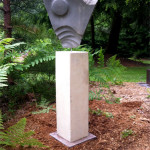
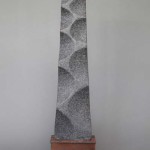
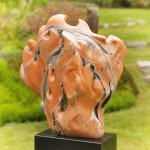
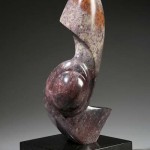
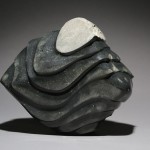
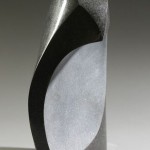
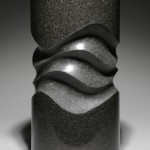
The long days of midsummer can lead you to believe that time is endless and mysterious. And what could last longer, or hold more secrets, than stone? Beginning in the creative mind, and traveling through to the capable hands of a sculptor, Sue Taves coaxes the stones to give up their secrets. If painting is a product of addition, sculpting stone is one of subtraction. Knowing what to remove and what to keep is the riddle that a sculptor must solve, in order to make the vision in their mind, translate to the form in front of them. Knowing when to keep the rough, natural character of a rock, and when the bend the surface to replicate the fluidity of water, is Sue Taves’ particular gift.
Sue is having a busy summer and you can see new sculptures featured in the group show, “Jason Waskey & Garden Garnishes: Sculptures for the Garden,” at Brackenwood Gallery in July (July 5-28). More new work will be at the lovely Froggwell Gardens during the Froggwell Biennale Aug. 1-3, and she’ll be at her Freeland studio for the Whidbey Working Artists Summer Art Tour on August 23/ 24 and 29-31.
Find her work on her website and at the galleries that represent her:
Anne Belov is a painter, printmaker, cartoonist, and designated bad influence. In addition to curating the Virtual Gallery, Belov also blogs for Whidbey Life Magazine, organizes the Froggwell Biennale, is the author of four collections of The Panda Chronicle cartoons, and the soon to be released children’s book, Pandamorphosis, published by Leaping Panda Press. You can find her paintings at The Rob Schouten Gallery and her cartoons at http://yourbrainonpandas.com
Sue Taves
Artists Statement
I start with an idea or particular stone that interests me and start sculpting and see where it goes. Each stone has its own story to tell and the carving process is about discovering that story. When carving, I try to capture the natural essence of the stone in my design and discover cohesive forms that use shape and texture to translate feelings, create moods, and invite people to be drawn in.
Some sculptures develop as a part of a series of work, like the “Rain” series, which celebrates this ubiquitous feature of the Pacific Northwest. Other pieces are explorations of a particular material or concept. I generally work on multiple stones at any one time so there are sculptures in various stages of completion scattered around my studio.
Over the past 7 years I have begun creating large-scale sculpture in granite and basalt that can stay outdoors in any weather. Exploring this new scale of work and the backdrop of the outdoors has been exciting and has also been a great opportunity to discover new tools and learn new skills. I also continue to work in softer stone, working by hand and creating smaller, more intimate sculpture especially when the weather is less inviting for working outdoors.
Sue Taves Bio
Sue blends a unique combination of movement and spirit in each of her sculptures. Originally from the Midwest, Sue moved west to California in 1990 where she enrolled in a series of sculpture classes that drew her more deeply into her art and introduced her to new techniques and mediums.
In 1993, she was transformed by the experience of carving her first stone. The experience of expressing movement in a medium so strong and rich in history was irresistible. In 1995 began to devote more time to her passion for sculpting and now works full time transforming stone into fluid forms. In 2004, Sue moved to Whidbey Island where she happily makes dust in her studio in Freeland.
For more information on any of this work or to find out where this work is showing, please contact the artist. All work is original and copyrighted by the artist. All photos are by Michael Stadler of Stadler Studio.
BY RUSSELL CLEPPER Whidbey Life Magazine Contributor
June 18, 2014
He’s a cowboy racing for all he’s worth across some Southwestern desert on a mighty fast pony. Or now, he’s standing over a jukebox in some lonely saloon, choosing a song as a sultry little thing nearby waits for him to dance with her. They are the only two people in the room. Outside the open saloon door, the vast desert lies flat and empty.
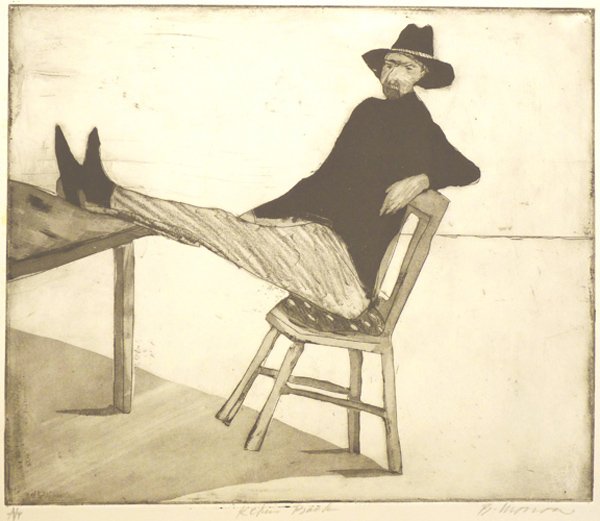
Or now, he’s leaning back in an old chair, its front legs off the ground, his feet on the table, and his mysterious smile—almost a smirk—casts an enigmatic mood into the room. Whatever happens next may be threatening, or simply mischievous, but there will be some kind of risk involved. It’s as if he just told his buddy, “let’s go out and do something, even it’s wrong.”
These three scenarios come from three boldly colorful paintings by Whidbey Island artist Bruce Morrow and they are currently on exhibit at Brackenwood Gallery in Langley. Morrow’s work is also featured in Whidbey Life Magazine’s Virtual Gallery this month along with that of his wife, Buffy Cribbs.
Morrow, with Cribbs, demonstrates the press. (photo by David Welton)
“I do figurative paintings mainly, not much abstract work. My paintings and etchings tell stories,” Morrow said. “At least, there is the beginning of a story there. Something is happening.”
The iconic figure of the American cowboy appears repeatedly in his work. The Glendale, California, native credits his two years spent in the small community of Velarde, New Mexico for instilling in him a fascination for the Southwest, its landscapes and its cultural myths.
“It’s being able to see in the distance, to see that horizon,” he said. “There are no trees in the way. And we have all seen so many Western movies. I latched onto that cowboy image. It’s the American male.”
Barn Dance, aqua tint etching (photo courtesy of the artist)
Those vast, empty spaces with mesas on the horizon under an even more vast, brilliant blue sky have captured the imagination of many American artists. It’s the kind of landscape most of us associate with that lonesome cowboy, independent and self-sufficient, needing nothing to get by, other than his own wit and grit. He has probably contributed more to the ideal of the American male than any founding father, soldier, sailor, politician, farmer, financier or industrialist.
Morrow portrays him often as a shadowy figure, a silhouette, sometimes alone, sometimes dancing with a female partner. At times, we see more of his facial features, but he is almost always sideways or obscure, barely displaying a gritty, weary pluck. In one of his artist statements, Morrow says that his figure represents to him “the ennui of the displaced American male, the maverick, the cowboy without a range.”
Who’s Driving, oil on canvas (photo courtesy of the artist)
Morrow does paint other subjects, often treated with whimsy or humor. An American bison standing in the bed of an old pickup truck. A jazz or blues guitarist. A bird on a wire. A murder (of crows) in a tree. Almost all the paintings feature vibrant, strong colors, often with bold, dynamic textures. Though they are figurative, they are not realist.
“Bruce’s work has been described as enigmatic,” said Morrow’s wife, Buffy Cribbs. “He has an interesting competence. His work feels loose, but he has a way of nailing motion. His work becomes really lively. It’s a kind of beautiful inexactness.”
The two artists met in Peter Voulkos’ studio in the Bay area in 1974. They moved to Whidbey Island in 1986 with their four-year old daughter, Briony. Both had a knack for carpentry as well as experience gained from renovating their first home, so it was natural for them to make a living in construction here. The supportive arts community on the island inspired Morrow to take up his paintbrush again.
Night Bison, aqua tint etching (photo courtesy of the artist)
They bought a small house on a couple of acres on Sills Road and built a his-and-her studio next to it. Later, they moved the little house across the street and built a spacious, two-story home. Eventually, they acquired another lot just across the road and have transformed the old garage there into their latest artistic venture—Flicker Feather Press. They make art prints by etching on coppers plates, by relief printing from wood or linoleum blocks or by using other transfer methods. Their big Takache press is commercially available for other artists to use.
“I go back and forth between painting and etching,” said Morrow. “I’ll paint a figure and then go see how that would work in an etching, or etch something and then want to paint it.”
Kickin’ Back, etching (photo courtesy of the artist)
Morrow told the story behind one of his paintings. A gallery owner in Seattle, Joyce Bronson, knew how important his New Mexico experience was to him. She arranged for Morrow and Cribbs to visit an art installation, or site-specific sculpture—“The Lightning Field” by Walter De Maria—on the western side of the state near the hamlet of Quemado. It’s a one mile by one kilometer patch of desert where the artist has placed hundreds of stainless steel poles with solid, pointed tips in a grid array.
To get there, Morrow and Cribbs had to wait at the only bar in Quemado for a local rancher called Cowboy Bob. When he showed up, they all drank a few shots of tequila together before clambering into Cowboy Bob’s Bronco and heading out 50 miles over the desert to the site, where he left them at a cabin to spend the night.
“We never got to see lightning strike the poles that night,” said Morrow. “But it did inspire a painting.”
It’s called “Heading to Quemado,” the story of a coyote chasing a hat in the wind.
Image at top: Morrow pulls a print from the new Flicker Feather Press. (photo by David Welton)
Russell Clepper is a singer-songwriter who plies his trade locally and around the country. He is also a substitute teacher for the Oak Harbor School District.
CLICK HERE to read more entertaining and informative WLM stories and blogs.
WLM stories and blogs are copyrighted and all rights are reserved. Linking is permitted. To request permission to use or reprint content from this site, email info@whidbeylifemagazine.org.
BY MARTHA McCARTNEY Whidbey Life Magazine contributor
June 10, 2014
Shortly after I moved to Whidbey Island two years ago, I walked into a shop in Langley called Chic Debris. In a room filled with the work of local artists and artisans—all worthy of any viewer’s attention—I was particularly drawn to a painting that was attached to the back of an olive oil can. The can had been perforated and cut open to create “windows” on all sides, then fitted with a light bulb in the top.
The subject of the painting was John Steinbeck, one of my literary heroes. But even if Mr. Steinbeck hadn’t resonated with me on a personal level, I would have been intrigued by the style, which—I later learned, after I bought the work—is known as “reverse painting.” Reverse painting is done on a translucent surface like glass or Plexiglas and has a long history, going back at least to the Renaissance and likely earlier.
As the name infers, the technique involves painting the subject in reverse on the backside of the glass. It’s slightly analogous to tying a tie while looking in a mirror but much more difficult and infinitely more aesthetic.
Buffy Cribbs explains the process of reverse painting (photo by Martha McCartney)
While it’s a challenging way to paint, the effort is more than balanced by the special depth and luminosity that are revealed in the process. The artist who created my now treasured painting is Buffy Cribbs. As the sense of happenstance that seems to thrive on Whidbey Island would have it, I later found myself sharing some time with Cribbs and discussing her work as well as its presentation in a number of venues this summer.
I met Cribbs for a tour of her studio and followed her through the gardens filled with fanciful assemblage sculptures. Every time I turned a corner I saw another installation bearing the artist’s unmistakable sense of fun. Pink and orange roses backlit by the sun grew along the fence and filled the spaces between bronze sculptures, rusting whimsical creatures fashioned from junkyard finds, a gazebo and a garden shed.
Stella, posing on the porch amidst the art (photo by Martha McCartney)
As I followed Cribbs and Stella, her Staffordshire bull terrier, into the house, the interior proved to be equally fascinating. Kitchen cabinets painted in bold geometrics, hand-built furniture that looked as if it had walked into the space instead of being carried and walls lined with fabulous prints and paintings combined for a powerful impression.
Her upstairs studio walls are hung with a selection of reverse paintings in preparation for an upcoming exhibit at Brackenwood Gallery in Langley. The exhibition is on display during the month of June and includes “whimsically capricious” paintings by Cribbs and Bruce Morrow. Both artists’ works are also currently being featured in the Whidbey Life Magazine Virtual Gallery.
Assemblage sculpture by Buffy Cribbs, entitled “Best of Show” (photo by Martha McCartney)
“This exhibit is something Langley has not seen and is going to be exciting and dynamic,” Cribbs said, standing by a large painting of crows silhouetted against a wallpaper-like pattern in striking shades of yellow. This piece and much of her other work are achieved by a bold buildup of brush strokes in lively colors.
The subjects of the paintings are narrative and the vibrant jewel tones bring each story to life. “Some people are afraid of color,” Cribbs said. “They are afraid that the intensity of pure color will interrupt the harmony of the piece. But I think dissonance in art can be as essential as dissonance in music. Conflict creates a focus and it’s one of the necessary elements for art to become even more compelling.”
Cribbs’ artwork is filtered through a variety of geographies and cultures including her childhood in California, coming of age in Ireland and working as a young artist in Paris. The result is a vibrancy and light-heartedness that infuse her art, regardless of the medium. Even at the beginning of her career she took the stance that art could be fun and she has supported her claim time and time again. How else could you describe a painting of two red bell peppers atop the fins of a cobalt-blue underwater sea creature?
Across the road from the studio is the new Flicker Feather Press print shop. The printing press can be used for copper plate etching, monographs and relief printing. Cribbs’ vision is for “collaborative salon” events where writers, poets and artists meet to share ideas and create within the context of partnerships. “Art is not about ownership,” she said. “Art is about what the viewer brings to the piece. As artists we make room for viewers to have their own experience, to participate and bring into the artwork their own story, their own narrative.”
Hand bound reverse glass painting portfolios by Buffy Cribbs (photo by Martha McCartney)
As an example of the kind of synergy that’s possible through combining a relief print and the written word, she pulls out a framed print with her original poem beneath. The black and white relief print softens and illustrates the written word. The Flicker Feather Press studio is being utilized by several local artists and is available for bookings and workshops.
You can view the intensely colorful reverse paintings of Buffy Cribbs during the month of June at Brackenwood Gallery in Langley and then see her work during the first week in August at Froggwell Gardens in Freeland. In September she will be exhibiting relief prints at the Brackenwood Gallery in a show that will include a number of Whidbey Island print artists.
Image at top: A studio tour with Buffy Cribbs (photo by Martha McCartney)
Martha McCartney is a poet, photographer, mixed-media artist, persistent gardener and candle-maker. She has never really gotten over not being photographed for a Richard Brautigan book cover. Currently she is learning to navigate by using her inner compass, which she keeps pointed towards her own true north.
CLICK HERE to read more entertaining and informative WLM stories and blogs.
WLM stories and blogs are copyrighted and all rights are reserved. Linking is permitted. To request permission to use or reprint content from this site, email info@whidbeylifemagazine.org.
BY ANNE BELOV
Virtual Gallery Curator
June 1, 2014
By the time June rolls around, we Northwesterners are starved for color, so this month’s Virtual Gallery brings it to you in abundance. The work of Bruce Morrow and Buffy Cribbs shimmers with vibrant hues and tales both imaginary and real.
While some people might feel that there is only room for one artist in a family, the Cribbs-Morrow dynasty would call into question that short-sighted notion. Not only has their work evolved and flourished with their individual iconographies and styles, but their daughter, Briony Morrow-Cribbs is an accomplished artist as well, with her own unique approach to creating a vivid visual world.
Be sure to visit the Cribbs/ Morrow exhibition this month at Brackenwood Gallery, as well as the Froggwell Biennale the first weekend in August, where you will find more of their exuberant work.
BY DIANNA MACLEOD Whidbey Life Magazine Contributor
May 21, 2014
Only a gardener with a certain amount of whimsy would christen a shady corner of her garden “The Dancing Rabbit Glen.” Although sculptor Georgia Gerber possesses more than her share of whimsy, she describes her gardening style as “ruthless.”
“I’m not afraid to whack something out of the garden.”
Most of us would agree that a ten-acre homestead demands a certain amount of ruthlessness—and a whole lot of whacking.
Rabbits tiptoe through the tulips (photo by David Welton)
Happy as a pig in…chips (photo by David Welton)
Gerber and her husband Randy Hudson moved to Whidbey Island in 1982, intent on building a house, an artist’s studio and a foundry for casting bronze sculptures. Once the couple had cleared an acre of the alder trees that dominated the property, they began to construct their rural retreat. Eventually they added more outbuildings, including a stable for Gerber’s horse (and a pony to keep the horse company). The surrounding garden—broad, sweeping swaths of plants that flow like a river—evolved slowly and in a way some gardeners would consider haphazard.
“I didn’t plan it on paper,” Gerber recalled. “Rather, I looked out each window of the house and made decisions based on what I wanted to see.”
Perhaps this lack of advance planning isn’t surprising coming from someone with a heightened ability to visualize in three dimensions. When beginning a new sculpture—regardless of its scale—Gerber seldom draws or makes models. Rather, she begins by working directly in the clay from an idea in her head, refining and changing until she is satisfied with the final image. The piece is then molded and continued through additional steps to create the piece in bronze. This complicated and laborious procedure involves constructing more molds made of sand, plaster and vermiculite. Metal, heated to blistering temperatures, is poured into the molds. The cooled sections are then welded together and tooled. Finally, the patina of the piece is developed with chemicals before being buffed with wax.
According to Gerber, gardening liberates her from all that.
Georgia, husband Randy Hudson and dog Arlo (photo by David Welton)
Tango in the tangle (photo by Dianna MacLeod)
“Working in bronze is physically and emotionally draining. I have to be absolutely certain about each piece. So I savor the freedom of the garden.” She also likes seeing the immediate results of wielding shears and shovel. “After a long day in the studio, I enjoy mowing the grass.” The impermanence and constant change of a garden appeals to her. “I don’t have to achieve perfection the first time—or ever.”
By placing her bronze seals, otters, ravens, and other animals among her own well-chosen and tended plants, it’s as though Gerber has found a way to unite the demanding nature of sculpture with the forgiving nature of a garden—while sneaking in a little of her signature offbeat humor. A bronze cat curls into itself—and into a stone wall. Three rabbits—the center one nearly obscured by ivy—dance beneath the lacy umbrella of a Japanese maple. A large hare lies prone at the foot of a raised bed in the artistically-fenced rabbit-proof vegetable garden. “I wouldn’t put penguins among the vegetables,” she said. “That does not seem as appropriate as another garden setting might offer.”
It seems fitting that Gerber has chosen to include a variety of shrubs in her garden beds; the shrubs provide a backdrop that holds its own against the hard materials and strong forms of her bronze pieces. “I chose low-maintenance plants in repeating patterns. In my garden, spirea is the uniting plant. And I like the way red tones of the leaf echo the red siding on the house.”
Rabbits celebrating the rhodedrondrons (photo by David Welton)
The dry stone wall favored by the cats (photo by David Welton)
Although she has included alliums and lilies among the greenery, Gerber’s garden is not one that depends heavily on flowers. The emphasis is on form, foliage, and contrasts in color, texture and leaf shape. “I adore the English perennial gardens, but maintaining them would be too much work.” With Gerber’s eye for coloration and patina, it’s not surprising that foliage would exert a primary appeal. (She creates the patina on most of her own sculptures using three basic chemicals combined in varying strengths and applied at varying temperatures. “Patinas, like gardens, can change over time. They both can have a mind of their own, and sometimes you just need to accept it.”)
As much as her garden beds create the impression of complexity and contrast, Gerber has simplified their maintenance. “I go through my beds in early spring and then do very little throughout the year. It has to be that way, because there are too many to fuss over any single one.” She utilizes landscape cloth and wood chips to minimize the tedious chore of weeding. Early on she built up the soil to improve its texture and productivity, a lesson she learned on the acreage in rural Pennsylvania where she was raised. “My father had a tractor—two tractors, in case one broke down. And he had every tractor attachment known to man!”
Sea otters swim through the shrubbery (photo by David Welton)
As a sculptor, Gerber works in “editions” of 15. Gerber and Hudson keep the last piece of most editions, and some of those are permanently placed in her garden, making it a kind of Noah’s ark of creatures large and small. When Gerber walks through her garden, it’s like walking through her own evolution as an artist.
Georgia Gerber’s sculptures are situated in outdoor settings all over the country. While some are faithful representations of the creatures of the natural world, others are fanciful: a boy riding a bear, a girl reclining against a rabbit four times her size. In those settings—beach, park, library entrance—a Gerber sculpture confers a sense of magic. In no place is that sense of wild whimsy more apparent than in the sculptor’s own garden.
To look around at cats curled up in the ivy and rabbits cavorting among the fronds, you’d never suspect that the woman responsible for this bucolic Eden was anything but bountiful and merciful.
But look again at the relationship between sculpture and plants, between hard and soft, between enduring and fleeting, and you’ll probably come to the conclusion that a little ruthlessness can be a good thing.
Photo at top: Weeding under the watchful eye of the hare (photo by David Welton)
Dianna MacLeod holds a degree in journalism from the University of Michigan. An alumna of Hedgebrook, she moved to the island in October of 2011 to complete a novel—and never left.
CLICK HERE to read more entertaining and informative WLM stories and blogs.
WLM stories and blogs are copyrighted and all rights are reserved. Linking is permitted. To request permission to use or reprint content from this site, email info@whidbeylifemagazine.org.
Spring has arrived on Whidbey Island, and creativity takes flight. Or maybe I should say that creativity is for the birds. The eagles have begun nesting at Froggwell, the swallows have returned to Whidbey, and this morning I saw that the osprey had returned to their nest on a power pole about two miles north of Freeland.
In the Virtual Gallery this month, we have two artists that have a special interest in birds. Frances Wood will be showing her watercolors of her avian muses at The Rob Schouten Gallery this month, “Taking Flight.” Frances’ birds have a spark in their eyes that comes from long observation of her feathered friends.
Georgia Gerber, a sculptor with an international reputation, also has long been interested in birds, as well as many other animals. Georgia doesn’t stop with the descriptive, she takes the forms, lines, and masses and bends them to her considerable will, ending up with something that is both bird and more than bird. Her work ranges from the highly realistic to bordering on abstract, but always with an eye to the animals from which she receives inspiration.
(featured photo: “Bowed Raven,” bronze sculpture by Georgia Gerber)
Anne Belov is a painter, printmaker, cartoonist, and designated bad influence. In addition to curating the Virtual Gallery, Belov also blogs for Whidbey Life Magazine, organizes the Froggwell Biennale, is the author of four collections of The Panda Chronicle cartoons, and the soon to be released children’s book, Pandamorphosis. You can find her paintings at The Rob Schouten Gallery and her cartoons at http://yourbrainonpandas.com
CLICK HERE to read more entertaining and informative WLM stories and blogs.
WLM stories and blogs are copyrighted and all rights are reserved. Linking is permitted. To request permission to use or reprint content from this site, email info@whidbeylifemagazine.org.
BY CAROLYN TAMLER
Whidbey Life Magazine Contributor
April 16, 2014
In a lively conversation Cary Jurriaans shared her strong opinions about art: “Artists are made, not born,” she said.
This is the mantra of the Gage Academy in Seattle, where she got a lot of her training. She has observed, “Some people are born with talent; however, they never develop it. Successful artists work hard on improving and learning more. Before someone can be successful as a representational painter, they need to work at developing their skills in drawing.”
“Hommage to Morandi,” oil on linen (photo courtesy of the artist)
Jurriaans was born and raised in the Netherlands and grew up among some of the most beautiful art in the world. She comes from a family of painters; most notably, her aunt was the Parisian painter Mena Loopuyt (1902-1991) and she is also a direct descendant of Johan Joeke Gabriel van Wicheren (1808-1897), a Frisian portrait painter. Her work shows the influence of the Dutch Gold Age that included many of the great masters who were painting food and everyday things.
“I paint from life, never from photos,” Jurriaans said. “I have always been interested in seeing beauty in the ordinary: things around the house, such as kitchen utensils and food…the essence of our life in the kitchen…where a family gathers and talks.” Jurriaans added, “I do take a reference photo of the set-up so when food rots I can replace it.”
“Fromages Bleu,” oil (photo courtesy of the artist)
Jurriaans said she finds painting very nurturing and healing for her. “Still life is a peaceful and quiet subject matter; it calms me down, and I get into a meditative mode where time is totally forgotten.”
Her art is described as “Classical Realism.” She knew she needed to develop her technical skills before she could let her imagination take over. “I learned to draw at the Florence Academy of Art in Italy and I did classes and workshops at the Gage Academy in Seattle. With the workshops we put on at Whidbey Island Fine Arts Studio (WIFAS), I am still learning.”
She said that Picasso, Monet, Manet, Degas, Van Gogh and most of the Impressionists were all excellent draftsmen before developing their own special style later.
New materials also led to this new style of art. “The invention of modern pigments led to more experimentation for artists with color, this led to the boom in Impressionism.”
“From our Tree,” oil on linen (photo courtesy of the artist)
Jurriaans and her husband, Sieb, moved to the United States 42 years ago. She was quick to note that she couldn’t be living her current lifestyle as an artist and teacher without the continual support of her husband. After moving all over the country for Sieb’s business, they settled in Seattle with their children and eventually moved to Whidbey. Jurriaans said she and Sieb are in love with Langley.
Cary Jurriaans originally created her Fine Art Studio in Fall City, but today the studio is flourishing on Whidbey Island. The Whidbey Island Fine Art Studio offers a range of drawing and painting classes including still life, figure and landscape. The classes and workshops are small and provide opportunities for artists to develop their skills in an intimate and supportive setting.
Her work has been exhibited in numerous juried shows in the area, including the PONCHO Invitational, and her paintings are in private collections in the United States and Europe. She is currently a member of Evergreen Artist Association, Oil Painters of America and Puget Sound Group of Northwest Painters. She is the first female member invited to join this historic group of artists that was established in 1928.
Carolyn Tamler was a marketing research and community involvement consultant in the Seattle Area for many years before moving to Whidbey Island, where she has become known as a writer who enjoys telling the stories about the many businesses and entrepreneurs on the island.
CLICK HERE to read more entertaining and informative WLM stories and blogs.
WLM stories and blogs are copyrighted and all rights are reserved. Linking is permitted. To request permission to use or reprint content from this site, email info@whidbeylifemagazine.org
BY CAROLYN TAMLER Whidbey Life Magazine Contributor
April 9, 2014
What struck me first about Sandy Byers’ website was the entire section devoted to “Cats Only.”
Sandy Byers (photo by Kathy Khile)
“Biscuit and Gravy were two loves of my life; they were my muses,” Byers said. Both of the cats went to “cat heaven” but while they were in her life, she did dozens of paintings of them, individually and together. Her pastel of the two, “Dibs on the Red Chair,” won first place in the Animal & Wildlife category of Pastel Journal’s “Pastel 100 Competition” and appeared in the April 2012 issue.
Photo of Biscuit and Gravy, Byer’s “muses” Photo by Sandy Byers
Byers said she came late to the world of professional artists, even though she had her first private lessons in oil painting when she was 13. She has been obsessed with art her whole life but she didn’t take her next oil lessons until she was 25. For the next several years she worked for Microsoft and then for Expedia in program management and program development. “The longer I worked in the software industry,” she said, “the more I became motivated to pursue art.”
In 2002 she moved to Oak Harbor, left the software business and began to concentrate on her art in a studio her husband built in their home. Today, Byers and her husband live next door to her parents; her family lived in Oak Harbor during one of her father’s Naval deployments and, after retirement, her parents settled there. Her sister, Diane (who has two cats) lives around the corner and her brother lives in Cornet Bay.
Award-winning painting “Dibs on the Red Chair” Photo courtesy of the artist
Because art was a second career for Byers, she needed to build her cachet in that world. A few years after opening her studio, she achieved signature status at national, regional and local levels. Her website indicates awards and presentations that began in 2004 with two awards in Pastel Journal and extend to the cover art for the American Veterinary Medical Association magazinein November 2013.
She has also greatly expanded the media with which she works her wonders. “Art is my constant companion wherever I go and I like to experiment with many different materials,” she said. Her primary media are now oils and pastels. But she is constantly setting new goals for herself: new processes or subjects, where to focus her attention and how much to paint.
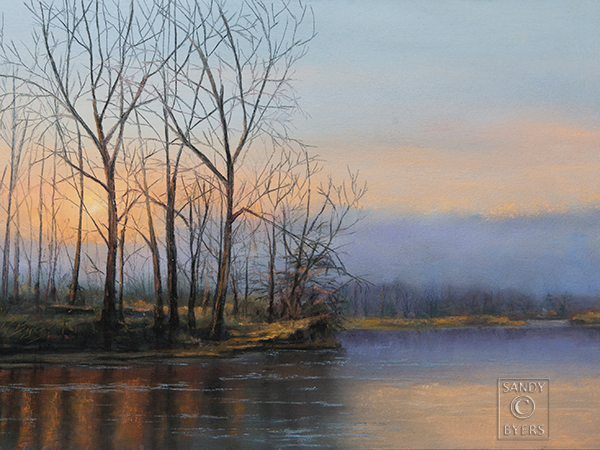
“Deception Pass” by Sandy Byers Photo by Sandy Byers
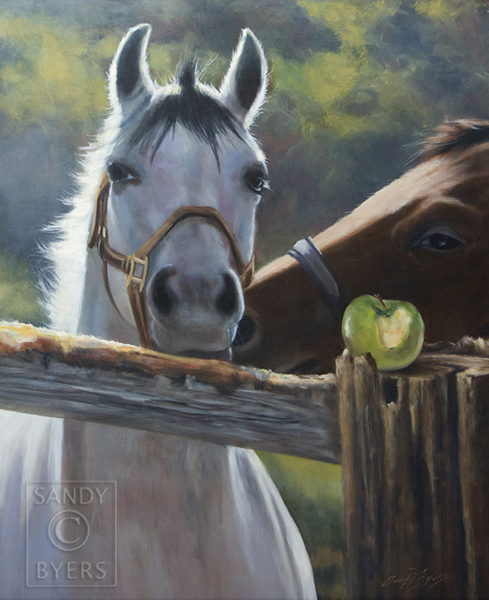
She has a love of all animals, she said, and that is expressed in much of her art. She tells the story of having a chicken follow her around and realizing, upon returning home, that she had fallen in love with it; the chicken soon became the subject of a painting. Animals represent about a third of her paintings. However, when her cats died, she began focusing more on outdoor painting. Her website shows five areas of specialization; in addition to “Cats Only” and “Animals” she features “Figures,” “Land and Sea” and “Still Life Floral.”
Byer’s art studio, built by her husband, Larry Photo by Sandy Byers
Byers said she recently discovered the world of plein air painting. “I’ll be outside a lot in the coming months, on Whidbey and beyond, looking for whatever calls to me.” She especially appreciates how much she gets to interact with people when she is doing her plein air work. “People are drawn to what I’m doing and enjoy talking with me while I’m working. All the sights and sounds that occur around the painting become a memory of what I’ve done,” she added. One of her favorite stories is her experience painting an interesting barn and noticing a teenage boy who came running up to see what she was doing. When he saw her painting, he exclaimed excitedly, “That’s my barn!”
Sandy Byers appreciates seeing others enjoy art. She teaches workshops out of her home studio and is supportive of anyone who seeks her out, responding to questions or giving advice about an art project.
Carolyn Tamler was a marketing research and community involvement consultant in the Seattle Area for many years before moving to Whidbey Island, where she has become known as a writer who enjoys telling the stories about the many businesses and entrepreneurs on the island.
Photo at top: “Edge of Skagit” pastel by Sandy Byers (photo courtesy of the artist)
CLICK HERE to read more entertaining and informative WLM stories and blogs.
WLM stories and blogs are copyrighted and all rights are reserved. Linking is permitted. To request permission to use or reprint content from this site, email info@whidbeylifemagazine.org.
While April showers are having their way with us, we turn to two painters of the world around us, in hopes that we can call springtime weather to us just a little sooner. Or at least distract ourselves from the storms that soak our gardens and keep us indoors.
Cary Jurriaans was born in Holland. The Dutch set the gold standard for still-life paintings and scenes of everyday life that are still influencing artists several centuries down the pike. She works in oils—with subjects that you might find as you move through your day—making the ordinary extraordinary with her use of light and color.
Sandy Byers’ work exudes love and affection for her subjects, be it a tempestuously-clouded sky over the Skagit flats or a couple of cats squabbling for dominance in the comfy chair. Rich color and strong compositions bring solidity and grace through her use of pastels, a medium that, quite frankly, has always eluded me. In her hands it sings and swings.
I hope you will enjoy this month’s virtual gallery. Watch for articles about these artists coming soon.
Anne Belov
WLM Virtual Gallery Curator
Photo at the top: “Building Trust,” oil by Sandy Byers