Tag: Whidbey painters

  • Artists of Whidbey Island || The I’s of Art: Inspiration, Idea, Imagination

    Artists of Whidbey Island || The I’s of Art: Inspiration, Idea, Imagination

    PHOTOS AND TEXT BY DON WODJENSKI
    Whidbey Life Magazine Contributor
    June 29, 2016

    Imagine looking over David Ossman’s shoulder at the image fragments he’s gathered in the creation of a new collage.

    You see, on his desk a seemingly random assortment of small pieces of paper—scattered colored prints from years past, selected for content, color, line, size and meaning. Assembling the pieces, with scissors and glue close at hand, he examines each of them, positioning them in relation to both a foundational image and other selected fragments, placed or still loose.

    You wonder: what’s the idea?

    Looking over David Ossman’s shoulder inspires wonder.
    Looking over David Ossman’s shoulder inspires wonder.

    Considering concepts of artistic vision and the origin of ideas is challenging, to say the least. It’s simple to say anything or everything can prompt an idea. We all experience new ideas. We are, after all, thinking beings. Engineers, mathematicians, scientists—typically inclined toward empirical solutions rather than artistic expression—will generate ideas that match their personal inclinations.

    So where do artists’ ideas come from?

    How do artists dream up the work we see in exhibits or online? Are they the overflow of an active subconscious or the result of conscious intent? Could they be inspired realizations or the happy accidents of engaging in the creative process?

    In Ossman’s basement studio, every surface is covered with evidence of a life in the performing and visual arts. A founding member of the iconic “Firesign Theater” group, Ossman is a writer, poet, performer and visual artist. His studio space is filled with memorabilia and oddities. LP albums and books are crammed onto shelves along with collections of marketing toys. 1960s posters and signed black and white photographs of 20th century film celebrities (elegantly framed) are a background for bobble-head Beatles. Is it out of this visually rich environment that he draws inspiration, or from a deeper, richer source than his environment reveals?

    David Ossman working in his creatively rich environment.
    David Ossman working in his creatively rich environment.

    American artist Chuck Close dismisses the idea of inspiration as waiting for lightning to strike. He believes that only by engaging in work will ideas be abundant and materialize from the process.

    However, I like the idea of a ‘spark’ of inspiration to light the imagination. The ancient Greeks called upon the Muses for inspiration. Interestingly, there was no muse for painters, sculptors or architects. Music, dance, theater, literature and poetry have their respective muses, but visual artists, artisans, and architects appealed to Athena for divine guidance.

    Cary Jurriaans’ painting methods are inspired by Dutch masters.
    Cary Jurriaans’ painting methods are inspired by Dutch masters.

    Cary Jurriaans’ mastery of traditional painting methods is rooted in the application of classical western European aesthetics and motifs. For her, the ideals of western art serve to inspire and inform her clear and carefully rendered paintings. From the application of traditional compositional and perspective techniques to a skillful rendering of light and atmosphere, Jurriaans’ work is a study in the methods of classic oil painting traditions.

    Alternatively, artists may clear their minds and let the form take shape through a simple implementation of skills and intent. For example, ceramicist Al Tennant has adopted the Japanese idea of wabi-sabi as his inspiration and guiding artistic principle—abandoning traditional ideas of perfection for an appreciation that results from an object’s imperfection and embracing the impermanent nature of existence. Tennant’s wood-fired vessels and sculptural forms reflect his preference for the simplicity and honesty of unrefined stoneware.

    Al Tennant constructs his ceramic pieces following wabi-sabi sensibilities.
    Al Tennant constructs his ceramic pieces following wabi-sabi sensibilities.

    Whether ideas are inspired by studio environments, semi-divine muses, western traditions, eastern philosophy or “all of the above,” concepts are massaged in the imagination until an idea is applied to the artist’s chosen medium. Ultimately, the creative process prompts the artist to develop art that best expresses the original idea. And that work often becomes an inspiration for further ideas.

    For more images of David Ossman, Cary Jurriaans, Al Tennant and all of the participants in “The Artists of Whidbey Island” series, go to http://www.wodjenskicreative.com/f1067522829.

    Don Wodjenski, is an artist, photographer, teacher and musician living in Coupeville. Recently retired after 20 years as an Arts instructor with South Whidbey Schools, he remains active in the Whidbey arts community. Although, never without an opinion on art and culture, he is new to blogging.

    __________________

    CLICK HERE to read more WLM stories and blogsHave a great story idea? Let us know at info@whidbeylifemagazine.org.

    WLM stories and blogs are copyrighted and all rights are reserved. Linking is permitted. To request permission to use or reprint content from this site, email info@whidbeylifemagazine.org.

  • ‘Forgeries at Froggwell’ set for Friday, July 31 through Sunday, August 2

    ‘Forgeries at Froggwell’ set for Friday, July 31 through Sunday, August 2

    BY ANNE BELOV
    Whidbey Life Magazine Contributor
    July 29, 2015

    You can hardly throw a rock on Whidbey Island without hitting an artist, (or, for that matter, a yoga instructor.) But while we’re well endowed with contemporary artworks, you have to travel quite a long way to enjoy great art from past centuries.

    However, since 2009, the classic masterpieces come to Freeland the first weekend of every other August… in the form of, um… forgeries.

    The Forgeries at Froggwell show has its roots in the love of classical painting and sculpture. The owner of Froggwell Gardens has dubbed his home The Froggwell Cultural Institute, claiming that the house and garden are themselves a bit of a forgery or—at least—an homage to English estates and their gardens.

    Babara Hepworth
    A Barbara Hepworth sculpture.  Or is it? (photo courtesy of The Froggwell Cultural Institute)

    Most artists, whether self-taught or art school-educated, have made copies of masterworks as part of their training. It’s a great learning tool that helps a student artist understand there is more to painting than just depicting subject matter. Lessons about color, composition, the application of paint, and the creation of illusions with colors, shapes and values are the payoff to the copy-making artist.

    The show at Froggwell had its origin in two events that occurred in 1999. The Seattle Art Museum held a show of John Singer Sargent’s work starting in late December. Looking at his painting “A Street Scene in Venice,” I remarked, “I wish I’d painted that.” I was challenged to do just that, so I did.

    Shortly after that, while on a trip to Amsterdam, we admired a painting in a small gallery. The gallery owner said that there was a small problem with the painting; it was a forgery of the work of a very famous painter whose art could be found in The Rijksmuseum as well as other museums across Holland. The painting of forgeries to sell to the Germans during their occupation of Holland during World War II was a popular pastime among Dutch painters. This story was guaranteed to hook us, and the painting came to Whidbey to become the first forgery in the Froggwell Collection.

    pollock etc
    “Pollock,” etc. (photo courtesy of The Froggwell Cultural Institute)

    “Forgeries at Froggwell” grew out of another show that has been hosted there since 2004, showcasing the work of a select group of painters, sculptors and printmakers on the island. After four years of doing the Froggwell Invitational, we decided to make it a biennial, but to have a different kind of show on the alternating years.

    The first show, in 2009, had the theme: “paint a copy of your favorite painting”; the only requirement was that the copied artist had to be deceased. For the 2011 show, we took a rather tongue-in-cheek approach and declared that the show would commemorate the 98th Anniversary of the 1913 Armory Show of New York (because any idiot can hold a 100th anniversary show, but it takes a special kind of idiot to celebrate the 98th anniversary). All the work in this show had to copy work exhibited in the original 1913 show.

    We were lucky enough to be in New York two years later and see the real 100th anniversary exhibition of the 1913 Armory Show at The New York Historical Society. About half a dozen original paintings in the show were ones that we had copied and it was inspiring to see the real thing and appreciate what a good job we had done copying them.

    The house at Froggwell Garden
    The house at Froggwell Garden (photo courtesy of The Froggwell Cultural Institute)

    Our 2013 “Forgery” theme was “From the School of…” and the participating artists created work “in the style of…” rather than creating exact copies. They were also encouraged to invent stories about these inauthentic works to explain their rather dubious provenance. I created an excerpt from Sargent’s journal to explain the painting of Madame ‘P.

    This year’s show returns to our wide-open favorite painting theme, with over 25 artists participating. Many of the artists have been in the show before, but a number of them are new to this year’s show. Among the artists to be forged are John Singer Sargent, Jacque Louis David, J.M.W. Turner, Frida Kahlo, Mark Rothko, Edward Hopper, Louise Nevelson and many more.

    So if a trip to the Tate Britain or The Metropolitan Museum is not in your budget this year, Froggwell Garden is just around the corner.

    All works in the show are for sale, so if you’ve always had a hankering for a John Singer Sargent or Thomas Moran but don’t have a spare million in your bank account, you might find the painting of your dreams this weekend.

    Froggwell Garden is located at 5508 Double Bluff Rd. in Freeland on Whidbey Island. The show will be open from 10 a.m. through 6 p.m. Friday, July 31 through Sunday, Aug. 2.

    For more information about the artists, the show, and driving directions, visit http://froggwell.wordpress.com or email froggwellbiennale@gmail.com.

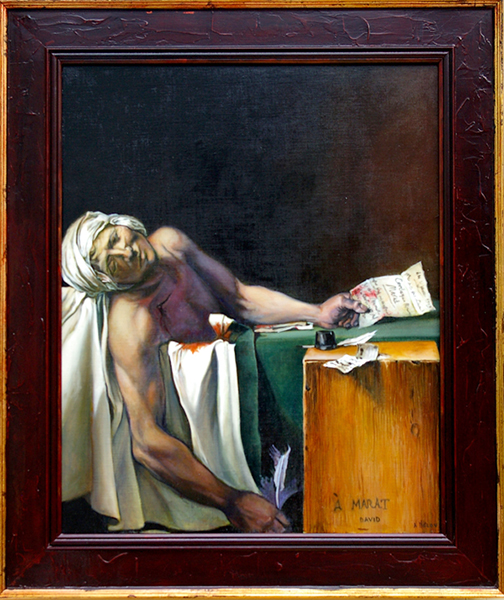
    Image at top: J L David’s “Death of Marat”?   Or is it? (photo courtesy of The Froggwell Cultural Institute)

    Anne Belov is a painter, printmaker, cartoonist, and notorious forger living on Whidbey Island. When not channeling the spirit of John Singer Sargent, she channels her own muse, writes for Whidbey Life Magazine, and encourages pandas to behave badly. You can see her work at The Rob Schouten Gallery and her cartoons on The Panda Chronicles. You will find her this week-end at Froggwell.

    __________________

    CLICK HERE to read more WLM stories and blogs. Have a great story idea? Let us know at info@whidbeylifemagazine.org.

    WLM stories and blogs are copyrighted and all rights are reserved. Linking is permitted. To request permission to use or reprint content from this site, email info@whidbeylifemagazine.org.

  • Rob Schouten Gallery presents Keiichi Nishimura’s mixed-media paintings on silk through October

    Rob Schouten Gallery presents Keiichi Nishimura’s mixed-media paintings on silk through October

    Sept. 24, 2014

    Come see the moon and the sea in a whole new, elysian light.

    Rob Schouten Gallery presents “Keiichi Nishimura, Mixed-Media Paintings on Silk” in this longtime artist’s first Whidbey Island show from Oct. 1 to 30.

    Nishimura is known for his unique approach to wave imagery and his use of metal leaf within each of his original, one-of-a-kind paintings on silk. 

    Nishimura’s work is a modern interpretation of traditional images and techniques. He understands deeply both the discipline of his Eastern culture and the freedom of Western expression—a combination he strives to integrate into his work.

    “When I came to this country 30 years ago, all I saw in California was an old style of Asian art,” Nishimura said. “I wanted to show people a new style of painting; I wanted them to see more of what was current art in Japan.”

    Nishimura began taking what he saw as a traditional Japanese style of art to a new place, adding his own semi-abstract style on familiar themes.

    "Quiet Storm," triptych, mixed-media on silk by Keiichi Nishimura. / Photo courtesy of the artist
    “Quiet Storm,” triptych, mixed-media on silk by Keiichi Nishimura. (photo courtesy of the artist)

    The medium he uses is a water-based pigment derived from suihigofun (a mineral), which the artist grinds to a finer consistency and then mixes with a delicate balance of nikawa (melted pine sap).  The nikawa is what gives the pigment its deep rich color and also enables it to adhere to the silk.  Variances in color and tone are created by hand with wide brushes. He may incorporate a color resistant technique using flour or sand, sumi (charcoal), gold leafing, ink and other techniques all in a single work. 

    Now a resident of Whidbey Island, Nishimura was born in Kyoto, Japan, where he began his training as an artist in 1976 under the apprenticeship of his father, Jintaro Nishimura, a master artist for more than half a century. Nishimura has shown his work extensively in the San Francisco Bay area and in Hawaii.

    The artist said he is excited to have the Whidbey community see his work and is curious to know what people here will make of it.

    “I’m just so glad to have this opportunity to show my paintings on this beautiful island for the very first time,” he said.

    The gallery will also feature Anne Belov’s original drawings from her children’s picture book “Pandamorphosis” for two weeks only, from Oct. 1 through Oct. 15, with an artist book-signing from 2 to 4 p.m. on Saturday, Oct.11.

    Please join us for light refreshments and a chance to meet both these artists from 1 to 4 p.m. Sunday, Oct. 12 during Greenbank Farm’s “Second Sunday at the Farm” event, when the Farm’s galleries, shops, cafe and market welcome visitors to enjoy a relaxed afternoon of fine art, good food, natural beauty and lively conversation.

    Pictured at top is “Peaceful Morning,” mixed-media on silk by Keiichi Nishimura. (photo courtesy of the artist)

    Rob Schouten Gallery, a premier showcase for Whidbey Island and Northwest artists, is located at 765 Wonn Road, #C-103 at the historic Greenbank Farm. Gallery hours are 11 a.m. to 4 p.m. weekdays; 10 a.m. to 5 p.m. weekends; closed Tuesday or by appointment.  For further information, call 360-222-3070 or email info@robschoutengallery.com.

  • World-renowned Spanish painter to teach September workshop at Whidbey Island Fine Arts Studio

    World-renowned Spanish painter to teach September workshop at Whidbey Island Fine Arts Studio

    August 6, 2014

    Technical skills as a painter are important, but not everything.

    So says Spanish master painter Golucho, who will teach an advanced four-day painting workshop titled “Beyond Skill” at Whidbey Island Fine Art Studio in Langley on Sept. 9 through Sept. 12.

    Whidbey Island Fine Art Studio founder and artist, Cary Jurriaans, has been offering workshops at her studio for more than eight years. By inviting Golucho, Jurriaans said she wanted to offer a workshop that gives artists the opportunity to make a leap to the next level of skill.

    “When I first heard about Golucho and saw his work, I knew there was something way more than just skill,” Jurriaans said. “Golucho is a highly-regarded European painter on the level of Lucien Freud, Vincent Desiderio and Odd Nerdrum. We want to provide the opportunity for advanced-level artists to glean inspiration from this exceptional artist.”

    "La Cañada Summer 86" oil on board by Golucho.
    “La Cañada Summer 86” oil on board by Golucho.

    Golucho (born Miguel Angel May) was born in Madrid, Spain in 1949 and started painting at age 12.  In 1964, he studied in Paris at the Place des Vosges for six years and is reported to have studied master works at the Museo Nacional del Prado and the Casón del Buen Retiro in Madrid. Golucho is well-known in Spain as a contemporary figurative painter, showing his work in numerous venues, including in Madrid, Paris, Brussels, Philadelphia and New York.

    Golucho says that the art of painting is not all about technical mastery of skill, but also about mastering one’s self. It’s about the painter finding his or her authentic voice which is then expressed visually on canvas. That ability, says Golucho, can be more valuable to a painter than even the most technical of skills.

    This idea of finding one’s voice on the canvas, a non-academic way of teaching, appealed to Jurriaans. After the skill is learned, she said, more has to come out to make a painting a true work of art and that is something that is not so easy to learn.

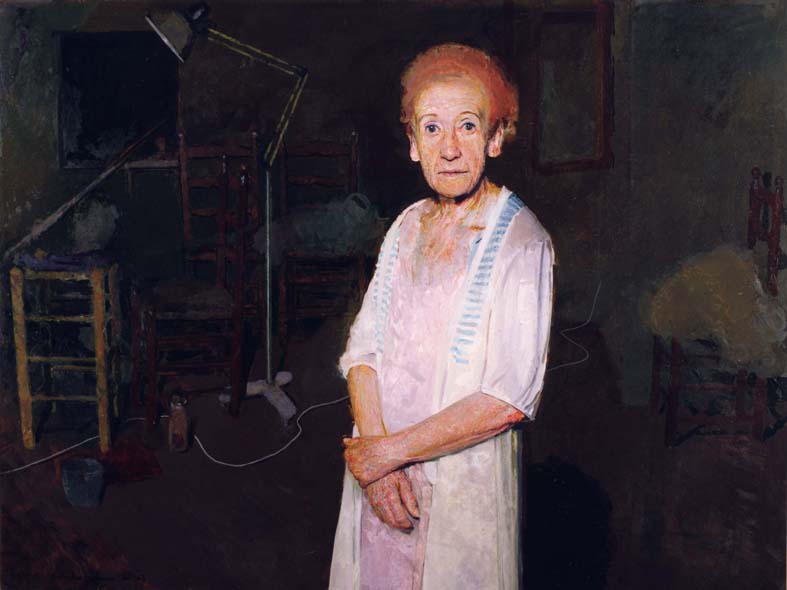
    "Alma in the Studio" is an oil on board by Golucho.
    “Alma in the Studio” is an oil on board by Golucho.

    “Golucho’s work is very amazing when you see it in person. You get a feeling that you are standing in front of something unique and indescribable,” Jurriaans added.

    Golucho not only paints. He is also a published poet, which plays into his philosophy about voice in art.

    “His observations really hit at the core of something and go far beyond the technical approach,” Jurriaans said.

    To that end, a workshop at Whidbey Island Fine Art Studio goes beyond just painting. Jurriaans likes to think of her studio as a place where artists can immerse themselves in the process of making art and exchanging ideas about making art.

    “Students stay around Langley, paint together, eat together if they wish, come to the WIFAS studio for a student/instructor dinner and talk art. “I think it is amazing that he is willing to come to Whidbey Island and conduct a four-day workshop,” Jurriaans said.

    Students watch a painting demonstration at Whidbey Island Fine Arts Studio in Langley. / Photo courtesy of WIFAS
    Students watch a painting demonstration by artist Susan Lyon at Whidbey Island Fine Arts Studio in Langley.  (photo courtesy of WIFAS)

    The workshop starts Tuesday, Sept. 9 and runs through Friday, Sept. 12. The cost is $950; the skill level is advanced/professional.

    To find out more about the workshop with Golucho, his work and his teaching style, visit the Whidbey Island Fine Art Studio website here.

    Jurriaans recently launched an Indiegogo campaign in order to pay for some of the workshop’s expenses and to ensure that this unique workshop will be offered. The number of seats are limited and WIFAS wants to make the workshop as accessible as possible and also offer one scholarship for a qualified student. Visit Indiegogo campaign for Golucho here.

    Whidbey Island Fine Art Studio is a sponsored project of Fractured Atlas, a non-profit arts service organization. Contributions for the purposes of Whidbey Island Fine Art Studio must be made payable to Fractured Atlas and are tax-deductible to the extent permitted by law.

    Whidbey Island Fine Art Studio is located at 813 Edgecliff Drive in Langley, Wash. Call 206-571-0442 or email info@whidbeyislandfas.com for more information.

    Pictured at top is Golucho’s painting “Alicia,” oil on board.

  • Painter Rebecca Collins reflects her life in full color

    Painter Rebecca Collins reflects her life in full color

    BY PATRICIA DUFF
    Whidbey Life Magazine
    Dec. 23, 2013

    At her cozy log home near Honeymoon Bay, Rebecca Collins’ kitchen doubles as her creative space, where two small easels steal focus, and a plethora of pastels are laid out on the table. You may have noticed the products of this colorful chaos in WLM’s Virtual Gallery this month.

    If not, you may have seen Collins’ work in various locales around the island, as this 20-year-resident of Whidbey Island has been painting as many years and more, reflecting the joyful color of surroundings.

    Penn-Cove;-oil-pastel;-11x14
    “Penn Cove Hay Field” oil pastel by Rebecca Collins.

    Collins studied art at Central Washington University, where she got her bachelor of arts in fine art and went on to receive an MFA from Syracuse University. For the past 10 years, she’s been a graphic design artist at the South Whidbey Record, but has also been busy painting.

    Collins often participates in the Froggwell Invitational Exhibit of Fine Art in Freeland, a forgery show organized by local painter Anne Belov, (also  the curator of WLM’s Virtual Gallery). Collins said she is currently at work on a painting in the style of the Canadian Group of Seven  — sometimes known as the Algonquin school — who were seven, early 2oth century Canadian landscape painters and believed that a distinct Canadian art could be developed through direct contact with nature. It’s not surprising that she chose that group’s style to emulate, as it’s apparent from looking at Collins’ work that she connects with nature and pays attention to her enviroment.

    Horsetail-Clouds;-oil-pastel;-14x11
    “Horsetail Clouds” oil pastel by Rebecca Collins.

    Collins also shows her work sometimes at Rob Schouten Gallery at Greenbank Farm, but specializes in commissioned portraits, many of which she does from old photographs.

    “I do a lot of portraits for people who have lost a loved one, or found an old family photo, and would like to turn the image into a portrait,” Collins said.

    Collins likes to work with oil pastels and graphite. Her work is naturalistic and colorful, and focuses often on the landscapes of Whidbey Island or the places to which she has traveled.

    “I’ve become interested in sailing and have been doing a lot of nautically-themed pieces,” she said. “Our latest trip to Barkley Sound in B.C. gave me a lot of material to work with.”

    She also likes painting old cars and trucks, which she said seems to be popular subjects for island artists.

    Mast-Hoops;-oil-pastel;-14x11
    “Mast Hoops” oil pastel by Rebecca Collins.

    Take a look at the WLM Virtual Gallery slideshow to see Collins’ paintings now.

    CLICK HERE to read more entertaining and informative WLM stories and blogs.

    WLM stories and blogs are copyrighted and all rights are reserved. Linking is permitted. To request permission to use or reprint content from this site, email info@whidbeylifemagazine.org.
  • Watercolor painter Ginny O’Neill is hot for hot-pressed

    Watercolor painter Ginny O’Neill is hot for hot-pressed

    BY PATRICIA DUFF
    Whidbey Life Magazine editor
    Dec. 16, 2013

    Freeland painter Ginny O’Neill likes to work wet and loose with watercolors.

    Take a look at the slideshow of her work which is featured on the WLM Virtual Gallery this month.

    “I just recently began doing more people and animals,” O’Neill said.

    “It may be my favorite thing to do. I just love painting portraits and I love painting dogs. If you love them, which I do, you can just feel them and you can capture their soul in their eyes, and that is the most important thing to me − getting the eyes.”

    A Portrait of Buster–Commission;WC;9x12
    “Portrait of Buster” was a commissioned work by the watercolor artist Ginny O’Neill. / All photos courtesy of the Ginny O’Neill

    O’Neill started getting into the watercolor process 10 years ago and learned hers style on “hot pressed” paper from fellow Whidbey Island painter and teacher, Patti Gulledge-White.

    “I work on hot pressed,” O’Neill said referring to the kind of paper she uses for her paintings. Ninety-five percent of watercolor work is done on cold press; the paper determines the look of the painting,” she added.

    Hot-pressed watercolor paper has a fine-grained, smooth surface, with almost no tooth. This makes it ideal for large, even washes of color. With the hot pressed process, the paper doesn’t absorb the paint quite as much and gives the painter the opportunity to move the paint around before it dries, O’Neill said.

    “I start out with lots of layers; very, very pale layers and then, when I start to work up the subject, I continue the layering, building up the color. Everything is very loose,” she said.

    That’s followed by the painter’s attention to the details, and then finally, some dry brush work toward the end.

    “So it begins wet and loose and then goes to dry and detailed,” O’Neill said.

    She said the process is time consuming, but worth it because it allows her to get atmosphere of the Pacific Northwest, with its wet air and fog.

    “It just allows you to do that by building up layers for more richness of color and more depth,” she added.

    Bainbridge Ferry;WC;8x12
    “Bainbridge Ferry,” a watercolor on hot-pressed paper by Ginny O’Neill.

    O’Neill always had a passion for drawing as a young person and was painting by the time she was out of college, but family and work put that passion on hold. She took it up again in 2001, when she moved to the island and found Deon Matzen’s popular oil painting class. After discovering watercolors, she began studying with master painter Patti Gulledge-White, who O’Neill now assists in her classes at Gulledge-White’s Maxwelton Valley studio.

    O’Neill currently shows her paintings at the Brackenwood Gallery in Langley and at the Kristen Gallery in Seattle. Check out her recent paintings here at the WLM Virtual Gallery.

    Stay tuned for a look at the work of the other featured Virtual Gallery painter for December, Rebecca Collins.

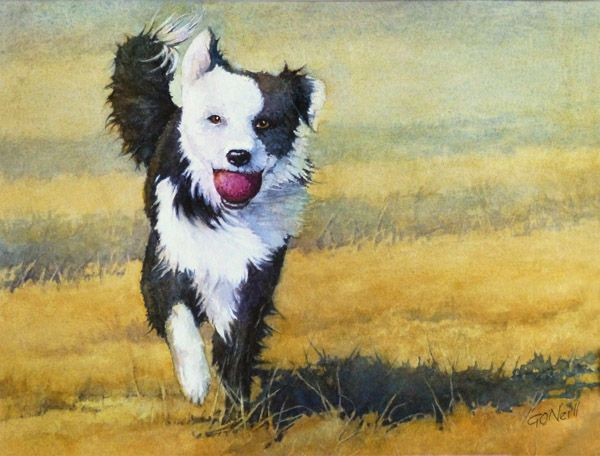
    (Pictured at top, “Last Run of the Day,” watercolor on paper by Ginny O’Neill.)

    CLICK HERE to read more entertaining and informative WLM stories and blogs.

    WLM stories and blogs are copyrighted and all rights are reserved. Linking is permitted. To request permission to use or reprint content from this site, email info@whidbeylifemagazine.org.