Tag: Whidbey history

  • Then…and Now || Community Spirit Passes through Generations at Dave Mackie Park

    Then…and Now || Community Spirit Passes through Generations at Dave Mackie Park

    BY DAVID WELTON
    Whidbey Life Magazine Contributor
    Nov. 4, 2015

    Just as baseball was the universally acclaimed national pastime during the last century, on a smaller scale softball was the pastime of Whidbey Island. As early as 1913, the four Mackie brothersTheodore, Peter, James and David—cleared and leveled the sandy ground at Maxwelton beach to provide a playing field for ballgames. Dave Mackie passed away in 1939 and his heirs donated the land to Island County to create Dave Mackie Memorial Park.

    Maxwelton Seals, probably about 1930 (photo courtesy of family)
    Maxwelton Seals, probably about 1930   (photo courtesy of Doug Green)


    A 1913 women’s team at Maxwelton field (photo courtesy of family archives)
    A 1913 women’s team at Maxwelton field (photo courtesy of George Mills)

    Maxwelton’s ballgames anchored community life during the summer. Families and friends picnicked on the grass to watch the contests until dusk. Before too long, someone had the bright idea to illuminate the field to extend ballgames into the night. Public funds were sparse after the Great Depression and World War Two, however, so the community pitched in and did it themselves. Clayton Mackie and a party of volunteers rigged a device to transport and raise the log light poles and electrician Payton Rudd donated his professional services to wire the poles.

    The grandstand as it appeared during the 4th of July Maxwelton parade in the early 1950s
    The grandstand as it appeared during the 4th of July Maxwelton parade in the early 1950s  (photo courtesy of George Mills)

    The lights were dedicated on the Fourth of July, 1947 and the community was proud of the smallest lit ballpark in America. The hat was passed after each night game to fund the electric bill.

    The next step toward the big leagues was a covered grandstand to gather spectators and to shelter them from the elements. Once again the neighbors stepped up to the plate; a team of helpers from the Maxwelton Community Club and Woodland Hall erected the structure at the south end of Maxwelton Road, using donated lumber. Foul lines and outfield fences, located out past the light poles, were installed. Construction was completed in November of 1949 and the arrival of a “major league” quality arena fostered fierce competition.

    richard grubbs
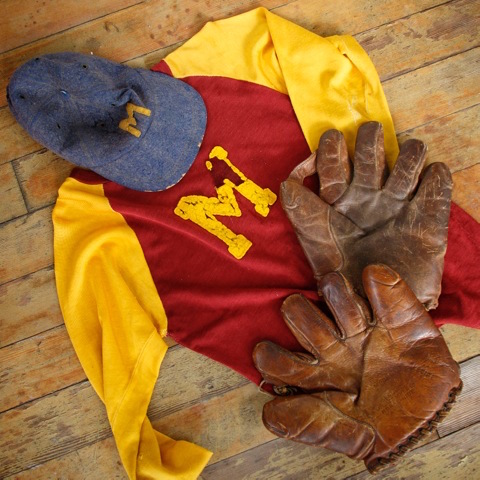
    Richard Grubb with his 1950s Maxwelton jersey and his father’s ballcap and glove from the ’30s. (photo by David Welton)


    1936 Baseball team (photo courtesy of family archives)
    1936 Baseball team    (photo courtesy of Doug Green)

    A surprising number of middle-aged and older players, from both Little League and adult recreational teams, still live nearby. They gathered recently to reminisce about the good old days.

    Doug Green recalled the pre-television-1950s as a “transition era. Communities did stuff together at churches and gathering places,” he said. He remembers bobbing for apples at Woodland Hall.

    Ralph Green, Bob Miller and Doug Green hoist the 1947 tournament trophy, engraved with parents’ and uncles’ names (photo by David Welton)
    Ralph Green, Bob Miller and Doug Green hoist the 1947 tournament trophy, engraved with parents’ and uncles’ names (photo by David Welton)

    Ralph Green and Parker Wildes, a barrel-chested first baseman of Ruthian proportions, were known for prodigious home runs that occasionally landed in the surf beyond the short right-field fence. Richard Grubb claimed “the outfielder had to wear hip boots.”

    Doug Green swings an antique bat. Richard Grubb uses his father's mitt and ball cap, adorned with a yellow ”M.” (photo by David Welton)
    Doug Green swings an antique bat and Richard Grubb takes his place as catcher.  (photo by David Welton)
    Rich and Lanny Workman show off the treasured uniform. (photo by David Welton)
    Lanny Workman, right, shows off the reminder of days gone by.   (photo by David Welton)

    The center fielder had to dodge the light poles that were 20 feet inside the outfield fences. There were no ground rule doubles, so “if the ball hit the pole, you had to play it off,” said Green.

    “There was a particularly spirited rivalry between Clinton and Maxwelton,” Bob Miller said, “with heated games on the Fourth of July.” Local teams from Midvale, Langley and Freeland hosted games at their own fields. A game in Coupeville made for a greatly anticipated but long road trip in those days. Regional teams from Mukilteo and Seattle traveled to play in the crown jewel of the Maxwelton Valley.

    Dorothy Mills, far left, watches a late 1930s game with lady friends and two children. (photo courtesy of family members)
    Dorothy Mills, far left, watches a late 1930s game with lady friends and two children. (photo courtesy of George Mills)

    Little League, adult recreational and pickup games were played there, as well as “hens and chickens” games that pitted single women against their married counterparts. County commissioner Helen Price Johnson grew up in Maxwelton and played in a co-ed league as a child.

    The Cross Country Store and gas station, owned by Miller’s grandmother, Julia, and located across the street from the ballpark, stayed open late to refuel hungry players with candy and soda pop.

    In the summer of 2011, plastic outhouses were placed temporarily alongside the lean-to storage building next to the grandstand in anticipation of the Whidbey Island Triathlon. Sometime after midnight they were vandalized and set on fire. Although the fire was promptly extinguished, the storeroom was destroyed and the stands were damaged.

    Bugs Bunny mural. (Does anyone know more about its creation?) (photo by David Welton)
    Bugs Bunny mural. (Does anyone know more about its creation?)    (photo by Steve Marx of Island County Public Works)

    Cleanup and demolition revealed a long-forgotten mural, concealed on the first-base side, that featured a 1939-style Bugs Bunny admonishing people to “Keep your park clean, no alcohol allowed.” None of the players from the 1950s remember this work of art. The creator and the date of this drawing remain unidentified, but some speculate it was painted by Carolyn Cook, sometime between 1960 and construction of the attached storeroom.

    The economy struggled in 2011 and county resources were once again strained so, in the grand Whidbey tradition, work parties—comprised of parents of South Whidbey Crab Little Leaguers—rebuilt and painted the grandstand and modernized the dugouts.

    Steve Marx, Assistant Director of Island County Public Works has pointed out that most older wooden ballparks have fallen to decay or fire and no longer exist in the United States. Nevertheless, the grandstand at Dave Mackie Park still remains—a physical reminder of the community spirit of Whidbey Islanders.

    Image at top: Richard Grubb’s 1950s Maxwelton jersey and his father’s ballcap and glove from the ’30s.   (photo by David Welton). 

    David Welton is a retired physician and staff photographer for Whidbey Life magazine. He thinks and processes information visually and, therefore, [he says] he is a man of few words with limited verbal communication skills.

    “Then…and Now” is an occasional series of historical Whidbey Island photographs paired with contemporary images by David Welton. If you have a “Then…and Now” story to share, contact info@whidbeylifemagazine.org.

    __________________

    CLICK HERE to read more WLM stories and blogs. Have a great story idea? Let us know at info@whidbeylifemagazine.org.

    WLM stories and blogs are copyrighted and all rights are reserved. Linking is permitted. To request permission to use or reprint content from this site, email info@whidbeylifemagazine.org.

  • Now, and Then || A Home, Lost, Expands the South Whidbey Fire Department

    Now, and Then || A Home, Lost, Expands the South Whidbey Fire Department

    BY DAVID WELTON
    Whidbey Life Magazine Contributor
    August 19, 2015

    The cry of a distant siren reminds us of our vulnerability, yet reassures us that aid is near those in distress. But it wasn’t always so.

    When South Whidbey’s volunteer Fire Department was founded in 1950, the only fire station was in Langley. On a night in Nov. 1953, events on French Road—ten country miles to the south—catalyzed change.

    Mary Sue Kinskie, 13, had just put her two younger brothers, Art and Fred, to bed; her mother Susan was working the night shift at White Acres Nursing Home in Freeland. Mary Sue had just settled herself at the kitchen table with her homework when she and her father, Clarence “Tern,” smelled smoke coming from the dining room.

    Mary Sue and her brothers, with their scooters beside the house, a year before the fire. (photo courtesy of the family)
    Mary Sue and her brothers, with their scooters beside the house, a year before the fire. (photo courtesy of the family)

    Mary Sue rushed to the hand-crank telephone—a party line that served 14 homes. Fortunately, someone at a prayer meeting at the Little Brown Church, just down the hill from the home, answered at the same time as the operator and heard her call for help. The young woman awakened her brothers and, as they fled the house, she tumbled down the front steps, injuring her knee. Her father, an amputee, tried to dowse the flames with a pail of water, but the one-man, one-legged bucket brigade was no match for the growing inferno.

    Mary Sue points, on her dollhouse replica, to where the fire began.
    Mary Sue points, on her dollhouse replica, to where the fire began.   (photo by David Welton)

    The men from the church arrived long before the fire truck; there were rumors of an empty gas tank and a flat tire. They were able to save a few belongings, including the stove, a water heater and, from the basement, a box of dynamite—essential to Tern’s lumber business for the removal of stumps. The house, however, burned to the ground. A firebreak kept the flames back from the tree line.

    Mary Sue said one thing she recalls was an elderly neighbor lady who, while the house burned, gave her father a tongue-lashing about the dangers of storing dynamite in the basement—all while she sat right on top of the crate.

    The teenager and her brothers spent a sleepless night with neighbors and were sent to school the next day, but with a valid excuse for losing their homework.

    The fire truck, barely visible, in 1954 at Dave Mackie Park during the Maxwelton 4th of July festivities. Pictured are Floyd Grubb, Darrell Green, Clay Green, Lincoln Wildes, Lyle Borden, Wayne Hawley, Pat Nourse, Allen Bilderback, John Patton, Randolph Erikson, unknown, Paul Long, Dewey Hoistra, Gus Skarburg. (photo courtesy of George Mills, Maxwelton Valley historian)
    The fire truck, barely visible, in 1954 at Dave Mackie Park during the Maxwelton 4th of July festivities. Pictured are Floyd Grubb, Darrell Green, Clay Green, Lincoln Wildes, Lyle Borden, Wayne Hawley, Pat Nourse, Allen Bilderback, John Patton, Randolph Erikson, unknown, Paul Long, Dewey Hoistra, Gus Skarburg. (photo courtesy of George Mills, Maxwelton Valley historian)

    The Kinskies had no insurance—forecasting dreary holidays for the family—but the next morning a procession of visitors arrived with gifts of food and clothing. A neighbor allowed the family to stay in his empty guesthouse nearby. Timber was felled and hauled to Green’s Mill at Maxwelton Slough to provide lumber to rebuild the house. A work party soon assembled, and within a year the family was home again.

    Everyone agreed it was time for the fire department to expand. A temporary one-bay station was quickly erected on Maxwelton Road and a fire truck acquired. A larger two-bay facility, which stands to this day, rose at the intersection of French and Bailey Roads, just below the Kinskie property.

    Mary Sue still lives in the reconstructed house. The rescued water heater still functions in the basement. (photo by David Welton)
    Mary Sue still lives in the reconstructed house. The rescued water heater still functions in the basement. (photo by David Welton)

    Mary Sue got married and moved away, but later returned and still lives in the rebuilt family home where the rescued water heater serves their needs. Looking back, she said “I still chill to this day when recalling the heat of the fire. But, in the long run,” she added “it was a good thing, as it brought the community together.”

    Today, she has memories of family and friends and a 1/12th scale replica of the original house. And South Whidbey has a modern, well-equipped fire department with six strategically located stations, numerous fire trucks and even a fire boat. In real life, adversity can lead to happy endings!

    Kinskie House 1938008WLM
    Tern and Susan Kinskie along the fence in front of their home, 1938 (photo courtesy of the family)

    David Welton is a retired physician, staff photographer (and occasional writer) for Whidbey Life magazine.

    “Now, and Then” is an occasional series of historical Whidbey Island photographs paired with contemporary images by David Welton. Read the first story in the series: “Maxwelton 4th of July” here. Contact david@whidbeylifemagazine.org if you have a story to share.

    __________________

    CLICK HERE to read more WLM stories and blogs. Have a great story idea? Let us know at info@whidbeylifemagazine.org.

    WLM stories and blogs are copyrighted and all rights are reserved. Linking is permitted. To request permission to use or reprint content from this site, email info@whidbeylifemagazine.org.