Tag: Gardens

  • Lumens || When the Heart is Lifted: Valerie Easton

    Lumens || When the Heart is Lifted: Valerie Easton

    BY SHARON BETCHER
    Whidbey Life Magazine Contributor
    April 27, 2016

    While sociologists of religion speak of the Pacific Northwest as the epitome of “the none zone” (where the majority of persons register no official religious preference on a census), most residents know Whidbey Island to home contemplatives, mystics, naturalists and activists of many religio-spiritual strains with a paradisal dream of living in intimate reciprocity with all beings. Lumens lifts up the voices and wisdom of those who live among us—the creatives whose very creativity, their luminescence, opens out from the taproot of the spiritual path and/or religious faith.

    Val Easton is most widely known as “The Natural Gardener,” her weekly column in The Pacific Northwest magazine included in the Sunday edition of The Seattle Times. On South Whidbey, she is also a beloved yoga teacher and the owner of Langley’s Half-Moon yoga studio. Easton has been a student of the soil and of the soul for almost the same amount of time. While Easton started studying yoga in her twenties, she began teaching only five years ago. After leaving her position as horticultural librarian at the University of Washington Center for Urban Horticulture, she moved to Langley in 2005 and opened her studio in the Village off Second Street in 2010.

    On a Friday morning in late March, Easton settles her 15 students on their yoga mats, inviting them to observe how, like the vine maples swelling with bud, our human bodies catch the rush of rising sap. “We get heady and then exhausted in springtime,” she observes. The practice today will consequently be, she informs them, one of twists—to wring out and oxygenate the organs—and balance poses, specifically addressing the body’s need to hold its ground amidst the heady winds of spring. Ayurvedic sensibilities summoned, Easton—with settled calm and an inviting chuckle—leads her students through imitative animal poses (downward dog, lizard, dead bug) while encouraging them to “ground your feet,” “float your chin,” and always and again, “lift your heart.”

    Easton, Yoga Teacher and Owner of Half-Moon Yoga, Langley (photo by Susan Scott)
    Easton, Yoga Teacher and Owner of Half-Moon Yoga, Langley (photo by Susan Scott)

    Of Vine and Breath

    Easton’s two practices of embodied wisdom, yoga and gardening, are as much philosophically informed as they are visceral and as practical as they are spiritual. “Yoga has kept me from getting injured doing the heavy lifting of gardening,” Easton offers. But in the next breath she tears slightly as she speaks of how the “heart centered alignment” of Anusara yoga, in which she has found her spiritual home, countered the cold, alcoholic and anti-religious dynamics of her childhood in Seattle. In her early career years as a librarian, Easton—having been raised by a mom, who had become an avowed atheist in the very Catholic climate of Yakima, and a dad, who abandoned Christian Science when he became an adult—recognized there was a whole cultural discourse she didn’t know, that of the religions. She studied to fill up the hole, finding herself “drawn to the physicality of Hinduism and Buddhism,” where philosophy meets up with the body.

    Yoga, see-sawing between effort and ease, between the creation of a pose and its intentional dissolution, is, Easton asserts, about learning to channel vital life forces through the body.  It releases psychic creativity by unlocking the fascia of the body, the place where we store bad habits, tension, grudges and old hurts. By planting the feet, then the hips, and by breathing through the midline of the body, one returns to the primary vibration or “heartbeat” of the universe. In that way, yoga helps people open towards “the practice of experiencing their own aliveness, of learning what they can and cannot control” in the physics of daily life. Gardens can likewise be seen as a practice of opening out the creative physics of plants—learning how plants conspire together, creating sanctuary there not only for humans, but for bees and birds. (Easton gardened organically before magazines even allowed her to use the word “organic.”)

    Planting the Feet (photo by Susan Scott)
    Planting the Feet (photo by Susan Scott)

    Heart Yoga

    Anusara yoga, a branch of Hatha yoga, is about alignment and flow, yet is practiced by holding bodies with a loving gaze. In this tradition, one looks for the beauty and appreciates the perfection of the other. Some traditions of yoga, like Iyengar, focus intensely on technical precision, and sometimes one’s life may call for that, Easton noted. As Easton’s first teacher, Maurice Svoboda, told her, “Freedom comes through discipline.”  If that initially rang true for this child raised in a chaotic household, Easton, after her twenties, came to a point of disenchantment with the strictness of the Iyengar method.

    In the yoga studio, Easton’s voice—a combination of calm directness and joy—coaxes bodies towards their best. “Expand and soften,” she invites, her voice carrying a lilt that these bodies now obviously trust. “Relax your jaw, drop your shoulders,” she continues, and the flesh of bodies visibly unlocks. “Consider how if you lift your chin, your heart opens and receives.”

    Walking among the bodies now moving into a pose called “the cat cow,” Easton—with the gentlest touch of the fingertips—invites a muscle here or the locked fascia there to release. “Perfect, yes,” she comments. “Isn’t that nice?” she sings to another body. “We’re admiring your spine,” she adds, instructing others by inviting their gaze. “Bend more deeply. Yes, exactly. Beautiful.”  Over and again, the class hears Easton praise their beauty. And yet, Easton’s studio instruction is also an invitation to “do what is a challenge.”  Consequently, bodies are coaxed into the balance pose of “baby dancer”—posed like the heavy headed blooms of angelica tested by the winds.

    Baby Dancer (photo by Susan Scott)
    Baby Dancer (photo by Susan Scott)

    Easton’s practice tends the singularity of each body—its historied flesh, its particular limits. Many days, she observes, it’s simply enough to show up for class, to move and breathe. “The longer I teach,” she reckons, “the less I presume to know what is good for each and every body.”  Each body has its own limitations, and those are different each day, each practice. Treating those limits with respect (sometimes flushing those muscular knots with breath, sometimes honoring “the good enough”) is also part of the physics of yoga. Easton is not seeking perfection. Or rather, “perfection” in this practice of yoga is viewed through an entirely different lens than symmetry and athletic precision. Perfection is about learning to live with and through what presents itself.

    Intriguingly, her floral bouquets—which she admits are what whet her palate for gardening and what determines her choice of plants—sport a similar naturalistic beauty. These involve no floral tape, no wire. The challenge is “translating the field of the plant inside—not overcoming it,” she observes. Floral bouquets, Easton insists, are best conceived as appreciating the nature of nature—whether the essence of sweet pea or hydrangea, rather than bending them to our will. Beauty–sri in Sanskrit—is a word of applause that welcomes the truths of flesh and soil, the ephemeral nature of a bloom, while also gently inviting creative transformation or “opening,” as one works and reworks a bouquet, a garden, a body.

    Floral Bouquet for Museo Gallery (photo by Susan Scott)
    Floral Bouquet for Museo Gallery (photo by Susan Scott)

    The loving gaze of Anusara benefits the flesh of each student differently. “It keeps my anxiety at bay,” one student offers.  “It heals my body,” adds Kelly, who suffered vertigo and who, following surgery, has found this the only path of recovery. Dave mentions that he takes yoga for its dynamic counterpoint to the pounding of harder sports. Stella, observing that she, like Easton, reads the philosophy of yoga and practices in order to somatically ground her aspiration towards non-judgment.

    Sanctuary

    Half-Moon studio, like Easton’s backyard garden, is a sanctuary—a place of rest, a place with just enough of a privacy shield coupled with a loving gaze so that bodies relax. As students rest into their own weight and catch earth’s dynamic energies, the heart—that center of desire and conspiratorial joy, of compassion and empathy—can finally open.

    Opening the Heart (photo by Susan Scott)
    Opening the Heart (photo by Susan Scott)

    That the restorative poses—like savasana or “corpse pose”—are often the hardest for her students may say something about them, but just as much about our culture. In the corpse pose, which concludes every practice, one lies back on the floor, arms and legs slightly spread; one’s weight is invited to drop heavily into the floor.  You could call it rest, repose, stillness. But most of us trying to perfect the pose ask ironically and repeatedly, “What muscles are involved?  How do I do it?”

    This teacher with a gentle laugh replies, “You are not ‘doing’ anything.”  Attracted to perfecting technique, we know little about “dissolution,” about release, about opening the heart, that softening of our presence to the other. In the garden, we, determined to pull the last weed, often comparably know little about sitting and enjoying the sun in the garden. “A garden is successful,” Easton sagely observes, “when the gardener loves it, when the gardener takes pleasure in it, reposefully and in the heart.”

    If Easton were to write another book, it would be about “healing gardens”—gardens in which the focus on the organic principals she has employed throughout her years as a horticulturalist expands upon this aspect of sanctuary. Gardens can be a sanctuary for the bees lolling in the blooms. A sanctuary where bird song mixed with the joyful buzz of insects becomes as moving as Pachelbel’s Canon in D. A sanctuary filled with fragrance and profuse with the herbs one makes into green sauces. A sanctuary, like Half-Moon Studio, where we can finally allow ourselves the great reveal, the opening of the heart.

    Easton in her Langley Garden (photo by Susan Scott)
    Easton in her Langley Garden (photo by Susan Scott)

    Photo at the top: Val Easton (photo by Susan Scott)

    An academic theologian and philosopher by background, Sharon Betcher is now an independent scholar, writer and wannabe farmer living on south Whidbey. As a writer, she won the 2012 Short Story Smash and took first place in the memoir category of the Whidbey Island Writers Association’s 2012 contest. In March 2015, Betcher presented at the annual Women of Whidbey (WOW) Stories Conference.

    __________________

    CLICK HERE to read more WLM stories and blogsHave a great story idea? Let us know at info@whidbeylifemagazine.org.

    WLM stories and blogs are copyrighted and all rights are reserved. Linking is permitted. To request permission to use or reprint content from this site, email info@whidbeylifemagazine.org.

  • Sirithiri || Flora

    Sirithiri || Flora

    BY SIRI BARDARSON
    April 20, 2016

    I have returned to Freeland after a year and a half up in a tiny condo in Oak Harbor. I missed many things about the south end and one of them was my yard in Freeland. Watch what you wish for; I am staring out the living room window at all one and a half acres of it.

    I call my yard the “the yard that saved my life.” It functioned as a haven and an escape during trying times. The marriage gone bad, employment re-tooling, re-schooling, late-in-life parenting, I took these issues and their struggles into my yard. I could’ve built beautiful gardens, organized and expert with carefully chosen plantings and color schemes shaped by the seasons to soothe my chaos but, no. My yard wasn’t organized or beautiful.

    Apple blossoms (image by Siri Bardarsan)
    Apple blossoms  (image by Siri Bardarsan)

    I slaved in chaos.

    My Scandinavian DNA, refined for the sole purpose of the hardship of a Viking voyage or eating pickled herring drove me to weed, ride the mower, prune, dig turf, build dahlia and asparagus beds, raise chickens and transplant trees. Our simple construction-grade rambler with 18-inch beds next to the foundation, (inside the roof overhang so everything was bone dry and dotted with pinched rhodies), was a tabula rasa and the yard became a monster of my own making. But the yard was never beautiful; it was as messy as my emotional state and just as prone to weeds.

    To top it off, I was cheap!

    I rarely bought a good plant but, instead, I would take cuttings or do some plant rustling from an abandoned house and bring them home and lodge them in the ground. Friends gave me plants, plants that looked terrific in their carefully conceived gardens. I would take these gifts home and most of the time I would just lodge them in to the ground. They stayed there permanently, dying or—finally—I would dump the pot and they would root in. I bought leftover orphans at the end of the season and planted free Arbor Day seedlings anywhere and everywhere. In my yard, there is a bank of orange euphorbia nestled up to pink rhododendrons, a prostrate willow strangled by its proximity to a Korean fir that, in turn, is bullied by a “free” Arbor Day Hawthorn that is growing over the house. At the foot of a lopsided Japanese maple—half of its limbs amputated in an accident prior to my buying it on sale—there are mounds of catmint next to sedums and lavender shrubs in deep shade.

    You get the picture and that is just the front of the house.

    Gardening was what I did to solve the anxieties of my personal life; the work was like an immense green sweat lodge or a Finnish sauna with sunburn, blisters and nettles playing the part of hot steam and slender birch whips. My intention wasn’t to garden.

    I met an Oak Harbor friend for coffee last week and we talked about our yards. I know she is a passionate gardener and I listened to her. I shared what I had discovered returning back to my yard that, honestly, I haven’t worked in for most of a decade.

    New iris (image by Siri Bardarsan)
    New iris (image by Siri Bardarsan)

    In the back yard, there are two pine trees, both of which were live Christmas trees my son and I bought. One of them is 35 feet tall now. In my rose garden, I have recovered and moved many of my old roses. There is the Mr. Lincoln, the long-stemmed red rose that won me “Best Rose” at the Island Count Fair. Over by the fence I discovered a row of Shasta daisies that I took from my Swedish grandma’s yard after she died. There is the Audrey Hepburn rose my youngest sister gave my when our son was born. The 40-foot tall Douglas firs around the perimeter of the yard were stolen from the Trillium clear-cut 22 years ago when they were just two feet tall. There is a dog buried under the rosemary bush and another one out by the raspberries.

    The lilac bush that is in full bloom right now was once the size of a pencil and lived in a coffee can. When I stuck my shovel into the earth near it, the soil was rich and black. That spot was where a pile of cow manure sat for most of a year after my friend Glen and I unloaded it from his old Suburban while our small children laughed and ate crackers. There is a Yellow Transparent apple tree that I bought at Casey’s in Bayview for $2 and planted in December. Today it is covered with blossoms and its apples make the best pie in the universe. There is a hedge of bearded iris along one end of the house. An old boyfriend ripped the rhizomes wholesale out of the yard of his first house and gave them to me in a leather suitcase.

    Mother Nature continues to work on her one goal of “more and improved” in our Whidbey Island location that is rich and green. Over the years, “the yard that saved my life” has changed and so have I. Though not my intention, everything has turned out to be beautiful.

    A Northwest native, Siri Bardarson is a writer with an emotional hotline to the vibrant natural beauty of Puget Sound. When not writing about the importance of the wild blackberry, daisies and natural time, she practices her cello a lot and sings at the same time. She loves her Whidbey Island home.

    __________________

    CLICK HERE to read more WLM stories and blogsHave a great story idea? Let us know at info@whidbeylifemagazine.org.

    WLM stories and blogs are copyrighted and all rights are reserved. Linking is permitted. To request permission to use or reprint content from this site, email info@whidbeylifemagazine.org.

  • Buzzing With Tranquility – Meerkerk Rhododendron Gardens

    Buzzing With Tranquility – Meerkerk Rhododendron Gardens

    PHOTOS & ARTICLE BY MARTHA McCARTNEY
    Whidbey Life Magazine Contributor
    March 11, 2015

    On the morning of the last day of February, rain that had fallen during the night cleared, leaving a brilliant blue sky over Meerkerk Gardens. Mingled smells of pine, cedar and damp earth combined with sounds of trickling water and birdsong from the forest canopy, creating a haven from things man-made.

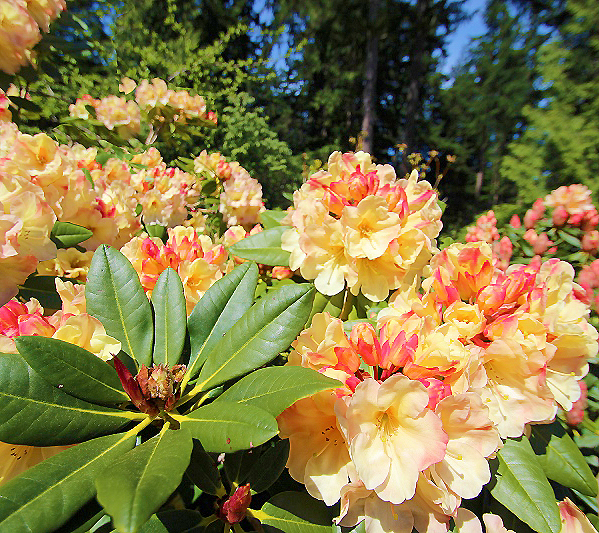
    Ferns and moss were scattered with dropped blossoms as if a flower girl had walked just ahead. The sun beamed through hemlock and Douglas fir, spotlighting a vivid show of red, pink, salmon, lavender and white rhododendrons scattered through the forest—all abuzz with pollinators.

    Meerkerk Pinks-GroundMeerkerk Gardens was created by Ann and Max Meerkerk in 1961 and was later bequeathed to the Seattle Rhododendron Society. Now it’s an independent not-for-profit garden maintained and improved by volunteers, Island County Master Gardeners and local garden club members. The Meerkerk endowment provides partial funding, but 90% of the operating funds must be raised each year. This is achieved through Friends of Meerkerk memberships, plant sales, admission donations, grants, fund-raisers and contributions.

    There are 10 acres of display and educational gardens and an additional 43 acres of forest with walking trails. The garden trails are partially ADA accessible and arrangements can be made for drop-off and pick-up to facilitate closer trail access for anyone using a wheelchair. In addition, an ADA restroom is accessible from mid-March through the first week of October. Pets are welcome if they remain on a leash.

    Meerkerk White RhodiesThe flowering starts in late February and early March and reaches a peak in April and May. However, the garden is open year-round from 9 a.m. to 4 p.m. daily, and the woods are filled with wrens, thrushes, chickadees and woodpeckers—with an occasional fly-over by ospreys and a nesting bald eagle pair known as George and Martha Washington.

    Chipmunks and Douglas squirrels, rabbits, deer and coyotes also inhabit the grounds. Benches are tucked away among the ferns and other native plants. The meditation garden pond reflects the trees and sky and buzzes with dragonflies.

    I recognize the rhododendron as the state flower of West Virginia because I lived there, and when I moved to Whidbey I was both pleased and surprised to learn it’s also the Washington state flower. Seeing the plants is like greeting an old friend and strolling through Meerkerk Gardens feels a lot like home.

    Meerkerk benchDuring my most recent visit I was fortunate to speak with Susie Reynolds, who has been the property manager for the past 19 years. I mentioned my experience of the garden, my feeling of being totally immersed in nature, and she agreed. “In the days following the destruction of September 11, 2001, the gardens were full of people seeking peace and respite from the chaos being shown on television. Many visitors expressed the feeling of stillness and the serene energy that being in the gardens and walking the paths brought to them.”

    There are over six hundred species of rhododendrons in the garden, including tropicals and hybrids. Many different varieties are for sale in the nursery, which is open during the prime planting seasons. The spring sale period starts on March 21, goes through early summer and is then open again to coincide with the fall planting season.

    Throughout the year Meerkerk hosts many special events for all ages—concerts, bird watching, wine events and the fabulous Fairy House Festival. Classes on planting and the care and propagation of rhododendrons are offered, in addition to guided tours. And, of course, there is always a need for more volunteers.

    Meerkerk singlPinkTreeTo get more information, visit the website at www.meerkerkgardens.org. Along with event listings, educational events and photos of the beautiful grounds, there are pages of helpful rhododendron growing instructions. Meerkerk Gardens is located two miles south of Greenbank on Whidbey Island, WA.

    ______________________

    Coming up in the next two weekends:

    Saturday, March 14, 10 a.m. to Noon

    Going Native:
    Identifying and Using Native Plants in the Landscape

    Learn the why, what and how of using native plants in the landscape. Plant samples and photos of landscapes using native and domestic plants will be shown.

    Don Lee (ICMG), president of Meerkerk Rhododendron Gardens, co-chairs the Island County Water Resources Advisory Committee and was the 2009 WSU Master Gardener of the Year. He is recognized as a local expert in native plants. Fee is $10; reservations are requested.

    Saturday and Sunday, March 21 and 22
    9 a.m. to 4 p.m 

    Nursery Spring Opening Sale

    Meerkerk opens its nursery for the season offering a wide variety of hybrid, species and heritage rhodies from Fujioka, Watson, Barlup & Lem collections. One gallon to mature six foot plants available. Knowledgable staff will be on hand to assist you in picking out the perfect plant for your location. Shop early for best selection. Entrance to the Gardens is free during these special sales.

    Meerkerk Daffodils

    Martha McCartney is a poet, mixed media artist, photographer, persistent gardener and candle maker living the Whidbey life under the blue hole in the sky. She currently owns no goats.

    ______________________

    CLICK HERE to read more WLM stories and blogs. Have a great story idea? Let us know at info@whidbeylifemagazine.org.

    WLM stories and blogs are copyrighted and all rights are reserved. Linking is permitted. To request permission to use or reprint content from this site, email info@whidbeylifemagazine.org.

    Meerkerk ferns
    Fiddlehead ferns

    Meerkerk BriteYellow