This article is from the Spring/Summer print issue of Whidbey Life Magazine. You can find out where to get a copy of your own at the end of the article.
BY SHAWN BERIT
Whidbey Life Magazine Contributor
August 2, 2017
There is a place on Whidbey Island whose very name evokes opposing images: rustic and elegant, tranquil and stimulating, delicate and forceful. From this place, one can see the Olympic Mountains, the Strait of Juan de Fuca, and a landscape of pines and prairies. Some consider this one place to be the essence of Whidbey Island. This place is Lavender Wind Farm.
The fields of Lavender Wind Farm coming into bloom. (Photo by Sarah Richards)
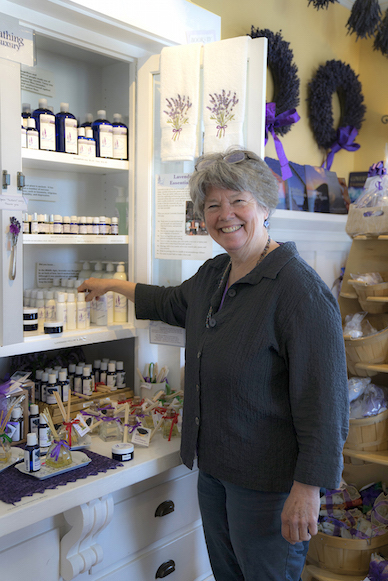
The farm shop and café in Coupeville is where the unique art and craft of owner and farmer Sarah Richards is fully displayed. Shelves hold an assortment of lavender products: soaps, hand creams, bath salts, essential oils, shampoo—and a natural cleaner, a byproduct of the distilling process. Less expected are culinary lavenders and delicious baked goods that can be enjoyed in the café. (The scones are outstanding.)
Sarah Richards’ story begins on a windswept island of rocky beaches, beautiful villages, and summer tourists. Much as this describes Whidbey, it is almost as far away from the island as one can get and still be in the continental United States. Richards grew up on Martha’s Vineyard. The experience of living there, a place with few public beaches, would directly influence her future choices.
Owner Sarah Richards in the Lavender Wind Farm shop. The display case holds lavender soaps, shampoos, and other personal care products. (Photo by Marsha Morgan)
After stints in France and Oregon, Richards went searching for the home that had somehow eluded her. During a visit to Port Angeles, she discovered Whidbey Island. Like so many who call the island home, and so many who return to visit again and again, the island called to her.
In 1998, Richards purchased a five-acre farm within the Ebey’s Landing National Historical Reserve. The memory of the private beaches of Martha’s Vineyard compelled her to create a place that could be shared with the public. The beauty of her new farm reinforced that vision. “Lavender and sharing grew into the farm,” she recalls.
Lavender is bundled as it is harvested. (Photo by Sarah Richards)
Why lavender? “It was an accident,” Richards says with a laugh. While searching for a crop that would do well during the dry summers of Whidbey but be able to survive its damp winters, she learned that lavender could do both.
Lavender is native to the Mediterranean, parts of Africa, southwest Asia, and southeast India. It’s found on farms throughout France, where it’s used in the perfume industry. There are 47 known species of lavender (a member of the mint family) and hundreds of cultivars. While most humans love lavender, most animals do not. In fact, it repels deer, rabbits, and other grazers. Lavender thrives in sandy, well-drained soil with full sun exposure. The middle of Whidbey Island is the perfect climate for this lovely plant.
Richards distills oil from up to 25 pounds of lavender at once in a copper rotating-column still made in Portugal. (Photo by Sarah Richards)
Though passionate about starting a lavender farm, Richards had no background in farming. According to her, “learning how to farm and then to sell the crop” were among her biggest challenges. Yet, in typical Whidbey Island style, she found help from her fellow farmers. She opened the farm in 2000. Since then, her crop size has increased, but not beyond what is manageable. Richards says she “always wanted to keep it at a human scale.”
Today, Lavender Wind Farm is a summer destination and a favorite place for photographers and painters. During blooming season, visitors delight in a waving sea of purple. The Olympic Mountains and the Strait of Juan de Fuca make a postcard backdrop as winds come in off the Sound carrying the scent of lavender.
A lot of lavender blossom is required to extract a small amount of essential oil. Two of Richards’ oils recently won awards from the prestigious Lavender Sommelier. (Photo by Sarah Richards)
Throughout the summer, visitors enjoy the lavender labyrinth, you-pick areas, picnicking, and views, as well as the chance to observe the distilling process used to capture lavender’s essential oils. Many also enjoy the opportunity to stroll the grounds: gazebo, ponds, flower gardens, scenery, and fields. Over the years, Lavender Wind Farm has played host to a variety of events, and this year is no exception. A Saturday afternoon concert series is planned for the summer season.
Richards counts as one of her greatest achievements the opening of the store and café in Coupeville, describing it as “a center of happiness.”
Bright umbrellas and shades of purple enliven a corner in Coupeville. Customers are invited to sit and contemplate which of the many varieties of potted lavender they plan to take home. (Photo courtesy of Sarah Richards)
In 2012, Richards and her team purchased a 1916 Craftsman house in the historic waterfront district for the purpose of opening a shop. Only a block off Front Street, the shop has become an extension of the farm. Coupeville residents were delighted by the restoration of both house and property. Several people have come into the store who used to work at a previous business located there or who lived in the house years ago. “We are a part of the story of the house,” Richards says.
All those who visit Lavender Wind Farm, whether at the farm or the Coupeville store, are also a part of that story. Richards says, “The relationship between us and the customers and fans is the source of inspiration for what we do.”
The interior of the shop features lavender products of every kind; the air is scented by lavender drying on the wall. (Photo by Marsha Morgan)
The shop at the corner of Coveland and Alexander streets in Coupeville is open year-round. The farm, located northwest of Coupeville at 2530 Darst Road, is open during the summer.
Stop in to meet Sarah Richards and her team for a breath of fresh air—and a gust of lavender wind.
Shawn Berit lives near Maxwelton Beach on the south end of Whidbey Island. He freelances as a social media manager and marketing consultant for churches and spiritual groups, organizations, artists and musicians, and occasionally small businesses. He is a father of three and an all-around creative. Berit is a painter and drawer (acrylics and pastels) of mystical scenery, story illustrations, and science fiction concept art; a nature photographer; a vocalist wanting to start a band; a science fiction writer working on his first novel; and a television and voice-over actor wishing the island had a radio station. Follow him and learn more on Facebook.
To enjoy more articles from the print issue of Whidbey Life Magazine, purchase a copy at local and off-island retailers or receive it in the mail via subscription.
WLM stories and blogs are copyrighted and all rights are reserved. You may link to this story. To request permission to use or reprint content from this site, please contact us.
BY JENNY GOFF
Whidbey Life Magazine Contributor
May 3, 2017
Mission accomplished: 13 days and 750 nautical miles after leaving Port Townsend, the sailboat “Coyote” arrives in Ketchikan. (Photo by Jenny Goff)
My legs were wobbly as I stepped onto the dock in Ketchikan at 2 a.m. After 13 days of rowing, paddling, sailing, and drifting about 750 nautical miles from Port Townsend to Ketchikan during the second annual Race to Alaska (R2AK), our crew of three was nearly delirious and totally ecstatic to have made it to the finish line.
A crowd cheered and surrounded us with congratulations, questions, and much-appreciated beers. When the R2AK interviewer asked us what our next adventure would be, my mind immediately screamed, “Garden and babies!” This was not exactly the standard reply among such an adventurous group, but I knew that the homestead and family life would be the greatest adventure I could possibly undertake.
I was ready to start ASAP. I was ready to get home to Whidbey.
As I wandered around Ketchikan waiting for my flight home, I had a chance to ruminate on the race and my two decades of sailing adventures. I knew that there was a direct correlation between all that I had learned at sea and the new territory I was settling into on terra firma: the extreme emotions of fear and exhilaration, the connection with nature and self, the pendulum swinging between total responsibility for survival and a distinct lack of control.
The Race to Alaska gave me a booster shot of all these lessons and challenged me in ways I couldn’t have imagined. I started off the race with confidence and enthusiasm, as I had tens of thousands of nautical miles in my wake. But the ferocity of the landscape quickly humbled me. We were three women on a small homebuilt trimaran without an engine (part of the race rules) and with very limited gear. My team encountered tidal rips, extreme weather fluctuations, whirlpools, and racing currents.
Jenny on the Coyote during the race (Photo by Katy Stewart)
My mind worked overdrive thinking of all the disasters that could befall us. I found myself yearning for control, but after days of being pushed backward by strong currents, dealing with dead batteries and malfunctioning gear, and struggling with luffing sails while nursing blistered hands from rowing, I realized (once again) that control was a myth. Day after day, there were bouts of extreme exhaustion. I felt ready to give up more than once, but the fire inside would not let me. I knew I needed to change my attitude if we were going to make it to Alaska.
Instead of focusing on the discomfort and all the horrible events that could happen, I made the conscious decision to stay present to what was actually happening. I repeated to myself over and over, “In this moment, I am OK.” I knew all I could do was simply guide the boat to the best of my ability, listen to the wind and waves, and surrender to the flow of events.
Enter farming and parenthood.
Back on the island after the race, my partner Kevin Dunham and I worked in our increasingly fertile garden, tended pigs, turkeys, chickens, and goats, and dreamed of starting a family on land that we would someday purchase. We didn’t have to dream for long because we found ourselves pregnant less than two months after my return from Alaska.
Jenny pregnant in the garden. (Photo by Kevin Dunham)
I was overwhelmingly ecstatic about being pregnant, but I was caught in emotional, confused seas that tossed me about like nothing I had ever known: I was seasick (on firm land) for months. The constant barrage of worry about genetic testing, possible prenatal complications, labor, and that whole “Will I be a good parent?” thing seeped into my thoughts. I was driving myself crazy with all the possible disasters that could befall our tiny family before it even began.
Meanwhile, we were acquiring more and more animals that needed our daily attention and care, but we couldn’t always predict the outcome of our efforts. Chickens disappeared, turkeys grew too quickly, goats wouldn’t mind us even with a cup of grain in our hands. Our vegetable garden was sometimes as unruly: seeds didn’t germinate, bunnies got through our gantlet of fences, weeds took over entire beds and drowned out heirloom beets and carrots.
Jenny and Kevin at their Bayview farm (Photo by Cindy Boone)
Feet in the soil, fingers around a shovel instead of a tiller, I close my eyes, feel the rocking of the sea in my bones, and remind myself “In this moment, I am OK.” I have not had complete control of my pregnancy and will definitely not have total control over my child after she is born. I can nurture the animals, but their lives will not always be predictable or easy for me to handle. I can plant seeds, water and tend them, but also know the garden ecosystem is not fully tamable (nor would I want it to be — I love dandelion in my salad).
As with an ocean voyage, there is no such thing as being in control or totally prepared for all that is ahead of me. I can simply remind myself that, in this moment, I am OK (often more than OK) and surrender myself to the flow of child-rearing, animal husbandry, and farming.
And love every minute of this wild, adventurous, beautifully-rooted journey on Whidbey Island.
This article was inspired by the talk I gave at WOW 2017. You can watch a video of it below.
Jenny Goff is a writer, chef, gardener, and sailor living on a small farm in Bayview.
__________________
Enjoy more articles in the print edition of Whidbey Life Magazine, which you can purchase at local and off-island retailers or receive in the mail via subscription.
WLM stories and blogs are copyrighted and all rights are reserved. You may link to this story. To request permission to use or reprint content from this site, please contact us.
BY KATE POSS Whidbey Life Magazine Contributor
May 3, 2017
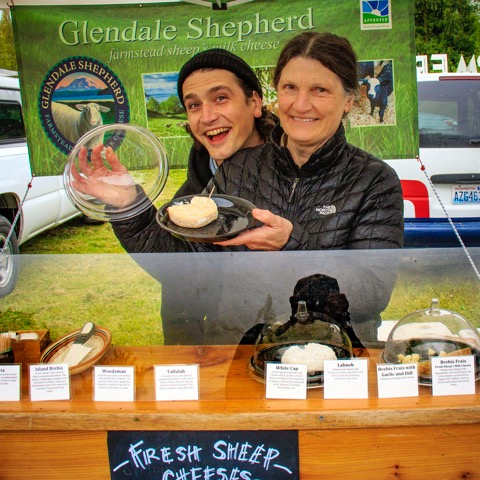
It’s springtime, and lambs are being born at the Glendale Shepherd dairy farm. Their mamas, about 60 ewes, are milked twice a day to produce milk for yogurt, soft brebis frais, and hard cheese. The ewes are a cross between European and North American breeds, and owners Lynn and Stan Swanson have been making award-winning cheese from their milk for the past five years.
The family runs a Grade A dairy in Clinton and is committed to practicing sustainable agriculture with artisan sheep milk cheeses and pasture-raised lamb. With forest, pasture, ponds, and meadows, the farm provides a diverse landscape for livestock and wildlife alike.
Lambs that are weaned are called “weaners.” This group of young rams and ewes eat special blends of organic grains and grasses. (Photo by David Welton)
“Lynn and I have been here for 30 years,” says Stan Swanson, his loyal dog Cocoa on his lap. Since he was injured cutting a tree in December of 2015, his motorized “hot rod” gets him around the family farm. After the accident, which crushed his back, Stan was flown to Harborview Medical Center, where he says he was fortunate to have excellent care and doctors who put him back together with nuts and bolts. The retired dentist and former rock climber says the community held fundraisers to help offset the cost of medical care. He remains upbeat and cracks jokes as he leads a tour of the rolling hills of his family farm. “The community was awesome. Everyone pulled together,” Swanson says. “Now all I need is a computer to convert my brain waves to my legs. (Meanwhile) you should see me rod around Costco!”
Stan Swanson and his sidekick Cocoa. (Photo by David Welton)
Lynn Swanson, also a talented clothing designer and sculptor, ran a summer horse camp for years before the couple became interested in making sheep milk cheese after buying the flock from another island artisan cheese maker nearly 10 years ago. These days, the Swansons are the only commercial cheese makers on the island.
“We put together the milking barn and got certified as a dairy,” Stan says. “Then we put in a pasteurizer. It was a lot of work.”
Lynn popped out of the super-clean kitchen, where she was preparing fresh yogurt and brebis frais, the soft cream-cheese-like pasteurized cheese sold locally at the Star Store in Langley, Bayleaf in Coupeville, and the Bayview Farmer’s Market.
Lynn Swanson has won top awards for her sheep cheese varieties. (Photo by David Welton).
At the Ballard Farmer’s Market last Sunday, business was brisk at the Glendale Shepherd booth. Regulars such as chiropractor Gary Moskowitz stop by each week to return empty jars and buy new ones full of fresh yogurt. Moskowitz says he’s been coming by for years. He was greeted as a regular as he approached the counter.
“We were looking for some new yogurt. My wife tried their sheep yogurt, and it was the best yogurt she’s ever had,” Moskowitz says. “We get it all the time for smoothies. My wife can’t do cow’s milk, so she does goat or sheep milk. The cheeses (from Glendale Shepherd) are unbelievable. I don’t even eat cheese, just never have, and I come here all the time to buy cheese for my wife and yogurt for us. Their people are incredible, too.”
Back at the farm, Stan rods over to the barn where a newborn baby ram calls out. The newborn is nestled with other lambs in a bed of straw under a heat lamp. Lambs are separated from their mothers at birth and fed formula, a common practice in working dairies to minimize the stress of separation.
Anna Magnuson, who once attended summer horse camp at the Swanson farm, now helps run the dairy business with the Swansons and their son Erik.
Anna Magnuson holds a ram born early that morning. (Photo by David Welton)
“My history here is a long, 20-year story,” Magnuson says. “I’d come here as a kid for horse camp. Then I went to school and worked in Manhattan with Beecher’s Handmade Cheese and later in Seattle, with artisan cheeses at Whole Foods. My parents said I should talk to the Swansons, and I moved out here on a whim.”
Stan says there were about 120 lambs born this year. Some will be used for dairy and some for meat. All wear ear tags: right ears for rams and left ears for ewes.
Holding the newborn ram with his short buds of wool and his long legs, Magnuson says he resembled his mama and grandma with their “freckles” of black dots sprinkled amid the white wool.
Magnuson, Becca Shim, and Erik Swanson milk the ewes twice a day. This season is the first time she has helped midwife some of the lambs at birth. After about a month, the lambs graduate to “weaner” status, meaning they no longer need milk. They grow strong on their diet of organic hay from Wilbur Bishop’s Ebey Road Farm and their diet is supplemented by a special organic blend of grains made just for these sheep. The ewes are fed grain and allowed to go in the pasture for about an hour a day. They’ll graze more as the pasture dries up and is not so muddy.
Erik and Lynn Swanson on opening day of this season’s Bayview Farmers’ Market. Erik is Stan and Lynn’s son and helps run the dairy with his parents. (Photo by David Welton)
Over in the store and kitchen, Lynn finishes filling sterilized glass bottles with fresh yogurt. She points proudly to a wooden board, which announces that Glendale Shepherd’s Tallulah cheese took first place in 2016 at the Washington Artisan Cheese Festival. Tallulah is soft, ripened, has a creamy interior and a smooth, mild, and nutty flavor. The award joins many others displayed in the farm store.
Chef Jess Dowdell runs the island’s gastropub Roaming Radish with her husband J.P., and as a farm-to-market food devotee, she gives high marks to Glendale Shepherd’s cheeses.
“I love their products from cheese to yogurt to meat to wool.” Dowdell says. “The Tallulah is my favorite with some chicken liver pate and herb crostinis.”
Some of the cheeses made by Glendale Shepherd that are sold at the Bayview Farmer’s Market. (Photo by David Welton)
Lynn Swanson says that she is in full compliance with the Food Safety Modernization Act, which requires certification and university classes to meet its strict standards. The legislation was a considerable reform of our nation’s food safety laws and was signed into law by President Obama on January 4, 2011. It aims to ensure that the U.S. food supply is safe by shifting the focus from responding to contamination to preventing it. The small farm has also earned an Animal Welfare Approved designation, meaning the animals are well-treated and cared for. Indeed, the sheep appear to be in a Zen state of mind.
“We need the same level of certification to operate as does a bigger dairy like Tillamook,” Swanson says. “I want to take no risks when it comes to protecting the public’s health.”
If you’re in Seattle, you’ll find the farm’s cheese, yogurt, and meat at the Ballard Farmer’s Market, University District Farmer’s Market, and Kurt Farm Shop. As for restaurants, you’ll find the cheese on the menu at Orchard Kitchen and Roaming Radish locally and at Bar Ferdinand, Salare, and Mkt. in Seattle.
The farm store is open Sundays from 11 am to 4 pm. Farm tours are available by reservation.
Kate Poss worked as a library assistant at the Langley Library until last June, when she retired. She worked for three summers as a chef aboard a small Alaskan tour boat from 2008 to 2010. She was a newspaper reporter in Los Angeles for many years before moving to Whidbey Island, where she likes cooking for new and old friends, hiking, reading great fiction, and writing her second novel with friend Fred Bixby.
David Welton is a retired physician who has been a staff photographer for Whidbey Life Magazine since its early days. His work has also appeared in museums, art galleries, newspapers, regional and national magazines, books, non-profit publicity, and on the back of the Whidbey Sea-Tac shuttle!
__________________
Enjoy more articles in the print edition of Whidbey Life Magazine, which you can purchase at local and off-island retailers or receive in the mail via subscription.
WLM stories and blogs are copyrighted and all rights are reserved. You may link to this story. To request permission to use or reprint content from this site, please contact us.
This article was originally printed in Whidbey Life Magazine’s Spring/Summer 2016 print issue. The Fall/Winter 2016-17 print issue of Whidbey Life Magazine will be out in a couple of weeks! Look for it in your mailbox {subscribe here} or grab it at one of our local distributors. To whet your appetite, we thought you’d like to read an article from the Spring/Summer 2016 print issue.
BY DIANNA MACLEOD
Whidbey Life Magazine Contributor
October 5, 2016
Have you ever pulled dandelions from a city lot to make a childhood bouquet? Broken off blooming branches from an untended shrub to display on a windowsill? Wandered along the side of a country road picking Queen Anne’s lace and foxglove, butterfly weed and yarrow?
Tobey Nelson of Vases Wild selects flowers for an arrangement. Photo by Marsha Morgan
Have you ever grown a row of flowers between your vegetables? Left a couple of dollars in a neighbor’s honesty box for a Mason jar full of blooms? Gathered a handful, or an armload, of something beautiful that grew right beneath your feet?
If you did, count yourself a slow flower enthusiast—an admirer of flowers that are seasonally available, suited to local conditions and free of chemicals.
Such pullers and pickers count themselves among the increasing number of Americans who love the simple elegance and admirable hardiness of blooms grown in their own part of the world. They are less well known, and a little bit behind, those who have joined together to form the movement known as Slow Food—those advocates who promote local food grown with taste, nutritional value and sustainable agriculture in mind. But the movement known as Slow Flowers, is…well…steadily growing. Locavores, move over and make room for locaflores.
Some might ask whether it really matters if our flowers come from far away or from our own backyards. Whether it matters if our blooms take their time coming to maturity under the open sky or are sped along by fertilizers applied in precise doses at precise times in the confines of a greenhouse that operates like a factory.
To Amy Stewart, author of “Flower Confidential,” it matters very much. She claims that once you understand the difference between imported and homegrown, “you’ll never look at a cut flower the same way again.”
Three Whidbey Island flower growers agree. With shovels, secateurs and seeds, they make both a living and a life raising and selling blooms that are sustainable, artistic, ethical and breathtakingly gorgeous. They are our very own, homegrown Slow Flower farmers.
Wedding centerpieces created by Vases Wild. Photo by Molly Landreth Weddings, Lightworks360
Vases Wild
This marks the fifth summer that gardener, horticulturist and wedding planner Tobey Nelson has been making flower art under the name Vases Wild.
It all started at a wedding show in Seattle when she asked herself why nuptials were not being exchanged more often on Whidbey, an island within easy reach of the city that offers the perfect backdrop for one of life’s most important rituals. As she researched the situation, Nelson found that Whidbey was something of a secret. “I talked to people who didn’t know about the island, attended a wedding here, and then fell in love with the place.”
That realization coincided with her innate pride of place. “I feel strongly about promoting Whidbey Island as a destination and as a community. Events in general, and weddings in particular, provide jobs.”
Hellebore and black pussy willow oral jewelry created by Vases Wild. Photo by Suzanne Rothmeyer
As she began promoting Whidbey as a wedding destination among her clients and peers, Nelson also polished her social media skills in order to market to the betrothed. And, since brides are bombarded with imagery and information, she had to find ways to make her creations stand out. Fresh and dried floral jewelry, botanical headpieces and arrangements using succulents are some of the ways she distinguished herself from other floral designers. Her jewelry and headpieces, delicate yet durable, can be worn for a wedding or for any special event—a date, a prom, a night at the theatre.
Five years later, Nelson continues to take every opportunity to recommend local hair salons, stylists, dressmakers, musicians, chefs, caterers, vintners, brewers, hoteliers, venues, photographers, officiants. She also employs local artisans—metal workers and carpenters—to make custom forms, including floral chandeliers, cylinders to support flowers in vases and arbors. A collaborator by nature, Nelson values the synergistic spirit present among Whidbey Island flower growers, who refer clients back and forth, lend and borrow equipment and sell flowers to each other.
But for a floral artist to locate on Whidbey, far from the lucrative urban wedding trade, other factors must be at work. So it is with Nelson, who has a passion for pastoral landscape, farmland preservation and healthy soil.
As a long-time landscape designer, Nelson is keenly aware of the effect of pesticides on water quality and soils. “Many of the local farms I work with achieve fertility by building soil with manures and compost rather than by applying chemical or synthetic fertilizers, resulting in less runoff,” she said. “Spraying is reduced or eliminated in fields that are planted for diversity. And many flower farms are bush-based, so those fields are not regularly plowed, which means fewer carbon emissions.”
Nelson reported that 80 to 90 percent of all flowers in America come from beyond our borders, where pesticide regulation is lax to nonexistent. Plants are sprayed with pesticides while still growing in the ground or in the greenhouse. Many flower heads—especially roses—are dipped in a fungicide before being packaged. When a box of flowers arrives in a port, it is likely to be fumigated. These are the ingredients in the bouquets into which we bury our faces—seeking fragrance—and then place on our tables, right next to our lovingly-prepared organic food.
Mass-produced flowers also put workers at risk, Nelson noted, whether they are spraying pesticides on rows of identical plants or inhaling fumes over open vats of fungicide. And commercial blooms just don’t deliver what Nelson always takes care to include in a Vases Wild bouquet: scent. A flower bred for traveling is not a flower bred for sniffing. When it comes to commercially grown flowers, looking “fresh as a daisy” is all important; scent is sacrificed in favor of longevity. That’s why Nelson grows her own fragrant beauties: roses (the shrub rose “Golden Celebration” is a favorite), peonies and sweet peas. In addition to scented flowers in her bouquets, she also includes cedar, salal, fern, alder branches, filbert catkins and white poplar (foraged on the beach, after obtaining permission). “When I sell a bouquet, I love it most when I can say ‘this bouquet is island grown’. But I’m always proud of my commitment to using all American-grown flowers, even when I can’t source all my blooms from Whidbey.”
Hairpiece created from sedum by Vases Wild. Photo by Shonda Hilton Photography
In her own garden, Nelson has something blooming all year long, both for her own pleasure and for the survival of pollinators. “When it’s warm enough for bees to wake up, I have something for them to eat. Once we get into summer, the garden is bursting with lush floral color and fragrance.” She likes to “stack” her plantings to “keep the soil covered and busy so nature doesn’t introduce her own agenda.” The governing principle for both her garden and her floral arranging is diversity of leaf and bloom.
As a grower and arranger, Nelson’s passion for slow flowers is deeply rooted. “To support my local economy. To keep from exposing myself or my customers to pesticides. To preserve American farmland. To encourage bees by providing bee habitat. And because local flowers lend themselves to a romantic, naturalistic kind of styling. There are so many reasons to love slow flowers!”
Melissa Brown of Flying Bear Farm inside her greenhouse. Photo by Marsha Morgan
Flying Bear Farm
Melissa Brown first discovered Whidbey Island as a child when her mother’s art was being shown in a Langley gallery. After that, her visits to the island were occasional, but the place was never too far from her mind or heart. As a young woman, she learned about plants by working at Seattle’s Tilth Garden, which is where she met her future husband, Benjamin Courteau. After they married, the couple teamed up with her parents to launch an experiment in intergenerational living. The four set about to find a property on Whidbey large enough to accommodate a homestead for two families and land enough to farm. When that land and homestead appeared near Langley, Flying Bear Farm was born.
“We’re interested in supplying ourselves and our community with things you don’t normally get,” said Brown, who grows flowers for her floral arrangements, sold under the name Flying Bear Design. Brown sees a cultural shift away from conventional floral arrangements to slow flowers. “There’s a desire for local flowers with a ‘gardeny’ look and natural fragrance.”
Weddding reception centerpiece by Melissa Brown, Flying Bear Farm. Photo by Krista Welch, Love Song Photo
That cultural shift is coming at a good time for Brown, because opening a flower shop is an expensive enterprise with an uncertain future. Overhead and the need for a large and diverse inventory make it difficult to make a go of it. And flowers, considered luxuries by most of us, are one of the first items to be sacrificed when money is tight. The 2008 recession forced many flower shops out of business, and in the years since the domestic trade hasn’t fully recovered.
What’s a flower grower, designer and seller to do?
One of Brown’s solutions is the “pop-up”—a temporary stand in front of, or inside, an existing retail business. A one-off, one-time farmer’s market stall. Flying Bear’s latest pop-up—held outside the Langley restaurant Kalakala over Valentine’s Day weekend—was a perfect example of what happens when young entrepreneurs join together to attract customers. Cooperation. Collaboration. Synergy.
“We brought everything: table, chairs, umbrella. We had a square reader for taking credit cards and tracking things. We had rustic buckets and wonky crates, and we used them to tell our story. I brought things to build our brand: galvanized French flower buckets and chalk boards,” she recounted. “I try to think of what people are going to expect when they buy flowers and then incorporate it into my ethos.”
Brown is convinced that part of the appeal of slow flowers is their authenticity. “Young people had grandparents who grew sweet peas, and those memories inform desire. There’s also the desire for the story—the story of where something comes from. We’ve grown up in a culture of obsolescence, everything fake and cheap and anonymous. People are rediscovering the importance of the story that’s attached to what they buy. Who grew it? Who made it? Where does it come from?”
As much as Brown enjoys creating a rustic ambience, she enjoys surprising her customers. She enjoys being the woman behind the accidental find. “There’s pleasure in discovery. People like coming upon something unexpected,” she said. “And then taking it home with them.”
Although Brown grows a variety of flowers, she also sources blooms from places like MilePost 19, Sonshine Flower Farm and Full Cycle Farm. Like Tobey Nelson, Brown appreciates the cooperative spirit among Whidbey Island flower farmers and envisions a future in which they intentionally coordinate their crops to help fill gaps in each other’s inventory.
Bridal bouquet by Melissa Brown, Flying Bear Farm. Photo by Krista Welch, Love Song Photo
Another of Brown’s workarounds to the lack of a bricks-and-mortar flower shop is to attract customers to the farm. This summer she plans to offer a CSA subscription for a weekly bouquet (recycled vase included) or a bucket of flowers (for those who like to arrange their own).
Although the farm and floral business is both a team effort and a family affair, Brown finds she has many more ideas than hours in the day to realize them. For someone so enterprising and inventive, the life of a slow flower farmer offers balance and the opportunity to…well, slow down.
“The best part is being around beauty all the time, having the opportunity see beauty wherever it is,” she said with a smile. “Even if I’m just weeding, I’m seeing the beauty of the soil.”
Kelly and Pam Uhlig of Sonshine Flower Farm at the Bayview Farmers’ Market. Photo by Dianna MacLeod
Sonshine Flower Farm
Three years ago, Pam and Kelly Uhlig sold off their goats and alpacas, plowed up the fenced pasture that fronted on their farmhouse, and began creating what would become a giant flower garden. Over time, they erected two large greenhouses, a poly-tunnel and a seed house. Downed cedars were milled into doors for the greenhouses and planks for the sides of raised beds. A hemlock tree became a potting table. Last spring, they added a long-awaited cooler—a 10′ x 12′ refrigerated space—that holds buckets of cut flowers along with the promise of a more flexible planting and harvesting timetable.
The Uhligs—a mother-daughter team—have remained true to their original intention to create a production flower farm that is gentle on the earth. To preserve water, they installed a drip irrigation system. To build soil fertility, they mulched with aged goat and alpaca manure. To keep hard rains from compacting the soil, they placed layers of cardboard over bare earth, allowing the cardboard to break down over the winter and add to the humus.
Bird’s-eye view of a portion of Sonshine Flower Farm, early spring. Photo by arborist Kyle Rapp, taken from 40 feet up a tree.
“I believe in being a good steward of the land,” said Pam. “If I spray, it’s certified to harm neither people nor the land.” Pam relies on the Organic Material Review Institute to guide her toward benign products. When arranging flowers, she rejects the spongy green material known as Oasis in favor of chicken wire and sphagnum moss, coconut husk fiber and biodegradable “floral soil.”
“I grow flowers to be used locally and sustainably. No fossil fuels for shipping, no dipping in chemicals,” Pam said. To her, Amy Stewart’s “Flower Confidential” is the revelatory book that should spawn a revolt against fast—and foreign—flowers.
The Uhligs plant their crops on a scale most of us can barely imagine: 10,000 bulbs, including tulips, ranunculus and anemones, were planted during the fall of 2015 while dahlia tubers were being dug up and stored in bulb crates for separating and replanting the following spring. This kind of mass planting requires massive planning, from the first day of the year (January for sweet peas) to the last (December for ordering annual seeds).
Pompon ranunculus. Photo by Kelly UhligSweet peas / Photo by Kelly Uhlig
But no amount of planning can account for the vagaries of weather and temperature. Sweet peas can finish by July 1 or last right through the month. Tulips can arrive on time or three weeks early, before flower buyers are prepared—emotionally and psychologically—for them. Early or late arrivals can pose a problem or offer an advantage, depending on the kind of bloom and the season’s progress. Because the price of flowers, like any commodity, is governed by supply and demand, some early arrivals are welcome. “Flowers are a mind game,” said Pam. “You can’t anticipate everything; you do try to get your product to market first.”
But no matter what the weather throws at her, planting is Pam Uhlig’s great passion. “A snapdragon seed is practically microscopic,” she observed. “Yet months later I’m cutting stalks of flowers from that plant for baby showers, weddings, memorial services.”
Although 10,000 bulbs may sound like an impossibly large amount, the Uhligs know that not all of those flowers will make it to market. “Birds, bugs, weather, predators…you lose a lot and you have to accept that,” said Kelly. “Bugs are attracted to white flowers, so they get chewed more than other colors.”
Of the flowers that survive, a portion are destined for the Bayview Farmers Market, where the Uhligs arrange and sell glorious bouquets under a tent that draws customers from all four corners. Another portion is meant for the Seattle Wholesale Growers Market, which means loading a van with buckets of tightly-bunched blooms and catching the first ferry to be on site shortly after dawn, when florists are shopping. Another portion ends up in the flower-arranging hands of Melissa Brown and Tobey Nelson.
Kelly Uhlig composes a bridal bouquet. Photo by Pam Uhlig
As much as the Uhligs enjoy bringing their flowers to the wholesale market in Seattle, they love the contact with customers that the Bayview Farmers Market provides. “Generally, guys want bright colors: orange, yellow, red. Women like the jewel tones and the muted colors,” Kelly observed. “But in the fall, as the days grow shorter and darker, everyone wants bright colors,” Pam added.
Pam, a graduate of the Edmonds Community College horticulture program, understands the importance of offering “leafy greens” with her flowers. Foliage provides a contrast in color, texture and shape to the flowers in a bouquet. Accordingly, she grows the sturdy and handsome ninebark and other deer-proof shrubs around the perimeter of the garden while interplanting purple cardinal basil and other striking foliage plants between rows of flowers.
The talent for growing flowers extends to knowing how to cut them to preserve their freshness and make them last. Pam offers bouquets that will, if treated correctly, hold for at least a week. “The trick is knowing when to cut…and using clean implements. Containers and clippers need to be sterile. Clip the leaves off a flower stalk, because foliage quickly rots when submerged in water.”
Just like the other slow flower growers on Whidbey, the Uhligs alternate between shears and social media. Kelly regularly posts photos and videos on Instagram to market what’s in season and to include admirers in the daily life of the farm, with all its tribulations and triumphs.
Despite either, mother and daughter look forward to each and every day, come rain or shine, deer or slugs, late frost or early warmth. They enthusiastically agree that slow flower farming—the cultivation of beauty and commitment to earth’s ecology—comes pretty close to a life lived in the Garden of Eden:
“Slow flowers express emotions, appeal to the senses, touch the soul.”
Cultivated, harvested and designed by the likes of Tobey Nelson, Melissa Brown and the Uhligs, how could it be otherwise?
RESOURCES “Flower Confidential,” Amy Stewart, Algonquin Books, Chapel Hill NC, 2007 “The 50 Mile Bouquet: Seasonal, Local and Sustainable Flowers,” Debra Prinzing, St. Lynn’s Press, Pittsburgh PA, 2012 “Slow Flowers: Four Seasons of Locally Grown Bouquets from the Garden, Meadow and Farm,” Debra Prinzing, St. Lynn’s Press, Pittsburgh PA, 2013
Dianna MacLeod wore out her knees, bent her back and learned a little Latin in her own garden for 25 years before moving to Whidbey Island in 2011, and when she came she brought 300 of her green friends with her. Dianna has managed an organic demonstration garden, written grants for gardening nonprofits and opened her Seattle garden to Tilth and Northwest Perennial Alliance tours. She looks forward to wearing out her knees and bending her back on her own five acres sometime this year.
WLM stories and blogs are copyrighted and all rights are reserved. Linking is permitted. To request permission to use or reprint content from this site, email info@whidbeylifemagazine.org.


 To enjoy more articles from the print issue of Whidbey Life Magazine, purchase a copy at local and off-island retailers or receive it in the mail via subscription.


 Enjoy more articles in the print edition of Whidbey Life Magazine, which you can purchase at