Tag: Coupeville

  • Sailing Back In Time: Recalling Whidbey’s Maritime Heritage

    Sailing Back In Time: Recalling Whidbey’s Maritime Heritage

    BY SHAWN BERIT
    Whidbey Life Magazine Contributor
    July 5, 2017

    The small fleet entered Admiralty Inlet on its way into Puget Sound. Crisp sails grabbed the wind, propelling them south to their destination in Tacoma. The tall masts of the Lady Washington and Hawaiian Chieftain stood out, their majestic and massive sails pushing the ships onward.

    As they sailed past the Admiralty Head Lighthouse on June 13, the tall ships were nearly passed by a shining, white-sailed schooner. From its port of Coupeville, the swift Suva cut through the waters with ease. “We had all we could do not to pass the tall ships,” says Captain Mark Saia.

    The Suva, Hawaiin Chieftain, and Lady Washington passing by the Admiralty Head Lighthouse on June 13. (Photo by David Welton)

    The flotilla from the past was bound for the Festival of Sail in Tacoma. The Suva joined a proud maritime heritage that included the Lady Washington, a 112-foot brig. A replica of a late 1700s ship of the same name, the Lady Washington was built in Aberdeen and launched in 1989 for the Washington state centennial. In addition to being used to teach Washington’s maritime history, the Lady Washington is a movie star. It was used in “Pirates of the Caribbean: The Curse of the Black Pearl” as the HMS Interceptor, as the brig Enterprise in “Star Trek Generations,” and appeared in a number of other movies, television shows, and even a Macklemore music video.

    Beautiful as the passing ships were that June day, only two of them called Whidbey Island home: the Suva and the Cutty Sark. The Suva was built in 1925 for Coupeville resident Frank J. Pratt Jr. Designed by famous Seattle naval architect Ted Geary, it was built in Hong Kong using old-growth Burmese teak. It was docked in Coupeville for many years before being sold and moved to Seattle. Eventually, the Suva made its way to Port Townsend.

    The Cutty Sark and the Lady Washington (Photo by David Welton)

    The Cutty Sark, a 50 foot classic ketch, was built in Hong Kong in 1957 and was the first of ten sister ships of the Mayflower class designed by Hugh Angleman and Charlie Davies. Through the educational non-profit Aeolian Adventures, the Cutty Sark takes students on educational cruises in the San Juan Islands at no charge to them or their sponsoring organizations. Captained by John Colby Stone, the vessel calls Oak Harbor and Coupeville home.

    Mark Saia had been offering charter boat rides for 10 years in Coupeville and found himself in a position to look for a new sailboat. “Three years ago, I found Suva in Port Townsend,” he says. It was love at first site, “I thought a classic boat would be fun to have in Coupeville.” Saia started researching the history of the boat and learned that Coupeville was its original port. He knew then that he had to bring it home.

    Saia realized that it was a huge opportunity for historical preservation and education, so he founded the Coupeville Maritime Heritage Foundation to buy the Suva. In six months, he raised the money to purchase it.

    Mark Saia, in the wheelhouse of the Suva, holding the original bell. (Photo courtesy of Coupeville Maritime Heritage Foundation)

    Saia says that bringing the Suva home is about more than just giving rides in a beautiful sailboat. “Coupeville is a sea captain’s town. It was founded by sea captains,” he says. “They used to build boats in Coupeville.” Captain Saia hopes to bring more of the town’s maritime heritage back to life, “Coupeville should be just as strong in maritime as Port Townsend,” he says. He has made it his mission to bring Coupeville back to what it was.

    Today, in addition to touring and sailing on the Suva, the best place to learn about Coupeville’s maritime beginnings is at the Island County Historical Society Museum. There, you can find a collection of artifacts related to the town’s maritime heritage.

    (Video courtesy of Coupeville Maritime Heritage Foundation)

    Saia is hoping to add to that, however. He is currently working to acquire a sister ship of the Suva called the Red Jacket. His hopes extend to improvements in the harbor, including dredging out twenty feet of silt to return it to a previous safer depth, and the addition of a breakwater and large marina to attract tourists who travel by boat.

    Visitors can tour the Suva or book a cruise. Some membership levels of the Coupeville Maritime Heritage Foundation include a ride on one of the Suva’s cruises around the area. Members also have the opportunity to be trained as part of the crew.

    The Suva is moored at the Coupeville wharf, where you can climb aboard for a tour. You can take a walk through its carefully maintained cabins or take a leap and learn to be a sailor.

    If you’re interested in a day you’ll always remember, up to six people can board the Cutty Sark for a 10-hour day sail for $600 plus tax, which includes the ship, captain, and fuel. All proceeds go to Aeolian Adventures, a 501(c)3 nonprofit organization.

    Shawn Berit lives near Maxwelton Beach on the south end of Whidbey Island. He freelances as a social media manager for churches and organizations. A father of three and an all-around creative, Shawn paints and draws fantastical scenery, story illustrations, and science fiction concept art. He is a nature photographer, a vocalist wanting to start a band, a science fiction writer working on his first novel, and a television and voiceover actor wishing the island had a radio station. He is also one-half of the Dakota Guys on YouTube and in love with all things Whidbey Island.

    David Welton is a retired physician who has been a staff photographer for Whidbey Life Magazine since its early days. His work has also appeared in museums, art galleries, newspapers, regional and national magazines, books, nonprofit publicity, and on the back of the Whidbey Sea-Tac Shuttle!

    Read the other stories published this week

    Read a related story

    __________________

    Enjoy more articles in the print edition of Whidbey Life Magazine, which you can purchase at local and off-island retailers or receive in the mail via subscription.

    WLM stories and blogs are copyrighted and all rights are reserved. You may link to this story. To request permission to use or reprint content from this site, please contact us.

  • Rock Bottom Line || Taxed by Taxes: Who Pays How Much on Whidbey?

    Rock Bottom Line || Taxed by Taxes: Who Pays How Much on Whidbey?

    BY HARRY ANDERSON
    March 29, 2017

    I’m not one to complain about the cost of our county government here on the Rock. In fact, I think it’s just short of amazing how much our government does for the relatively small amount of tax dollars it receives.

    Island County is the second-smallest county in the state of Washington. Latest population estimate: about 80,500. Approved county budget for 2017: $85.7 million. Do the math. That’s about $1,065 for every person who lives here, and it has to cover public safety and law enforcement, roads and bridges, county courts, public health, parks and recreation, and a host of other services we all take for granted.

    Compare that with our Lilliputian neighbor to the north, San Juan County — the state’s smallest county — with current population of about 16,250 and an annual budget this year of $23.3 million, or about $1,400 per resident. Or look at King County — the state’s largest county — with a current population of about 2.2 million and an annual budget this year of $1.6 billion, or $728 per resident. (Urgent plea to King County residents: Please don’t move here just to cash in on that $338 per person in county spending you don’t get. Come visit us and spend your tourist dollars; we’ll show you a really good time.)

    The main sources of general income for our county government are property and sales taxes. Having lived in California and Texas and paid much more than I do here, I have been pleasantly surprised by how reasonable our local taxes are. I know others might disagree, but I’d suggest you do a little research before you whine about how “high” or unfair our local taxes are.

    I also was surprised recently by a kerfuffle over whether some communities on Whidbey contribute more to the county budget — and, by implication, whether others get a free ride or at least an undeserved bargain. A couple of our esteemed county commissioners recently cast aspersions on Coupeville for not supporting “the economic driver” of the island, which to them, of course, has to be Oak Harbor with its huge naval air station pumping big defense dollars into the economy. Those impolite sentiments from Commissioners Jill Johnson and Rick Hannold came in the context of the smoldering debate over jet noise, so I’ll chalk them up to Johnson and Hannold’s own smoldering.

    To be sure, Oak Harbor does have about 27 percent of the county’s population and it’s growing faster than other areas, thanks to the Navy. But, leaving aside the jet noise hot potato, the supposition that it’s our “economic driver” made me want to understand better where the collected sales and property tax revenues come from on our island. To find out, I did a little digging into arcane databases and spreadsheets.

    Let’s start with sales tax for the third quarter of 2016, the latest available. Countywide, $273.1 million was collected — a healthy increase of almost 16 percent from the year before. Praise the Lord, our economy is growing! But where did that tax revenue come from? Langley, $13.4 million; Coupeville, $18.1 million; Oak Harbor, $105.5 million; and — drum roll, please — all the unincorporated areas of the county, $136.1 million. No question that Oak Harbor is a rock star in sales tax but the biggest sales tax star on the rock is actually “unincorporated.” Who knew?

    Property tax is a bit more complicated but the broader picture is clear. Again, “unincorporated” generates the most revenue, almost twice what Oak Harbor generates. But to see if some get soaked while others skate, I decided to look at it in a different way to see where the burden falls. I divided the reported property tax revenue collected in each county area by that area’s estimated population.

    Here’s what I learned: Oak Harbor pays about $79 per person in property taxes. What a bargain! That’s the lowest rate in the county by far, and it’s undoubtedly because Oak Harbor has many more children and more people living under one roof than most other areas. Meanwhile, “unincorporated” pays about $106 per person. Coupeville pays about $148 per person.

    And — another drum roll, please — Langley pays a whopping $248 per person in annual property tax. That’s more than three times the per-person rate in Oak Harbor. Why? It’s simple. Homes in Langley tend to be much more valuable than those in Oak Harbor and, because the South End population tends to be older, there are fewer people living under each roof there.

    I realize that numbers can be made to say just about anything you want. Arguments over who pays too much and who doesn’t pay enough are endless. And the numbers I cited don’t include taxes for schools, libraries, and hospitals, which is a whole separate column.

    But my bottom line is this: Every one of us gets a lot for what we pay to our county government on Whidbey Island, no matter where we live.

    Remember that on your next trip to America, while stuck in traffic on I-5 next to all those King County folks who get less from their county than you do.

    Once upon a time, Harry Anderson made an honest living as a reporter, editor, and columnist at the Los Angeles Times. He now lives in central Whidbey where he spends his time gardening and ruminating on things that interest him.

    __________________

    The views, opinions, and positions expressed by Whidbey Life Magazine bloggers, as well as those of the people who comment on their blog posts, are theirs alone and do not necessarily reflect the views, opinions, or positions of Whidbey Life Magazine. 

    __________________

    Have a great story idea? Let us know at info@whidbeylifemagazine.org.

    WLM stories and blogs are copyrighted and all rights are reserved. You may link to this story. To request permission to use or reprint content from this site, email info@whidbeylifemagazine.org.

  • October Traditions in Coupeville

    October Traditions in Coupeville

    BY DAVID STERN
    Whidbey Life Magazine Contributor
    October 26, 2016

    Thousands of families travel to Sherman’s Pioneer Farm in Coupeville each year to carry on or start a new tradition and create happy memories. The farm, with its squash, gourds, barns, and cows helps me reconnect with a time when I spent my summers on a farm as a teenager.

    Sherman’s has been farming pumpkins and squash since the 1950s, and Dale and Liz Sherman produce some of the finest squash in Washington State. The Blue Hubbard variety grown here was developed by the Sherman family and has become a staple of chefs and fine grocers around the region. Hundreds of thousands of pounds of this squash are processed and packaged on the farm to be shipped all over the state.

    But that is not why most people come to visit the farm in October. Taking a trolley ride to the pumpkin patch and selecting your own jack-o-lantern is the main attraction. The Sherman family’s sense of humor is obvious when you see all their toys on the farm. Dale Sherman pulls people to and from the pumpkin patch with a larger-than-life “Tonka” tractor.

    For me, traditions start when I visit a place that I simply cannot go a year without re-visiting. Sherman’s Pioneer Farm is one of those places. The brightly colored pumpkins, squash, and gourds bring happiness during a season that ushers in many dreary days. Thankfully, families like the Shermans are committed to creating a beautiful place to visit, while also working a historic local farm.

    Sherman’s Pioneer Farm is open for trolley rides Friday through Sunday from 10 a.m. to 5 p.m. in October. During the rest of the week, you can purchase pumpkins with cash or check by depositing your payment in the honesty box on the farm stand door.

    The farm is located on Ebey’s Landing National Historic Reserve at 46. S Ebey Road. Coupeville, WA 98239.

    A tractor pulling a trailer with a pile of squash in foreground.
    Big Toys at Sherman’s Pioneer Farm in Coupeville.
    A large bin full of green squash.
    Buttercup squash is among the sweetest and creamiest of all varieties. As good as a sweet potato, and it grows on Whidbey Island.
    A bin full of light green, football-shaped squash.
    The Sugar Hubbard variety was developed by the Sherman family and is unique to Whidbey Island.
     A large plastic jack-o-lantern on a shipping pallet.
    Larger than life pumpkins welcome visitors to Sherman’s Pioneer Farm.
    A Radio Flyer wagon with "monster truck" wheels.
    Big boys need big toys.
    A cow surrounded by pumpkins.
    Dale Sherman’s cows are always on hand to help eat the rotten pumpkins. Nothing gets wasted on the farm.
    Two men on a trailer shake hands.
    New friendships are made on the trolley to the pumpkin patch.
    A father looks at the bottom of a pumpkin as his young son watches.
    The most common method for choosing a pumpkin is making sure it will stand up straight.
    A young boy carries a large pumpkin.
    The perfect pumpkin has been chosen.
    A tractor pulling a trailer filled with families.
    Dale Sherman bringing back a full load of happy families and their new pumpkins.

    David Stern is a Coupeville-based photographer and co-owner of Whidbey Custom Photography with his wife Madisun Elizabeth. David was mentored by his grandfather, a world-famous landscape photographer based in New England. David hopes to work as a photojournalist one day, traveling the world and telling stories.

    __________________

    To read more WLM stories and blogs, CLICK HERE. Have a great story idea? Let us know at info@whidbeylifemagazine.org.

    WLM stories and blogs are copyrighted and all rights are reserved. You may link to this story. To request permission to use or reprint content from this site, email info@whidbeylifemagazine.org.

  • Rock Bottom Line  ||  Kathy Baxter’s Vision Becomes Historic Reality

    Rock Bottom Line || Kathy Baxter’s Vision Becomes Historic Reality

    BY HARRY ANDERSON
    October 26, 2016

    My friend Kathy Baxter is a very spiritual person. In fact, she made her living until recently as a spiritual coach, helping people overcome physical and emotional issues to find their own wisdom and truth with a variety of healing modalities.

    So it’s no surprise that she uses meditation and visioning in her own life. In 2012, living in a rented cottage in Freeland while gradually winding down her practice in Seattle, she spent time imagining where her journey would now take her.

    “I meditated a lot,” Kathy said, “and a vision came to me—a small farmhouse on a little piece of land on a prairie with a sweeping view. I invested in that vision and waited.”

    Kathy Baxter’s house before restoration (photo courtesy of Friends of Ebey’s)
    Kathy Baxter’s house before restoration   (photo courtesy of Friends of Ebey’s)

    She didn’t wait long. Within days she opened a Whidbey real estate website and saw the exact picture she had in her vision. And what has happened since then has taken her on quite a journey.

    The house for sale was on Ebey Road just outside Coupeville, almost exactly in the center of Ebey’s Prairie. It was a two-story, 1890 farmhouse on an acre of land with a squash barn and a horse barn.

    ______________________________

    OPEN HOUSE
    Historic Perkins House
    Sat. Oct 29, 1 to 3 p.m.

    1405 Ebey Road near Coupeville
    Sponsored by the Friends of Ebey’s
    and its Ebey’s Forever grant program

    No charge but donations accepted
    for the Ebey’s Forever fund.
    ______________________________

    But the house was a wreck, written off as a teardown by most potential buyers and their contractors. It had been terribly “remuddled” in the 1950s; its old vertical double-hung wooden windows were replaced with horizontal sliders, a “modern” front door was added, its clapboard siding was covered over with cedar shakes, and its original yellow exterior paint color was changed to pale lavender. “They tried to turn it into a ’50s ranch house,” Kathy said. Also, every room was filled with stuff: boxes of junk, old furniture, kitchen bric-a-brac, etc.

    Baxter’s house after restoration. (photo courtesy of Friends of Ebey’s)
    Baxter’s house after restoration (photo courtesy of Friends of Ebey’s)

    But the price was certainly right—$135,000. By the time Kathy made her offer the property already had an accepted offer with four backup offers, many from buyers who expected to tear it down and build a new house. But, true to her vision, Kathy waited and, one by one, all the other offers fell out. She struggled for several months to find a bank that would lend on such a dilapidated house. But finally, on Christmas Eve, 2012, the house was hers.

    “I had blind faith that I could do this,” she said. “I had been told there were no ‘little properties’ on Ebey’s Prairie like the one in my vision, that nothing was for sale anyway, and that I likely couldn’t afford a house there even if one did come up.”

    She didn’t know how it could happen, only that she believed it could. “Every step along the way has been an unlikely long shot. I just decided to keep taking forward steps until I couldn’t.”

    Shakes removed from front and new cedar shingle roof installed (photo courtesy of Friends of Ebey’s)
    Shakes removed from front and new cedar shingle roof installed (photo courtesy of Friends of Ebey’s)

    Things began to fall into place. Her vision was to restore the house as much as possible to its original look and configuration as a prairie farmhouse. After one large contractor flatly turned her down, she found a small contractor on Whidbey who was absolutely sure it could be restored, and who really wanted the work. Staff members at the Ebey’s Landing National Historical Reserve office were enthusiastic supporters and helped her find many resources to make the restoration as accurate as possible. (The staff maintains the inventory of contributing historic structures in the Reserve that now includes 426 buildings—including Kathy Baxter’s house.)

    With help from the Reserve office and long-time prairie residents, Kathy has pieced together a bit of the history of her house. An unknown owner built the four-room house in 1890; a local farmer may have used it as a home for his seasonal farm workers. A dining room and kitchen were added around 1900, but it had no indoor plumbing. By 1915, ownership had passed to the family of Sabine Abbott, a Whidbey homesteader in the 1860s who returned to the island late in life after working in Seattle.

    In the late 1920s, the house passed to Abbott’s granddaughter, Thirza Cawsey. She never lived in it but rented it for much of the ’30s to a branch of the Sherman family, pioneer farmers on Ebey’s Prairie.  The Shermans bought the place in the ’40s and divided the original five acres among themselves except for the acre with the house and barns. In 1950, the Shermans sold the property for $1,000 to the Smith family, who still operate the nearby Willowood Farm.  The Smiths did a major remodel, adding the house’s first indoor bathroom and a laundry porch.

    A Navy captain bought the property in the early ’60s and added perhaps its most unique feature: an above-ground nuclear fall-out shelter in the horse barn with concrete walls two feet thick.

    Edwin Perkins and his family, operators of a chainsaw and lawnmower repair shop in Oak Harbor, purchased the house in the ’80s and lived there until Edwin died in 2011.

    All that history made Kathy even more determined to give the house back its “old dignity.” But it took a lot of work. She organized volunteer groups to help rip off the shakes and expose the original clapboard siding; I happily joined that rigorous effort one Saturday morning in 2013, earning blisters on my hands in the process.

    5-old-front-door-spot-discovered
    Boarded-up frame of the original front door (photo courtesy of Friends of Ebey’s)

    Then came a very lucky break. The non-profit organization, Friends of Ebey’s, had been founded in 2011 to raise funds that would help property owners preserve and restore historic structures in the Reserve. Kathy applied for and received an $11,000 matching grant that paid for a new cedar shingle roof like the one the house had in 1890 as well as clapboard siding that was milled to match the original and used to replace rotted sections.

    “I doubt I could ever have afforded those expensive things without the Friends of Ebey’s grant,” she said. “These grants are an accelerator that take a restoration from ‘serviceable’ to accurate. They preserve historic integrity in a way that nobody else is doing.”

    Once the shakes were removed, architectural discoveries were made. The openings of the original double-hung windows were found. And the biggest surprise was the boarded-up frame of the original front door on the north corner of the front wall. Kathy has installed newly milled double-hung windows where the originals once were and she found, in a South Whidbey barn, a front door at least 100 years old that was exactly the right size for the original doorframe.

    The restoration took nearly two years but today Kathy is proud to show off her beautiful home, which she will do this Saturday (Oct. 29) from 1 p.m. to 3 p.m. during a public Open House sponsored by the Friends of Ebey’s.

    And, being the spiritual person she is, Kathy is aware that this space has been shared by many before her. A friend of hers who she describes as a shaman, or spiritualist and healer, visited her not long after she moved into her historic home. He immediately sensed that there were “a lot of spirits here,” Kathy said. Four of them, he believed, were Native Americans who had lived on the prairie long ago and loved it so much that they stayed around to “guard the land.”

    “That explained so much to me,” Kathy said. “It tells me why people love this place and families have stayed here for decades or more, and maybe it’s even why we created the Ebey’s Landing National Historical Reserve.”

    Image at top: Kathy Baxter and her completed “new” home  (photo by Harry Anderson)

    Once upon a time, Harry Anderson made an honest living as a reporter, editor, and columnist at the Los Angeles Times. He now lives in central Whidbey where he spends his time gardening and ruminating on things that interest him.

    __________________

    CLICK HERE to read more WLM stories and blogsHave a great story idea? Let us know at info@whidbeylifemagazine.org.

    WLM stories and blogs are copyrighted and all rights are reserved. Linking is permitted. To request permission to use or reprint content from this site, email info@whidbeylifemagazine.org.

  • Magically Real  ||  It’s all happening at the Coupeville Dump

    Magically Real || It’s all happening at the Coupeville Dump

    BY STEPHANIE BARBÉ HAMMER
    September 21, 2016

    I mean the recycling center. Well, it’s the recycling center AT the dump.

    Read on.

    Friends: now that I live on an island, I find myself thinking about where things come from. Like electricity. And where things go. Like our garbage.

    The visit to the dump is my husband Larry’s job. Mind you, he doesn’t complain about it; he is a wonderful man. But he’s also a sophisticated intellectual who blogs about religion and who is working on a memoir. This kind of work takes him away from his writing. Which would account for the fact that he does a lot of sighing when this job comes around.

    img_5074

    He makes a great deal of organizing sounds, which involve opening and closing the back door, opening and closing cabinets, more sighing, then opening of the car trunk. These are accompanied by the melancholy sounds of plastic bags rustling and then glass clanking. The back door slams shut in what can only be called an existential manner, and the car backs out of the driveway. It proceeds slowly, with gravitas, towards the highway.

    “This is a time-consuming, somewhat intricate operation, you know,” my husband informed me yesterday as he prepared to leave.

    “Hmm,” I thought. “I’d better come along and supervise.”

    img_5075

    Going to the Coupeville dump is a complex adventure, because the recycling area isn’t just the blue can that we were used to in Beverly Hills and Los Angeles. No sir. It’s a huge space, the size of a couple of tennis courts (not that I play tennis—I’m a poet, for Pete’s sake!).

    When you bring your recycling items, you must sort them into subcategories and place them in the appropriate receptacle/bins/stacks.

    img_4149

    There are a lot of them. Green glass goes one place. Aluminum goes someplace else. Cans go someplace else. Cardboard, as opposed to paper, goes someplace else. The good news: brown paper shopping bags go with cardboard! There are even spots for batteries and printer cartridges.

    “Why are there so many subcategories?” I asked the person with the orange vest who was in charge for the day. I was told that as many as five different trucks come on different schedules to haul away ONE specific type of recyclable. These then go off-island back to the Seattle area.

    img_4152

    Did I mention that there is also a thrift shop at the dump? You can buy a bicycle! A man in a very fancy sports car stopped by and did just that while I was there supervising.

    You can also donate clothing.

    There’s a kind of beauty to the recycling area at the Coupeville Dump. Things are not being wasted; they are being exchanged. There’s something cool about actually seeing all the stuff we use, get sorted and readied to be reused.

    img_4151

    The person in the orange vest smiled and waved as we left.

    I think I will go to the dump with my husband next time.

    I might even offer to help!

    Stephanie Barbé Hammer is a four-time Pushcart Prize nominee in Fiction, Nonfiction, and Poetry. She is the author of a poetry chapbook “Sex with Buildings” (dancing girl press 2012), a full-length poetry collection “How Formal?” (Spout Hill Press, 2014), and a comic magical realist novel “The Puppet Turners of Narrow Interior” (Urban Farmhouse Press, 2015). You can follow her on twitter (stephabulist) or read her blog “Magically Real” as she tries to read “100 Years of Solitude” in less than 100 years at http://www.stephaniebarbehammer.net.

    __________________

    CLICK HERE to read more WLM stories and blogsHave a great story idea? Let us know at info@whidbeylifemagazine.org.

    WLM stories and blogs are copyrighted and all rights are reserved. Linking is permitted. To request permission to use or reprint content from this site, email info@whidbeylifemagazine.org.

  • Postcards from Whidbey Island  ||  ‘Orcadorks’ Gather in Coupeville

    Postcards from Whidbey Island || ‘Orcadorks’ Gather in Coupeville

    BY DIANNA MACLEOD
    Whidbey Life Magazine Contributor
    September 13, 2016

    Over Labor Day weekend, a contingent of 50 or so “orcadorks” gathered at the intersection of Highway 525 and Coupeville’s Main Street, many sporting their signature colors (black and white) and some wearing costumes (variations on fins, tails, and snouts).

    Free Tokitae Rally in Coupeville on Sept 3
    The “Free Tokitae” Rally in Coupeville on Sept. 3

    What’s an orcadork? According to Susan Berta of the Orca Network, an orcadork is a person who knows a great deal about orca whales and, more importantly, cares a great deal. One orca in particular supplied the reason for Saturday’s gathering: Tokitae (also known as Lolita), the orca who was captured in Penn Cove 46 years ago and has been held ever since at Miami Seaquarium in Florida.

    Costumed orcadorks 
    orcadork_lilyhaight
    Lily Haight and her dog

    The demonstration in Coupeville was part of a national protest of the conditions of Tokitae’s captivity and a demand for her return to the Pacific Northwest. The legal struggle to win her freedom has been agonizingly slow, marked by both progress and setbacks. The courts can’t seem to decide which anti-cruelty laws apply to Tokitae, and her captors at Miami Seaquarium see only as far as their bottom line. The clock is ticking for Tokitae; although orcas can live a long time in the wild, they are susceptible to various illnesses—including depression—when kept in a shallow, concrete tank. In fact, Tokitae is the last orca alive of the seven young whales captured in August of 1970 in Penn Cove. She has outlived her brothers and sisters by 29 years. Amazingly, Tokitae’s grandmother, the matriarch of her family group–known as the Southern Resident pod–still swims in our waters. Bonds are strong and memories long among orcas, and orcadorks hope that one day Tokitae and her grandmother will once again converse in the vocabulary of their species.

    During the Labor Day demonstration, Orcadorks were clumping on all four corners of the intersection and lining the pedestrian walkway above the highway. They waved placards and home-made signs at passing motorists, who responded by honking horns, waving, and jabbing thumbs into the air. Curious about their reasons for spending part of their holiday weekend in this way, I asked several orcadorks why they cared so much about the fate of one whale, taken so long ago and held captive so far away.

    thumbnail_young-orcadorks-by-tina-marrie
    Young orcadorks

    Veyariva, age 10: “It’s not fair that the babies were captured and kept in a small tank. It’s cruel. I’ve cared about Tokitae ever since I was little.”

    Jayden, age 9: “I saw her in Florida. It made me sad. They trained her, but it took a lot of practice. In a shed I saw some of the tools used for training her, spears and hooks. Now she’s scared to not do the tricks because she’ll get stabbed. Also, orcas need to dive deep down in the water, and she can’t. And there’s no shade over her tank, and in Florida it’s hot.”

    Noelle, age 12: “I think she should be freed. How they captured babies is not fair. It’s not fair to take them young and use them for our entertainment.”

    Alexa, age 14: “When I was in fifth grade, I became interested in whales. I wanted to be a marine biologist and joined a program in Gig Harbor called Harbor Wild Watch. When you go to any kind of wildlife park and see animals in cages, you can see the pain in their faces. Humans can fight for what we want; animals can’t do that. More and more people are joining the movement. I’m hopeful that in the next few years Tokitae will be moved to a sea pen.”

    The Haight Family
    The Haight Family

    Rachel, age 27: “I grew up in Nebraska and went to the zoo all the time as a kid, never thinking about what the animals experience. When I saw the movie “Free Willy,” I started to care about their captivity. I visited Whidbey when I was 13; that’s when I learned about the captures. I loved the whales so much that I moved out here in 2011. When I volunteered at a wildlife rehabilitation center, I understood how much wild animals hate cages. A week after I learned about the Orca Network, I went out on my first wild whale sighting. What draws me to orcas is that they are family oriented. They are social and emotional. We can’t even begin to understand their intelligence. Who are the people who are paying money to see Tokitae in a tank?”

    Minda, age 33: “I began to care about marine animals in the sixth grade. I wanted to be a marine biologist. When I was 18, I worked at SeaWorld, in merchandising. I went whale watching in 2014, and it all clicked: this is where Tokitae should be. I’m a member of the Whatcom Marine Stranding Network. We educate people on shore about what they should do if they encounter a marine animal on the shore. We also collect decayed animals to determine their cause of death. If people could see how related Orcas are to us… Tokitae, even after all these years separated from her family, responds to recordings of their calls. How could you not care about that? I have hope that she will be freed in my lifetime. I want to be there at the moment she’s released into her sea pen. I have this vision in my head of what it will be like.”

    The logistics to realize that vision are already in place: the country’s best marine scientists have crafted a rehabilitation plan, a protected sea pen has been created, and a staff is assembled to help Tokitae transition back into the ocean. All that’s lacking is the consent of the marine park owners. And that, it seems, is where public pressure will make the difference between immediate freedom and continued captivity for Tokitae.

    You don’t have to stuff your brain with facts about orcas to join our regional pod of Orcadorks; as I discovered, it’s the size of your heart that makes you one of the family.

    To learn more about Tokitae, whales, or the Orca Network, visit the Whale Center in Langley (115 Anthes Ave. 360-331-3543) or log on to www.orcanetwork.org.

    All Photos Courtesy of the Orca Network.

    Dianna MacLeod holds a degree in journalism and environmental advocacy. She is proud to be counted among our island’s orcadorks.

    __________________

    CLICK HERE to read more WLM stories and blogsHave a great story idea? Let us know at info@whidbeylifemagazine.org.

    WLM stories and blogs are copyrighted and all rights are reserved. Linking is permitted. To request permission to use or reprint content from this site, email info@whidbeylifemagazine.org.

  • Shining a Light on the Past: Whidbey Island’s Fort Casey and Admiralty Head Lighthouse

    Shining a Light on the Past: Whidbey Island’s Fort Casey and Admiralty Head Lighthouse

    BY LARA DUNNING
    Whidbey Life Magazine Contributor
    August 17, 2016

    This article was originally printed in Whidbey Life Magazine’s Spring/Summer 2015 print issue. Since it’s such a great time of year to wander through this beautiful setting, we wanted to give you a peek at the sights and a sense of the years of history you’ll discover. 

     *   *   *

    It’s a balmy evening in early July at Fort Casey Historical State Park on Whidbey Island. Admiralty Head Lighthouse is lit by a pinkish glow, a hue that leads me to imagine the life of a lighthouse keeper—nights of vigilance, days with the sea as a constant companion. A short walk away is the gun battery at Fort Casey, the barracks at Camp Casey Conference Center and the Georgian Revival-style houses at Fort Casey Inn. Together, they conjure up sepia-toned scenes of officers’ wives preparing family meals, soldiers in artillery training and a radiant lens illuminating surly seas.

    final_02_FORT CASEY_MORGAN-72
    A ferry pulls into Keystone while a D.C. rifle points toward Admiralty Inlet.  (photo by Marsha Morgan)

    This historic setting is a 35-minute drive from either end of Whidbey Island. Along the way, forests turn into farmlands, cliffs slope into beaches, and structures from another era dot grassy fields.

    In front of the Lighthouse, I stand atop a concrete gun emplacement built into the top of a 100-foot cliff—at the start of my walk through a place and a time when Washington had yet to achieve statehood.

    Admiralty Lighthouse

    “Build ‘em stout, and make ‘em last,” was the motto of German lighthouse architect Carl Leick. His creation, Admiralty Head Lighthouse, has lasted for over 100 years and with good reason. The two-story residence and attached 30-foot tower was laid with 18-inch thick brick walls before being covered with white stucco. But this is no drab utilitarian building. Understated Victorian embellishments—peaked window frames and porch columns—add a touch of charm.

    Admiralty Head Lighthouse at sunset (photo by Marsha Morgan)
    Admiralty Head Lighthouse at sunset   (photo by Marsha Morgan)

    Docent Dick Malone steers me along the sidewalk in order to point out a spot at the southern tip of the Fort’s grassy ridgeline. “The original lighthouse was built in 1860 at Admiralty Head’s true geographic point,” he says. “In 1903, when construction was underway at Fort Casey, the Lighthouse was moved up here.”

    Originally called Red Bluff Lighthouse, and notable as Washington Territory’s first wooden lighthouse, its stationary light could be seen for 16 miles. At the Lighthouse’s present location, 127 feet above sea level, its light could be seen for 17 miles out at sea. Converted into a museum in the 1970s, the Lighthouse serves as a reminder of the early days of navigation when the color scheme of such towers served as day markers and their light patterns as night signatures.

    Once inside the lighthouse, I’m fascinated by pictures of the construction and completion of Admiralty Head Lighthouse. An informative display shows how the Oregon Donation Land Claim Act of 1850 brought settlers to the area who then claimed much of the Lower Skagit Tribe’s homelands. I get a close-up view of a Fourth Order fixed Fresnel lens and a Fourth Order rotating bull’s-eye Fresnel lens displayed in glass cases. Most of all, I’m eager to do the one thing everyone wants to do—walk up the black spiral staircase to the lantern house and revel in the 360-degree view.

    From the top, Port Townsend is visible three miles to the west. Beyond that, the Olympic Mountains rise like humpbacked giants from the sea. Forty miles north is Victoria, Canada. The San Juan Islands are layered with fog.

    A spiral staircase built by Whidbey Island high school students leads to a lantern house. (photo by Marsha Morgan)
    A spiral staircase built by Whidbey Island high school students leads to a lantern house.   (photo by Marsha Morgan)

    Fort Casey State Park

    At the turn of the century, the battleship was considered the ultimate weapon. It cruised at 20 knots, had a fully stocked armory and 12 inches of “belt armor” to protect it. This is what Fort Casey was built for—to defend against British and Canadian battleships entering Admiralty Inlet on their way to attack the Naval Shipyard in Bremerton. To this day, all ships heading south to Seattle or Bremerton follow this same route through the Strait of Juan De Fuca into Admiralty Inlet, cruising right past the Lighthouse and Fort.

    To better understand the Fort’s artillery defense system, I join a free 45-minute battalion guided tour that takes place on weekends May through September. After we’ve all gathered at the kiosk next to the parking lot, Malone leads us up a small hill and pauses when Admiralty Inlet comes into view. “When was Fort Casey built?” he asks.

    There is silence until a child chimes in, “World War Two.” Malone shakes his head. “A good guess, but no.” Someone else calls out, “World War One.” Again, Malone shakes his head.

    “Construction began in 1897, and forts like these took ten years to complete,” says Malone.

    Ten years of shoveling, moving dirt, construction and finally—training.

    Fort Casey, as well as nearby Fort Worden and Fort Flagler, was part of a coastal defense system to protect access to Puget Sound. Upon completion, some 100 guns were in place to defend the areas’ waterways. At Fort Casey, the weaponry ranged from 3-inch rapid-fire guns to 10-inch D.C. rifles and 12-inch mortars. The original guns were salvaged for scrap metal, but in the 1960s two 10-inch D.C. rifles were shipped from the Philippines and installed. One bears battle scars from Japanese fire.

    The highlight of the tour includes a visit to the “Powder Room,” which has four-foot thick walls. Malone explains how copper along the ceiling corners funneled water away from the gunpowder, protecting it from the “Pacific Northwet.” I notice the children’s enthusiasm at the demonstration of 617-pound shells being pulled up to the loading area above. Afterward, we follow our leader into the dark subterranean communication room known as the Switchboard. One girl is determined to see the ghost of a British soldier who is said to roam inside, but none of us encounter him on this particular day.

    The defenses built into Fort Casey were state of the art for their time. But during WWI, advances in weaponry and the development of the newest weapon—the airplane—signaled a decline. During WWII, the Fort was used to train military personnel in amphibious landings.

    The former officers’ quarters now accommodate guests at Fort Casey Inn. (photo by Marsha Morgan)
    The former officers’ quarters now accommodate guests at Fort Casey Inn.  (photo by Marsha Morgan)

    In 1956, two years after the fort was declared surplus, Washington State Parks Department purchased the southern portion of Admiralty Point, which included the gun emplacements and Admiralty Head Lighthouse. The park also includes 1.8 miles of hiking trails, 35 campsites, a boat launch, hot showers and restrooms.

    After my tour concludes, the park quiets down. The only activity I hear over the surf comes from campers at Camp Casey Conference Center.

    Camp Casey Conference Center

    I check in for my stay at Fort Casey Inn to the sound of boisterous laughter coming from the adjoining parade field; young girls run after a soccer ball; boys take positions for their football game. I ask Patty Encinas, a customer service agent for Camp Casey and Fort Casey Inn, about the activity.

    “During the spring and summer, we host a lot of camps and classes. In winter, we tend to host more church groups. We often sell out to weddings and family reunions during the weekends,” says Encinas.

    Owned by Seattle Pacific University for over 60 years, Camp Casey Conference Center consists of 200 acres along the shoreline and includes 36 buildings, a private campground, picnic areas and a heated swimming pool.

    Final03_FortCasey_Morgan-72
    Youth at summer sports camps practice on the parade grounds at Camp Casey Conference Center.    (photo by Marsha Morgan)

    As I gaze out over the complex with its sprawling green fields, various sleeping quarters, gymnasium, several classrooms and beach, I understand why so many educational groups, sports camps, music retreats, artistic workshops and reunions choose this breathtaking spot on Whidbey Island. It’s almost as if history created it just for them.

     Fort Casey Inn

    Relaxing on the porch of the “Doctor’s House” at Fort Casey Inn, I observe a lone deer wandering through the yard to graze. I see Crockett Lake, a natural bird sanctuary, in the distance, and appreciate a peace unbroken by blaring televisions and ringing cell phones.

    In front of me, a row of Georgian Revival-style houses line up neatly beside each other with what seems like military precision. Each house includes a farm-style kitchen, covered front porch, spacious back porch, living area and gas fireplace. At the far end is Eagle’s Nest, a one-bedroom studio, and Garrison Hall, a large space for gatherings.

    In 2001, Seattle Pacific University purchased Fort Casey Inn. “It’s a great spot for locals and travelers. We have a little bit of something for everyone—beach walkers, bikers,” says Encinas. “You can go into Coupeville to shop and eat.”

    A local myself, I walk the beach and later dine in Coupeville. The slow pace of my visit gives me plenty of time to ponder the lives of those who lived here and to envision their day-to-day routines.

    A view of Crockett Lake from Fort Casey Inn (photo by Marsha Morgan)
    A view of Crockett Lake from Fort Casey Inn   (photo by Marsha Morgan)

    In the evening, I hike up to Admiralty Head Lighthouse and watch the sunset…perhaps following the same path walked by soldiers and lighthouse keepers more than a century ago. As the sun’s orange glow fades across Admiralty Inlet, I’m keenly aware that the history of this place hasn’t faded. Those who cherish it—docents, customer service agents, park employees—bring it to life for all of us, here and now, to experience.

    Lara Dunning is a freelance writer. She has been published in The Crossing Guide, the Anacortes Scene and Waggoner’s Pacific Northwest Boating. Her interests include young adult novels, history, hiking and locavore inspired food.

    __________________

    CLICK HERE to read more WLM stories and blogsHave a great story idea? Let us know at info@whidbeylifemagazine.org.

    WLM stories and blogs are copyrighted and all rights are reserved. Linking is permitted. To request permission to use or reprint content from this site, email info@whidbeylifemagazine.org.

  • Ebey’s Landing National Historical Reserve—Reflected in Four Lenses

    Ebey’s Landing National Historical Reserve—Reflected in Four Lenses

    BY MARSHA MORGAN
    Whidbey Life Magazine Contributor
    July 20, 2016

    I recently had the opportunity to attend an excellent photography workshop taught by Keron Psillas at Coupeville’s renowned Pacific Northwest Art School. A part of every day’s work included venturing out of the classroom to complete photography assignments.

    A barley field on the prairie and the Ferry house glow in the late summer evening. (photo by Julie Boyd)
    A barley field on the prairie and the Ferry house glow in the late summer evening.   (photo by Julie Boyd)

    One of the most fascinating aspects of the class, to me, was realizing how we all interpreted many of the same assignments with varying viewpoints—the same locations, but seen, by each of us, with very different “intention.”

    We began to learn to reveal—to ourselves—what motivates each of us. What is it we feel compelled to convey? Are our eyes drawn to the larger landscape or the smaller details? Is it the light we long to capture or the serenity of the person on the trail? The rhythm of the barley in the wind? The mood of the sky?

    The vista below Sunnyside cemetery (photo by Julie Boyd)
    The vista below Sunnyside cemetery   (photo by Julie Boyd)

    After the workshop I asked three participants, all South Whidbey residents, to send me images from Ebey’s Historical Preserve to use in this photo essay. These are the unique viewpoints of four photographers as they wandered the preserve.

    My thanks to photographers Julie Boyd, Marie Plakos and Marcia Wesley.

    Above the state beach parking lot looking up at the bluff trail (photo by Marcia Wesley)
    Above the state beach parking lot looking up at the bluff trail (photo by Marcia Wesley)


    A lone hiker walks the bluff trail (photo by Marcia Wesley)
    A lone hiker walks the bluff trail   (photo by Marcia Wesley)
    A barley field shortly before harvest (photo by Marsha Morgan)
    A barley field shortly before harvest   (photo by Marsha Morgan)
    Hill Road looking east (photo by Marsha Morgan)
    Hill Road looking east   (photo by Marsha Morgan)
    An old tractor on Ebey Road (photo by Julie Boyd)
    An old tractor on Ebey Road (photo by Julie Boyd)
    Hay bales dot a field after harvest (photo by Marie Plakos)
    Hay bales dot a field after harvest (photo by Marie Plakos)
    9 Marie-Ebey-FerryHsFence
    A welcoming entrance (photo by Marie Plakos)
    The porch of an old house is a marked contrast to the modern harvester. (photo by Marie Plakos)
    The porch of the Ferry House is a marked contrast to the modern harvester. (photo by Marie Plakos)
    The block house of Isaac Ebey (photo by Marcia Wesley)
    The block house of Isaac Ebey (photo by Marcia Wesley)
    Bridge pilings cross Crockett Lake. (photo by Marsha Morgan)
    Bridge pilings cross Crockett Lake. (photo by Marsha Morgan)

    The website for Pacific Northwest Art School is https://pacificnorthwestartschool.org. Keron’s Psillas’ website is http://www.keronpsillas.com.

    Marsha Morgan is a staff photographer for Whidbey Life Magazine.

    __________________

    CLICK HERE to read more WLM stories and blogsHave a great story idea? Let us know at info@whidbeylifemagazine.org.

    WLM stories and blogs are copyrighted and all rights are reserved. Linking is permitted. To request permission to use or reprint content from this site, email info@whidbeylifemagazine.org.

  • Go Hiking on Whidbey: Multiple Options—and Even More Trails

    Go Hiking on Whidbey: Multiple Options—and Even More Trails

    BY DEB CRAGER
    Whidbey Life Magazine Contributor
    June 22, 2016

    “The great thing about hiking on Whidbey,” said Sarah Boin, a longtime, avid hiker, is that you can’t get too lost; you’ll find yourself at the water or on a road.” She has hikes she affectionately calls “wood walks”—easy, relaxing and good training for her more rigorous 10-mile treks. Her favorite place to start out is Ebey’s Landing, where the view is spectacular and the trail connects with Kettle’s Trails. Other beginner hikes include Saratoga Woods or the trails at South Whidbey State Park.

    Boin began hiking as a child with her family and has hiked all over the Northwest, both alone and with others. She said that Washington offers the most extraordinary hiking. There is something unexpected in hiking alone, she added, and says it’s a completely different experience when you can hear and see some things you might miss in a group.

    Sons of the Beach (l-r): Bill Vogt, Dale Christiansen, Wayne Nehrlich, Paul Goldfinger and Dennis White (photo by Chuck Clark)
    Some of the Sons of the Beach (l-r): Bill Vogt, Dale Christiansen, Wayne Nehrlich, Paul Goldfinger and Dennis White   (photo by Chuck Clark)

    “My experience is exactly the opposite,” Roger Britt said, referring to solitary hiking. “People enjoy chatting and socializing in these groups.” Britt is a member of the hiking groups Meet Feet and Sons of the Beach. “We don’t want people in these groups walking alone….” he said “Many trails have numerous forks and we wait at the forks so people don’t get lost.”

    Sons of the Beach (SOB), a hiking group that is now closed, began with seven hikers in 2008. Paul Goldfinger, a long-time hiker when he moved to Whidbey 14 years ago, was one of the founding members; he credits George Jackman, a fellow hiker, with teaching him the local trails. “George is a great source of hiking knowledge, both here on Whidbey and all over the Northwest,” Goldfinger said. They met in 2004 during a work party to reroute a trail in Putney Woods on South Whidbey and began hiking many of the island’s trails: Saratoga Woods, South Whidbey State Park, Possession Point State Park, and Fort Ebey State Park. Jackman wanted to start a hiking group; Goldfinger had heard of the long-standing Ladies of the Beach, and knew a men’s group could draw similar interest.

    Jackman, here since 1987, said he’s always enjoyed hiking, although he’s slowed down a bit. “Some people golf; this is what I do, I hike,” he said. He enjoys the group, he added, and the fact that many of the trails offer a period of time when you can choose to be alone, something some members have told him they prefer. “It’s the safest way to hike,” Jackson said. “You’re alone, but someone is still around.”

    Dennis White on the trail (photo by Chuck Clark)
    Dennis White on the trail   (photo by Chuck Clark)

    The men’s hiking group has grown, with more than 100 hikers on the e-mail list, although only a dozen or so walk on any given week. Over a period of a year, they complete approximately 50 different trails. During the winter, the group meets for half-day hikes and then goes to lunch, or out for a beer. “Getting a beer is almost a requirement,” Goldfinger said. “We’ve debated calling ourselves the ‘Sons of the Brew.’”

    During the summer, the SOBs occasionally go off-island, to areas such as Anacortes and Cranberry Lake, for longer, more challenging hikes. One of the most recent hikes was to Cougar Mountain in King County, with a distance of 6.4 miles and an elevation gain of 1,650 feet. The finale, according to Goldfinger, was a fine lunch at the Issaquah Brew House. The off-island hikes require coordination with ferry reservations and carpooling, but offer a more challenging trek. Goldfinger said he believes it’s the longer hikes that keep him fit.

    Another hiking group with a long history is Meet Feet. Once called Whidbey Walkers, this group evolved into a coed group that gets together on Saturdays. During the summer, they sometimes schedule hikes on Fridays so members can be part of all the summer activity on Whidbey.

    Trying not to get lost. Paul Goldfinger and Bill Vogt (photo by Chuck Clark)
    Trying not to get lost—Paul Goldfinger and Bill Vogt   (photo by Chuck Clark)

    Britt started hiking with Meet Feet before joining Sons of the Beach. He has developed websites for both groups that record the key points, often including GPS-generated maps. The websites (see below) list the hikes and offer information about past hikes—a wealth of information for those just beginning to hike.

    Almost all the current hikers with Meet Feet are retired; some still work, however, so the Saturday times are convenient for them, and there has been some recruitment to get younger hikers involved. In addition, Meet Feet allows dogs on leashes, so one’s best friend can also exercise. Meet Feet is always open and the hikes aren’t complicated, from both a hiking and carpooling perspective.

    Richard Renninger, also a member of both groups, was a hiker in Juneau, Alaska, where the hikes were typically four to six hours. He said he still appreciates the longer, harder hikes off-island. “There are lots of pleasant hikes on the island, which is wonderful,” he added, “but I’ve pushed for rigorous activity, so we can work at the Cascades and Olympics.”

    Renninger said he finds a certain peacefulness in the silence, and he enjoys the times and places you can break away, depending on the hike. But he also enjoys the socializing too, and “if you’re with a group, you’ll be missed eventually!”

    Hikers Paul Goldfinger and Dale Christiansen (photo by Chuck Clark)
    Hikers Paul Goldfinger and Dale Christiansen   (photo by Chuck Clark)

    °   °   °

    For more information on Sons of the Beach and Meet Feet, check out the websites created by Roger Britt.

    Deb Crager is originally from the Midwest but has lived on the island for 25 years. She wrote the book “101 Things to do on Whidbey Island: for a Day, a Weekend, or a Lifetime,” available on iPad and Kindle Fire, with older copies in print from Amazon and eBay.

    __________________

    CLICK HERE to read more WLM stories and blogsHave a great story idea? Let us know at info@whidbeylifemagazine.org.

    WLM stories and blogs are copyrighted and all rights are reserved. Linking is permitted. To request permission to use or reprint content from this site, email info@whidbeylifemagazine.org.

  • The Oystercatcher―Embracing the Locavore Lifestyle

    The Oystercatcher―Embracing the Locavore Lifestyle

    BY LARA DUNNING
    Whidbey Life Magazine Contributor
    May 11, 2016

    Above the door of The Oystercatcher the sign says “Simply Good Food,” but under Tyler Hansen’s culinary vision, the sign could be a book. The flavors are a little European, Mediterranean, Spanish, and Pacific Northwestern, all highlighting the fresh local produce of Whidbey Island.

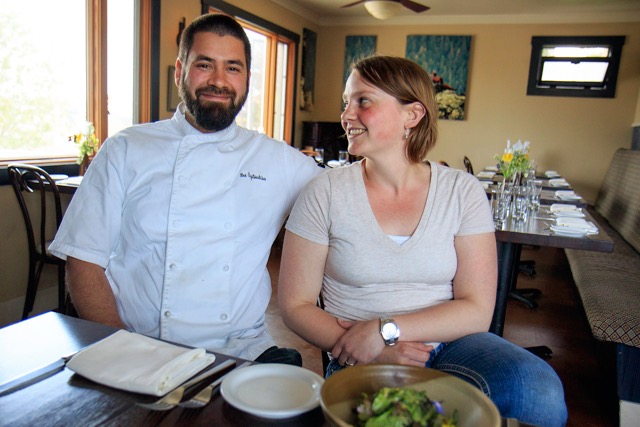
    “We can’t imagine doing this anywhere else,” said Hansen, who, along with his wife, Sara, is the third owner of The Oystercatcher. “We came into a place with a great reputation and put our own spin on it.”

    Hansen plans his menu around local and seasonal foods. (photo by David Welton)
    Hansen plans his menu around local and seasonal foods. (photo by David Welton)

    One glance at the menu clarifies how Whidbey Island’s bounty sparked Hansen’s creativity; for instance, a salad with kale, sorrel, oats, romesco, buckwheat walnut gazpacho, topped with a selection of edible flowers that change with the seasonal blooms — like borage, mustard flower, and watermelon radish — is named after Rosehip Farm, located on Ebey’s Reserve. The result―a colorful, light and flavorful salad.

    Seasonal edible flowers brighten the Rosehip Farm salad. (photo by David Welton)
    Seasonal edible flowers brighten the Rosehip Farm salad. (photo by David Welton)

    The menu also includes Penn Cove mussels with sautéed roasted onions, garlic, parsley and crème fraiche; Neah Bay halibut with duck egg gnocchi; crispy potato skin with an herb salad that includes olive and fennel nage; and one of my favorites, local bean cassoulet with braised pork, ham hock, andouille sausage, carrots and collard greens.

    “Our goal is to keep it fresh, buy as much as we can from local farms,” said Hansen, “I want guests to taste the quality and freshness of what we have in this area.”

    “Our goal is to make someplace that is an enjoyable place to spend time in.” ―Tyler and Sara Hansen. (photo by David Welton)
    “Our goal is to make someplace that is an enjoyable place to spend time in.” ―Tyler and Sara Hansen. (photo by David Welton)

    Who are the local farms? Willowood Farm, Rosehip Farm, Penn Cove Shellfish, 3 Sisters Farm, Eckholm Farm, Ebb Tide Farm, Jeremy Brown, Zylstra Farm, Prairie Bottom Farm, Red Dog Farm and Kettle’s Edge Farm.

    Hansen’s passion for using local produce and ingredients began on a childhood trip to Nicaragua and Ecuador. After two weeks of eating beans and rice, a local beekeeper gave him a piece of honeycomb. “I could taste the flavor of the town in that honey,” said Hansen. That experience inspired him to apprentice at Boulder Dushanbe Teahouse in high school. By the following summer, he worked there full time, and from that point on he “never looked back.”

    Hansen likes to experiment with textures and flavors. Here, he tastes a new bread recipe. (photo by David Welton)
    Hansen likes to experiment with textures and flavors. Here, he tastes a new bread recipe. (photo by David Welton)

    Hansen and his wife met at a restaurant in Bellingham. Her resume includes assistant manager at La Tour, which is touted as the best restaurant in Vail, Colorado. Together, they moved around the west honing their restaurant skills and then decided to put down roots on Whidbey Island. I met them during a writer residency when they worked at the Captain Whidbey Inn. I was impressed with the meal preparation and Sara’s care and attention to detail. After two days, she knew our names and food allergies. When I returned for the following residency, I was thrilled to discover they’d become the new owners of The Oystercatcher.

    “We give guests the whole package,” said Sara. “From the moment they come in we want them to feel welcomed and cared for with an amuse-bouche, a well-crafted drink or glass of wine, great food made with care and presented by wonderful servers. All of that makes for a great night.”

    Breadmaker, Michael Tu, cools down his creations. (photo by David Welton)
    Breadmaker, Michael Tu, cools down his creations. (photo by David Welton)

    It makes for a great weekend lunch too. Their menu tempts with items such as a 3 Sisters Beef burger, a Reuben with their house-smoked pastrami, and an oyster po-boy. Oh, and I can’t forget to mention desserts like beignets with honey cream cheese and buckleberry jam; olive oil pound cake with strawberry rhubarb jam and sorrel mint; and chocolate pot de crème with hazelnut butter and pepperberry tuile.

    Dinner hours are Wednesday through Sunday from 5 p.m. to close; lunch hours are Friday through Sunday, from noon until 3 p.m. Their location, at 901 Grace St. in Coupeville, Washington, has cozy inside seating with pictures and paintings of their signature bird the oystercatcher. Outside seating offers views of Penn Cove.

    Last year, the Hansen’s decided to take on a new endeavor: sell their rosemary olive, molasses oatmeal, and sourdough bread. A call out for yearly subscriptions, which is a $7 loaf a week for a year totaling $364, allowed them to purchase a bread oven. Now, they bake bread five days a week, and subscribers can pick-up their orders at The Oystercatcher, 3 Sisters Market and Kalakala Co. Mercantile in Langley. Loaves, for $10 each, may also be purchased at 3 Sisters Market and the Coupeville Farmers Market. If you have a hankering for their bread or are having a dinner party, they will bake an order with 24-hour notice (360-678-0683).

    (Photo by David Welton)
    Sara Hansen hangs the OPEN sign (Photo by David Welton)

    In June, they plan to add a street taco stand (pork, fish, vegetarian) and beer garden next to the lower level of the restaurant. While this will be a different dining experience than The Oystercatcher, guests can expect the same kind of attention to locally grown ingredients. Hansen is even working with a local farmer to grow produce like tomatillos and hot paprika peppers.

    I’ll admit, I’m a little biased when it comes to The Oystercatcher. I’ve relished every meal I’ve had there, even their seasonal fried green tomatoes, which I don’t normally care for. From the warm greeting to the delicious food, I know what to expect, and that’s a meal that begs your taste buds to linger in a locally-inspired culinary experience.

    Lara Dunning is a freelance writer and owner of SmallTownWashington.com. She has been published in The Crossing Guide, Experience Anacortes, RealFoodTraveler.com, and WaggonerGuide.com. Her interests include young adult novels, history, hiking and locavore-inspired food.


    __________________________

    CLICK HERE to read more WLM stories and blogs. Have a great story idea? Let us know at info@whidbeylifemagazine.org.

    WLM stories and blogs are copyrighted and all rights are reserved. Linking is permitted. To request permission to use or reprint content from this site, email info@whidbeylifemagazine.org.