BY PAT CRAIG
Whidbey Life Magazine Contributor
July 12, 2017
It was a perfect early-July morning – not too warm, not too cold, and bright enough to rival a brand-new dime. The sky was so blue that it would even inspire tough-as-cowhide baseball writers to use words like “cerulean.” Not to put too fine a point on it: It was a real swell day around the Bayview Farmers Market. The produce looked tasty, the craft items were clever, books by island authors looked like they were worth reading, and the silent thunder of vermicomposting went on all around us.
Zukes and cukes at a farmers market are easy to understand. Ditto for composting. But this vermi-stuff? How does it connect kitchen scraps to a bouquet of flowers?
What we’re talking about here is worms. These squiggly critters are no longer just the bait of choice for kids who “teach them to swim” on the end of a hook dangled in front of a bass or bluegill. They’re also silent partners in projects with large- and small-scale gardeners.
Fiona Hess dumps compost into a new worm bin near her home at the Fifth Street Commons while her mother Teresa and sister Simone look on. (Photo by David Welton)
They do work hard in trade for a two-room cedar home thickly carpeted with rich soil and table scraps, from truffles and tuna bones to tomatoes and toast.
In return for these lavish digs and meals, all that is asked of the red worms (the preferred breed) is their casings; OK, worm poop, if you must.
Teresa Spratt spends most Saturdays at the market, making new fans for the worm fertilizer business, talking with old friends, sharing worm stories, and discussing the finer points of the care and feeding of the tiny critters who turn table scraps and kitchen waste into black gold that grows excellent flowers and produce on the island and throughout the world.
She and her husband Todd now run their business, Bugabay, from Whidbey Island, after moving here from California’s Mother Lode foothills in Grass Valley. There, they ran a worm farm and helped build worm fertilizer operations at area schools and the county jail.
Michael Hoover and his wife Kimi have owned this worm bin for years and moved it from Port Townsend to their home at the Fifth Street Commons. The left side of the bin is now full of worm castings, and worms are beginning to migrate to the right side. (Photo by David Welton)
“We started the business here about eight years ago, but I’ve been doing composting and similar things for the past 40 years,” says Todd Spratt.“I’ve been doing this for my family and have helped educate hundreds of people on the importance of taking responsibility for our own food waste.”
The line gets a laugh, but the veteran vermicomposter is quite serious about his work in partnership with red worms. Food scraps will decompose no matter where they’re disposed, but when worms help do the job, the product they end up with is clean, rich fertilizer.
Left alone in a dump to be pushed around by heavy equipment, what food waste creates on the road to decomposition is unpleasant odors and methane gas – not only stinky but dangerous. Food waste currently makes up about a third of the waste stream buried in landfills and makes up part of our carbon footprint.
After the worms have migrated to the other side of the bin, the castings can be removed and used as fertilizer in the garden. (Photo by David Welton)
Savvy gardeners, on the other hand, whose worm partners produce more fertilizer than their gardens need, can sell the excess for a buck a pound, with a combination of rich dirt, peat moss, and the worm casings.
The worms live and work in their cedar houses (created by Spratt and displayed at the farmers market), which are the size of a small car trunk, with a top door sloping down in front and a hinge in the back. They have no bottom, so the house can be anchored to the earth, with a few inches of it buried in the ground.
Operations begin in one of the two halves of the house, where peat moss or aged manure are used to cover the food wastes. When all is ready, the worms are introduced and quickly make themselves at home, where they begin eating the food waste at what seems to be in incredible rate – about half to one-and-a-half times their body weight per day, says Spratt.
“That’s faster than any conventional composting,” he adds.
Hoover distributes castings around his rhubarb plant. (Photo by David Welton)
And it smells a lot better. Food scraps are kept in a tightly covered storage pot, and when they’re taken outdoors to the cedar bin, they’re covered with the aged manure bedding mixture and left for the worms to do their work.
As the first half of the box fills, the casings are harvested, and the process is repeated on the other side. The worms naturally move through openings in the center wall to begin operations in the room next door.
“Michael and I just ate our dinner, and it was made up of lettuce, carrots, beets, beet greens, cherry tomatoes, and garlic, and we had raspberries and blueberries for dessert,” says Kimi Hoover, who lives at the Fifth Street Commons in Langley, and whose worm bin inspired the acquisition of four more just like it at her intentional community. “The worm castings helped all of those things grow in our small garden. We eat mostly vegetables, and we have a lot of kitchen waste that would otherwise be thrown away.”
Hoover adds, “Without a worm bin, all that waste would’ve gone into the waste stream, and we would’ve had to buy fertilizer. This closes the loop. It’s nice not to have to throw anything out.”
Worms work fastest in summer and spring and slower during cooler months. Their speed also depends on the sorts of scrap they get.
“Mainly, we want to keep that as simple as possible,” Spratt says. “We tell people not to chop things up. It will all decompose eventually. What you feed them should be as diverse and nutritious as possible.”
Aside from giving humans a chance to trade scraps for fertilizer, the worm project gives them a truly fragrant cedar house that is pleasant to be around. The boxes are constructed from locally grown cedar, and the pieces used are small enough to be considered scrap by lumber companies.
Competitive gardeners find that the produce and flowers they grow using worm castings gives them an edge at the Whidbey Island Fair.
“Our people entering the fair do tend to take blue ribbons,” Spratt says with a smile.
Patrick Craig has written for newspapers for half a century. At the beginning of his career, he was a reporter in just about every department but business. Most of the past 50 years, though, he wrote reviews and columns about theater and television. He worked for a chain of daily newspapers and covered theaters in San Francisco, Ashland, New York, and Chicago.
David Welton is a retired physician who has been a staff photographer for Whidbey Life Magazine since its early days. His work has also appeared in museums, art galleries, newspapers, regional and national magazines, books, nonprofit publicity, and on the back of the Whidbey Sea-Tac Shuttle!
Enjoy more articles in the print edition of Whidbey Life Magazine, which you can purchase at local and off-island retailers or receive in the mail via subscription.
WLM stories and blogs are copyrighted and all rights are reserved. You may link to this story. To request permission to use or reprint content from this site, please contact us.
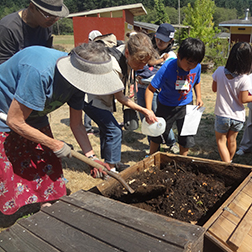
Linda Good is tending the worm bin donated to South Whidbey Tilth by Todd and Teresa Spratt of BugaBay, Inc. She is showing Japanese visitors how kitchen scraps, bedding material, and moisture encourage red worms to eat, reproduce, and, most importantly, defecate. Called worm castings, the worm “poop” becomes rich garden fertilizer. Using just kitchen scraps, the worms will thrive and the garbage bill will drop.
The Spratts will conduct a workshop on the care and feeding of worms, known as vermiculture, on Sunday, May 21, at South Whidbey Tilth. The workshop begins at 2:15 p.m. following the end of the weekly farmers market at 2812 Thompson Road, located on State Route 525 between Bayview and Freeland.
The cost is $15, but each attender will be entered into a drawing for a BugaBay cedar, inground, residential-size worm bin with worms. To register, please contact Angie Hart, Tilth’s education coordinator, 707-498-9086, ah23@humboldt.edu.
The Oak Harbor Garden Club is holding a Standard Flower Show “In Praise of Prose” onFriday, April 28, from 1 to 4 p.m. and Saturday, April 29, from 10 a.m. to 2 p.m. at the First United Methodist Church, 1050 SE Ireland, Oak Harbor.
The show is free and open to the public. See beautiful floral designs, educational exhibits, and plants that grow well on Whidbey Island. The Oak Harbor Garden Club is a member of Washington State Federation of Garden Clubs and National Garden Clubs.
BY KATE POSS
Whidbey Life Magazine Contributor
February 9, 2017
Ever dream about having a place to call your own? Drive around the island, and you’ll find workshops, barns, and studios that house creative tinkerers, writers, artists, and gardeners. Scattered like fairytale flowers among them are whimsical sheds, chicken coops, and garden houses built by Bob Bowling, of Bob Bowling Rustics on Bayview Road in Langley. Few can resist a tiny shingled beauty with antique windows on three sides, French doors, and a weathervane perched on a tin roof. Bowling has been filling custom orders for playhouses and other small structures for the past eight years.
Alan and Charlene Cohen asked Bob Bowling to design this custom garden house that adds a sense of place to their backyard. (Photo by Kate Poss)
Alan and Charlene Cohen of Langley fell in love with the charm of Bowling’s tiny garden houses at the Bayview Farmer’s Market some five years ago. Wanting to create a sense of place in their backyard, the Cohens worked with Bowling to design and build a custom beauty with red shingles, the same shade as their house, French doors, awnings, and antique windows that opened out from the bottom.
“Ever since he put it in the back yard, it felt like it has always belonged here,” says Charlene Cohen, gazing out through the winter mist last week at the fairy-tale cottage in her backyard. “It’s too nice to be a shed, so we call it a garden house. Initially, we’d sit inside and look out the French doors during afternoon cocktails. It has a more practical use now, as a garden shed for tools and garden soil.”
Cohen says it was impressive to watch delivery of the little garden house in her alley above Saratoga Passage. It arrived one day on the flatbed of a Hanson’s Building Supply delivery truck and was lifted by crane into their backyard.
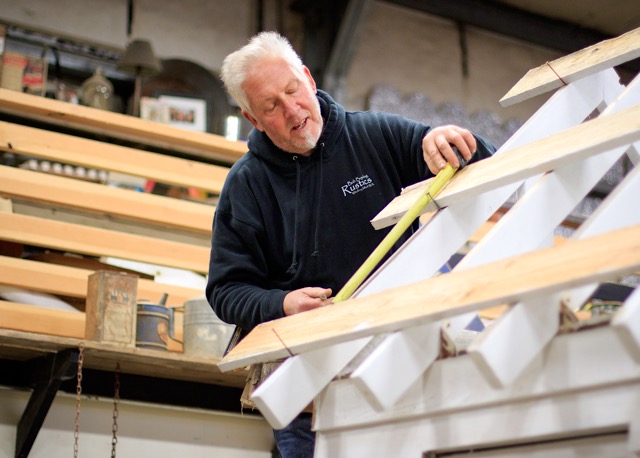
Bob Bowling works to complete whimsical tiny garden houses for the upcoming Northwest Garden Show in Seattle, Feb. 22 to 26. (Photo by David Welton)
These days, Bowling is working around the clock, getting ready for the upcoming Northwest Garden Show at the Seattle Convention Center Feb. 22 to 26. There, he will join more than 300 exhibitors at one of the premier garden shows in the state. He’s found it to be a good venue to inspire future business. Located in Booth 302, one of Bowling’s stars of this year’s show is a rustic beauty perched on top of a vintage truck bed graced with an antique sink and yellow fenders.
“I step it up,” Bowling says of how he works with his wife Julie Spangler to add pretty details such as fresh flowers, lamps and books to the tiny houses that feature Julie’s handmade linen pinafores on display “It’ll be a parade of trucks going to Seattle with the fully-decorated houses on board. We’re the first ones in and last one out. In the past, we’ve won Best of Show awards and Best Presentation. It’s a matter of personal pride to get the houses just right. It’s a lot of work. Last year, I built four houses in five weeks for the show.”
Using a vintage truck bed as a base, Bowling adds a rustic cabin. It will be one of his models at the Northwest Garden Show. (Photo by David Welton)
A lifestyle change brought Bowling to Whidbey Island in 2004. The former flooring contractor became an artist, designer, and builder of whimsical birdhouses and garden houses made of recycled and reclaimed material.
“If you had asked me 20 years ago if I’d be living on an island one day, I wouldn’t have believed it,” he says. “When I arrived here, I rented a barn from Sandy Whiting of Goosefoot to work in. Good people. A little over two years ago, I moved to my location here (at 5789 Bayview Road). Goosefoot did the lighting and remodeled it. It’s beautiful with the light coming in.
Foraging for material at Island Recycling, Bowling finds old windows and doors, antique coffee cans, restaurant vents, and loads of other castoff things. Using his imagination and construction expertise, he fashions the treasures into weather vanes, birdhouses, and bric-a-brac to adorn the facade and interiors of the garden houses or chicken coops.
While the house accessories are typically made of recycled and reclaimed material, the framework is comprised of new lumber. “We want them to hold up in the weather,” Bowling says.
Birdhouses made of vintage coffee cans and repurposed material. Bowling often finds treasures at Island Recycling. (Photo by David Welton)
Many of Bowling’s customers are women, some wanting a “little chapel” others wanting a cozy place of their own. “They’ll tell me, ‘My husband says he’ll build me one someday,’ and I tell them they can have one in no time,” Bowling says. “It’s a space to decorate.”
One of Bowling’s buildings is a dreamy, storybook tea house installed at a farmhouse on Bayview Road owned by the Gabelein family. It was featured as one of the highlighted gardens on the 2016 Whidbey Island Garden Tour
The tea house at the Gabelein farmhouse (Photo by David Welton)
“It’s fun work,” Bowling says. “I like making a little rooftop cupola out of an old funnel. It’s the cherry on the top.”
Kate Poss worked as a library assistant at the Langley Library until last June. She was thrilled to work for three summers as a chef aboard a small Alaskan tour boat from 2008 to 2010. She was a newspaper reporter in Los Angeles for many years before moving to Whidbey Island, where she likes “talking story,” hiking, hosting salons, and writing her novel.
WLM stories and blogs are copyrighted and all rights are reserved. You may link to this story. To request permission to use or reprint content from this site, email info@whidbeylifemagazine.org.
Anza Muenchow is the keynote speaker at South Whidbey Tilth’s annual membership meeting at 4 p.m. on Sunday, January 29. Muenchow presents an illustrated talk about her volunteer work in Kenya last September, where she worked with the Catholic Relief Services. She met small farmers and people participating in community garden projects, primarily in the Rift Valley. Anza traveled to many villages in western Kenya and wants to share her perspective on how small farmers face many of the same challenges we face here in Washington State. She will tell about some of their new challenges, too.
Muenchow co-manages her own farm, Maha, on South Whidbey and also works part-time for WSU Extension Island County in Coupeville and Oak Harbor.
The program is free and open to the public at Trinity Lutheran Church’s Annex in Grigware Hall, which is located at 18341 State Route 525 in Freeland. Visitors are invited to stay for a potluck, drawings for raffle prizes, and a short business meeting after the program. Bring a dish to share and your own eating utensils, if possible; hot beverages are available.
BY KATE POSS
Whidbey Life Magazine Contributor
October 26, 2016
While parents have long wondered how to get kids to eat their veggies, Cary Peterson has cultivated a simple solution that has students clamoring for “garden tacos” that they grow themselves in their school’s backyard.
A once-neglected half-acre of rubble behind the South Whidbey Elementary School now grows tidy rows of veggies, including kale and French sorrel, pumpkins, tomatoes, field peas, nasturtium, sunflowers, and ground cherries—sweet little globes wrapped in a papery skin that taste like tomatoes, pineapple, and mangos all in one. Students from kindergarten through fifth grade enjoy working the garden and harvesting the fruit of their labor in a program pioneered by Peterson, a master at creating community through the land.
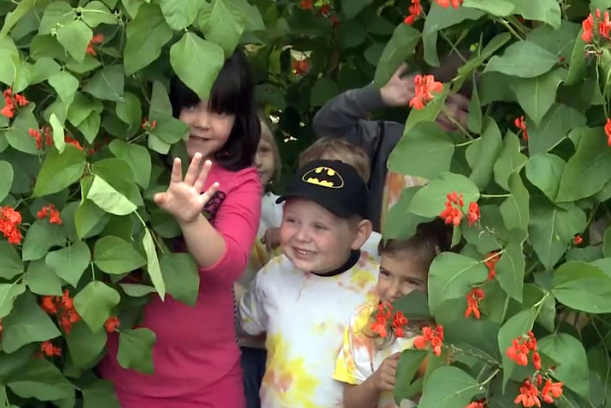
Students wave from a teepee of scarlet runner beans in their school garden. (from the film “Cultivating Kids” by Mark Dworkin and Melissa Young)
Local filmmakers Melissa Young and Mark Dworkin were so inspired by the garden’s success that they made a documentary, “Cultivating Kids,” which shows at the Clyde Theatre, Sunday, November 6, at 2 p.m. The event is free, but donations are welcome and will go toward matching a $30,000 grant provided by Goosefoot, a South Whidbey nonprofit dedicated to building community, preserving rural traditions, adding to the local economy, and creating a sustainable future.
Matching grant funds come from profits made by The Goose Community Grocer, which works with Goosefoot. The school garden received nearly $45,000 in funding in 2014, more than $52,000 in 2015, and has a goal of $60,000 for 2016. The funds pay for garden materials and the salaries of Peterson and her team: a curriculum coordinator and two apprentices. Goosefoot made a three-year commitment to the project, and future funding needs to come from the community. So far, the garden program has received grants from Whole Foods, proceeds from the South Whidbey Garden tour, community donations, and volunteer hours.
“We heard about the farm and went to visit it,” said Young. “We were totally entranced.” Dworkin has worked as a projectionist at the Clyde for more than 40 years. He and Young have made more than 20 notable documentaries, which have been shown on PBS and distributed internationally. Young, a long-time gardener herself, said that she and Dworkin are interested in broad issues of social justice and sustainability. Such themes are reflected in their films, which include “Shift Change,” a documentary about employee-owned businesses. “Good Food,” which aired on PBS in 2010, celebrates the comeback of the family farm and the importance of eating local produce. “Cultivating Kids” is one of their latest films.
“There are a lot of problems in the world,” Young said, “If we’re going to make it a better place, we need to look at what makes a difference.”
The couple began filming in 2015 during the growing season. They filmed students working in the garden through spring, summer, and fall, culminating in a Thanksgiving feast.
Middle schoolers use math skills when working in the garden. (photo courtesy of movingimages.org)
The film is already attracting praise, such as that from Lauren Howe, director of the Slow Gardens program for Slow Food USA. “Cultivating Kids is the ideal film to show all stakeholders that are either considering a school garden or have an existing garden that is needing an infusion of excitement,” she says. “The South Whidbey Island (Washington) project shows how school gardens connect to all aspects of a school day to support academic success, healthy eating habits, and connections to nature. Parents, teachers, school administrators, and community members will all find a special connection in this film that will motivate them to support a garden program for their school. The students are the real stars. A must see!”
On a recent visit to the garden on a cool misty afternoon, Peterson pointed out rows of squash and pumpkins curing in a greenhouse, awaiting a student Thanksgiving feast November 17. “The pumpkins were planted by last year’s third graders, and this year’s fourth graders harvested them for pies,” Peterson explained. “The potatoes pulled by this year’s third graders were planted by the children last spring when they were second graders.”
Mark Dworkin and Melissa Young created the film, “Cultivating Kids,” which will be shown at the Clyde Theatre November 6. (photo by David Welton)
Planting and harvest compliment student studies in math and science, Peterson explained. “We hold a picture of ‘Big Ideas’ for each grade.” The big ideas fostered for the elementary school students are like a foundation that gains strength as the children mature:
Kindergarten and first grade: We connect to the living world
Second grade: Soil nourishes life
Third grade: Life thrives through its diversity
Fourth grade: Our actions can support life
Fifth grade: All life is interconnected
Peterson’s big ideas for linking community and locally-grown food were founded in the creation of the Good Cheer food bank garden and the community garden at the Whidbey Institute. That work evolved to include working with students at the Bayview Alternative High School to restore their garden. When the school moved to the old primary school site and became the South Whidbey Academy, Peterson was asked to get a garden going there. She thought it was essential to serve the produce grown in the garden to students in the South Whidbey School District.
Cary Peterson, advocate for the Earth, community, and locally grown food is in her element in the school garden. (from the film Cultivating Kids by Mark Dworkin and Melissa Young)
Peterson consulted Chartwells, a corporate provider of school lunches nationwide, and together, they created protocols to ensure food safety. Now, South Whidbey School Farm and Gardens, sells its produce to Chartwells, which serves it at all schools in the South Whidbey School District. The student-grown produce also supplies Whidbey Island Nourishes, a nonprofit that provides food for needy students.
Meanwhile, a snack garden, which will provide healthy easy-to-pick veggies for the students’ snacks, is getting ready for spring. “The thing that distinguishes this garden, is that children can grow and eat their own food,” says Peterson. “This program happens due to the 150 percent support of the school and Goosefoot. What’s amazing is that these children know what a delicious carrot tastes like. That changes the system—to serve food that is delicious. It’s their benchmark. I think it’s a very powerful thing when it ripples out.”
Kate Poss worked as a library assistant at the Langley Library until last June. She was thrilled to work for three summers as a chef aboard a small Alaskan tour boat from 2008 to 2010. She was a newspaper reporter in Los Angeles for many years before moving to Whidbey Island where she likes “talking story,” hiking, hosting salons, and writing her novel.
WLM stories and blogs are copyrighted and all rights are reserved. You may link to this story. To request permission to use or reprint content from this site, email info@whidbeylifemagazine.org.
BY DAVID WELTON Whidbey Life Magazine Contributor October 12, 2016
October, always my favorite month, brings Fall to life, quickening the senses with color, scents, and sudden winds.
The sculptural, angled light at sunrise establishes the color palette for autumn leaves.As the days grow shorter and nights stretch longer and cooler, we are comforted by orange and black as we sit beside the fire.Within our broad swaths of deep evergreen forests, Whidbey Island presents pockets of intense color.Within our broad swaths of deep evergreen forests, Whidbey Island presents pockets of intense color.A weathered, worn fire hydrant is magically transformed by the glow of a burning bush (euonymus alatus) at South Whidbey High School.Sherman Farm pumpkins and jeweled spider webs set the stage for Halloween.Yellow grape leaves at Whidbey Island Winery contrast with the blue and green windsock and a 12th Man scarecrow.A Seahawk supporter struts his mutt at Bayview Farm and Garden.Puppies, forever youngA child frolics in treefall from the bigleaf maple.But childhood ends, and we transition from entertained to entertainer, and pursue adult pastimes.
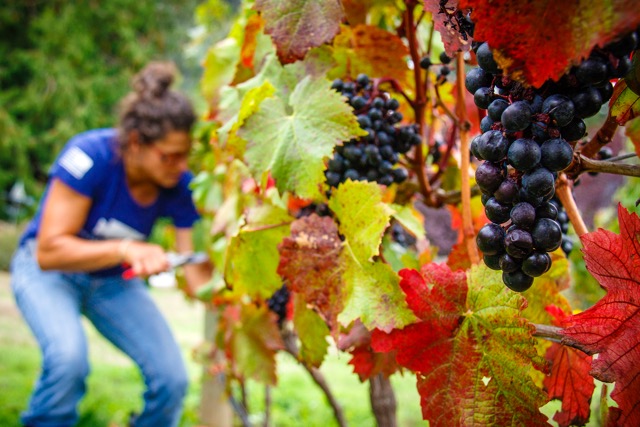
October winds stir up a favorite pastime: to windsurf with migratory birds at Double Bluff.Fall richness provides time for harvesting Pinot Noir at Spoiled Dog Winery.An early snowfall calls for a brisk walk with the dogs and announces the coming of a joyous Winter.
David Welton, a retired physician, is a Whidbey Island photographer who credits his grandmother’s travel slide shows and her gift to him of a Kodak Starflash camera for his interest in photographic art. His goal is to use his photographs to inspire others to realize their unrecognized potential. To learn more about Welton, visit his Web site www.davidweltonphoto.com.
WLM stories and blogs are copyrighted and all rights are reserved. Linking is permitted. To request permission to use or reprint content from this site, email info@whidbeylifemagazine.org.
You probably didn’t notice, but I am nearly a month late with this posting. I was last due on Sept. 12 at which time I was out of body, in another part of my mind. It was my birthday and I was completely absorbed in one and only one activity: completing the edit on my novel. I’d been sliding around it all summer but there was a lot to do to clear the way and then single-mindedly approach the book I wrote—oh, something like 20 years ago—with a fresh take and a clear eye.
It should have been easy, after all that time, to do that: look at it anew, after the passage of time. But it’s not easy. No, it is not. It requires a kind of suspension of disbelief that we generally reserve for strangers and things we’ve never read before. It required me to read this book as though I hadn’t written it, and glean how to make it better.
Try to remember September? (photo by Judith Walcutt)
Glean. I love that word. It means so much: “to extract from various sources,” “to collect gradually, bit by bit,” “to gather (left over grain or other produce) after a harvest.” In the land of language, we glean meaning from words and their innuendos. Face to face, we watch each other: the movement of eyebrows, the set of the mouth, a single movement of the hand—and suddenly we know more about each other than words can ever say. Unless, of course, we’re gleaning meaning from a poker face, in which case, the careful observer may note a certain twitching of eyelids and unconscious fingers twittering in the air without a keyboard. From such gestures, we can learn so much, glean so much, we ought to be able to write volumes about it. I know Henry James, Jane Austin, and a few others have gotten a lot of mileage out of interpreting faces and the unspoken words written across them—as have late night comedians, as they “do” the candidates in this unprecedented election season.
As I sit here writing this, catching up, as it were, on the passage of time, gleaning the changes in our understanding of language and its use in public discourse, I have to wonder at the paradigm shift I have seen in my lifetime! Someone ought to be ashamed. But, no, no one is. SO back to fiction, where I can control my characters and make them pay for their transgressions—or not—and just watch them struggle while trying to learn from their repetitious mistakes, but then, suddenly, intervene, divinely, and help them get to a satisfying end. I love fiction, for that very reason. It is so uplifting, in comparison to most of actual reality. People inevitably make mistakes. It is the human thing to do. But the really great thing is that sometimes people in the fictional story are redeemed in their lives, they get it—suddenly, they glean the bigger picture and they change because of it. They become better: they seek and get or give forgiveness. It is amazing how well fictional people can behave, if you just let them!
Author revises fictional reality with cat on board. (photo by David Ossman)
As for life off the page, the real reality we are living right now—all I can tell you is: gleaning meaning is a useful practice. Gleaning makes us go deeper into the circumstances, past the thin crust of things material and into the muddy waters beneath, where we can try to make something out of our experience, try to make a meaning bigger than our single selves can see or sense, when we are just tunneling along in our daily lives. Try looking at where the sky meets the water and the water meets the sky—and you will see the bigger picture for both parts.
Where water meets sky, sky meets water (photo by Kevin Patterson)
Like chutney made from found fruit, gleaned from abandoned fields and the sides of the road, there are so many flavors to consider, seeking the one taste of those many flavors. That’s what I did, when the rain stopped this past weekend. I went out looking for some beautiful fruit hanging from bended boughs, fruit that no one noticed or cared about. Apples—mottled red and yellow and pale green—the colors we are coming to now that summer has had her last late chance. I found a tree and picked a few—just a few—because that’s all you need to make something wonderful out of very little.
Here’s how to do it:
Find a tree with unpicked fruit. Apples or pears, or late ripening plums and wild grapes, if you can find them—it doesn’t matter what kind really, just the kind that needs to be seen, used, preserved, and not wasted. Notice its beauty and the bend of the bough. Pick as many as you can carry in your hands and cradled arms.
Glean this fruit! (photo by Judith Walcutt)
Take them home and admire them in a bowl on your table. Then gather the ingredients you want to taste—just like writing fiction, you are making this up as you go along. It is o.k. to be creative where chutney is concerned. With its various degrees of sweet, sour, hot, or salty—you almost can’t go wrong. Look to see what you have on hand that needs to be used before going bad or perhaps find that fruit in the freezer you haven’t gotten to all summer and throw it in the pot.
Here’s what I had on hand:
4 big, gleaned apples, peeled and chopped (about four cups worth)
1 large sweet onion chopped (about a cup or so)
Several handfuls of wild, sour white grapes (a gift from a friend who had too many, so I captured them in my freezer.) This time, I used one and a half cups, more or less.
Spices. I have lots and lots of them. I collect them. So for a chutney creation like this, I get them all out and let my nose lead the way.
When the tins they live in are opened, the whole house smells like a foreign country.
Fruit, spice, and time make gleaned chutney sublime. (photo by Judith Walcutt)
Here are some favorites and suggested amounts for one batch of Gleaned Fruit Chutney:
1 tsp. peppercorn
1 tsp. curry
1 tsp. ground ginger
1 tbl. fresh ginger grated
1 tsp. garam masala
¼ tsp. each cardamom and cardamom seeds
¼ tsp. Five Spice
1 star anise
A pinch of fennel
8-10 whole cloves (or ¼ tsp. ground)
Make it up with onions and apples. (photo by Judith Walcutt)
Make your spice mixture come alive by heating a tablespoon of canola oil, adding spices and stirring. The smells will awaken and fill the kitchen.
Oil and spice make nice! (photo by Judith Walcutt)
Add the onion first and stir around in the spices until it softens.
Add the apple and stir around again, until the spices are blended into the two. Cover and let it cook on low for a bit until the fruit settles down, then add the grapes, or the cherries, or the blueberries—whatever you can glean from around you. I threw in some dried sour cherries which I found fading in my pantry.
The four stages of chutnifying (photos by Judith Walcutt)
After the fruit has softened and begins to give off juices, add—stirring in gradually, with love and prayers for peace on earth and goodwill towards all sentient beings:
1 cup brown sugar
1 cup regular sugar (I use organic, raw sugar because it tastes better and is better)
Stir sugar until it dissolves and turns the fruit shiny and magical looking. (You’ll know it when you see it)
Add 1/3 cup apple cider vinegar. Stir, stir, stir.
Cover the pot and keep on low, but still stirring occasionally to keep the stuff from sticking, burning, or otherwise ruining itself like a badly behaved politician.
Pray or chant and stare hopefully into the heavens as you stir, to imbue the fruit you’ve gleaned from the truth you’ve gleaned, from the world you can’t believe is the one you are living in now.
Imagine that this chutney is medicine for what ails us. Let it cook on low for quite a while. Remove the lid and stir some more. Let the hot, sputtering juices evaporate, bit by bit, so that the fruit thickens, deepens, becomes more and more profound. Practice patience. Again and again, practice patience.
When this chutney created by you alone is done, you will know it. It is thick and smells of the past, the present, and the future. One taste. Many flavors. Enjoy.
And now, back to reality where I will go only as a tourist.
One taste, many flavors: gleaned chutney (photo by Judith Walcutt)
Judith Walcutt is a writer living on Whidbey Island who makes jams, chutneys, and variously invented preserves for the sake of sanity and spiritual uplift. Her old- novel-made-new-again, “Memoirs of a Modern She-Noodle,” will soon see the light of day from NeoPoiesis Press.
WLM stories and blogs are copyrighted and all rights are reserved. Linking is permitted. To request permission to use or reprint content from this site, email info@whidbeylifemagazine.org.
This article was originally printed in Whidbey Life Magazine’s Spring/Summer 2016 print issue. The Fall/Winter 2016-17 print issue of Whidbey Life Magazine will be out in a couple of weeks! Look for it in your mailbox {subscribe here} or grab it at one of our local distributors. To whet your appetite, we thought you’d like to read an article from the Spring/Summer 2016 print issue.
BY DIANNA MACLEOD
Whidbey Life Magazine Contributor
October 5, 2016
Have you ever pulled dandelions from a city lot to make a childhood bouquet? Broken off blooming branches from an untended shrub to display on a windowsill? Wandered along the side of a country road picking Queen Anne’s lace and foxglove, butterfly weed and yarrow?
Tobey Nelson of Vases Wild selects flowers for an arrangement. Photo by Marsha Morgan
Have you ever grown a row of flowers between your vegetables? Left a couple of dollars in a neighbor’s honesty box for a Mason jar full of blooms? Gathered a handful, or an armload, of something beautiful that grew right beneath your feet?
If you did, count yourself a slow flower enthusiast—an admirer of flowers that are seasonally available, suited to local conditions and free of chemicals.
Such pullers and pickers count themselves among the increasing number of Americans who love the simple elegance and admirable hardiness of blooms grown in their own part of the world. They are less well known, and a little bit behind, those who have joined together to form the movement known as Slow Food—those advocates who promote local food grown with taste, nutritional value and sustainable agriculture in mind. But the movement known as Slow Flowers, is…well…steadily growing. Locavores, move over and make room for locaflores.
Some might ask whether it really matters if our flowers come from far away or from our own backyards. Whether it matters if our blooms take their time coming to maturity under the open sky or are sped along by fertilizers applied in precise doses at precise times in the confines of a greenhouse that operates like a factory.
To Amy Stewart, author of “Flower Confidential,” it matters very much. She claims that once you understand the difference between imported and homegrown, “you’ll never look at a cut flower the same way again.”
Three Whidbey Island flower growers agree. With shovels, secateurs and seeds, they make both a living and a life raising and selling blooms that are sustainable, artistic, ethical and breathtakingly gorgeous. They are our very own, homegrown Slow Flower farmers.
Wedding centerpieces created by Vases Wild. Photo by Molly Landreth Weddings, Lightworks360
Vases Wild
This marks the fifth summer that gardener, horticulturist and wedding planner Tobey Nelson has been making flower art under the name Vases Wild.
It all started at a wedding show in Seattle when she asked herself why nuptials were not being exchanged more often on Whidbey, an island within easy reach of the city that offers the perfect backdrop for one of life’s most important rituals. As she researched the situation, Nelson found that Whidbey was something of a secret. “I talked to people who didn’t know about the island, attended a wedding here, and then fell in love with the place.”
That realization coincided with her innate pride of place. “I feel strongly about promoting Whidbey Island as a destination and as a community. Events in general, and weddings in particular, provide jobs.”
Hellebore and black pussy willow oral jewelry created by Vases Wild. Photo by Suzanne Rothmeyer
As she began promoting Whidbey as a wedding destination among her clients and peers, Nelson also polished her social media skills in order to market to the betrothed. And, since brides are bombarded with imagery and information, she had to find ways to make her creations stand out. Fresh and dried floral jewelry, botanical headpieces and arrangements using succulents are some of the ways she distinguished herself from other floral designers. Her jewelry and headpieces, delicate yet durable, can be worn for a wedding or for any special event—a date, a prom, a night at the theatre.
Five years later, Nelson continues to take every opportunity to recommend local hair salons, stylists, dressmakers, musicians, chefs, caterers, vintners, brewers, hoteliers, venues, photographers, officiants. She also employs local artisans—metal workers and carpenters—to make custom forms, including floral chandeliers, cylinders to support flowers in vases and arbors. A collaborator by nature, Nelson values the synergistic spirit present among Whidbey Island flower growers, who refer clients back and forth, lend and borrow equipment and sell flowers to each other.
But for a floral artist to locate on Whidbey, far from the lucrative urban wedding trade, other factors must be at work. So it is with Nelson, who has a passion for pastoral landscape, farmland preservation and healthy soil.
As a long-time landscape designer, Nelson is keenly aware of the effect of pesticides on water quality and soils. “Many of the local farms I work with achieve fertility by building soil with manures and compost rather than by applying chemical or synthetic fertilizers, resulting in less runoff,” she said. “Spraying is reduced or eliminated in fields that are planted for diversity. And many flower farms are bush-based, so those fields are not regularly plowed, which means fewer carbon emissions.”
Nelson reported that 80 to 90 percent of all flowers in America come from beyond our borders, where pesticide regulation is lax to nonexistent. Plants are sprayed with pesticides while still growing in the ground or in the greenhouse. Many flower heads—especially roses—are dipped in a fungicide before being packaged. When a box of flowers arrives in a port, it is likely to be fumigated. These are the ingredients in the bouquets into which we bury our faces—seeking fragrance—and then place on our tables, right next to our lovingly-prepared organic food.
Mass-produced flowers also put workers at risk, Nelson noted, whether they are spraying pesticides on rows of identical plants or inhaling fumes over open vats of fungicide. And commercial blooms just don’t deliver what Nelson always takes care to include in a Vases Wild bouquet: scent. A flower bred for traveling is not a flower bred for sniffing. When it comes to commercially grown flowers, looking “fresh as a daisy” is all important; scent is sacrificed in favor of longevity. That’s why Nelson grows her own fragrant beauties: roses (the shrub rose “Golden Celebration” is a favorite), peonies and sweet peas. In addition to scented flowers in her bouquets, she also includes cedar, salal, fern, alder branches, filbert catkins and white poplar (foraged on the beach, after obtaining permission). “When I sell a bouquet, I love it most when I can say ‘this bouquet is island grown’. But I’m always proud of my commitment to using all American-grown flowers, even when I can’t source all my blooms from Whidbey.”
Hairpiece created from sedum by Vases Wild. Photo by Shonda Hilton Photography
In her own garden, Nelson has something blooming all year long, both for her own pleasure and for the survival of pollinators. “When it’s warm enough for bees to wake up, I have something for them to eat. Once we get into summer, the garden is bursting with lush floral color and fragrance.” She likes to “stack” her plantings to “keep the soil covered and busy so nature doesn’t introduce her own agenda.” The governing principle for both her garden and her floral arranging is diversity of leaf and bloom.
As a grower and arranger, Nelson’s passion for slow flowers is deeply rooted. “To support my local economy. To keep from exposing myself or my customers to pesticides. To preserve American farmland. To encourage bees by providing bee habitat. And because local flowers lend themselves to a romantic, naturalistic kind of styling. There are so many reasons to love slow flowers!”
Melissa Brown of Flying Bear Farm inside her greenhouse. Photo by Marsha Morgan
Flying Bear Farm
Melissa Brown first discovered Whidbey Island as a child when her mother’s art was being shown in a Langley gallery. After that, her visits to the island were occasional, but the place was never too far from her mind or heart. As a young woman, she learned about plants by working at Seattle’s Tilth Garden, which is where she met her future husband, Benjamin Courteau. After they married, the couple teamed up with her parents to launch an experiment in intergenerational living. The four set about to find a property on Whidbey large enough to accommodate a homestead for two families and land enough to farm. When that land and homestead appeared near Langley, Flying Bear Farm was born.
“We’re interested in supplying ourselves and our community with things you don’t normally get,” said Brown, who grows flowers for her floral arrangements, sold under the name Flying Bear Design. Brown sees a cultural shift away from conventional floral arrangements to slow flowers. “There’s a desire for local flowers with a ‘gardeny’ look and natural fragrance.”
Weddding reception centerpiece by Melissa Brown, Flying Bear Farm. Photo by Krista Welch, Love Song Photo
That cultural shift is coming at a good time for Brown, because opening a flower shop is an expensive enterprise with an uncertain future. Overhead and the need for a large and diverse inventory make it difficult to make a go of it. And flowers, considered luxuries by most of us, are one of the first items to be sacrificed when money is tight. The 2008 recession forced many flower shops out of business, and in the years since the domestic trade hasn’t fully recovered.
What’s a flower grower, designer and seller to do?
One of Brown’s solutions is the “pop-up”—a temporary stand in front of, or inside, an existing retail business. A one-off, one-time farmer’s market stall. Flying Bear’s latest pop-up—held outside the Langley restaurant Kalakala over Valentine’s Day weekend—was a perfect example of what happens when young entrepreneurs join together to attract customers. Cooperation. Collaboration. Synergy.
“We brought everything: table, chairs, umbrella. We had a square reader for taking credit cards and tracking things. We had rustic buckets and wonky crates, and we used them to tell our story. I brought things to build our brand: galvanized French flower buckets and chalk boards,” she recounted. “I try to think of what people are going to expect when they buy flowers and then incorporate it into my ethos.”
Brown is convinced that part of the appeal of slow flowers is their authenticity. “Young people had grandparents who grew sweet peas, and those memories inform desire. There’s also the desire for the story—the story of where something comes from. We’ve grown up in a culture of obsolescence, everything fake and cheap and anonymous. People are rediscovering the importance of the story that’s attached to what they buy. Who grew it? Who made it? Where does it come from?”
As much as Brown enjoys creating a rustic ambience, she enjoys surprising her customers. She enjoys being the woman behind the accidental find. “There’s pleasure in discovery. People like coming upon something unexpected,” she said. “And then taking it home with them.”
Although Brown grows a variety of flowers, she also sources blooms from places like MilePost 19, Sonshine Flower Farm and Full Cycle Farm. Like Tobey Nelson, Brown appreciates the cooperative spirit among Whidbey Island flower farmers and envisions a future in which they intentionally coordinate their crops to help fill gaps in each other’s inventory.
Bridal bouquet by Melissa Brown, Flying Bear Farm. Photo by Krista Welch, Love Song Photo
Another of Brown’s workarounds to the lack of a bricks-and-mortar flower shop is to attract customers to the farm. This summer she plans to offer a CSA subscription for a weekly bouquet (recycled vase included) or a bucket of flowers (for those who like to arrange their own).
Although the farm and floral business is both a team effort and a family affair, Brown finds she has many more ideas than hours in the day to realize them. For someone so enterprising and inventive, the life of a slow flower farmer offers balance and the opportunity to…well, slow down.
“The best part is being around beauty all the time, having the opportunity see beauty wherever it is,” she said with a smile. “Even if I’m just weeding, I’m seeing the beauty of the soil.”
Kelly and Pam Uhlig of Sonshine Flower Farm at the Bayview Farmers’ Market. Photo by Dianna MacLeod
Sonshine Flower Farm
Three years ago, Pam and Kelly Uhlig sold off their goats and alpacas, plowed up the fenced pasture that fronted on their farmhouse, and began creating what would become a giant flower garden. Over time, they erected two large greenhouses, a poly-tunnel and a seed house. Downed cedars were milled into doors for the greenhouses and planks for the sides of raised beds. A hemlock tree became a potting table. Last spring, they added a long-awaited cooler—a 10′ x 12′ refrigerated space—that holds buckets of cut flowers along with the promise of a more flexible planting and harvesting timetable.
The Uhligs—a mother-daughter team—have remained true to their original intention to create a production flower farm that is gentle on the earth. To preserve water, they installed a drip irrigation system. To build soil fertility, they mulched with aged goat and alpaca manure. To keep hard rains from compacting the soil, they placed layers of cardboard over bare earth, allowing the cardboard to break down over the winter and add to the humus.
Bird’s-eye view of a portion of Sonshine Flower Farm, early spring. Photo by arborist Kyle Rapp, taken from 40 feet up a tree.
“I believe in being a good steward of the land,” said Pam. “If I spray, it’s certified to harm neither people nor the land.” Pam relies on the Organic Material Review Institute to guide her toward benign products. When arranging flowers, she rejects the spongy green material known as Oasis in favor of chicken wire and sphagnum moss, coconut husk fiber and biodegradable “floral soil.”
“I grow flowers to be used locally and sustainably. No fossil fuels for shipping, no dipping in chemicals,” Pam said. To her, Amy Stewart’s “Flower Confidential” is the revelatory book that should spawn a revolt against fast—and foreign—flowers.
The Uhligs plant their crops on a scale most of us can barely imagine: 10,000 bulbs, including tulips, ranunculus and anemones, were planted during the fall of 2015 while dahlia tubers were being dug up and stored in bulb crates for separating and replanting the following spring. This kind of mass planting requires massive planning, from the first day of the year (January for sweet peas) to the last (December for ordering annual seeds).
Pompon ranunculus. Photo by Kelly UhligSweet peas / Photo by Kelly Uhlig
But no amount of planning can account for the vagaries of weather and temperature. Sweet peas can finish by July 1 or last right through the month. Tulips can arrive on time or three weeks early, before flower buyers are prepared—emotionally and psychologically—for them. Early or late arrivals can pose a problem or offer an advantage, depending on the kind of bloom and the season’s progress. Because the price of flowers, like any commodity, is governed by supply and demand, some early arrivals are welcome. “Flowers are a mind game,” said Pam. “You can’t anticipate everything; you do try to get your product to market first.”
But no matter what the weather throws at her, planting is Pam Uhlig’s great passion. “A snapdragon seed is practically microscopic,” she observed. “Yet months later I’m cutting stalks of flowers from that plant for baby showers, weddings, memorial services.”
Although 10,000 bulbs may sound like an impossibly large amount, the Uhligs know that not all of those flowers will make it to market. “Birds, bugs, weather, predators…you lose a lot and you have to accept that,” said Kelly. “Bugs are attracted to white flowers, so they get chewed more than other colors.”
Of the flowers that survive, a portion are destined for the Bayview Farmers Market, where the Uhligs arrange and sell glorious bouquets under a tent that draws customers from all four corners. Another portion is meant for the Seattle Wholesale Growers Market, which means loading a van with buckets of tightly-bunched blooms and catching the first ferry to be on site shortly after dawn, when florists are shopping. Another portion ends up in the flower-arranging hands of Melissa Brown and Tobey Nelson.
Kelly Uhlig composes a bridal bouquet. Photo by Pam Uhlig
As much as the Uhligs enjoy bringing their flowers to the wholesale market in Seattle, they love the contact with customers that the Bayview Farmers Market provides. “Generally, guys want bright colors: orange, yellow, red. Women like the jewel tones and the muted colors,” Kelly observed. “But in the fall, as the days grow shorter and darker, everyone wants bright colors,” Pam added.
Pam, a graduate of the Edmonds Community College horticulture program, understands the importance of offering “leafy greens” with her flowers. Foliage provides a contrast in color, texture and shape to the flowers in a bouquet. Accordingly, she grows the sturdy and handsome ninebark and other deer-proof shrubs around the perimeter of the garden while interplanting purple cardinal basil and other striking foliage plants between rows of flowers.
The talent for growing flowers extends to knowing how to cut them to preserve their freshness and make them last. Pam offers bouquets that will, if treated correctly, hold for at least a week. “The trick is knowing when to cut…and using clean implements. Containers and clippers need to be sterile. Clip the leaves off a flower stalk, because foliage quickly rots when submerged in water.”
Just like the other slow flower growers on Whidbey, the Uhligs alternate between shears and social media. Kelly regularly posts photos and videos on Instagram to market what’s in season and to include admirers in the daily life of the farm, with all its tribulations and triumphs.
Despite either, mother and daughter look forward to each and every day, come rain or shine, deer or slugs, late frost or early warmth. They enthusiastically agree that slow flower farming—the cultivation of beauty and commitment to earth’s ecology—comes pretty close to a life lived in the Garden of Eden:
“Slow flowers express emotions, appeal to the senses, touch the soul.”
Cultivated, harvested and designed by the likes of Tobey Nelson, Melissa Brown and the Uhligs, how could it be otherwise?
RESOURCES “Flower Confidential,” Amy Stewart, Algonquin Books, Chapel Hill NC, 2007 “The 50 Mile Bouquet: Seasonal, Local and Sustainable Flowers,” Debra Prinzing, St. Lynn’s Press, Pittsburgh PA, 2012 “Slow Flowers: Four Seasons of Locally Grown Bouquets from the Garden, Meadow and Farm,” Debra Prinzing, St. Lynn’s Press, Pittsburgh PA, 2013
Dianna MacLeod wore out her knees, bent her back and learned a little Latin in her own garden for 25 years before moving to Whidbey Island in 2011, and when she came she brought 300 of her green friends with her. Dianna has managed an organic demonstration garden, written grants for gardening nonprofits and opened her Seattle garden to Tilth and Northwest Perennial Alliance tours. She looks forward to wearing out her knees and bending her back on her own five acres sometime this year.
WLM stories and blogs are copyrighted and all rights are reserved. Linking is permitted. To request permission to use or reprint content from this site, email info@whidbeylifemagazine.org.
BY KATE POSS Whidbey Life Magazine Contributor September 28, 2016
These are the days of cool and crisp weather, yellow-orange leaves, and apples red and green. Autumn calls some birds to travel south while others remain and prepare for winter weather.
Frances Wood’s book “Brushed by Feathers” commemorates a season of birds in the West (watercolor image by Frances Wood)
Naturalist Frances Wood observes bird migration to track the seasons. To mark the shift from summer to fall, Wood and her like-minded friend Linda Beeman waxed poetic to friends and admirers two days after the autumn equinox. Beeman read excerpts from her chapbook “Our Whidbey Year,” and Wood read from her book “Brushed by Feathers: A Year of Birdwatching in the West.”
“When I read her poetry, I thought she was a kindred spirit,” Woods said of Beeman’s way with words. “We’re both observers.”
“We thought we would begin in this most golden current season, the brink between late summer and early fall, when Gravensteins get turned into cider,” Beeman said.
During September, Wood notes, songbirds stop singing. “During the non-breeding season the section of a songbirds’ brain actually shrinks, making it impossible to sing, even if the urge arose,” she wrote. Swallows and warblers quietly fly south.
Swallows have already left for warmer climates (watercolor image by Frances Wood)
Wood noted that this time of year our regal great blue heron’s loose flight feathers show “gaps in its outstretched wings reminding me of a five-year-old’s toothless grin.”
Meanwhile, loons are arriving from Alaska and western Canada. They were sighted in Useless Bay and at Doublebluff Beach on the Equinox, according to Whidbey Audubon reports. In “Brushed by Feathers,” Wood notes that many of these large diving ducks known for their haunting calls stay through November before heading further south and that some remain all winter.
“For Thoreau, the loon’s call made ‘the woods ring with its wild laughter,’” Woods wrote in an October entry of her book. “Hearing the loon’s call makes me feel that all is right with the world, at least for the day. Like an overture setting the tone for an opera, the loon’s call announces the fall arrival of hundreds of ducks and seabirds into our bay.”
American robins enjoy autumn apples and pyracantha berries (watercolor image by Frances Wood)
For Beeman, autumn means that “banana slug trails reflected/in afternoon sunlight/track to their underground hibernations.” She writes of a robin that met its sudden end: “late season robin that mistook/my front door for sky/fatal error that rendered/an elegiac offering.”
Wood noted that the autumn apples attract robins, Steller’s jays, dark-eyed juncos, white-crowned sparrows, northern flickers, and even pileated woodpeckers to her backyard trees, where deer also arrive to stand on their hind legs to pick higher fruit. Quail forage under her Nootka rose bushes.
Since Whidbey Island is located in the Pacific Flyway, migrant visitors arriving in late September from the north include wigeons, ducks, coots, and “forty species of waterfowl,” along with red-tailed hawks, which join our resident birds.
As the cool, wet, windy weather moves in, we take comfort in warm soups, Beeman observes in her poem “Wind Storm”:
“lichen-furred alder limbs/hit the roof shot sounds/startle soup makers within/who stir wind moans/into their vegetable broths.”
In addition to her books, Wood has designed Collectable Bird Cards, newly printed and packaged. She said that her husband’s baseball card collection featuring a photo of the player on one side and statistics about the player on the reverse side had triggered the idea for her cards. As a former elementary teacher and now grandmother, Wood said she is on the lookout for ways to connect kids with nature, and her Collectable Bird Cards meet that need. One side features her watercolor drawings; the reverse contains bird facts with boxes to check if the bird is seen or heard. One of the birds depicted is an American goldfinch, Washington’s state bird. While a bright yellow during breeding season, it molts and morphs to a dull olive color during fall and winter. Wood’s goal is to create cards for the top sixty of our area’s common birds.
The American goldfinch is our state bird. It loses its bright plumage in the fall (watercolor image by Frances Wood)
When asked about her favorite bird, Wood said, “it’s whichever one is in front of my binoculars.” But the truth is she is really into the island’s pigeon guillemot population.
“They are the only seabird that regularly breeds in the Puget Sound,” she said. “We have 26 colonies of about 1,000 birds. They are noted for their bright fire-engine red feet and mouth lining. They are entertaining to watch. Their eggs are laid in bluff burrows.”
Wood has organized a cadre of citizen scientists who regularly observe the black sea birds and complete weekly surveys of their observations. For more information visit www.pigeonguillemot.org.
Artist and Naturalist Frances Wood (photo courtesy of Frances Wood Web page)
To learn more about the many hats of Frances Wood, visit her Web page at www.franceswood.net. Her growing collection of bird portraits can be viewed at the Rob Schouten Gallery in Freeland and at www.robschoutengallery.com/frances-wood.
Poet Linda Beeman (photo by Lorraine Healy)
Besides her work as a realtor at Windermere Real Estate/South Whidbey, Linda Beeman is an award-winning poet and author of “Wallace, Idaho,” a chapbook describing the gritty life in the small silver-mining town where she grew up. For more about her, visit her amazon page here.
Image at the top: Pigeon guillemots have bright red feet and nest in bluff hollows (watercolor image by Frances Wood)
Kate Poss worked as a library assistant at the Langley Library until last June. She was thrilled to work for three summers as a chef aboard a small Alaskan tour boat from 2008 to 2010. She was a newspaper reporter in Los Angeles for many years before moving to Whidbey Island where she likes “talking story,” hiking, hosting salons, and writing her novel.
WLM stories and blogs are copyrighted and all rights are reserved. Linking is permitted. To request permission to use or reprint content from this site, email info@whidbeylifemagazine.org.


 Enjoy more articles in the print edition of Whidbey Life Magazine, which you can purchase at local and off-island retailers or receive in the mail via subscription.