We islanders have our unique ways of celebrating holidays—and creating some of our own. Every month seems to bring at least one parade or festival that calls us into the streets, waters, and parks to cheer, march, or strut. Read the observations of one island philosopher and one “Conductor of Fun” on the relationship of celebration to community…and relive some of Whidbey’s best events through photographs that capture the spirit of islanders who know how to throw a better party.
BY KATE POSS
Whidbey Life Magazine Contributor
August 31, 2017
There are lots of nonprofits competing for donations on Whidbey Island, but only Friends of Friends raises funds by crowning someone “Mr. South Whidbey.” At the annual pageant, fashion and talent might be entertaining, but it’s the man who raises the most money for Friends of Friends who wins.
The organization supports South Whidbey residents who have medically-related expenses they can’t afford to pay. This year, retired cardiologist David Welton is in the running. Welton has lived on Whidbey for 12 years, and you may know him as the talented and prolific photographer who has taken many photos for Whidbey Life Magazine.
Welton serves his community by taking photos and donating them to organizations such as the Whidbey Island Garden Tour, Clinton and Langley chambers of commerce, the South Whidbey Parks and Aquatics Foundation, Whidbey Island Nourishes, Hearts and Hammers, Goosefoot, and others. Organizations use the photos for promotion on their websites and in printed publications.
David Welton has stars in his eyes when he thinks about running for Mr. South Whidbey. (Photo by David Welton)
“Photography is the way I’ve chosen to give back,” Welton says. “I was pleased to be asked to run for Mr. South Whidbey and look forward to my continued involvement with the community for as long as I’m able.”
There are four ways to donate to Friends of Friends and cast votes for David Welton. Every dollar donated brings Welton one step closer to being crowned Mr. South Whidbey:
Have Welton take your photo. He will donate all proceeds from family portrait and event sessions, taken between now and October 7, to Friends of Friends. To book a photo session, call him at 360.579.1030.
Donate online by entering the amount of your donation under David Welton’s name here.
Make out a check to Friends of Friends Support Fund. Be sure to write “David Welton” in the memo field, and mail it to Friends of Friends, P.O. Box 812, Langley, WA, 98260.
Attend the October 7 Mr. South Whidbey Pageant at 7 p.m. at Freeland Hall and cast your vote for Welton in person. (Event tickets are $30.)
Welton is running along with Brook Willeford, Victor Ramos, Rod Stewart, Daniel Goldsmith, and Anthony Molinero. Regardless of whom you “vote” for with your dollars, you can take pleasure in knowing that your donation will help a neighbor in need pay for medical costs.
Kate Poss worked as a library assistant at the Langley and Coupeville libraries before retiring last year. She worked for three summers as a chef aboard a small Alaskan tour boat from 2008 to 2010. Poss was a newspaper reporter in Los Angeles for many years before moving to Whidbey Island where she likes cooking for new and old friends, hiking, reading great fiction, and writing her second novel with friend Fred Bixby.
David Welton is a retired physician who has been a staff photographer for Whidbey Life Magazine since its early days. His work has also appeared in museums, art galleries, newspapers, regional and national magazines, books, nonprofit publicity, and on the back of the Whidbey Sea-Tac Shuttle!
__________________
Enjoy more articles in the print edition of Whidbey Life Magazine, which you can purchase at local and off-island retailers or receive in the mail via subscription.
WLM stories and blogs are copyrighted and all rights are reserved. You may link to this story. To request permission to use or reprint content from this site, please contact us.
It was as perfect a spring day as we could hope for in Coupeville. Azure sky, a light breeze on Penn Cove, temperature about 70 degrees, Mount Baker looming regally in the distance. Weather so sweet that you just want to smile, whistle a happy tune, and hug the person next to you.
That’s how it felt last Saturday at the Penn Cove Water Festival, the 25th annual occurrence since the festival was revived in 1992. I sometimes avoid the big touristy events we hold here on the Rock; I much prefer home gardening to crowds and traffic.
But the Water Festival is different, and that’s why I never miss it. It’s a wonderful reflection of Whidbey’s diverse culture today, while at the same time offering a lovely, if perhaps wistful, salute to cultures that used to be here. Granted, local merchants created the original festival in 1930 mostly as a way to draw more tourists and their automobiles to Coupeville in the spring, and its revived version still draws a big crowd. Several thousand people showed up Saturday.
But the main attraction of the festival has always been the dozens of Native Americans from Northwest Washington tribes – some of whose ancestors once lived on Penn Cove – who come to talk about their heritage and race their canoes on the cove.
Opening blessing (Photo by Harry Anderson)
I arrived just as a young woman was singing the opening blessing in the language of the Salish peoples. Then Water Festival President Vicky Reyes offered a welcome in English to the gathered tourists and locals outside the Island County Historical Museum.
“Today is a celebration of the many cultures that are here today; we are from many backgrounds and cultures,” she said. “But most of all it’s a celebration of the original cultures of Penn Cove and Whidbey Island.”
I thought that was a great way to describe the Water Festival. I stood next to a man in a Buddhist robe with two small children. Not far away was an African-American family from Naval Air Station Whidbey Island. And in the back was a priest wearing a clergy collar talking with an Asian-American family.
As I listened to the singing, which seeks a blessing from the Salish peoples’ creator, and then waited for the canoe races to begin, I let my mind wander back to what it may have been like here a couple centuries ago – before the European explorers sailed into Puget Sound in the late 1700s and the white settlers staked their land claims beginning in the mid-1800s.
Racers carrying their canoe to the water (Photo courtesy of Penn Cove Water Festival)
At least four Salish nations once shared our Rock: Skagit tribes in the central and north, Snohomish in the south. Food was abundant from the sea, the beach, and the land, and that helped the nations here build villages with strong social orders. These were not nomadic or marauding peoples. Land, water, fishing, and hunting rights were highly developed. By the time George Vancouver arrived in 1792, there may have been several thousand people living on the Rock – which Skagits called Tschakolecy, or land of abundance. It’s estimated that as many as 1,000 canoes plied the waters around Whidbey Island.
As young Native Americans raced their modern canoes on Penn Cove Saturday in tribute to their ancestors, I could feel a real sense of pride in keeping their traditions alive. I imagined that a potlatch held 250 years ago on these same waters likely had the same positive energy and spirit.
Racers from local tribes on the water in Penn Cove (Photo courtesy of Penn Cove Water Festival)
But then I realized, with more than a little sadness, that none of those young people in canoes racing on Saturday actually live on Whidbey. They had come from all over the region, but most had no relatives here to greet them or any other connection with this place. Within 125 years of the European exploration, virtually all the native peoples who lived on the Rock were gone. Many succumbed to smallpox, influenza, syphilis, and other diseases brought by the Europeans.
By 1870, the Washington territorial government had signed treaties relocating most Puget Sound native peoples to reservations. Most of the relatively small number of surviving Skagits in central and northern Whidbey eventually moved to the Swinomish reservation near La Conner – which is ironic, since they had not even been invited to the talks between the territorial government and mainland Skagits that led to the Point Elliott Treaty of 1855, which created the reservations.
Even with the hustle-bustle of the vendor booths, food carts, musical performances, and canoe races at the festival Saturday, I did feel something of the gentle hovering spirit of those first people – the ones who may have lived here 5,000 years or more before they were “contacted” by Europeans, who have been here for less than 250 years.
And I realized that a culture gone but still celebrated is a culture not forgotten.
The early days of the Penn Cove Water Festival (Photo courtesy of Penn Cove Water Festival)
Gatherings of boats for other reasons eventually led to races. (Photo courtesy of the Penn Cove Water Festival)
Once upon a time, Harry Anderson made an honest living as a reporter, editor, and columnist at the Los Angeles Times. He now lives in central Whidbey where he spends his time gardening and ruminating on things that interest him.
__________________
Enjoy more articles in the print edition of Whidbey Life Magazine, which you can purchase at local and off-island retailers or receive in the mail via subscription.
WLM stories and blogs are copyrighted and all rights are reserved. You may link to this story. To request permission to use or reprint content from this site, please contact us.
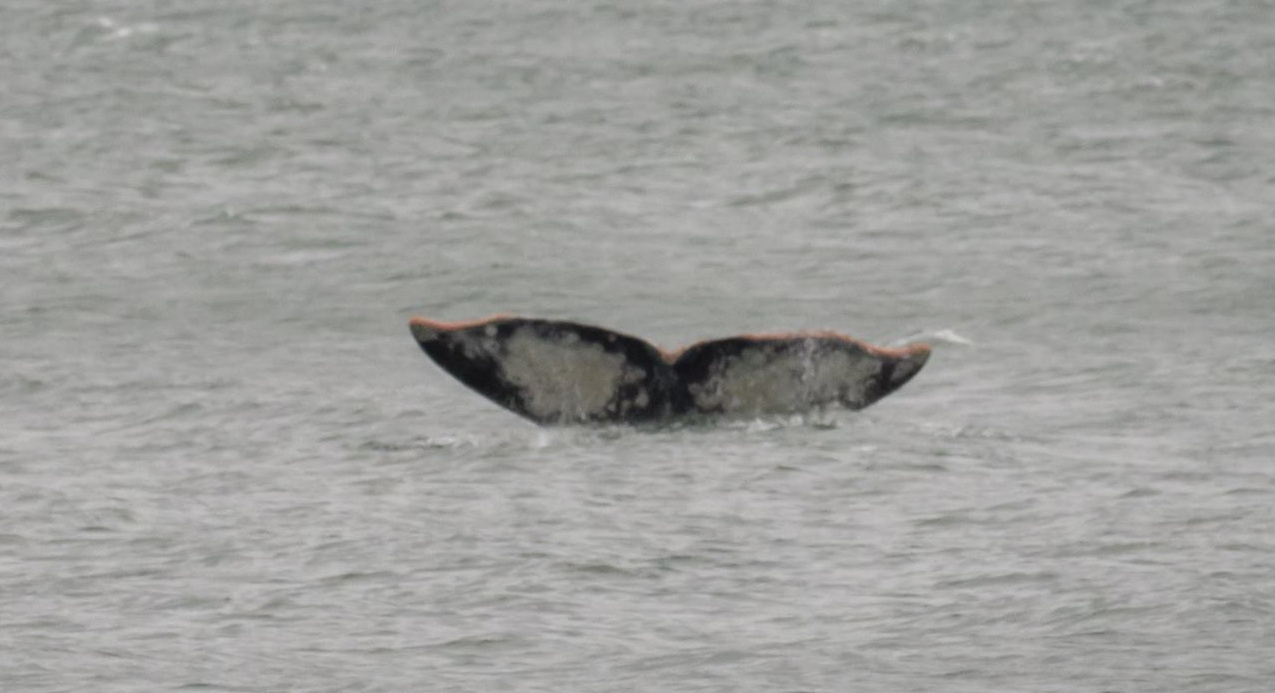
The small population of gray whales known as the North Puget “Sounders” return each year to feast on ghost shrimp in the tidal flats primarily around Whidbey, Camano, and Hat/Gedney Islands, and along Everett and Tulalip. The first gray whales this year were reported to the Orca Network’s Whale Sighting Network by Gary Lingenfelter, who observed them feeding on the intertidal flats off Tulalip at the mouth of Port Susan on February 28 and March 2.
This group of gray whales returns to Saratoga Passage and Possession Sound each spring for their annual three-month feeding foray in North Puget Sound. Cascadia Research of Olympia has been studying this population of gray whales for decades. In greater Puget Sound, we see approximately 12 grays per year, some have been seen every year since 1991. The whales are identified by the markings on the underside of their flukes, as well as by the patterns of barnacles, scars, and markings on their backs. Patch, or #49, was among the first identified by Cascadia in our local waters in 1991 and is a favorite of many local whale watchers, as he is easily identifiable by the large white patch on his right side, as well as white patches on the underside of his flukes.
This small group of gray whales typically arrives in our region in early March and stays through the end of May, feeding on ghost shrimp and worms in the mudflats of Saratoga Passage along Camano and Whidbey Islands, and in Possession Sound. The annual spring visit of gray whales provides an excellent opportunity to view them from the shorelines of Island and Snohomish counties, or from the Mukilteo/Clinton ferries, much to the delight of residents and visitors alike.
Orca Network’s Whale Sighting Network has followed the travels of these whales, as well as other whales in our region for decades, and since March 2014, our new Langley Whale Center has provided a great venue to learn more about the whales. The Whale Center is located at 115 Anthes in Langley on south Whidbey Island, one block up from “Whale Bell Park,” where the Whale Bell is rung whenever someone spots a whale in the area.
Orca Network provides a Whale Sighting Viewpoints Map to help watchers find the best locations for viewing whales from shore at our Langley Whale Center. To get the latest information on where the whales are, join and follow Orca Network’s Facebook page, where whale sightings are posted daily, along with news, events, and information about the whales of our region.
The Langley Whale Center also features displays and videos about gray whales, orcas, and the many other marine mammals of the Salish Sea. Cascadia Research has designed a new exhibit at the Langley Whale Center describing the gray whales in Puget Sound. Also on display are marine mammal skeletal and specimen displays collected and prepared by Orca Network’s Central Puget Sound Marine Mammal Stranding Network, to help visitors understand the anatomy and natural history of the marine mammals who share our island waters.
Welcome the Whales Festival April 8-9, 2017
On Saturday and Sunday, April 8-9, don’t miss the annual “Welcome the Whales Parade and Festival” in Langley to honor and celebrate the arrival of gray whales to Whidbey Island. Welcome the Whales Festival is sponsored by the Orca Network and Langley Chamber of Commerce.
Saturday, April 8, will include hands-on educational displays, costume-making, and children’s activities, followed by the Whale and Critter Parade in downtown Langley, ending at the Waterfront “Whale Bell” Park with a blessing for the whales, music, and celebration on the beach, while watching for gray whales in Saratoga Passage. The Langley Whale Center will be open from 11 a.m. to 5 p.m., with special activities and displays about gray whales and staffed by Orca Network/Whale Center docents.
In the afternoon, presentations will include our featured speaker Joel Reynolds, western director and senior attorney for the Natural Resources Defense Council, who has led several of NRDC’s largest campaigns, including campaigns to protect the gray whale birthing lagoon and World Heritage Site at Laguna San Ignacio in Baja California. Mr. Reynolds’ legal challenges and negotiations with the Navy to protect whales and dolphins are described in the book “War of the Whales” by Joshua Horwitz.
Sunday, April 9, browse the Langley Whale Center’s exhibits, displays, and gift shop from 11 a.m. to 5 p.m., and in the afternoon, from 3 to 5 p.m., take to the water to see the gray whales on the Orca Network’s gray whale fundraising cruise aboard the Mystic Sea whale watch boat.
For more information about Welcome the Whales weekend or the Orca Network’s Whale Sighting Network, visit our website.
BY KATE POSS
Whidbey Life Magazine Contributor
February 22, 2017
It’s a lot of fun to have coffee with Loretta Martin, the writer behind the mysteries of Langley’s Mystery Weekend. Who wouldn’t enjoy it? Writing mysteries for Langley’s Mystery Weekend each year, and seeing them brought to life by improv actors, makes her happy.
Dare to solve the murder with other amateur detectives Feb. 25 and 26 for Langley’s 33rd annual “Mystery Weekend: An ‘Un-Conventional’ Murder.” There are 34 characters this year, some of them posing as science fiction conventioneers — “members” of the International Society of Science Fiction Arts and Technology or ISSFAT. These characters are behind-the-scenes folks who operate the cameras, act as engineers, do makeup, and design costumes in the sci-fi world.
“I have worked behind the camera,” says Martin, who has a background in creating and producing local television shows.
In character as a police officer, Loretta Martin calls in a clue for Mystery Weekend (Photo by David Welton)
The sci-fi convention arrives nearly two months after a “sighting” of a Sasquatch in the Saratoga Woods on New Year’s Day, so the story goes. The tween who “saw” the local Bigfoot reports it on Facebook, and the story goes viral, drawing hunters and protectors of the hairy mystery-beast. The weekend’s remaining actors are those who are either Bigfoot Friends, those who wish to see the Sasquatch stuffed as a trophy, and the regular cast of characters including: I.B. Fuzz, her cousin Hagetha Kisstea, Gussie and Gus Gruesome, and the 49ers, a zany band of codgers always looking to make a quick buck — this year on “Sasquatch Sausage” and root beer made of Sasquatch scat for an “earthy” taste. A hairy gorilla-type creature is found dead behind the Saratoga Inn, and this is where the sleuthing begins.
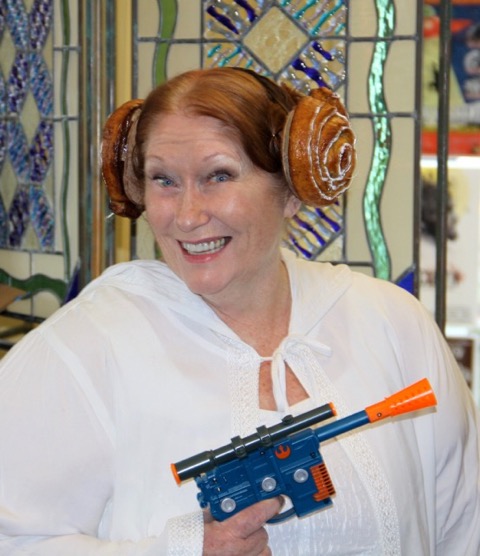
Annie Horton, who has performed in most of the Mystery Weekends, plays the character of Shari Fissure this year, the widow of the murdered character. As an homage to Carrie Fisher, who died Dec. 27, Horton’s character models Fisher’s Princess Leia of “Star Wars.” Shari Fissure, though, wears a hairdo of actual cinnamon buns on the sides of her head.
“I predict the phrase of the weekend will be, ‘Love your buns,’” Horton says.
Some of this year’s actors in Mystery Weekend featuring Sasquatch friends and enemies, science fiction conventioneers, and other characters. (Photo by Sharon Lundahl)
While many of the actors return again and again, there are new faces adding to Mystery Weekend this year.
Lilly van Gerbig, co-owner of Langley’s Fair Trade Outfitters, along with her husband Barry, is acting for the first time.
“I’m playing Lilly Landtree, an animal lover and a good friend to Bigfoot Friends,” van Gerbig said. “Our store is a sanctuary for Bigfoot Friends. I’m a little eccentric and I wear charms and necklaces. I am a staunch protector of Bigfoot. I think it’s really fun. I’m excited to do it.”
Van Gerbig said, while she’s “not theatrical,” she does enjoy interacting with customers in her store. Last year Fair Trade Outfitters provided a clue in solving “Much Ado About Murder: A Hare-Raising Tale.”
The 49ers Men’s Club have a get-rich scheme this year, including selling Sasquatch sausage and Sasquatch rootbeer, known for its secret ingredient (Photo by Sharon Lundahl)
The way Mystery Weekend works is that local businesses pay a small fee to the Langley Chamber to offer a clue. Visitors buy a $10 ticket from the chamber, which includes a map and locations of all the available clues, along with a copy of the “Langley Gazette.” Sleuths visit the businesses, collect clues, and guess who the culprit was at a 5 p.m. gathering Sunday afternoon at the Langley Middle School.
“Josh (Hauser of Moonraker Books) said I should be a character, this year,” van Gerbig says. “I love being with my customers, so I thought, what can you lose? It was fun last year, just seeing the excitement and meeting people who have done this for years. It is amazing to me. They’re bringing their children and grandchildren. No one knows who the murderer is. Everyone is a suspect. You have to play like you might be one or should be one. I think Loretta is a genius. I love her.”
Even the actors who play the characters don’t know who the murderer is until it’s revealed on Sunday evening. It’s the only part that’s scripted.
Annie Horton has performed in nearly every Mystery Weekend over the past 33 years. (Photo by Sharon Lundahl)
“We tell people that, when interviewing the suspects, they shouldn’t believe everyone, because one is the murderer and has (every) reason to lie,” says Martin. “The mystery is solved by getting clues, interacting with the suspects, and reading the story in “The Langley Gazette.”
Josh Hauser, owner of the Moonraker bookstore in Langley, has been a character in every mystery weekend but one. This year, she is cast as a bookstore owner. She recalled one of her favorite roles from days gone by.
“It was my best costume year. I had set up a business of ill repute upstairs,” Hauser says. “I found a red taffeta strapless evening gown. I’ve committed the murder twice. One day (during a previous Mystery Weekend), I was across the street and there were people walking by with signs to save our slugs. Someone thought it was a real small-town protest.”
“Officer” Loretta Martin”says suspects are “arrested” by Langley police on Langley Mystery Weekend (Photo by David Welton)
The first mystery Martin wrote was 18 years ago, when she worked as director for the Langley Chamber.
“It was an homage to the Titanic, and we called ours ‘The Wreck of the Calista,’ based on a boat that wrecked, here” Martin says. She described a jewel she loved at Wayward Sons, then, and used it as a device to help steer the story. “It was a $3,000 brooch, that had a large blue opal with rose gold vines and peridot and pink topaz. It would have looked good on a big girl like me. I had a long-time Langley resident play the part of an opera singer who wore the pin and is murdered by a spear-gun. The actor had to be off island that weekend, so I suggested we use the photo we already had of her as the photo of the “victim” opera singer in the mystery. We both thought that would be fine. I used her photo in the obituary, with the (Mystery Weekend) headline: “Opera Singer Murdered.” I got a call from her mother asking, ‘What happened to my daughter?’ The ‘Mystery’ newspaper is usally inserted in the real newspaper, and her mom started getting calls asking what happened to her daughter.”
Since then, Martin said the victims have always been fictitious and not part of the cast.
Barbara MacCallum, a Langley bed and breakfast owner, used to work with Martin at the chamber during the “Heads in Beds” campaign to entice visitors to the island during the winter. She recalls previous Mystery Weekends in which the Mosquito Fleet transported sleuths from Seattle to the Langley marina (and guests were told who the murderer was on the way home), bed and breakfast baking contests, cookbooks; all ways to bring out-of-towners to the island during the dark days of February. “Loretta’s imagination is phenomenal,” MacCallum says. “She comes up with clues, creates the characters, and the solution.”
Martin moved to Whidbey Island, a place she had visited since she was a child, to heal from complications due to a back surgery nearly 20 years ago.
“When I was diagnosed (and had to take months of antibiotic treatment as a result), I was so weak,” Martin recalls. “My mom and dad said I should move to their house on Mutiny Bay. I feel there’s a healing energy on Whidbey Island. I’ve always felt it. When we moved here, my husband Dewey landed a job in his field (construction). I worked at Whidbey General Hospital and wrote “The Pulse,” the hospital’s magazine. Then I landed the job at the chamber. The connections I’ve made are so important. Just keeping in touch means so much to me. It’s all about networking, especially with women. It’s why I support the Soroptimists.”
Regarding creating stories for Mystery Weekend, Martin says, “When I’m writing, it’s my favorite time of the year. The most fun thing is that it is not a linear (or scripted) story, but one that is done in improv by the actors. They bring the story to life in new ways I couldn’t imagine. When I see them in costume, (it’s like) J.K. Rowling might feel when she sees her characters come to life in a ‘Harry Potter’ movie. I’m so lucky that way.”
Michaleen McGarry, executive director of the Langley chamber of commerce, designed this retro poster advertising this year’s Mystery Weekend Feb. 25 and 26. (Photo by David Welton)
A couple of local businesses will carry Mystery Weekend-related merchandise. Sprinklz Ice Cream Parlor and Coffee Shop in Langley and Casey’s Crafts, on Hwy 525 near Bayview Road, now carry Sasquatch-themed items. Laurie Davenport, who owns Casey’s, said she will host a Bigfoot treasure hunt throughout the store as well.
Sharpen your Sasquatch-sighting skills the night before Mystery Weekend at the Langley Library, which will host David George Gordon, author of “The Sasquatch Seeker’s Field Manual: Using Citizen Science to Uncover North America’s Most Elusive Creature,” on Friday, Feb. 24, at 6:30 p.m.
Betty Freeman, visitor center representative for the Langley chamber of commerce, suggests buying tickets ahead of time. The chamber almost sold out of tickets last year and did sell out of 2016 Mystery Weekend T-shirts and sweatshirts. Order early. T-shirts are $20 and hoodies are $35. They are adorned with the vintage Sci-Fi logo seen on posters around town.
Kate Poss worked as a library assistant at the Langley Library until last June when she retired. She worked for three summers as a chef aboard a small Alaskan tour boat from 2008 to 2010. She was a newspaper reporter in Los Angeles for many years before moving to Whidbey Island where she likes cooking for new and hold friends,’hiking, reading great fiction and writing her novel.
WLM stories and blogs are copyrighted and all rights are reserved. Linking is permitted. To request permission to use or reprint content from this site, email info@whidbeylifemagazine.org.
Mokihana Calizar, a Hawaiian storyteller, blogger and writer of medicine stories will appear at the South Whidbey Tilth Farmers’ Market on Sunday, Sept. 25 starting at 11:30 a.m. She will tell a Hawaiian tale “Pele and Lono,” strumming her ukulele between. She invites the audience to join in group readings: a story of the original medicine of the Safety Pin Café, and a freshly minted story, “Feed the Land,” for the Tilth land. This is a medicine story about land, not property; about people, not consumers; about community not ownership; about pirates dressed in everyday clothes; about hearts and souls craving remedy and solutions that criss-cross the borders.
Donations will benefit the work of Real Change, a Seattle-based group which “exists to provide opportunity and a voice for low-income and homeless people while taking action for economic, social and racial justice,” and South Whidbey Homeless Coalition (SWHC) whose mission is to “help us make homelessness a brief and rare experience in our community.”
Calizar, who lives with Multiple Chemical Sensitivities (MCS), knows first-hand the issues of homelessness and life on the edges of a civilized society. “Come fragrance free,” she requests, “suspend your disbelief and be open to create a more robust version of reality.”Her blog can be seen at www.thesafetypincafe.blogspot.com.
Artist Carla Walsh will also be at Tilth and will engage young and old in making leaf prints during the market.
The South Whidbey Tilth Farmers’ Market is located at 2812 Thompson Road, on the corner of Thompson Road and State Route 525. The market is open from 11 a.m. to 2 p.m. through Oct. 16. It features fresh produce, flowers and concessions. SNAP card customers get double value. Farmers’ Market Nutrition Program coupons are accepted by many vendors. Artisans have unique gifts for early holiday shopping. Visit www.southwhidbeytilth.org, call 360-321-0757 or email market@southwhidbeytilth.org.
BY JUDY FELDMAN Whidbey Life Magazine Contributor August 31, 2016
Wendell Berry, farmer, poet and cultural critic, has said: “Eating is an agricultural act.”
Perhaps nowhere is this more visible and visceral than at a Farmers Market. Wandering through table after table of produce that was harvested just the day before, talking with the people who grew it, sharing ideas for how to store it, prepare it, preserve it, offering feedback to the growers about what we like and don’t…it’s possible that we think more deeply about the quality and importance of our food while at a Market than at any other time in our busy lives.
Bill McInvaille of Bur Oak Acres Farm weighs out vegetables for a happy customer. (photo by Judy Feldman)
Here on Whidbey, we’re fortunate to have many of these farmer-eater mashups. Langley, South Whidbey Tilth, Bayview, Clinton, Coupeville and Oak Harbor all boast lively markets that feature small-scale farmers, artisans, bakers, food vendors and music.
Folks who include Farmers Markets in their weekly shopping routine can rattle off a long list of why they do so: they like buying very fresh vegetables, they enjoy bringing visitors to a local experience, they want to support their farming neighbors, they appreciate being able to shop outside.
If you dig a little deeper though, you’re likely to discover that there is much more going on at a Farmers Market than an idyllic version of grocery shopping.
“Our family is here,” say Pam and Kelly Uhlig of Sonshine Farm. And by family, they mean not only the customers who buy their sustainably grown flowers, but the farmers they connect with in between transactions.” Britt Conn of Full Cycle Farm echoes this, saying “the Markets offer us an old-school version of social networking.”
Kelly Uhlig sees the Farmers Market as the best way to spread the word about the flower farm she and her mother, Pam, operate on South Whidbey. (photo by Judy Feldman)
Farmers, as small business owners, work hard. Their day to day tasks are obviously place-based, and are often driven by factors mostly out of their control…weather, water, soil, market demand, pollinators and other slippery elements. Keeping up with planting, weeding, irrigating, pest control, harvest schedules, washing and packaging takes a very large percentage of their waking time. They can become a bit isolated. And yet, sharing crop information and collectively making sense of the farming experience is important to them. Farmers Markets give them a platform for connection.
That connection extends beyond the network of farmers to their customers. “This is face time,” says Annie Jesperson of Deep Harvest Farm. “Here at the Market, we have the chance to really relate to each other as human beings with needs, challenges and celebrations.” Loren Imes of Quail’s Run Farm agrees. “It’s really fun for us to see people excited about the food we work so hard to grow…we get to watch as it transforms from produce on our table here to sustenance for them.”
Standing at a produce booth for 20 minutes can provide more insight as you listen to the stories shared back and forth between those who grew the food and those who will eat it. “I’m beating cancer,” says one woman. “And taking care to select good, whole, fresh food—grown by people who know me—is a huge part of my plan.” Another says “my kids say these tomatoes are better than candy!” Yet another holds up a bunch of beets, remarking “these always remind me of my mother.”
Farmers Annie Jesperson and Beth Wheat share observations of tomato varieties that have done exceptionally well this summer. (photo by Judy Feldman)
All of this is not to say that Farmers Markets are the be-all and end-all. “We’re so grateful to our community for coming out to buy from us,” says Stephen Williams, “and Market income makes up a significant portion of our farm revenue. But it’s hard won. While the customer traffic varies each weekend, depending on the weather and what else is going on here on the island, our harvest has to be consistent. Each step of getting here takes time—time to grow, time to harvest, time to stand here selling instead of working at my farm.”
Williams and others are quick to add that it’s an investment they happily make. “The connections we make here lead to some folks working with us on bulk purchases for food preservation,” says one farmer. Another chimes in, “we get booked for weddings and special events because people like what they see here at the Market.”
Over the seasons, customers learn a lot from “their farmers.” Arwen Norman of Sky Root Farm smiles proudly as she explains “we are not home gardeners…we are farmers. This is our job, our livelihood…we have seasons of experience and we have so much information we can share with those who come out to buy our food.”
It is this shared learning—between growers and eaters—that is generating more and more interest in locally sourced food here on Whidbey. In addition to the Markets, there are roadside stands, CSAs and even the occasional local item in our grocery stores. Hopefully, with efforts from agencies and non-profits like Goosefoot, which is interested in finding ways to support value-added, shelf-stable food projects, we may one day soon be able to enjoy the summer harvests even in the midst of our dark and damp winters.
Farmers Markets are for EVERYONE! (photo by Judy Feldman)
We speak to our “rural character” and we say we love having new young farmers working in our communities. We mourn the loss of flavor in the tomatoes grown by industrial ag and celebrate the ripe, tangy flavors that burst from those grown on island soil. We sometimes even acknowledge the vulnerabilities associated with being an island, separated from the commercial food system that we do still rely on for most of our needs.
So, perhaps what Farmers Markets do best is allow us to recognize the capacity for a more resilient local food scene, one that can indeed expand—but only if eaters and farmers grow together.
There are still lots of Farmers Market days left in this summer. Most run through October and some farmers can offer a smaller selection of goods even beyond that if you ask. August and September often yield the most abundant harvests, which is very useful for those who love hot-weather crops like tomatoes, eggplants and peppers, or those who love to pickle and can.
Anna Petersons of 12 Birches Farm weighs out a huge garlic bulb. (photo by Judy Feldman)
Talk with that smiling, hard working farmer that hands you a bag of beans or carton of tomatoes. Ask how you can take the food experience just a little deeper. As Wendell Berry suggests, you’ll be engaging in agriculture… entering into a relationship of growing a community together.
WLM stories and blogs are copyrighted and all rights are reserved. Linking is permitted. To request permission to use or reprint content from this site, email info@whidbeylifemagazine.org.
PHOTOESSAY BY DAVID WELTON
Whidbey Life Magazine Contributor
August 24, 2016
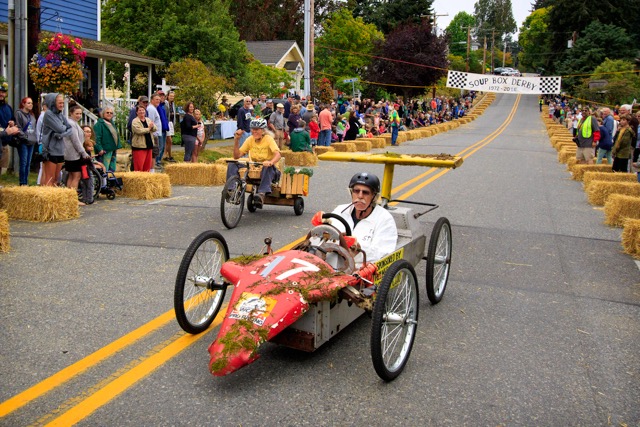
Hundreds of Whidbey Islanders and visitors welcomed a break in the recent heat spell by turning out for Langley’s 2016 Soup Box Derby on Sunday, August 21. The fun-run, which featured close to 30 “vehicles” this year, is put on by the Langley Community Club.
After registration and a quality-assurance check, completed by a run down the hill for each entry to assure braking and safety of the tricked-out barrels, boats and pontoons, the racers towed their craft back up First Street hill and paired off for the first of many two-by-two races.
Chris Spencer adorned his vehicle with a fearsome papier mâché triceratops and a pteradactyl that hoovered over the stern.“BeYouTiFul” returned this year, with cosmetic enhancements to the stinger-end.The Karate Kid, aged six and a half, was the youngest driver.Peter Lawlor, aged 95, gets a happy send-off from family and friends as he begins his practice run.A four-wheeled tandem racer, with a concrete block counterweight extending over the front-end, speeds by the crowd in front of Music for the Eyes.A street luge with handbrakes crosses the finish line first and exits the course.Phil Simon, with aerodynamic advantages, easily beat Cary Peterson in her vegetable cart.Gary Piper gives an enthusiastic thumbs-up to a competitor from 2nd Street Boutique.Boatwright Brad Price lost control of his speed pontoon racer and crashed. The announcer proclaimed: “We told you this could happen, do not sit on the hay bales!” Fortunately there were no injuries, and Brad only suffered a blow to his pride.Peter Lawlor’s girlfriend, Roberta Brown, is glad Peter will be back next year.Will Collins awarded gold medals to the intrepid participants. He said he enjoyed making the whimsical trophies with other Langley Community Club members at The Commons, using materials donated by Good Cheer.A few of the winning racers pick out their trophies.
After the final three-way heat, the crowd moved to Whale Bell Park for a pie-in-the-face fundraiser to benefit Good Cheer, Meals on Wheels and the Generation Park Improvement project. Paul Sarkis winds up to deliver a cream pie to his son Charlie.
David Welton is a retired physician and staff photographer for Whidbey Life Magazine.
WLM stories and blogs are copyrighted and all rights are reserved. Linking is permitted. To request permission to use or reprint content from this site, email info@whidbeylifemagazine.org.
South Whidbey Island will be rocking with peace, love, music and dance from many World Cultures on Saturday, August 20, 2016, 4 – 10 PM in a beautiful outdoor setting at Whidstock Ranch, 971 Sandy Point Road, Langley, WA. The Northwest Language and Cultural Center has been bringing people together to share in each other’s cultural traditions and foster greater understanding and appreciation of diversity since 1996. Join in the celebration at this enriching event that will be an opportunity to learn, share and make new friends while taking in music and dance from Turkey, Japan, India, Africa, China and more. A variety of ethnic street food from Africa to South America will be offered, as well as cool beers and delicious wines. Special children’s activities will keep them entertained and learning crafts and games from different cultures. There will also be a small Bazaar tent with handwork for sale from various continents around world. The intimate setting, rich cultural offerings and high intentions to do our part – to bring more tolerance and intercultural understanding – will be sure to create a one-of-a-kind event and fill hearts with love and understanding for our fellow man, which is exactly what the world needs now!
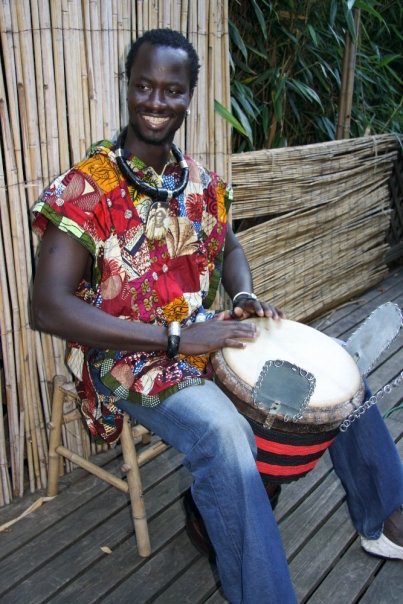
The program will featureThione Diop Drum Ensemble with Sumayya Diop performing West African drumming and dance. Thione is widely recognized for his powerfully expressive Djembe performances. He is descended from an ancestral line of Griot drummers in Senegal, West Africa, and is a master of the djembe, sabar, tama, and djun djun thrilling audiences across the world. Sumayya Diop is trained by the “Jali” (traditional storytellers) in African dance and has been dancing, drumming and singing with youth and adults in the Seattle area for more than 10 years. The program will also showcase members of the Anadolu Turkish Folk Dancers,the Japanese Sound Singers, the Bollyworks Dancers from India, Melody Xie Chinese Dancers, and much, much more in a 6-hour kaleidoscope of international music, dance, food, merriment and sharing!
Tickets are $20 per person presale, $30 at the door. Children 12 and under are free. Buy your ticket today!
All proceeds support the NWLACC Global Cultures Youth programs for Kindergarten through Middle School in partnership with SW Schools District.
The Northwest Language and Cultural Center is dedicated to inspiring intercultural awareness and understanding so that each person contributes to a more peaceful and harmonious global community now. Because cross-cultural understanding can’t wait!
Three days of free live music on two stages, thousands of attendees every Labor Day weekend for five years, and six scholarships annually to local students, have kept organizers hopping at the Oak Harbor Music Festival.
The Festival, named by readers of Whidbey News Group as Whidbey’s Best Event or Festival, is headed by Cynthia Mason, President of the all-volunteer board.
Mason says, “Our community has been amazing in the way it’s come out every year to support this event. The bands love the venue so much we’re getting far more acts inquiring about coming here to our beautiful town than we can handle, even in three solid days of music on two stages. And our coordinators for behind the scenes operations, beer and wine garden, and merchandise/information booths are still looking for volunteers to help out. It takes a huge amount of work to put this festival together, but it’s all worth it when we see the smiles and love on the faces in the crowd. Plus, we get to hand out thousands of dollars to deserving students from the island when it’s all over.”
Mason encourages citizens who want to help out the festival to contact Gary Jandzinski, Operations Director, or Bill Walker, Beer and Wine Garden Director, through the festival’s web site or directly by email at info@oakharborfestival.org.
Oak Harbor Music Festival is a 501(c)3 non-profit organization whose mission includes providing scholarships to local graduating seniors. The festival is held Friday, Saturday, and Sunday every Labor Day weekend on Pioneer Way in Oak Harbor, WA. www.oakharborfestival.com


 Enjoy more articles in the print edition of Whidbey Life Magazine, which you can purchase at