To learn more about Whidbey’s 4-H youth and their animals, pick up a copy of the 2018 Spring/Summer print issue, available at retail locations on the island.


All photographs by Marcia Wesley and Marsha Morgan.

To learn more about Whidbey’s 4-H youth and their animals, pick up a copy of the 2018 Spring/Summer print issue, available at retail locations on the island.
All photographs by Marcia Wesley and Marsha Morgan.
This article is from the Spring/Summer print issue of Whidbey Life Magazine. You can find out where to get a copy of your own at the end of the article.
BY HARRY ANDERSON
Whidbey Life Magazine Contributor
August 9, 2017
On Whidbey Island, we’re outnumbered; there are more domesticated animals than humans. That includes horses, cattle, goats, sheep, alpacas, and llamas as well as dogs, cats, parrots, parakeets, turkeys, and chickens. Given the island’s rural-agricultural heritage, and the passion of many new arrivals to live the “island dream” on a few acres with trees and a pasture, that should come as no surprise. Nobody keeps an exact tally, but that animal-to-people ratio is likely to grow—as will the need for healthcare for all those critters.
Whidbey has a dozen or so veterinarians who attend to our feline, canine, and feathered pets. But who takes care of the bigger ones? Only a small number of vets have that specialty, and they have some unusual stories to tell.

Dr. Ken Leisher, who has practiced on Whidbey for 20 years, recalls the time he was asked to help get an upside-down horse out of an old bathtub. The tub had been used as a water trough in a pasture. Somehow, the horse stumbled and flipped into the tub. “We managed to pull it out and get it back on its feet,” Dr. Leisher says. “It had some minor injuries but nothing serious. All in a day’s work.”
Dr. Robert Moody, a Central Whidbey large animal vet since 2002, was called to a wet pasture in Maxwelton Valley, where several cows had become stuck in deep mud. “We got some rope and pulled them out. Almost like towing stuck cars,” he says.
Dr. Sandi Farris, who arrived on Whidbey in 2011 after practicing for more than a decade in Alaska (and also participating in the annual Iditarod dogsled race there), took care of a pet goat on Whidbey whose rear foot had been accidentally stepped on and crushed by its “best friend,” a horse. “I had to amputate the foot above the ankle, but the goat’s adjusted to it and is doing fine,” she says.

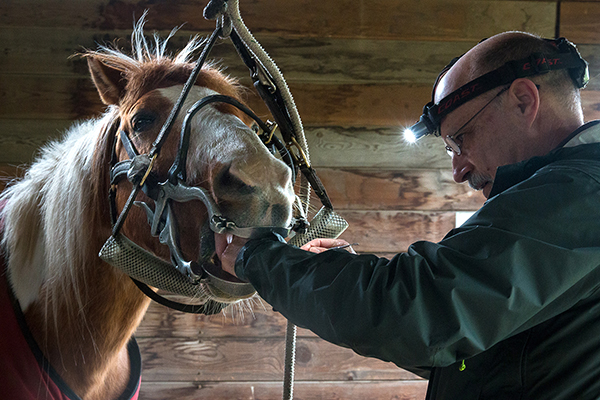
Of course, those are the rare “war stories” usually told to a rapt listener over a cup of coffee. Most of the work done by big animal vets on Whidbey is much more predictable. Annual check-ups. Vaccinations. Dental care. Hoof treatment. Antibiotics and other medications for parasites, respiratory problems, and abdominal pain. Remedies for cuts and bruises. Birthing problems. Euthanasia. The list goes on.
Unlike small animal vets, the ones who treat big animals must go where their patients are, not the other way around. They need to bring virtually all their equipment and medications with them. Leisher, Moody, and Farris—Whidbey’s “Large Animal Big Three”—all arrive in large, well-equipped vehicles that carry portable X-ray and ultrasound machines as well as bandages, syringes, medications, and even power tools for grinding teeth. Only complicated cases that might require surgery or other advanced treatments are handled in their “offices”—barns designed to provide a sterile environment.
Moody, Farris, and Leisher all have barn offices in Central Whidbey, which is convenient for owners who must transport sick large animals that may weigh 1,500 pounds or more. Moody operates Central Whidbey Veterinarian Services, Farris operates Harmony Veterinarian Services, and Leisher is associated with Mount Vernon Veterinary Hospital, although his practice is primarily on Whidbey Island.

One drizzly morning last winter, Moody was called to a Central Whidbey farm, where Summer, a 13-year-old mare, had been experiencing respiratory problems. As a result, she was in a cranky mood and didn’t much like it when the vet tried to take her temperature and listen to her heart and lungs with his stethoscope. She jerked the reins sharply, which momentarily knocked the vet off his feet and down into the mud. His jeans were dirty, but other than his pride, he was unhurt.
The diagnosis was horse “heaves,” a common allergy-based condition similar to asthma in humans and usually caused by breathing dust or other particles in the air. The treatment was a steroid shot, a bronchial dilator medication, and an antibiotic. Moody wrote up the diagnosis, treatment plan, and bill for his services on the laptop in his pickup, printed it out on the printer behind the passenger seat, talked with the owner, and then headed out to his next appointment.
A century or more ago, most of the big animals on Whidbey were dairy cows, oxen, and workhorses. No more. There are no cattle dairies left; there is one producing goat’s milk in North Whidbey and one producing sheep’s milk in Clinton. According to a recent Whidbey Island Conservation District survey, only three farms on the island still have 100 or more head of cattle. A few have 100 or more head of sheep, and one has 100 or more hogs. To be sure, there are still lots of farmers with smaller herds, but large-scale livestock production on Whidbey has dropped significantly in the past few decades.

As a result, the vast majority of patients treated these days by big animal vets on Whidbey are horses. All three doctors said horses represent at least 80 percent of their business. Farmers who still raise cattle, sheep, hogs, and other animals for sale generally don’t need to call a vet unless an emergency develops. The farmers typically handle things like birthing, vaccinations, and simple disease treatments themselves.
Not so with horses. According to the vets, the typical horse owner on Whidbey is a middle-aged woman. “They tend to be women who are done with their careers. Their kids are grown up. They have the economic resources to buy a horse and learn to ride, or re-learn what they loved to do as a girl,” Farris says. Today’s island horse owners often move here to begin such a “second act” in life. They may buy a few acres, acquire one to five horses, and then quickly come to understand just how much is involved. They typically treat their horse like a new child, and they may call their vets about every sneeze or symptom.
In that respect, Whidbey is different from many rural, traditional horse-owning areas. Leisher practiced in Yakima for 12 years before coming to the island. “There is more of a ‘cowboy’ culture there. People have been around horses for many years or maybe their entire lives,” he said. “There are fewer ‘newbies’ and more longtime owners who tell me, ‘Don’t worry about that, doc’.”

Educating horse owners about how to care for their animals is an important part of a day’s work for the vets here.
Jerry and Connie Lloyd were “newbies” more than a decade ago when they moved to their seven and a half-acre property near Greenbank. Today, their hobby has grown to include four horses, a beautiful pasture area with graveled paddock, a manure composting area, and even a covered arena for riding and training. They have become popular mentors for new horse people on the island.
The first thing prospective owners have to learn is how to manage their land, especially the mud that comes in winter and can be harmful, the Lloyds observe. “They need to take the time to talk with the Conservation District and others to figure out drainage and other issues, and then come up with a farm plan,” Jerry Lloyd says. “My advice is to buy a nice piece of property that’s fairly flat and has the potential for pasture, and also has a house you like or can remodel.”
And they need to understand two important things, he says. First, keeping a horse costs about $2,500 a year not counting surprises like illness or injuries. Second, one horse will produce eight or more tons of manure per year, and you have to know what to do with it.
Despite the drawbacks and expense, keeping big animals as beloved pets isn’t holding back people on Whidbey. Christine Williams, a retired university researcher who holds a veterinary degree from her native Great Britain but never practiced, retired to South Whidbey a dozen years ago. She currently keeps 25 sheep ewes on her property, but not for wool or meat. “They’re my lawnmowers,” she says with a laugh. She often mentors others who need help tending their adopted sheep, goats, and other animals.
“People who get into gentleman farming with sheep, goats, or horses learn quickly that they can spend a lot of time and money,” she says. “You’ve got no time for that quiet cabin in the woods. No money for a boat. You can’t take that long cruise or even go to a movie without a ‘sitter.’ But the good news is, you won’t have to buy many nice new clothes. Old, worn farm duds are all you end up wearing.”
Harry Anderson spent his 40-year career in journalism and corporate public relations. He worked for the Los Angeles Times, Paramount Pictures, and Tenet Healthcare. Today, he gardens and writes for the sheer joy of it for the Whidbey Examiner and Whidbey Life Magazine.
Marcia Wesley lives in Freeland with her husband and Bernese Mountain dog. When she is not working in Redmond as a psychologist, she is pursuing her other passion, photography.
__________________
 To enjoy more articles from the print issue of Whidbey Life Magazine, purchase a copy at local and off-island retailers or receive it in the mail via subscription.
WLM stories and blogs are copyrighted and all rights are reserved. You may link to this story. To request permission to use or reprint content from this site, please contact us.
This article is from the Spring/Summer print issue of Whidbey Life Magazine. You can find out where to get a copy of your own at the end of the article.
BY SHAWN BERIT
Whidbey Life Magazine Contributor
August 2, 2017
There is a place on Whidbey Island whose very name evokes opposing images: rustic and elegant, tranquil and stimulating, delicate and forceful. From this place, one can see the Olympic Mountains, the Strait of Juan de Fuca, and a landscape of pines and prairies. Some consider this one place to be the essence of Whidbey Island. This place is Lavender Wind Farm.

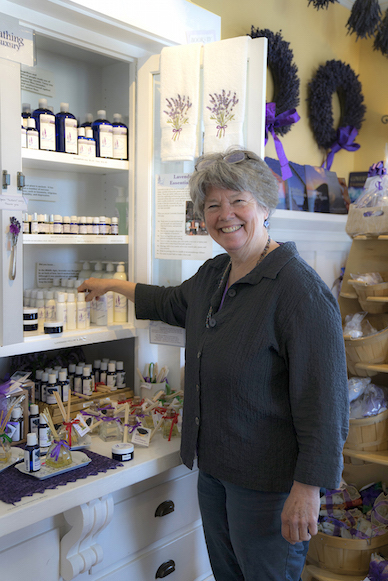
The farm shop and café in Coupeville is where the unique art and craft of owner and farmer Sarah Richards is fully displayed. Shelves hold an assortment of lavender products: soaps, hand creams, bath salts, essential oils, shampoo—and a natural cleaner, a byproduct of the distilling process. Less expected are culinary lavenders and delicious baked goods that can be enjoyed in the café. (The scones are outstanding.)
Sarah Richards’ story begins on a windswept island of rocky beaches, beautiful villages, and summer tourists. Much as this describes Whidbey, it is almost as far away from the island as one can get and still be in the continental United States. Richards grew up on Martha’s Vineyard. The experience of living there, a place with few public beaches, would directly influence her future choices.

After stints in France and Oregon, Richards went searching for the home that had somehow eluded her. During a visit to Port Angeles, she discovered Whidbey Island. Like so many who call the island home, and so many who return to visit again and again, the island called to her.
In 1998, Richards purchased a five-acre farm within the Ebey’s Landing National Historical Reserve. The memory of the private beaches of Martha’s Vineyard compelled her to create a place that could be shared with the public. The beauty of her new farm reinforced that vision. “Lavender and sharing grew into the farm,” she recalls.

Why lavender? “It was an accident,” Richards says with a laugh. While searching for a crop that would do well during the dry summers of Whidbey but be able to survive its damp winters, she learned that lavender could do both.
Lavender is native to the Mediterranean, parts of Africa, southwest Asia, and southeast India. It’s found on farms throughout France, where it’s used in the perfume industry. There are 47 known species of lavender (a member of the mint family) and hundreds of cultivars. While most humans love lavender, most animals do not. In fact, it repels deer, rabbits, and other grazers. Lavender thrives in sandy, well-drained soil with full sun exposure. The middle of Whidbey Island is the perfect climate for this lovely plant.

Though passionate about starting a lavender farm, Richards had no background in farming. According to her, “learning how to farm and then to sell the crop” were among her biggest challenges. Yet, in typical Whidbey Island style, she found help from her fellow farmers. She opened the farm in 2000. Since then, her crop size has increased, but not beyond what is manageable. Richards says she “always wanted to keep it at a human scale.”
Today, Lavender Wind Farm is a summer destination and a favorite place for photographers and painters. During blooming season, visitors delight in a waving sea of purple. The Olympic Mountains and the Strait of Juan de Fuca make a postcard backdrop as winds come in off the Sound carrying the scent of lavender.

Throughout the summer, visitors enjoy the lavender labyrinth, you-pick areas, picnicking, and views, as well as the chance to observe the distilling process used to capture lavender’s essential oils. Many also enjoy the opportunity to stroll the grounds: gazebo, ponds, flower gardens, scenery, and fields. Over the years, Lavender Wind Farm has played host to a variety of events, and this year is no exception. A Saturday afternoon concert series is planned for the summer season.
Richards counts as one of her greatest achievements the opening of the store and café in Coupeville, describing it as “a center of happiness.”

In 2012, Richards and her team purchased a 1916 Craftsman house in the historic waterfront district for the purpose of opening a shop. Only a block off Front Street, the shop has become an extension of the farm. Coupeville residents were delighted by the restoration of both house and property. Several people have come into the store who used to work at a previous business located there or who lived in the house years ago. “We are a part of the story of the house,” Richards says.
All those who visit Lavender Wind Farm, whether at the farm or the Coupeville store, are also a part of that story. Richards says, “The relationship between us and the customers and fans is the source of inspiration for what we do.”

The shop at the corner of Coveland and Alexander streets in Coupeville is open year-round. The farm, located northwest of Coupeville at 2530 Darst Road, is open during the summer.
Stop in to meet Sarah Richards and her team for a breath of fresh air—and a gust of lavender wind.
For hours, directions, and a schedule of events, visit the Lavender Wind Farm website.
Shawn Berit lives near Maxwelton Beach on the south end of Whidbey Island. He freelances as a social media manager and marketing consultant for churches and spiritual groups, organizations, artists and musicians, and occasionally small businesses. He is a father of three and an all-around creative. Berit is a painter and drawer (acrylics and pastels) of mystical scenery, story illustrations, and science fiction concept art; a nature photographer; a vocalist wanting to start a band; a science fiction writer working on his first novel; and a television and voice-over actor wishing the island had a radio station. Follow him and learn more on Facebook.
__________________
To enjoy more articles from the print issue of Whidbey Life Magazine, purchase a copy at local and off-island retailers or receive it in the mail via subscription.
WLM stories and blogs are copyrighted and all rights are reserved. You may link to this story. To request permission to use or reprint content from this site, please contact us.

BY KATE POSS
Whidbey Life Magazine Contributor
July 19, 2017
Like classic cars, two-cylinder John Deere tractors hold their appeal, and men with farming blood running through their veins, such as Bob Engle, collect them. Engle’s family farm on Fort Casey Road dates back to the 1850s, when his ancestors arrived to claim land as part of the Oregon Donation Land Claim Act.

The Cascade Two-Cylinder Club (C2CC) approached Engle and asked him to hold a rally at his family farm. The club serves nearly 200 members throughout the northern part of the state, including Lynden, Sedro Woolley, Anacortes, Bow, and Whidbey Island. The nonprofit club, formed in 1993, is made up of collectors who restore and preserve antique John Deere farm equipment and who gather throughout the year for parades, plow days, festivals, and tractor pulls.
C2CC is named for its dedication to preserving the legacy of two-cylinder John Deere tractors, which were built until 1960. Paul Hieb, president of C2CC, says it was the club’s first visit to Whidbey Island. He trailered his 425 Hi-Crop from his farm outside Sedro Woolley, where he still grows potatoes, cauliflower, and broccoli.

“Every year, we go somewhere,” he says. “We’ve gone to Lopez Island several years in a row … had to get on the ferry. I restore my own tractors. I still have a farm and use some of my John Deeres. It’s a great hobby.”
John Deere, a blacksmith, revolutionized the Midwestern farming world in 1837 by using a broken saw blade to create a self-scouring steel plow that the heavy clay soil of the prairie wouldn’t stick to. He went into production, and the company has since grown to become an international manufacturer of equipment used in agriculture, construction, forestry, and landscaping.

Between the late 1920s to 1960, the John Deere company built more than 1.25 million two-cylinder tractors that were sized for the needs of small family farms. Then the industrializing of agriculture called for larger equipment, and two-cylinder tractors gave way to four-, six-, and eight-cylinder tractors, as well as turbo-powered machines.
C2CC member Aldon Boon owns two two-cylinder John Deeres and co-owns a third with his son Zach who owns another on his own. The Boon family ran a dairy and chicken farm in Oak Harbor for years until they sold the property in 1999. Like Bob Engle, Aldon Boon never got tractors out of his blood.

“When we were married in 1979, we milked 300 cows a day,” says Corinne Boon, who married Aldon right after high school. For Aldon’s 50th birthday, she bought him a 1940 John Deere tractor, which he restored to pristine condition. Now, living in the suburbs of Oak Harbor, Aldon, who works for the City of Oak Harbor, keeps his pristine collection housed in sheds and takes them out for club events.
Zach Boon drove one of the tractors as part of the parade, towing an antique wagon on which his wife Miranda and baby daughter Anabeth sat. Corinne rode in the wagon, too, with her good friend Amy Hauser and their pair of smooth collie dogs, who lifted their noses at the scents that rolled by. Along the way, visitors stood on the side of the road and waved at the spectacle.

Corinne says that another of their four sons works on a large-scale dairy farm in Arizona, which milks 10,000 cows daily. Ironic, she mused, that big operations, such as the one where her son works, are the ones that put the family farms owned by her parents and the Boons out of business.
Loren Dahl, C2CC vice president, reminisced about the simpler days of easy-to-fix two-cylinder tractors, which he used when he farmed for years in the Skagit Valley raising beef cattle and growing hay. He pulled out his phone and proudly showed photos of old potato harvesters he collected that looked like pole diggers. Then he scrolled to a photo of a red monster machine that his son drives to harvest potatoes all at once and shook his head at how times are changing.

He jokes that he now has five tractors for his five acres in Bow, but the truth is, he enjoys tinkering with and polishing the old gals. Dahl talked with photographer David Welton, who had recently lusted after a 1947 John Deere Model M, parked beside a barn near the Maxwelton Slough. Welton fantasized about restoring the tractor, which was listed for sale at $1,400. But Dahl warned him that restoration costs would be expensive: “Most people think they will economize by doing the job themselves, but they always learn that it’s easier and cheaper in the long run just to buy the finished product.”
Heib weighed in on the conversation, saying he buys old junker tractors and scavenges their parts to keep his collection of beauties up and running.

After club members drove their tractors in a parade around the Ebey’s Landing Historic Reserve, they gathered for lunch and talked good-naturedly while balancing their paper plates piled high with ham, baked beans, and potato salad. Then they headed out for another tour, this time to the Sunnyside Cemetery, which would have delighted many of the old farmers buried there who once used tractors just like them to till the prairie.
Kate Poss worked as a library assistant at the Langley and Coupeville libraries before retiring last year. She worked for three summers as a chef aboard a small Alaskan tour boat from 2008 to 2010. Poss was a newspaper reporter in Los Angeles for many years before moving to Whidbey Island where she likes cooking for new and old friends, hiking, reading great fiction, and writing her second novel with friend Fred Bixby.
David Welton is a retired physician who has been a staff photographer for Whidbey Life Magazine since its early days. His work has also appeared in museums, art galleries, newspapers, regional and national magazines, books, nonprofit publicity, and on the back of the Whidbey Sea-Tac Shuttle!

__________________
Enjoy more articles in the print edition of Whidbey Life Magazine, which you can purchase at local and off-island retailers or receive in the mail via subscription.
WLM stories and blogs are copyrighted and all rights are reserved. You may link to this story. To request permission to use or reprint content from this site, please contact us.