With its beaches, inland lakes, and shoreline access, Whidbey Island offers numerous opportunities for water recreation. Whether you prefer skim boarding, swimming, diving, kite surfing, kite boarding, paddle boarding, rowing, kayaking, or sailing, Whidbey is a water lover’s paradise where you’ll find your favorite way to float.
Mystic Sea Charters
719 28th Street, Suite B
Anacortes, WA 98221
Toll Free: 1 (800) 308-9387
Local: (360) 588-8000 mysticseacharters.com
Langley Marina
South Whidbey Harbor at Langley
228 Wharf Street
Langley, WA 98260
360-221-1120 portofsouthwhidbey.com
Photo courtesy of Whidbey Island Kayaking.
Oak Harbor North Puget Sound Dragon Boat Club
North Puget Sound Dragon Boat Club
1401 SE Catalina Drive (location)
P.O. Box 907 (mail)
Oak Harbor, WA 98277
Schooner Suva
Coupeville Maritime Heritage Foundation
PO Box 532
Coupeville, WA 98239
Email: suva.schedule@gmail.com
360-320-4337 schoonersuva.org
South Whidbey Parks and Recreation
5475 Maxwelton Rd
Langley, WA 92360
360.221.5484 swparks.org
Photo by Marcia Wesley
South Whidbey Yacht Club
PO Box 316
Greenbank WA 98253 swyachtclub.org
Urban Surf
2100 N Northlake Way
Seattle, WA 98103
UrbanSurfKiteSchool@gmail.com
Whidbey and Camano Islands Tourism
Island County Tourism Committee
P.O. Box 365
Coupeville, WA 98239
Whidbey Island Dive Center
1020 NE 7th Av. Suite #1
Oak Harbor, WA 98277
Phone: (360)-675-1112
info@whidbeydive.com
Photo by Marcia Wesley
Whidbey Island Kayaking
360 221-0229 or 800 233-4319
info@whidbeyislandkayaking.com
Whidbey Island Skimboards Everywhere
kayonaze@yahoo.com
Facebook page for messages
BY KATE POSS
Whidbey Life Magazine Contributor
July 12, 2017
Start the day with a cup of coffee and drewslist, and it could turn out much different than you expected. You might find an event or class you want to attend, snag a replacement for a lawnmower that just died, score a deal on a used car, get a new job, or find your lost cat.
Drew Kampion launched the eponymous service in 2009 with a little more than 150 names. Today, drewslist is delivered via email six days a week to more than 6,750 subscribers and has knitted together a uniquely tailored community. It’s the resource that realtors recommend their clients subscribe to as soon as they move to South Whidbey.
Drew Kampion with some of the books he’s written. (Photo by David Welton)
Those who sell items are asked to donate five or ten percent of the amount they receive, but it’s an honor system, and some folks are “honorably dishonorable,” says Kampion. Even though some don’t pay their way, Kampion’s perspective remains upbeat, as noted at the end of each of his messages: “Life is a wave. Your attitude is your surfboard. Stay stoked & aim for the light!”
A former editor of surfing, windsurfing, and New Age magazines, author of eight books (with more in the works), and former publisher and founder of the Island Independent newspaper, Kampion has worked in journalism and publishing for nearly 50 years. These days, he works six days a week in partnership with his son Alex, who lives in Finland.
Drew Kampion in 1968 as editor of Surfer Magazine. (Photo courtesy of Drew Kampion)
“There are very few people on this island that compare to Drew,” says Jerry Millhon, co-creator of Thriving Communities. “His unique perspective is sublimely integrated within drewslist. The man is still surfing, still looking for the big one to ride, and taking us with him. He is a bright light of connectivity on Whidbey Island.”
Surfing shaped Kampion’s life from the time he was a teen. While he doesn’t surf as much as he would like to these days, he joined in a memorial paddle in Santa Cruz on July 8 for legendary surfer Jack O’Neill, who died at the age of 94 last month. Kampion’s 2011 book “Jack O’Neill: It’s Always Summer on the Inside,” documents the life of one of the world’s most renowned surfers, one credited with creating the wetsuit and expanding surfing internationally.
Kampion at Cotton’s Point circa 1968. (Photo courtesy of Drew Kampion)
Another significant voice in the surfing world was publisher John Severson, a friend and mentor of Kampion’s, who founded Surfer Magazine in 1960. Kampion started as an associate editor in 1968 and was promoted to editor after three weeks. Severson’s home in San Clemente was next door to some fine surfing at Cotton’s Point, Kampion recalls. Unfortunately, the sweet days of catching waves were complicated when Richard Nixon moved in next door with his security posse.
Kampion was born in 1944 and grew up in Buffalo, New York, far from the surfing scene. His dad found work with Lockheed and moved to California, where the family lived in Burbank for a while. Kampion was “anti-surfer” until he started dating a girl who liked the sport, which led to his buying his own Dave Sweet surfboard (Sweet is credited with pioneering polyurethane surfboards, which helped revolutionize the sport and culture in the late 1950s).
“I rode my first wave in Malibu in ’62,” Kampion recalls, saying the guy who sold him the surfboard taught him to how to look at the ocean and its waves, its rhythm, and its sets. “It was an honor to get pushed off the board by surfing gods like Miki Dora.”
Kampion’s work in surf publishing took him on beats covering surfing championships in Australia and Hawaii. He married in 1978, and he and his wife Susan had two children, Alex and Alana, who began their education in Waldorf schools in Southern California. In the early nineties, he and his family moved to Whidbey and became involved in the Whidbey Island Waldorf School community.
Kampion interviewing Robby Naish, the greatest windsurfer of all time, circa 1985 (Photo courtesy of Drew Kampion)
While riding the Ferris wheel at the county fair that first summer of ‘91, Kampion viewed Camano Island and learned it was the other significant part of Island County. He was struck with the notion of creating a newspaper that connected local island communities. The fortnightly Island Independent was born and served Whatcom, Skagit, and Island counties, Anacortes, the San Juans, and Port Townsend. One of the paper’s regular contributors was Jim Freeman, who is known as “the conductor of fun,” and an emcee of poetry slams.
Freeman said it was Don Zontine, one of the early founders of the Whidbey Island Waldorf School, who networked the cast and crew of the Island Independent together when it began. “Don knew all the locals,” Freeman says. “Drew, Chris Crotty, G. Armour Van Horn, Chris Adams, Lorinda Kay, and I were in there.”
The Island Independent was first published on April Fools’ Day in 1993 and ended its run on the last day of March in 1996 – three years to the second. “Computers were younger then, and there were issues,” says Kampion. “Our intrepid ad man and business manager, Chris Adams, suffered a series of hard-drive wipeouts that simply took the wind out of our sales. We were doing well, otherwise, until an attempt to go from a free to a $1-a-month publication failed. A buck, it seems, was just too high a price to pay.”
The creation of the Island Independent was inspired by a ride on the Ferris wheel at the county fair. (Photo by David Welton)
Elliott Menashe, who promotes working with nature by saving old-growth forests and using natural shoreline buffers, says, “He teaches by example. He inspires. Drew has a far-reaching feeling for phenomena and a childlike sense of wonderment. His curiosity is boundless. Drew is without pretension or artifice and has an utterly unique ‘elationship’ with the universe. He actually likes people.”
One of the criticisms of drewslist is that it’s overwhelming: Up to thirteen email messages could land in your inbox around 4 a.m. each morning, with subjects such as “For sale, wanted, and free,” “Art, artists, and galleries,” and “Boats, kayaks, and other hulls.”
To the often-voiced refrain that there are more categories than an individual may want to read, Kampion says, “I run all the listings because there is a synergizing effect of the email. I don’t want to lose the (community’s) incentive to participate. People will see what they want to see.” Kampion adds that a long-neglected web page exists and invites a volunteer webmaster to step in and update it.
Drewslist is a ‘reboot’ of the Island Independent, Kampion says. “As the website develops further, it will allow us to truncate the daily emails, which should be far less irritating to fraught islanders.” Ever since the paper folded, he has looked for ways to revive its spirit, and drewslist is the closest he’s come to replicating it.
“All I know is that Drew has been in the forefront of creating community on Whidbey for years,” says Kampion’s long-time friend and hometown hero Nancy Waddell. “I still have my “Island Independent” t-shirt and loved the paper; now drewslist brings us together in so many different ways. It’s the go-to place to find almost anything here! He had an idea and brought it to life.”
Christine Tasseff, owner of Roots Landscaping, says, “It has been my great fortune to have Drew as a central player in my human family. He is brother, father, and friend, and fills each of these with infinite generosity of spirit. Drew is a weaver, binding threads of heart and culture and humanity in all he does. He works to connect us, unite us, and always to wake us up!”
To subscribe to drewslist, email drewslist@whidbey.com and ask to be added. To learn more about Kampion and his world, visit his website.
Drew signs off each email message with “Life is a wave. Your attitude is your surfboard. Stay stoked & aim for the light.” (Photo by David Welton)
Kate Poss worked as a library assistant at the Langley and Coupeville libraries before retiring last year. She worked for three summers as a chef aboard a small Alaskan tour boat from 2008 to 2010. Poss was a newspaper reporter in Los Angeles for many years before moving to Whidbey, Island where she likes cooking for new and old friends, hiking, reading great fiction, and writing her second novel with friend Fred Bixby.
David Welton is a retired physician who has been a staff photographer for Whidbey Life Magazine since its early days. His work has also appeared in museums, art galleries, newspapers, regional and national magazines, books, nonprofit publicity, and on the back of the Whidbey Sea-Tac Shuttle!
Enjoy more articles in the print edition of Whidbey Life Magazine, which you can purchase at local and off-island retailers or receive in the mail via subscription.
WLM stories and blogs are copyrighted and all rights are reserved. You may link to this story. To request permission to use or reprint content from this site, please contact us.
BY MARK FORMAN
Whidbey Life Magazine Contributor
July 5, 2017
Regardless of your political or cultural orientation, it’s hard to overlook the fact that our country is in the midst of almost unprecedented polarization. Heather Johnson has been wrestling with that challenge. As the executive director of the Whidbey Institute, she says, “It’s difficult to maintain equilibrium with the intensity of vitriol at every level of society.” Johnson addresses this polarization by striving to hold a larger perspective. For her, the question is: “How do we grow our capacity to respond? How do we mature ourselves to become people who can see and understand things differently?”
A graduate of Pacific Integral’s Generating Transformative Change leadership program, Johnson also has a bachelor’s degree in finance. This breadth of background and skills is well-suited to a position that demands pragmatic, as well as visionary, talents. In fact, even as she applies herself to the tough work of leading an organization that aspires to nurture community at a time when so many of us seem to be talking past one another, a major part of her focus is on a capital campaign that seeks to add significant new housing to the institute and support other key initiatives.
Later this month, on July 22, a groundbreaking ceremony will officially kick off the first phase of the housing portion of the campaign. That’s the pragmatic part of Johnson’s contribution to the stewardship of the institute. The visionary component, though, is guided by her desire to shift the frames through which we navigate our social conflict. She says she’d like to encourage people to “step back from saying ‘we’re failing to do this right’ and rather to ask ‘what are possible deeper purposes for all of this?’”
Heather Johnson speaking at the Whidbey Institute (Photo courtesy of the Whidbey Institute)
She adds, “I don’t proclaim to know what those purposes are. I do know that we have a lot of learning, a lot of growth to do. And we’re being presented—in really big ways—with the deep chasms between who we are as human beings now and who we’re being called to become.”
Johnson believes that we’re being asked to recognize that our development as human beings is ongoing: “Growing up” is an endless process. And that there is a simplicity on the other side of the complexity we feel ourselves swimming in; a simplicity that lives at the core of our inheritance of global wisdom traditions.
Through technology and the proliferation of media outlets, we inhabit worlds that are more and more insular. Because they’re filled with like-minded people, they can feed polarization. “There is a subtle pattern arising when ‘like-minded’ people come together, learn together, and find solace with one another,” Johnson says. “It can grow into a crusade mindset or the belief that the answer to the problem is to indoctrinate the other into the right shared ideology.”
Johnson participates in a creative exercise during a Salish Sea Bioneers Conference at the Whidbey Institute. (Photo courtesy of Whidbey Institute)
As executive director of an organization committed to catalyzing positive change, Johnson is sensitive to the potential traps that can lie in that work. One of her goals is to invite people beyond a mindset of “If they’d be different, we’d be OK, and the job—the positive change work—is for us, with our ‘right’ idea, to go and indoctrinate them with our right idea.”
At the heart of the Whidbey Institute campus is Thomas Berry Hall. Though the institute’s work is not about Berry’s teachings in particular, his work holds an important anchor for its focus. Thomas Berry was a Catholic priest, a cultural historian, and ecotheologian. One of his quotes has been a particular inspiration for Johnson: “The universe is a communion of subjects, not a collection of objects.”
To Johnson, the approach of indoctrinating others with the right idea represents a “collection-of-objects” mindset. As she puts it, “If we are trying to change the world in a positive way through engaging with others as objects to fix, we’re inherently in our own way.” This is a concern she expressed as early as August 2015, when she moved from program and associate director to executive director.
Johnson brings a group together by ringing the Chinook Bell in the Thomas Berry Hall Courtyard. (Photo by Mercia Moseley)
In an open letter to the Whidbey Institute community, she wrote about constructs, defining them as: “The meaning-making structures in which we are steeped—cultural, racial, religious, familial, generational—which allow us to see the world and our place in it in unique ways.” Although constructs are important for those reasons, she pointed to the risk that they “can also make us blind to perspectives beyond our own. We are all, to some degree, in over our heads, doing our best to navigate being human in a changing world.”
Johnson’s letter from two years ago has even greater relevance today. As she engages with people in a world that has become even more polarized since then, she sums up the challenges in an elegantly simple way. “It’s about how do we do this together, how do we actually recognize that, on this planet, we are all in this together—that it’s a reality, and then: How do we behave that way?”
Sarah Sullivan, left, carries her child alongside Johnson during a community event at the Whidbey Institute. (Photo courtesy of Whidbey Institute)
Tips for building bridges
Try on their perspective. When you feel yourself reacting to another, as difficult as it may be, try to imagine what it is like to live as them. What is it like to wake up as them in the morning? To live your days walking around in their reality? To face the challenges they face? To have the opportunities they have?
Listen for what others hold important. Behind the specifics of what others are expressing, be curious: What are the values that inform their position? What do they care about? And why?
Focus on what you share. What do you both hold dear? What motivates care and commitment in each of you?
Make a choice to build relationship. Particularly in this time, it can feel much more important to be right than to build relationship. Taking these steps asks us to make a choice to not turn the other into an object that needs to be corrected or protected against, but to see another as a human being, a person, with inherent dignity.
Mark Forman is a filmmaker and writer who moved to Whidbey Island with his wife Kathleen Secrest in 2015. Mark’s favorite projects include: “The King of the Hobos,” a film portrait of Steam Train Maury Graham, which aired on PBS at the beginning of Mark’s career; a promotional video for La Romita School of Art in the Umbrian region of Italy filmed in 2008; and a fund-raising video that he and Kathleen produced this fall as a donation to the Whidbey Institute.
Enjoy more articles in the print edition of Whidbey Life Magazine, which you can purchase at local and off-island retailers or receive in the mail via subscription.
WLM stories and blogs are copyrighted and all rights are reserved. You may link to this story. To request permission to use or reprint content from this site, please contact us.
BY CAMERON CASTLE Whidbey Life Magazine Contributor
May 24, 2017
Coming up the hill, as we neared the corner, I said, “Mom, wait till you see this. It’s so quiet. A dead-end street. You can’t really see the neighbors if there are any. So peaceful. We’re going to make an offer any ….” As we turned by the rickety mailboxes, we saw the strangest thing. Cars. I drove slowly down the tree-lined lane, and on either side of the road, there were parked cars. It looked like there could be a hundred of them.
My mom, in the back seat with her purse on her lap, said, “Hmmm, doesn’t seem very peaceful to me.”
“Laura? What the heck?” I asked. I was wracking my brain. “Is it an open house? Are we competing with hundreds of buyers? This is insane.”
I turned into the driveway between parked cars, past the gate, up the drive and parked. I got out and walked across the yard to the top of the hill. Next door, at a pond, were scores of people. Barbecue smoke was billowing. There was a tent. I, zombie-like, walked toward the crowd.
“Hi. Do you want a hot dog?” came from the cheeriest voice ever.
“Ah, no. Ah, what?”
“Why, it’s the fishing derby, silly. You don’t know about it?”
“No.”
“Every year at this time. A fishing derby. We give away bikes, have a barbecue. Loads of fun. Do you live there?”
“No. I mean, not yet. Hopefully. I was showing my family the quiet house we were going to buy.”
“Well, this must be a shock. Nope. Just once a year. Sure you don’t want a hot dog?”
Eight years later, another fishing derby. What a tradition! Albert and Lori Gabelein have been hosting this event for 27 years. It is supported by the Holmes Harbor Rod and Gun Club, which buys the many bikes that are given away as prizes.
“It’s just a worm, Dad.” The author shows off his fishing expertise. (Photo by David Welton.)
Every year, Albert has 800 teenage fish dropped into the pond. And every year, I hope to witness it. I hear a truck backing down the drive and jump to see if it’s the one sloshing with fish. One year, as I was pulling into our driveway, a flatbed truck with a large plastic tank on it was pulling out of the Gabelein’s driveway. I honked and waved, and the driver stopped.
“Thanks! Thanks so much. Really cool. Sorry I missed it. Have a great day.”
The driver gave me an odd look. Kind of a shy look. Fine. Not everybody is as outgoing as me.
He drove away. I parked, walked over, and I imagined I could see the new pond denizens swimming freely under the water. That’s when I saw them. Not the fish, but the two port-a-potties freshly delivered by that flatbed truck. Most likely the best reception that driver had ever experienced for delivering port-a-potties.
One year during the derby, I stood near a family: a mom, dad, and three boys. Two of the boys looked rather uncomfortably wet. “I have three sons, and two of them have fallen in,” said the mom. As she finished that sentence, boy three tripped, slipped and fell shoulder first into the pond.
Why one would fall into this pond rather than wade in is because it is configured with a sort of ledge. There are tall reeds, one giant, exotic, prehistoric-looking broad-leafed plant, and lots of huge, flat-topped rocks positioned around the water. Pretty. The rocks are great spots for dropping in or casting out one’s line. But what that also means is: If you are not careful, or are very young, or I reluctantly say, a member of the aforementioned family, you can fall in. And once in, getting out is sometimes a small challenge.
They give away new bikes to the kids for all sorts of best fish categories. It is so generous, and the looks on the faces of the winners are priceless.
Two happy winners. (Photo by David Welton)
One kid, though, was infamous among bike winners.
There was this rather feisty boy, an accomplished young fisherman, but he appeared to be the kind of student the principle might know by sight. He heard his name called as the winner of a new bike and was so excited. Vibrating sort of excited. He took off running. There is a slight rise from the pond up to where the barbecue tent, tables, and line of prize bikes are located.
The bike was proudly awarded, and he jumped on it. With glorious enthusiasm, he started peddling. Problem was that, added together, his enthusiasm, a natural cavalier attitude, pedaling, and … gravity, produced a result that is unforgettable.
It is a short downhill trip, and he was going fast. He and the bike, as they left the water’s edge, lofted into the air, very reminiscent of the scene in “E.T.” when the boy and bike appear as a silhouette before the moon. He landed tires-first onto the surface of the pond. Splash! Then nothing. Nothing but a cacophony of gasps, mixed with howls of laughter. Luckily the pond is not that deep. He was able to stand, lift the handlebars of his new bike out of the water, do a short walk/wade of shame to the edge of the pond, and struggle out.
I cannot remember if he got an ovation or not, but he deserved one. In my mind, enthusiasm and talent are way more important than not making a foolish decision. I am sure the bike was fine, and I am also sure that, in the next 20 or 30 years, he will forget all about the maiden voyage of his prize.
Living next door affords us the luxury of reaping the benefits of the fishing derby and the glorious pond year-round. So, fishing on that day is not a priority. But we always show up to marvel at the turnout and circle the pond to view the happiness. It is always such a pleasant and positive experience. For example, at nearly every derby, I have witnessed a five-year-old prematurely cast and hook his father’s ear, rather than a trout. The result was not cursing, but remarks like, “No, buddy. Here let me get this off my ear and we’ll try again. Wait till Daddy says ‘Go,’ next time, OK?”
What the fishing derby is all about. (Photo by David Welton.)
The carnage is sometimes a bit much. If one is a lover of all sacred life, seeing an eight-year-old holding a string of six dead fish and sporting a huge smile might be a tad unsettling. But fish just seem to get a bum deal in the human realm of compassion. How many vegetarians have you met who say, “Oh, well I do eat fish”?
There is a great children’s book, “Bear Wants More,” by Karma Wilson. In this book, Bear is very hungry, and his good friends help him find food. Lovely little adventure, and Bear’s animal pals impart a nice message about friendship. Unless you’re a fish.
In this story, Bear’s animal friends (a mouse, hare, badger, and raven) help Bear get some food. Together, they catch a trout. I was reading this and thought, “Why didn’t the trout say, while dangling from the hook, ‘Hey, what the heck? I’m an animal too. Eat that mouthy crow if you’re hungry!’”
“I know, I know. But you might win me a bike.” (Photo by David Welton.)
I asked Albert if there was something he wanted to say about this great event, something important that needed to be in the story. And he said, “Just, that it’s a chance for kids to catch their first fish.”
That sums it up perfectly. Simple and important. Because, and I don’t know why this is, but when a child pulls that first fish out of the water, the look on his or her face is always so special. A look of unbridled joy and great accomplishment. The size of the fish doesn’t matter in the least. I have a photo of my son Mason (who is now 30) when he was about five, holding a line with a dangling fish. The picture captures his rapturous joy, marveling at that fish, which had to be almost three full inches from head to tail.
My son Carter, eleven, joined the fun this year and expertly cast hooked worms into the pond from one of our favorite rock perches. He was a bit disappointed that he didn’t catch anything in the time we were there. Kids were pulling fish out of the water all around us. Two little girls, both from his brother’s second-grade class, kept running past us in tandem, each with a freshly snagged trout wiggling within their grasp. But I reminded Carter that it is a 40-yard walk from our property to the pond for another try.
Logan and Shiloh confirming it was a great day. (Photo by David Welton.)
While we were there, a bunch of bikes were doled out to squeals of joy. One boy even successfully raced his bike around a portion of the lake though his kickstand was down. I still don’t know how that is possible.
By all accounts, the day was a huge success. Again. Especially if one measures success by the number of big, beaming smiles on all the kids’ faces.
That weed was a real fighter. (Photo by David Welton.)
To view the photos below full-size, click them. All photos by David Welton.
[envira-gallery id=”44203″]
Cameron Castle is an author and a stay-at-home dad. His recently published memoir is entitled, “My Mother Is Crazier than Your Mother.” He lives on Whidbey Island.
David Welton is a retired physician who has been a staff photographer for Whidbey Life Magazine since its early days. His work has also appeared in museums, art galleries, newspapers, regional and national magazines, books, nonprofit publicity, and on the back of the Whidbey Sea-Tac shuttle!
__________________
Enjoy more articles in the print edition of Whidbey Life Magazine, which you can purchase at local and off-island retailers or receive in the mail via subscription.
WLM stories and blogs are copyrighted and all rights are reserved. You may link to this story. To request permission to use or reprint content from this site, please contact us.
BY KATE POSS
Whidbey Life Magazine Contributor
May 17, 2017
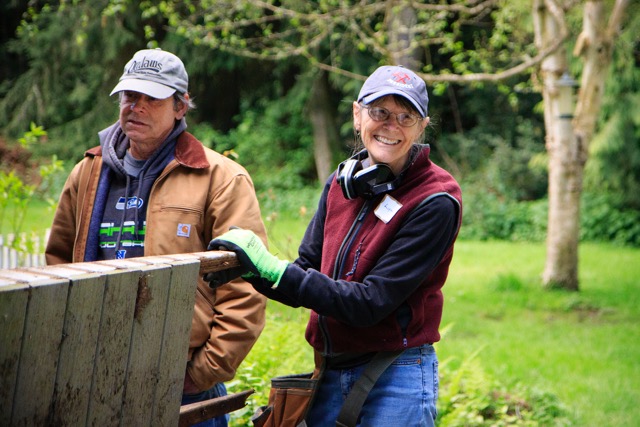
Although Hearts and Hammers is an event organized for Whidbey Islanders by Whidbey Islanders, this year’s event attracted volunteers from off the island.
Ahren Bader Jarvis drove up from downtown Seattle with his girlfriend Mary Pat Murphy to volunteer for the day. Hearts and Hammers helped him when he was a boy, living on Whidbey Island with his brother and single mom years ago. “Hearts and Hammers came to our house and helped us,” he says. “Now it comes full circle.”
Ahren Bader Jarvis and his girlfriend came from Seattle to volunteer. His mom received help from Hearts and Hammers when he was a boy, and he wanted to give back. (Photo by David Welton)
Seattle resident Beryl Fernandes learned about Hearts and Hammers last February, after attending a Thriving Communities conference at the Whidbey Institute. “I’m originally from Zanzibar, and we had this kind of community, which I miss living in Seattle,” she says. “I would love to see this model replicated.”
Hearts and Hammers began as a simple notion. Noticing that some women of her church needed help with house repair and gardening, Lynn Willeford, a self-described “serial starter-upper,” organized people to gather and help their neighbors. With initial sponsorship by the Langley United Methodist Church, Hearts and Hammers began as a pilot program in 1994 to help repair and rehabilitate homes for those who were either unable or couldn’t afford to do the work alone. The group is now a 501(c)3 nonprofit.
“It doesn’t take a whole lot of time or trouble to make someone happy,” Willeford says.
Organized like a military unit, including military titles, this year’s event was headed by a new “general,” Matthew Swett, who runs Taproot Architects.
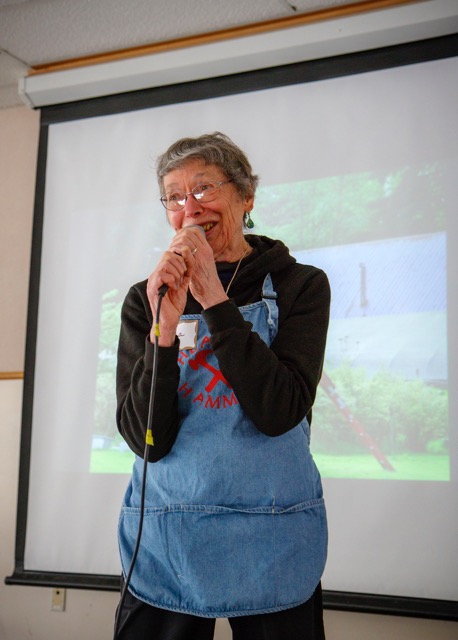
“We share the load — that’s the benefit of a team,” Swett said at the morning breakfast where volunteers gathered with their captains in the cafeteria of South Whidbey High School. A crowd of about 330 gathered to help out at 35 homes.
Sarah Birger, Hearts and Hammers president Baz Stevens, and Birger’s husband, “general” Matthew Swett, enjoy a moment before everyone heads out. (Photo by David Welton)
Joining the army of volunteers was Helen Price Johnson, an Island County commissioner. “We’ll be doing siding on a house,” she said. “I’ve been doing this every year. It helps to have a contractor (Dave Johnson) as a husband. This is a tremendous event.”
By 8:15 a.m., participants gathered outside for a group photo by David Welton before heading off to their assignments. Welton has photographed Hearts and Hammers for the past five years and now leads a team of photographers who help him document the day.
About 330 volunteers helped with home repair and gardening for the 24th annual Hearts and Hammers work day. (Photo by David Welton)
“By the time I get there, residents are so in love with their crew,” Welton says, describing the alchemy between those who give and those who receive. “The community is like a quilt involving different personalities stitched together by love and respect.”
I joined Welton for the day, which was filled with meeting people who volunteered their time and those who received much-needed help.
Mary and Clarence Conkey
Our first stop was in Freeland to meet Mary and Clarence Conkey, a couple that has been married 60 years. Their garden reflected Clarence’s artwork with handmade stepping stones, birdhouses, and whimsical mermaids. Mary is 87, Clarence is 92, and Mary says she doesn’t want Clarence up on ladders to trim the trees and bushes anymore. So a crew from Hearts and Hammers comes to the Conkey’s half-acre property, which overlooks Holmes Harbor, equipped with pruners and clippers.
“We love these people,” says Claudia Cox, team captain for the Conkey’s garden. “We’ve been coming here for four years.”
Mary Conkey leads a Hearts and Hammers volunteer over hand-made stepping stones made by her husband Clarence. (Photo by David Welton)
Margaret Schultz
Next was a visit to a log cabin in Freeland. Hearts and Hammers volunteers planned to make structural repairs for Margaret Schultz, a retired Metro bus driver from Seattle.
“What we’re doing here is repairing the second story deck, replacing joists,” said team captain Dave King, who was overseeing a team of eight volunteers. “Inside we’re strengthening the upstairs railing and installing a grab bar in the bathroom.”
Schultz says it’s hard for her to get around these days. Though she has new hips and knees, which work fine, her foot doesn’t work so well.
“A neighbor told me about Hearts and Hammers,” she said, while sitting downstairs with her feisty black cat Riley. “I’ve volunteered in the past and wound up needing help.”
Don Boram and Declan King help repair Margaret Schultz’s log cabin home. (Photo by David Welton)
Wood Chucks
Our next stop was a quick visit to the “Woodchucks,” at Mary Jane and Kevin Lungren’s home overlooking Holmes Harbor.
“We do wood chucking every year at Kevin’s,” says Harriet O’Neal, who has volunteered the past 10 years for this post. They’ll deliver split wood to eight neighbors who need wood to heat their homes during this cool and wet spring season. The wood ministry at Trinity Lutheran Church donates much of the wood.
John Welsch is one of the hard-working woodchucks who helped load pickups for delivery of firewood. (Photo by David Welton)
Gayle Six and Gary Dronen
At the home of Gayle Six and her brother Gary Dronen, a Hearts and Hammers team planned to install a ramp using a railing salvaged from home repairs in the past. Dronen suffered a heart attack last October and needs assistance getting around.
“We thought having a ramp would make it easier for Gary to get in and out,” says Six, her dog Bandit at her feet. “My daughter has MS and uses a walker. Hearts and Hammers is doing a great job. Last year, they put in railings for our stairs and in the bathroom.”
Bandit inspects the work while his owner Gayle says how much she appreciates Hearts and Hammers. (Photo by David Welton)
Leonard and Linda Good
Our next stop was Leonard and Linda Good’s hand-built home. Linda is a renowned strings teacher to hundreds of island students. Leonard, a retired and beloved science teacher, resisted getting help in repairing a leaky roof until his friends persuaded him to let Hearts and Hammers help.
“I asked the roofer to give Hearts and Hammers a slight break in the cost,” said Larry Rohan, “colonel” for the Good’s reparation team. “He said he’ll do it for free. That’s unheard of. It’s like me (a builder) giving someone free kitchen cabinets. This (Hearts and Hammers) is the best thing! I’ve been doing it for 20 years.”
While Bill Taylor, of Freeland’s AB Custom Roofing, and his crew were busy tearing off old roofing material, Leonard sat on the bed of a pickup truck to rest. “We needed a roof — our utility room rug was soaking wet, and there were two rotten places on the roof,” he said. “I’m flabbergasted by this show of kindness. Lynn Willeford started all this. She’s living proof that one woman can change the world.”
“Colonel” Larry Rohan and Leonard Good admire the free roof donated by AB Custom Roofing. (Photo by David Welton)
Jim and Jo Shelver
Jim and Jo Shelver, long known and loved for their volunteer work at the Whidbey Institute, Whidbey Island Center for the Arts, South Whidbey Commons, and Hearts and Hammers, also found themselves on the receiving end this year as a crew of friends made repairs at their Langley home.
“This is the first year we’re getting the full treatment,” says Jo. “I’ve been involved with Hearts and Hammers for years, working in the kitchen. I feel so blessed to be in a community like this. I never expected it would be us that needed help because we were always on top of home repairs. But we needed the help now.”
Jim Scullin captained the team at the Shelvers’ home. “We’re putting in a wheelchair ramp, railings, a concrete sidewalk, and doing some garden mulching,” Scullin said, taking a break for lunch provided by volunteers on the Shelvers’ front porch. “The Shelvers are huge service contributors.”
Jo Shelver and “captain” Jim Scullin take a break while building ramps, laying concrete, and gardening. The Shelvers are beloved community volunteers who received repairs to their home. (Photo by David Welton)
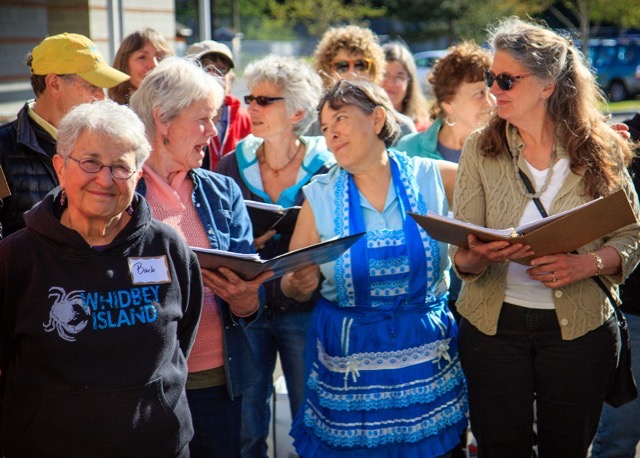
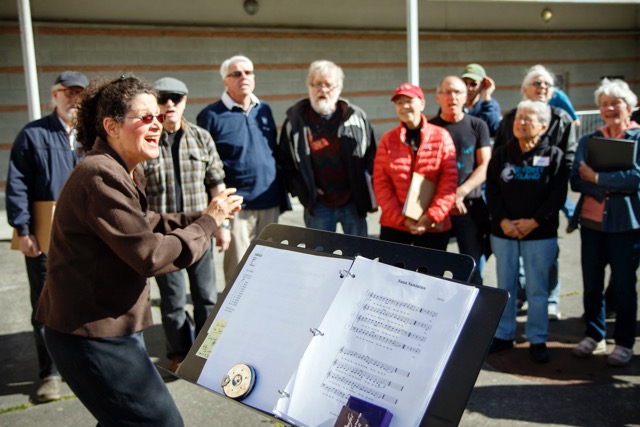
As the day came to a close, members of the Open Circle Singers stood outside the front door of the high school, welcoming volunteers and homeowners as they returned for dinner. Faces reflected smiles of contentment for meaningful work done and received.
“I’m still up in heaven about this,” Leonard Good beamed as he walked in the door with Linda.
Year after year, Hearts and Hammers makes possible the synergy of neighbors helping neighbors, proving that there is far more power in unity than any of us can harness alone.
The Open Circle Singers welcome hungry volunteers and homeowners back to the high school for dinner. (Photo by David Welton)
To view the photos below full-size, click them.
Peggy Rasmussen holds a support to shore up a balcony at Margaret Schultz’s cabin. (Photo by David Welton)
Lynn Willeford, whose idea for helping women get help with home repair grew into Hearts and Hammers, helps out at the Six and Dronen home to install a railing. (Photo by David Welton)
House captain Blake Willeford uses a circular saw and Dean Enell prepares a recycled railing. (Photo by David Welton)
Open Circle Singers welcome volunteers and recipients back to the high school. (Photo by David Welton)
Open Circle Singers (Photo by David Welton)
Linda Good thanks Hearts and Hammers for its repair and cleanup of the home that she and Leonard have lived in for more than 50 years. (Photo by David Welton)
Sarah Hess bids for a wheelbarrow load of firewood and a bottle of sparkling apple cider at the Hearts and Hammers dinner. (Photo by David Welton)
Lynn Willeford receives a bouquet in thanks for founding Hearts and Hammers 24 years ago. (Photo by David Welton)
Dez Rock, owner of Useless Bay Coffee Company, prepares food in the kitchen for a dinner thanking the volunteers. (Photo by David Welton)
Kate Poss worked as a library assistant at the Langley Library until last June when she retired. She worked for three summers as a chef aboard a small Alaskan tour boat from 2008 to 2010. She was a newspaper reporter in Los Angeles for many years before moving to Whidbey Island, where she likes cooking for new and old friends, hiking, reading great fiction, and writing her second novel with her friend Fred Bixby.
David Welton is a retired physician who has been a staff photographer for Whidbey Life Magazine since its early days. His work has also appeared in museums, art galleries, newspapers, regional and national magazines, books, nonprofit publicity, and on the back of the Whidbey Sea-Tac shuttle!
__________________
Enjoy more articles in the print edition of Whidbey Life Magazine, which you can purchase at local and off-island retailers or receive in the mail via subscription.
WLM stories and blogs are copyrighted and all rights are reserved. You may link to this story. To request permission to use or reprint content from this site, please contact us.
BY KATE POSS Whidbey Life Magazine Contributor
April 5, 2017
During Whidbey Earth and Ocean Month, students all over Whidbey Island were invited to participate in an art show. This year, young people chose social justice as their theme, and the resulting entries will be on display at the Bayview Cash Store from April 8 through May 29.
Sam Mirkovich is in his third year of teaching art classes at South Whidbey High School, following time spent teaching high school art in Croatia. He let students know about this year’s contest, and more than a dozen chose to enter, hoping to win prizes including $150 for the best overall piece. During “studio time,” when students work on their own pieces, they created art inspired by a spectrum of ideas ranging from the death penalty to unequal pay for women.
South Whidbey High School art teacher Sam Mirkovich has more than a dozen of his students participating in this year’s Climate Arts Project sponsored by Goosefoot. (Photo by David Welton)
The following students from South Whidbey High School participated:
Sophie Hamer, a sophomore, created a watercolor and pastel drawing depicting inequality in pay for women, who tend to earn 80 cents for every dollar men earn. “I am inspired by political things and wonder why women aren’t paid enough,” she said.
In her work for the show, Sophie Hamer focused on equal pay for women. (Photo by Sam Mirkovich)
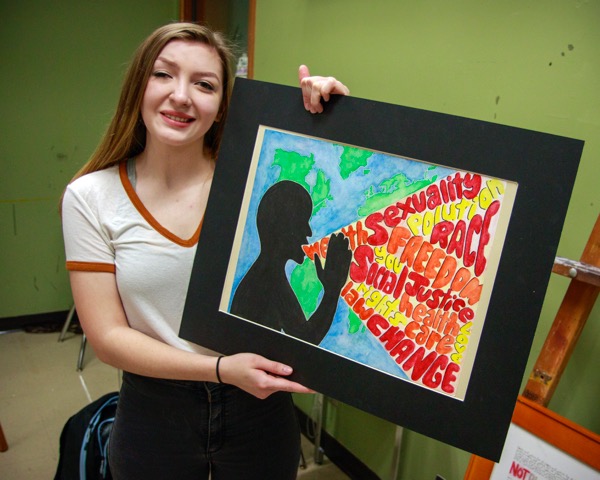
Kyah Nelson, a sophomore, took the approach of featuring a silhouette of a man broadcasting social issues such as wealth, sexuality, race, and healthcare depicted on the background of a world map. “There are problems all over,” she said, adding that her inspiration for social justice comes from her grandpa, Jon Nelson, a former soldier who fought in Viet Nam.
Kyah Nelson’s art shows social justice issues that need attention. (Photo by David Welton)
Libby Hawkins, a junior, said her piece was based on the Pledge of Allegiance and its final phrase, “with liberty and justice for all,” which struck her as not equally practiced in our country. Her large piece contains the word “not” before words such as “blacks,” “LGBTQ,” “Muslims,” “immigrants,” “homeless,” “women,” “poor,” and “refugees.” “I got the idea for making this immediately after this year’s election,” she said.
Libby Hawkins’ piece illustrates that “with liberty and justice for all” still excludes many Americans. (Photo by David Welton)
Bethany Justus, a senior, drew a black-and-white portrait of Martin Luther King framed by his “I Have a Dream” speech. “His message is true and valuable today,” Justus said. “It has a positive ring to it.” Her inspiration is her English teacher, Miss Cave, who practices inclusivity with her students.
Bethany Justus remembers Martin Luther King’s ‘I Have a Dream’ speech in her work about human rights. (Photo by David Welton)
Alejandro Fredrickson, a sophomore, said transgender issues are important to him and created art depicting the prejudice of separate bathrooms for whites and people of color as compared to today, where transgender teens are singled out and segregated, much as blacks and whites were in the 1960s. “Trans rights are human rights,” he said.
Alejandro Fredrickson’s piece compares segregation by color in the past with segregation by gender in modern days. (Photo by David Welton)
Miki Lundy, a junior, made a piece featuring a woman’s face surrounded by harsh words, yet around her eyes and lips are words that she is loved. “The words outside are what people are calling her, yet inside she knows she is loved and worth more than she’ll ever know,” she says.
Miki Lundy illustrates the need to be strong in the face of bullying words. (Photo by David Welton)
Dakota Williams, a senior, painted a watercolor with the statement, “Illegal is not a noun,” illustrating her objection to calling people “illegal aliens.” “People need to be knowledgeable when they shout their opinions,” she said.
Dakota Williams’ piece is about taking the time to use words with integrity and thought. (Photo by David Welton)
Kareena DeClercq, a sophomore, said what is important to her is “What’s in your heart. I feel right now there’s a lot of discrimination against people, especially Muslims. Islam is a misunderstood religion.” In DeClercq’s piece, one face is illustrated with pupils depicting the Twin Towers and another with a brain depicting a nuclear war, both ways people from Muslim countries can be erroneously seen. At the bottom of the piece is a Muslim woman in a hijab surrounded by rainbows with a radiant heart.
Looking at Muslim people as humans with hearts instead of as terrorists is depicted in Kareena DeClercq’s art. (Photo by David Welton)
Lila Stach, a junior, drew an hourglass, with pieces of the earth trickling through over cities. “It is a slow trickle of what’s happening, pollution, water levels rising, global warming,” she said.
Time is running out for the earth if we don’t act, is student Lila Stach’s statement for social justice. (Photo by David Welton)
Carmen Warwick, a senior, chose human trafficking as the subject for her piece, “Not for Sale,” depicting a black and white drawing of a woman with a blank expression, conveying the numbness of the victim. “When I thought about social justice, this idea was brought to light in my head,” she said.
Carmen Warwick chose the subject of human trafficking for her art theme. (Photo by David Welton)
Anthony Murtha, a junior, drew a tree with a rope hanging from it. Death by hanging is still legal in this country and Murtha takes issue with the practice saying it is inhumane. His idea for the piece came from a family friend who was on death row in Texas and hanged.
Anthony Murtha’s art depicts his opposition to legalized hanging. (Photo by David Welton)
Mary Zisette, a sophomore, drew on the adage, “The rich get richer and the poor get poorer,” and featured a tearful man holding a sign. “Our problems are getting worse,” she said. “Here on the island we’re really lucky that people can get help.”
Mary Zisette’s art depicts the theme “Equal Work for Equal Pay.” (Photo by David Welton)
Emmalee Norris, a freshman, looked at uneven pay between men and woman and her piece depicts a man sitting on a higher tower of coins than the woman facing him. “I interviewed my mom, who works hard and doesn’t get paid as well as men do,” Norris said. “She’s lived with it. If women were paid as much as men were, poverty among working single mothers would drop.”
Emmalee Norris advocates for equal pay for women. (Photo by David Welton)
Expanding on Lila Stach’s theme of time running out for the Earth’s climate, the students later attended an assembly featuring Xiuhtezcatl (pronounced shoo-tez-cat) Martinez, a teen speaking about climate change. Sponsored in part by Sno-Isle Libraries and Humanities Washington, Martinez, an internationally known 16-year-old climate activist from Colorado and leader of Earth Guardians, spoke about the importance of caring for the Earth.
“I used to think that climate change was a privileged older white people’s concern,” the indigenous young man, originally from Mexico, said. “But it is our responsibility to care for the earth as well. People have fallen out of love with the world.” Martinez received a community service award from President Obama and has been featured on HBO, ABC, Showtime, and PBS. He talked about the need to reconnect to the earth and to each other.
With teens such as Martinez rallying students, Julie Glover is enthused by the growing interest in climate change and social justice island-wide. She met with South Whidbey High School’s drama club and green team last year and proposed using art as a means of educating young people about climate change issues. The collaboration has come to be known as CAP (the Climate Arts Project).
This year, CAP is designing and running the Earth Day activities at the high school as well as participating in an island-wide art show and also presenting a showcase performance at the Bayview Cash Store on April 19 on the subject of climate change.
“You can see how much these young people have to offer, both through their art and through their conversation,” Glover says. Her aspiration is for youth to share their voices with the larger community, with many more teen art shows and performances in the future.
“They are so worth listening to!” she says. “This is a real opportunity to celebrate the accomplishments of our young people, as well as to engage in a unique youth/adult exploration around the youth perspective on social justice issues. I can’t wait to see what they come up with this year.”
Kate Poss worked as a library assistant at the Langley Library until last June when she retired. She worked for three summers as a chef aboard a small Alaskan tour boat from 2008 to 2010. She was a newspaper reporter in Los Angeles for many years before moving to Whidbey Island, where she likes cooking for new and old friends, hiking, reading great fiction, and writing her second novel with her superhero friend Fred Bixby.
David Welton is a retired physician who has been a staff photographer for Whidbey Life Magazine since its early days. His work has also appeared in museums, art galleries, newspapers, regional and national magazines, books, non-profit publicity, and the back of the Whidbey Sea-Tac shuttle!
WLM stories and blogs are copyrighted and all rights are reserved. You may link to this story. To request permission to use or reprint content from this site, email info@whidbeylifemagazine.org.
BY LIS DAVID Whidbey Life Magazine Contributor
March 22, 2017
You reap what you sow. Fourth generation farmer Georgie Smith has put her heart and soul into Willowood Farm for more than two decades, growing food for Whidbey Island and Seattle. Smith is a woman of true grit and contagious perseverance who has received a great deal of support since the farm’s iconic barn burned to the ground on March 6. She has spent decades planting the seeds of the support she is now reaping.
Before: The Smith barn on Willowood Farm (Photo courtesy of Georgie Smith)
Willowood Farm has been in the Smith family since the late 1800s. In the early 1970s, with the loss of two family members in one year and a double inheritance tax bill, the Smith farm was in jeopardy of being developed. Through the work of the family, neighboring farms, and concerned citizens, a novel idea took shape to save the Smith farm and the surrounding central Whidbey agricultural community from the pressures of development. In 1978, the Smith farm, long considered the “heart of Ebey’s Prairie” and the surrounding 17,000 acres were made the Ebey’s Landing National Historical Reserve by the National Park Service. This created a new sort of park that was focused on preserving a working, agricultural community with a visual, cultural continuity to the past. Georgie Smith, who was just seven at the time, would grow up to re-establish her family’s farming practice on their remaining 20 acres of land, smack in the middle of the scenic Ebey’s Prairie, establishing a thriving, sustainably grown vegetable farm called “Willowood.” This was the original name bestowed on the first farmstead established there by Eason Ebey (Isaac Ebey’s son) in the mid-1800s and before the Smith family arrived.
The historic Smith barn, which was built around 1880, was a community landmark that held a great deal of history and family memories. The fire destroyed it and endangered the livelihood of the family. “The barn was the hub, the nexus, of all farming operations,” says Smith. It housed most of the farm’s equipment, including all their 2017 seeds, several thousand pounds of dry beans, all seven of their laboriously acquired and maintained tractors, and countless other supplies. Smith wasn’t sure in the first few days after the fire if she’d ever farm again.
However, in true and determined Smith form, the farmers were back in the fields just three days after the fire. Still figuring out the farm’s future, she and her farm crew of three realized that they had vegetables in the fields that needed to be harvested. When she learned that people wanted to help, Smith put a call to the community and dozens of volunteers came out. Kettles Edge Farm and Rosehip Farm and Garden lent equipment and farm crews while Sherman Farm lent space to pack and store produce. With this help, the farm has harvested hundreds of pounds of produce since the fire.
The week after the Smith barn burned, chefs had Willowood produce back in their coolers and on menus. Chef Vincent Nattress of Orchard Kitchen felt the loss from the fire and immediately reached out to fellow restaurant owners on Whidbey Island. “I think I feel like most chefs; seeing that barn burn caused a visceral reaction. This is the livelihood and home of a person who feeds us all,” Nattress says, adding, “If you know her at all, you know she personally embodies a critical hub for this island’s food. She’s like the mother of all farmers here.”
Nattress hosted a meeting at Orchard Kitchen that was attended by many of the island’s local chefs and business owners to plan a number of upcoming fundraisers to benefit the Smith Family. Various charity efforts have already taken place in Seattle and on Whidbey Island. Chefs are planning dinners and reaching out to guests for donations or are contributing proceeds from the sales of menu items that are dedicated to the farm.
Local chefs and restaurant owners gather to plan Willowood Farm fundraisers (Photo by Tyla Nattress)
Local coffee shops donated drink vouchers to volunteers at the farm, a Girl Scout troop donated cookie sale proceeds, people signed up for a Meal Train to provide food for the Smith family, and the list of community support goes on and on.
Farm Raising logo created and donated by Rodric Gagnon
Within days after the fire, people donated more than $50,000 to help rebuild the barn through a GoFundMe campaign started by friend Kristen Stavros. On GoFundMe, Stavros wrote, “This beautiful, historic beast dominated the landscape of Ebey’s Prairie and was also host to many a local fundraiser. As much as this barn means to the island, it is the family that actively works the land around it that means even more.”
Stravos says she started the campaign because she wanted Smith to get up the next morning and be able to get through this, adding “One accident like this should not put a fourth-generation farm out of business.” Another $13,000 has been donated via a “Smith Family Farm” benefit account set up at the local Coupeville People’s Bank.
Georgie Smith (Photo courtesy of Georgie Smith)
The Smiths have been a vital part of shaping Ebey’s Landing National Historic Reserve, and since Georgie Smith started farming the family land, she has continued to build community through Willowood. Fellow farmer Wilbur Purdue says he believes the community wants to be involved because, “She has such an amazing operation in such a special place and always is willing to provide her facility and expertise. I think people know the real deal when they see it, and they admire that in a person.” Smith is already thinking of ways to give back, saying, “I can tell you we are determined to do something great to honor all this support and to pay it forward to our amazing, giving community.”
To donate, volunteer, or find and fundraising event for Willowood Farm, please visit this page. To see more of David Stern’s beautiful photos of Willowood’s first harvest by volunteers, view his photo essay Growing Forward.
Writer Lis David and photographer David Stern donated their time to write and illustrate this article to help raise funds for Willowood Farm.
Lis David is writing, eating, and drinking her way from one end of Whidbey Island to the other. She developed her passion for writing about food and beverage by working in restaurants and on farms in Washington, D.C., Chicago, Spain, and Ireland.
David Stern is aCoupeville-based photographer and co-owner of Whidbey Custom Photography with his wife Madisun Elizabeth. David was mentored by his grandfather, a world-famous landscape photographer based in New England. David hopes to work as a photojournalist one day, traveling the world and telling stories.
WLM stories and blogs are copyrighted and all rights are reserved. You may link to this story. To request permission to use or reprint content from this site, email info@whidbeylifemagazine.org.
BY KATE POSS
Whidbey Life Magazine Contributor
March 22, 2017
International social artist Tannur Ali performs. A powerful line from one of her poems: “Our babies weren’t made in vain.” (Photo by David Welton)
There are people who see problems in their communities and say, “Somebody should DO something about that!” And then there are people who roll up their sleeves and come up with solutions. The sixth annual Thriving Communities gathering at the Whidbey Institute last week was a celebration of problem-solvers who prove that community needs are best met by community members themselves.
The theme this year was “Communities Poised on the Edge” and featured films and speakers addressing issues such as affordable housing, food security, local investing, diversity, mentoring new mothers, supporting people in their healing, and aging in place. In between presentations, guests were treated to performances by Tannur Ali, a powerful and distinctive social artistry poet who founded iLogic (Institute for the Love of Genius in Communities).
Thriving Communities’ new films highlighted the Organic Farm School, Mother Mentors, and Healing Circles on South Whidbey, along with Portland entrepreneur, Franklin Jones’ B-Line Sustainable Urban Delivery, a robust sustainable delivery service that has found a growing niche.
Judy Feldman, executive director of the Organic Farm School, talked about the need to teach farmers how to survive and thrive. She recalled when the program was on the edge: when grants ran out and land used for the classroom was no longer available. Thriving Communities’ Jerry Millhon connected her with Ron Sher, founder and CEO of Sher Partners, a family real estate and investment firm known for Third Place Books. Sher happens to own land in the Maxwelton Valley that became the home of the Organic Farm School.
“After each wall we hit, I asked if we were still relevant,” Feldman said. “Thanks to Ron and Eva, and to Jerry, who did a video on us, now we have a phenomenal place and an eight-month-long program.”
Thriving Communities is shepherded by Jerry Millhon, former director of the Whidbey Institute. A beloved elvish-like grandfather figure, Millhon connects those who have needs with those who can help.
“The thing that we do best is find people (usually women) in communities that see a need and fill that need with the work they do,” says Millhon. “The story that is important is how they have used community capital (not financial capital) to bring a passion into fruition. And that is the story that opens up others to copy that in other communities. We think there are about 45 to 50 community members who have copied some aspect of the work and rooted it in their own community.”
Jerry Millhon, right, left his post as executive director at the Whidbey Institute to shepherd Thriving Communities. (Photo courtesy of the Whidbey Institute)
In addition to the Organic Farm School, the following organizations presented.
Healing Circles in Langley was created by Diana and Kelly Lindsay and is associated with Commonweal Cancer Help Program, a national leader in cancer support. It provides low- to no-cost service that offers a safe sanctuary, social support, classes and conversation on a variety of topics from care for caregivers to a book group devoted to reading “A Year to Live: How to Live This Year as if It Were Your Last,” by Stephen and Ondrea Levine. “We are a lab whose idea is spreading across the country,” Diana Lindsay says.
Mother Mentors of Whidbey Island was founded in 2009 by Kristin Lasher, a grandmother who saw the need for mothers to find ways out of isolation and connect with other moms and their children. Providing mentoring for moms and Playscape programs for children, the program has expanded to Oak Harbor. “Parents can have adult conversations, get their basic needs of support met, and learn the basic knowledge of parenting,” says Kate Grossman McVay, executive director for Mother Mentors.
Lynn Willeford, front, a ‘serial starter-upper’ talked about her latest project, South Whidbey at Home. She sits with Pam Schell, of the Inn at Langley, who is active in providing support for community non-profits. (Photo by David Welton)
Judy Alexander, of 2020 in Port Townsend, and Katie Raines, of GRuB in Olympia, who spoke about food security.
Andrea Caupain, of Centerstone in Seattle, and Victoria Santos, of Young Women Empowered, also in Seattle, who spoke about the challenges and opportunities in communities of diversity.
Katie Raines, executive director of Olympia’s GRuB, talks about the community-creating, farm and food program. (Photo by David Welton)
Year by year, the Thriving Communities gathering yields more videos and stories about inspirational organizations that bring healing and resilience to their communities. It showcases the best in us — inspiring the rest of us.
Kate Poss worked as a library assistant at the Langley Library until last June when she retired. She worked for three summers as a chef aboard a small Alaskan tour boat from 2008 to 2010. She was a newspaper reporter in Los Angeles for many years before moving to Whidbey Island, where she likes cooking for new and old friends, hiking, reading great fiction, and writing her second novel with her superhero friend Fred Bixby.
WLM stories and blogs are copyrighted and all rights are reserved. You may link to this story. To request permission to use or reprint content from this site, email info@whidbeylifemagazine.org.
BY KATE POSS
Whidbey Life Magazine Contributor
February 22, 2017
It’s a lot of fun to have coffee with Loretta Martin, the writer behind the mysteries of Langley’s Mystery Weekend. Who wouldn’t enjoy it? Writing mysteries for Langley’s Mystery Weekend each year, and seeing them brought to life by improv actors, makes her happy.
Dare to solve the murder with other amateur detectives Feb. 25 and 26 for Langley’s 33rd annual “Mystery Weekend: An ‘Un-Conventional’ Murder.” There are 34 characters this year, some of them posing as science fiction conventioneers — “members” of the International Society of Science Fiction Arts and Technology or ISSFAT. These characters are behind-the-scenes folks who operate the cameras, act as engineers, do makeup, and design costumes in the sci-fi world.
“I have worked behind the camera,” says Martin, who has a background in creating and producing local television shows.
In character as a police officer, Loretta Martin calls in a clue for Mystery Weekend (Photo by David Welton)
The sci-fi convention arrives nearly two months after a “sighting” of a Sasquatch in the Saratoga Woods on New Year’s Day, so the story goes. The tween who “saw” the local Bigfoot reports it on Facebook, and the story goes viral, drawing hunters and protectors of the hairy mystery-beast. The weekend’s remaining actors are those who are either Bigfoot Friends, those who wish to see the Sasquatch stuffed as a trophy, and the regular cast of characters including: I.B. Fuzz, her cousin Hagetha Kisstea, Gussie and Gus Gruesome, and the 49ers, a zany band of codgers always looking to make a quick buck — this year on “Sasquatch Sausage” and root beer made of Sasquatch scat for an “earthy” taste. A hairy gorilla-type creature is found dead behind the Saratoga Inn, and this is where the sleuthing begins.
Annie Horton, who has performed in most of the Mystery Weekends, plays the character of Shari Fissure this year, the widow of the murdered character. As an homage to Carrie Fisher, who died Dec. 27, Horton’s character models Fisher’s Princess Leia of “Star Wars.” Shari Fissure, though, wears a hairdo of actual cinnamon buns on the sides of her head.
“I predict the phrase of the weekend will be, ‘Love your buns,’” Horton says.
Some of this year’s actors in Mystery Weekend featuring Sasquatch friends and enemies, science fiction conventioneers, and other characters. (Photo by Sharon Lundahl)
While many of the actors return again and again, there are new faces adding to Mystery Weekend this year.
Lilly van Gerbig, co-owner of Langley’s Fair Trade Outfitters, along with her husband Barry, is acting for the first time.
“I’m playing Lilly Landtree, an animal lover and a good friend to Bigfoot Friends,” van Gerbig said. “Our store is a sanctuary for Bigfoot Friends. I’m a little eccentric and I wear charms and necklaces. I am a staunch protector of Bigfoot. I think it’s really fun. I’m excited to do it.”
Van Gerbig said, while she’s “not theatrical,” she does enjoy interacting with customers in her store. Last year Fair Trade Outfitters provided a clue in solving “Much Ado About Murder: A Hare-Raising Tale.”
The 49ers Men’s Club have a get-rich scheme this year, including selling Sasquatch sausage and Sasquatch rootbeer, known for its secret ingredient (Photo by Sharon Lundahl)
The way Mystery Weekend works is that local businesses pay a small fee to the Langley Chamber to offer a clue. Visitors buy a $10 ticket from the chamber, which includes a map and locations of all the available clues, along with a copy of the “Langley Gazette.” Sleuths visit the businesses, collect clues, and guess who the culprit was at a 5 p.m. gathering Sunday afternoon at the Langley Middle School.
“Josh (Hauser of Moonraker Books) said I should be a character, this year,” van Gerbig says. “I love being with my customers, so I thought, what can you lose? It was fun last year, just seeing the excitement and meeting people who have done this for years. It is amazing to me. They’re bringing their children and grandchildren. No one knows who the murderer is. Everyone is a suspect. You have to play like you might be one or should be one. I think Loretta is a genius. I love her.”
Even the actors who play the characters don’t know who the murderer is until it’s revealed on Sunday evening. It’s the only part that’s scripted.
Annie Horton has performed in nearly every Mystery Weekend over the past 33 years. (Photo by Sharon Lundahl)
“We tell people that, when interviewing the suspects, they shouldn’t believe everyone, because one is the murderer and has (every) reason to lie,” says Martin. “The mystery is solved by getting clues, interacting with the suspects, and reading the story in “The Langley Gazette.”
Josh Hauser, owner of the Moonraker bookstore in Langley, has been a character in every mystery weekend but one. This year, she is cast as a bookstore owner. She recalled one of her favorite roles from days gone by.
“It was my best costume year. I had set up a business of ill repute upstairs,” Hauser says. “I found a red taffeta strapless evening gown. I’ve committed the murder twice. One day (during a previous Mystery Weekend), I was across the street and there were people walking by with signs to save our slugs. Someone thought it was a real small-town protest.”
“Officer” Loretta Martin”says suspects are “arrested” by Langley police on Langley Mystery Weekend (Photo by David Welton)
The first mystery Martin wrote was 18 years ago, when she worked as director for the Langley Chamber.
“It was an homage to the Titanic, and we called ours ‘The Wreck of the Calista,’ based on a boat that wrecked, here” Martin says. She described a jewel she loved at Wayward Sons, then, and used it as a device to help steer the story. “It was a $3,000 brooch, that had a large blue opal with rose gold vines and peridot and pink topaz. It would have looked good on a big girl like me. I had a long-time Langley resident play the part of an opera singer who wore the pin and is murdered by a spear-gun. The actor had to be off island that weekend, so I suggested we use the photo we already had of her as the photo of the “victim” opera singer in the mystery. We both thought that would be fine. I used her photo in the obituary, with the (Mystery Weekend) headline: “Opera Singer Murdered.” I got a call from her mother asking, ‘What happened to my daughter?’ The ‘Mystery’ newspaper is usally inserted in the real newspaper, and her mom started getting calls asking what happened to her daughter.”
Since then, Martin said the victims have always been fictitious and not part of the cast.
Barbara MacCallum, a Langley bed and breakfast owner, used to work with Martin at the chamber during the “Heads in Beds” campaign to entice visitors to the island during the winter. She recalls previous Mystery Weekends in which the Mosquito Fleet transported sleuths from Seattle to the Langley marina (and guests were told who the murderer was on the way home), bed and breakfast baking contests, cookbooks; all ways to bring out-of-towners to the island during the dark days of February. “Loretta’s imagination is phenomenal,” MacCallum says. “She comes up with clues, creates the characters, and the solution.”
Martin moved to Whidbey Island, a place she had visited since she was a child, to heal from complications due to a back surgery nearly 20 years ago.
“When I was diagnosed (and had to take months of antibiotic treatment as a result), I was so weak,” Martin recalls. “My mom and dad said I should move to their house on Mutiny Bay. I feel there’s a healing energy on Whidbey Island. I’ve always felt it. When we moved here, my husband Dewey landed a job in his field (construction). I worked at Whidbey General Hospital and wrote “The Pulse,” the hospital’s magazine. Then I landed the job at the chamber. The connections I’ve made are so important. Just keeping in touch means so much to me. It’s all about networking, especially with women. It’s why I support the Soroptimists.”
Regarding creating stories for Mystery Weekend, Martin says, “When I’m writing, it’s my favorite time of the year. The most fun thing is that it is not a linear (or scripted) story, but one that is done in improv by the actors. They bring the story to life in new ways I couldn’t imagine. When I see them in costume, (it’s like) J.K. Rowling might feel when she sees her characters come to life in a ‘Harry Potter’ movie. I’m so lucky that way.”
Michaleen McGarry, executive director of the Langley chamber of commerce, designed this retro poster advertising this year’s Mystery Weekend Feb. 25 and 26. (Photo by David Welton)
A couple of local businesses will carry Mystery Weekend-related merchandise. Sprinklz Ice Cream Parlor and Coffee Shop in Langley and Casey’s Crafts, on Hwy 525 near Bayview Road, now carry Sasquatch-themed items. Laurie Davenport, who owns Casey’s, said she will host a Bigfoot treasure hunt throughout the store as well.
Sharpen your Sasquatch-sighting skills the night before Mystery Weekend at the Langley Library, which will host David George Gordon, author of “The Sasquatch Seeker’s Field Manual: Using Citizen Science to Uncover North America’s Most Elusive Creature,” on Friday, Feb. 24, at 6:30 p.m.
Betty Freeman, visitor center representative for the Langley chamber of commerce, suggests buying tickets ahead of time. The chamber almost sold out of tickets last year and did sell out of 2016 Mystery Weekend T-shirts and sweatshirts. Order early. T-shirts are $20 and hoodies are $35. They are adorned with the vintage Sci-Fi logo seen on posters around town.
Kate Poss worked as a library assistant at the Langley Library until last June when she retired. She worked for three summers as a chef aboard a small Alaskan tour boat from 2008 to 2010. She was a newspaper reporter in Los Angeles for many years before moving to Whidbey Island where she likes cooking for new and hold friends,’hiking, reading great fiction and writing her novel.
WLM stories and blogs are copyrighted and all rights are reserved. Linking is permitted. To request permission to use or reprint content from this site, email info@whidbeylifemagazine.org.
BY KATE POSS Whidbey Life Magazine Contributor
February 15, 2017
These days, deciding whether to smile on our brother or to turn away seems more difficult. At the Northwest Language and Cultural Center in Langley, kindergarteners are learning to smile on their brothers and sisters, even though they may look different or do things another way.
On a very rainy Thursday in Langley last week, five- and six-year-olds were learning simple Chinese words, such as ni hao for hello, laoshi for teacher, and xiexie for thank you. They sampled comforting Chinese rice porridge made by a kindly Chinese chef and learned to make sticky rice balls and lanterns, celebrating Lunar New Year. The Year of the Rooster began Jan. 28.
Students learn how to say simple Chinese words such as hello, teacher, and thank you. (Photo by David Welton)
The idea of bridging cultures has found form through Josette Hendrix, founder and director of the Northwest Language and Cultural Center. The guesthouse and center have celebrated viva la difference for the past 20 years, hosting families from other countries, teaching English immersion and culture, and an appreciation of the natural beauty of Whidbey Island. During the past two years, the center has opened its doors via the Global Culture Experience program to Langley Middle School students and, as of last September, to kindergartners from South Whidbey Elementary School.
“The concept, at its core idea, is to present, in face-to-face settings, a way that allows students to have a primary experience with a native culture,” Hendrix said on a bustling day when nearly 80 kindergartners, along with parent volunteers and teachers, rotated between Chinese culture games, crafts, movement, music, storytelling, and cooking. “The students can form a relationship to others and understand each other as human beings.”
Chef Andre Liu enjoys teaching kindergartners how to make Chinese comfort food. (Photo by David Welton)
To that end, Justine Boren, a kindergartner, said, that her favorite class was, “Cooking!”
It’s easy to understand Boren’s enthusiasm when meeting Andrei Liu, who drives from Anacortes to cook for the little people and teaches them how to make comfort food from Northern China. Liu’s warmth and heartfelt cooking can permeate his rice, spinach, mushroom, ginger, and tofu porridge. He taught students how to make sticky rice balls in celebration of the new year.
“This is very simple and healthy and makes the stomach feel good,” Liu said, his voice flavored with a Chinese accent. “Things [about teaching children to cook] move me. One of the kids hugged me, a natural love. They ask me if they can have more, and some parents use my recipes. I believe cooking is an art. If you rush, rush, food is no good.”
Liu, who manages an art gallery in Anacortes, said he once worked as a cook in San Francisco restaurants. The porridge recipe is his mother’s, who is nearly 90 and healthy, due, in part, to her cooking.
South Whidbey kindergartners learn how to make sticky rice balls in celebration of the Year of the Rooster. (Photo by David Welton)
Suzanne Wong-Scollon, who is of Chinese descent, moved to Whidbey Island a year ago, after visiting the island off and on over the past 50 years. On this Thursday morning, she played guitar for the kindergartners, leading them in a song written by Maria Ellis, a Russian-born teacher who helps Hendrix run the center. Around an inflated globe on the covered porch, the children sang Ellis’ Global Cultures song:
We go around the globe
Discovering its wonders
Everywhere we meet new friends.
In the south, north, east, west
We’ll find out what is best.
In heart we are all the same.
We go around the globe
Discovering its wonders.
Everywhere we meet new friends.
Spanish, Kenyan, Chinese, Japanese and Lebanese…
In heart we are all the same.”
“We promote hands-on participation with native speakers, Ellis said. “I’m amazed at how quickly the kids pick up the accent and pronunciation. I speak five languages and cannot speak Chinese as well as these students can.”
Rene Neff, a former South Whidbey Elementary school teacher, volunteers for her granddaughter’s class. (Photo by David Welton)
Rene Neff, a retired and beloved teacher from South Whidbey, now accompanies her granddaughter Ophebia to the weekly Thursday cultural immersion.
“I think this is a great program,” Neff said. “The children get a lot of exposure to different cultures. It’s a lot of fun.”
After lunch, a regal CeCe Hier, originally from Bejing and now a resident of Maple Valley on the mainland, hosts a rambunctious group of kindergartners and teaches them about the traditions of Lunar New Year. She folded her hands together under her chin and said that is a Chinese version of a hug. Later, she showed students how the new year is celebrated with Chinese families. In the Chinese culture, lanterns with riddles on them are lit and float away in the night sky. There are gods to pray to for wealth in the coming year. There are sweet rice balls to make and eat.
Students learn the Chinese art of fan dancing (Photo by David Welton)
“Today, we believe that people need to interact with each other much more, human to human, heart to heart,” Hendrix wrote in a Feb. 3 blog post for NWLACC. “Through such cultural exchanges, there can be greater understanding that other values and norms are as valid as our own, often containing sides to the truth that we may have lost or forgotten.”
With public schools’ funding deficits, the program is carried by NWLACC, which is seeking grants and donations to continue funding it. For more information, contact the Northwest Language and Cultural Center.
Kate Poss worked as a library assistant at the Langley Library until last June. She was thrilled to work for three summers as a chef aboard a small Alaskan tour boat from 2008 to 2010. She was a newspaper reporter in Los Angeles for many years before moving to Whidbey Island, where she likes “talking story,” hiking, hosting salons, and writing her novel.
WLM stories and blogs are copyrighted and all rights are reserved. You may link to this story. To request permission to use or reprint content from this site, email info@whidbeylifemagazine.org.





 Enjoy more articles in the print edition of Whidbey Life Magazine, which you can purchase at