I mean the recycling center. Well, it’s the recycling center AT the dump.
Read on.
Friends: now that I live on an island, I find myself thinking about where things come from. Like electricity. And where things go. Like our garbage.
The visit to the dump is my husband Larry’s job. Mind you, he doesn’t complain about it; he is a wonderful man. But he’s also a sophisticated intellectual who blogs about religion and who is working on a memoir. This kind of work takes him away from his writing. Which would account for the fact that he does a lot of sighing when this job comes around.
He makes a great deal of organizing sounds, which involve opening and closing the back door, opening and closing cabinets, more sighing, then opening of the car trunk. These are accompanied by the melancholy sounds of plastic bags rustling and then glass clanking. The back door slams shut in what can only be called an existential manner, and the car backs out of the driveway. It proceeds slowly, with gravitas, towards the highway.
“This is a time-consuming, somewhat intricate operation, you know,” my husband informed me yesterday as he prepared to leave.
“Hmm,” I thought. “I’d better come along and supervise.”
Going to the Coupeville dump is a complex adventure, because the recycling area isn’t just the blue can that we were used to in Beverly Hills and Los Angeles. No sir. It’s a huge space, the size of a couple of tennis courts (not that I play tennis—I’m a poet, for Pete’s sake!).
When you bring your recycling items, you must sort them into subcategories and place them in the appropriate receptacle/bins/stacks.
There are a lot of them. Green glass goes one place. Aluminum goes someplace else. Cans go someplace else. Cardboard, as opposed to paper, goes someplace else. The good news: brown paper shopping bags go with cardboard! There are even spots for batteries and printer cartridges.
“Why are there so many subcategories?” I asked the person with the orange vest who was in charge for the day. I was told that as many as five different trucks come on different schedules to haul away ONE specific type of recyclable. These then go off-island back to the Seattle area.
Did I mention that there is also a thrift shop at the dump? You can buy a bicycle! A man in a very fancy sports car stopped by and did just that while I was there supervising.
You can also donate clothing.
There’s a kind of beauty to the recycling area at the Coupeville Dump. Things are not being wasted; they are being exchanged. There’s something cool about actually seeing all the stuff we use, get sorted and readied to be reused.
The person in the orange vest smiled and waved as we left.
I think I will go to the dump with my husband next time.
I might even offer to help!
Stephanie Barbé Hammer is a four-time Pushcart Prize nominee in Fiction, Nonfiction, and Poetry. She is the author of a poetry chapbook “Sex with Buildings” (dancing girl press 2012), a full-length poetry collection “How Formal?” (Spout Hill Press, 2014), and a comic magical realist novel “The Puppet Turners of Narrow Interior” (Urban Farmhouse Press, 2015). You can follow her on twitter (stephabulist) or read her blog “Magically Real” as she tries to read “100 Years of Solitude” in less than 100 years at http://www.stephaniebarbehammer.net.
WLM stories and blogs are copyrighted and all rights are reserved. Linking is permitted. To request permission to use or reprint content from this site, email info@whidbeylifemagazine.org.
So I have some exciting news to share. My second book in my “Rejected Writers’ Book Club” series has just been acquired by Lake Union Publishing. For a bunch of ladies who have been rejected on the page, they’re sure getting a lot of attention from a real publisher.
Lake Union is one of Amazon’s own imprint companies so this news warranted a trip down into Seattle to meet with the publishing team and venture into the Willy Wonka of buildings—the infamous Amazon Towers, corporate headquarters of the company.
So off I trundled with my agent, Andrea Hurst, and her associate agent, Sean Fletcher, for a day in the big city—clad in my OICs (Off Island Clothes).
Amazon Tower in Seattle (photo by Anthony Bobnie for Business Journal)
I should say, at this point, I only possess three sets of OICs—you know, the ones you wear with underwear, and they don’t include clogs or boots in the ensemble. Because of limited OICs and the fact that this was the second meeting with Lake Union, it dawned on me (with only one more appropriate set of togs), that I may have to stop writing books they like or find another publisher.
Anyway, we left at the crack of dawn for a noon lunch meeting and, believe it or not, we actually arrived at 11.45. I could have flown in from San Diego quicker. But you know how it goes, there was a line for the ferry, then we crawled through traffic on the way down. Then with coffee and bathroom breaks, we finally entered Seattle at around 11 a.m.—only to have us overshoot our exit.
With the sights and sounds of the big city turning my menopausal brain into mush, I finally got my iPad navigation working, only to be informed by Siri that the exit we needed was half a mile behind us. This resulted in us crawling, in the boiling heat, through Game Traffic till we eventually looped back around.
The three biospheres in front of the Amazon headquarters will bring the outdoors indoors with over 300 species of plants from 30 countries. (photo by Suzanne Kelman)
We finally arrived to attend our lunchtime meeting in a new Italian restaurant in the shadow of the Amazon Tower. We had an excellent meeting with food so exquisite I wasn’t sure whether to eat it, plant it or mount it in a frame above my fireplace.
Once lunch was over it was off to the tower to have an editorial meeting and also enjoy a grand Amazon tour. I made it through security—yes, I had to go through security; I guess they were worried I might be sneaking in a Penguin publisher in my off-island pants. The first thing I realized, on entering, is that this is no ordinary building; with such impressive facilities, it felt more like a European airport than the place I order my toilet paper from.
It was, in fact, like entering a different universe. The 37-story building has a five-story meeting room center, featuring an amphitheater and stage with stadium-style seating for 2,000. There are also shops and restaurants, including a Starbucks, Skillet Street Food, Marination, Mamoon, Anar, Potbelly Sandwich Shop, and two restaurants from local chef Josh Henderson. That is a lot for a country mouse in her second set of OICs to absorb in one building.
My first port of call was Starbucks for a meeting with my new editor, who had flown in from New York for the week. We had a very successful business meeting discussing future projects and the plans for the Rejected Ladies. This included outlining the six months of work my newest manuscript will go through to make it into the beautiful package it’s sure to become. We had a great chat in such a comfortable little booth that it was hard to believe this was a work environment at all.
After my meeting, it was time for my tour of the rest of the tower. A trip up the building was an adventure all in itself as there are no buttons inside the elevators. Instead, you tap the desired floor into an electronic keypad mounted in the corridor; it then directs you to the elevator to take. I have to admit it seemed a very effective way to get you from A to B, but it was a little disconcerting, shut inside a metal box zooming skyward without the safety of illuminated buttons to chart my course or as a distraction to stare at as people entered. I kept thinking—as we gained speed, higher and higher—that maybe we would shoot right out of the roof just as in Charlie and the Chocolate Factory. We didn’t, as it happens, but when I got out on the 37th floor, we might as well have; it felt as if I was on the top of the world. What a fantastic view.
Proof that I made it all the way to the top! (photo by Suzanne Kelman)
As I toured the building, making my way down from floor to floor, I was in awe. Some of the highlights for me were the areas dedicated to fun, with an art and craft room and an electronic gaming room for employees to play and blow off steam. Also, a food court and an outside barbecue deck.
But my favorite by far was the dog floor. There is a unique outdoor deck, with a wall covered in tennis balls, so employees can bring their pooches to work. It’s complete with grass, fire hydrants, stacks of towels and dog toys. What a smart and innovative company.
Ever seen this many tennis balls at one time? On a wall? (photo by Suzanne Kelman)Dogs on top of the world (photo by Suzanne Kelman)
I was told by Gaby, my author-liaison lady, that not only do Amazon allow their employees to bring them new ideas to make this working environment the best that it can be, but they also encourage it.
I loved my trip to the big city and it was fun to meet everyone at Lake Union and see firsthand where all the magic happens. But I was so glad to shelve my OICs for another year and get back into my yoga pants (that have never been to yoga) and my clogs. It was a very successful trip and the good news is that my crazy ladies will be back in a second book to entertain everyone. It’s scheduled to be released in the summer of 2017.
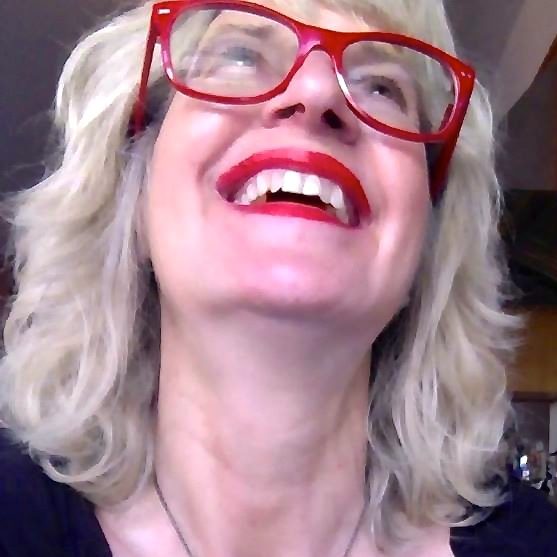
Image at top: Suzanne Kelman, photo by Kim Tinuviel
Suzanne Kelman is a multi-award winning screenwriter, playwright, and an Academy of Motion Pictures Nicholl Finalist. Her debut novel The Rejected Writers’ Book Club was released in 2016 and quickly became an Amazon international bestseller within its first week. Her second book in the same series is due to be released by Lake Union Publishing in Summer 2017.
WLM stories and blogs are copyrighted and all rights are reserved. Linking is permitted. To request permission to use or reprint content from this site, email info@whidbeylifemagazine.org.
Today we talk about theft. Stealing. Purloined ideas and stories.
Elvis Costello has said, “every artist is a magpie and a thief.” I believe that statement, and there have been several well-known court cases about copyright infringement. Back in the ’70s, George Harrison was the first be nicked for this crime; it seems “My Sweet Lord” sounded a little too much like the Motown classic “He’s So Fine.”
In a bizarre case in the early ’90s, John Fogerty was sued because his new song, “Old Man Down The Road,” sounded too much like his ’60s Creedence hit “Run Through The Jungle,” for which he no longer held the copyright. Sued for stealing from yourself. Hmmm. (Excellent background on this can be found here.)
So, if the courts (and my 12th grade English class) are any indication, stealing of words and ideas happen all the time. The difference is, I believe, that artists steal from real life. And, they fictionalize and improve on what they have stolen.
After the short story master Raymond Carver died, Tobias Wolfe (known for his local novel and film entitled “This Boy’s Life”) gave a moving tribute in Esquire magazine. He recalled that Carver was ruthless in taking ideas and anecdotes from anybody. Someone at a party had mentioned watching an eagle taking a salmon and dropping it out of the sky. Sure enough, within weeks, a Raymond Carver short story had an eagle accidentally dropping a salmon on the hood of the narrator’s car. Lest we paint brother Raymond as someone who just took other’s good ideas, remember that he changed them, honed them, and remade them according to his own vision. As Carver said in an interview with Paris Review, “a little autobiography and a lot of imagination are best.”
Gordon Sumner, better known as Sting, has said this mindset can actually be a little dangerous. This power, this using real life as material, is not the healthiest thing. As Bill Flanagan recorded in his book, “Written In My Soul,” Sting told him that the song, “‘Every Breath You Take,’ was written for one specific person. That is the power I have: If you piss me off or jilt me I’ll make you famous.”
Yikes. Sting is writing about real people and real situations.
In a CBS Sunday Morningfeature earlier this year, songwriter Jason Isbell was being interviewed about his childhood, and his mother said, “We have a joke in the family: watch what you say around him—it’ll end up in a song.”
In one of his better-known songs, “Decoration Day,” he weaves an amazing story of a blood feud between two southern families. He has said it came from his own family’s history, which he was not supposed to disclose—a true story of a grudge that was big news in the south in 1984. But, again, it was injected with a healthy dose of fiction thrown in:
It’s Decoration Day
And I’ve got a family in Mobile Bay
And they’ve never seen my Daddy’s grave.
But that don’t bother me, it ain’t marked anyway.
Cause I got dead brothers in Lauderdale south
And I got dead brothers in east Tennessee.
My Daddy got shot right in front of his house
He had no one to fall on but me
Spoiler alert: Isbell was writing in character, from the opposite side of his family’s viewpoint. His dad is alive and well.
Another well-known American writer, Edgar Allan Poe, lifted perhaps his most famous short story, “The Cask of Amontillado,” from a true tale that was being hushed up at an Army base in the 1800s. Seems an unpopular officer was kidnapped and bricked up inside one of the fortress walls. Poe asked questions about the rumor, and was told by superiors to quit talking about it.
He promised never to talk about it, but then changed the setting to European Carnival season and wrote it down! A vengeful enemy tricks his rival to follow him down to the catacombs, traps him, and bricks him in behind the wall to die. Brilliant. A very creepy and unsettling story, perhaps because it just might be true….
The final say in this matter must go to writer/artist Austin Kleon. His amazing illustrated book, “Steal Like An Artist,” and the two follow-ups (Just buy them all, right now. Trust me) are inspiring, liberating works. In his opinion, stealing done properly doesn’t pass off someone else’s work as your own; rather, it enhances it, honors its influences, and makes something entirely new. For his newspaper blackout poems, blog posts, artistic endeavors, and more fun than one guy should have, go to www.austinkleon.com.
Erik Christensen teaches English at Oak Harbor High School, writes songs and poetry, and often repeats the Ken Kesey adage: “It’s a true story, whether or not it really happened.”
Erik Christensen Band plays at the Fleet Reserve in Oak Harbor on Sept. 23, the Bayview Farmer’s Market on Oct. 1, the Island Arts Council Poetry Slam on Oct. 29 at the Freeland Cafe and Blooms Winery in Bayview on Oct. 30.
WLM stories and blogs are copyrighted and all rights are reserved. Linking is permitted. To request permission to use or reprint content from this site, email info@whidbeylifemagazine.org.
I cried when I accidentally drove over my favorite snake with the ride-around mower and hacked her into three bloody pieces. I have the best garter snakes at my house and she was the biggest of them all! The one with bright blue stripes and a girth the diameter of a napkin wring. Did you know that garter snakes live to be ten years old? I wept for the rest of the afternoon and woke up crying the next morning.
When my tears stopped and I reflected a bit, I saw my many reasons to cry. Garter snakes are the same age as fifth graders and it had been a tough teaching year and my colleague had died. That sounds silly. Surely the snake was many things: an emotional metaphor for vulnerability, the slaughter of innocents and rage against the machine.
I needed to visit God’s Hospital.
I can hear the sharp intake of breath at that language. We live in such a spiritually neutered time, but “God’s Hospital” is just a name from the language of my favorite adults. My mom coined the phrase. A visit to “God’s Hospital” meant a swim in Puget Sound.
Two of my sisters and I did this the other evening. There is no big blue letter “H” on a signpost to guide you to the beach but maybe there should be. We chose the north end of Homes Harbor. The tide was up, the sun shone at a late August slant and the prevailing northerly wind feathered the waves of the flooding tide. Both forces pushed the warm surface water in to shore.
I picked my way over the rocks on the shore. The voice of my 14-year-old self appeared out of nowhere and warned that if I ever wore shoes in the summer, I was old. Maybe that was why I was crying.
The northerly wind chilled my car ride sweat to goose bumps and, for a moment, I second-guessed my swim. But there is no pausing at the door to “God’s Hospital.” Not if you want relief from everything that ails you. I was first in and my sisters followed quickly.
My twin and I are the oldest siblings and we are Pisces, through and through. We began our saltwater swims, as children, at our grandma and grandpa’s cabin at old Brighton Beach in Clinton. Our grandma set the standard for the afternoon swim; if the sun was out, we went in.
There was a bit of ritual around it. A quick run up the wooden steps to the attic bedroom loft where you yanked open an old sliding mullioned window and leaned out to grab your dry swimsuit from off the shed roof. A swimsuit that has been swum in all summer, in the saltwater and sundried, is as stiff as a board and full of sand. You pull it on with a sort of painful yank, the crotch and the leg holes stiff and chafing, pieces of dried eelgrass and lettuce kelp fluttering to the floor. The only relief is to get the suit wet again.
Our grandma would be ready downstairs in her rubber slippers and her swim cap with the snapping chinstrap and the divot of rubber ripped off and missing at her forehead from too much tugging. She held a rolled-up rice mat edged in black grosgrain ribbon, and my Grandpa’s transistor radio swung on her wrist from a thin leather strap.
My twin and I would run ahead, across the yard and the blazing hot macadam road to the beach. We picked our way past the beach grass and its fragrant green, hay smell and over the big driftwood. We ran barefoot over the rocks to the water because we were young.
We would glance over our shoulders toward Grandma and wait for her. She would carefully roll open the rice mat and place her towel and the little radio on it. Her skin was the color of milk, her shoulders a little hunched, but she had beautiful legs. She would walk down to the water and stride in knee-deep, pause, and splash the cold water on her chest and shoulders and dive in. We would do the same. She would whoop and swim briefly and get out but we would stay. Once your ankles stop aching you can stay in the water forever.
We always swam underwater. On a sunny day, the shallow water in Puget Sound is a yellow-jade color. Below the surface, the sunlight beams down in wavering streams in a silence as thick and viscous as the feel of the water. You can hear buzzing engines from far away, muted and unimportant, and the sensory deprivation is calming.
We would pop out of the water after awhile and our Grandma would go up to start dinner. She would leave us the rice mat and the little radio and we’d lay on our stomachs with our hands straight at our sides, our heads to one side, the salty snot running from our noses, and the hot sun drying the saltwater on our skin into little salty circles that itched and pulled.
The radio hummed and all was well at the edge of “God’s Hospital.”
A Northwest native, Siri Bardarson is a writer with an emotional hotline to the vibrant natural beauty of Puget Sound. When not writing about the importance of the wild blackberry, daisies and natural time, she practices her cello a lot and sings at the same time. She loves her Whidbey Island home.
WLM stories and blogs are copyrighted and all rights are reserved. Linking is permitted. To request permission to use or reprint content from this site, email info@whidbeylifemagazine.org.
Okay, Okay. I admit it. I have magpie tendencies, collecting objects that I like or that I think may have use for down the road. When you add the magpie tendencies to the packrat predilection, you have a crisis brewing.
Part of the problem is that I’ve lived in my house for going on 15 years. While it’s not a big house, it has a sufficient amount of functional storage space, or at least it did for the first eight years I lived here. I was very proud of the fact that everything (mostly) had its place and that things could live in their places, ready for when I needed them. Nothing lived on the counters or worktops in my studio, but I could lay my hands on a tool or tube of paint the moment I needed it.
Let me assure you, this is not an endorsement of a minimalist stripped down life-style. No indeedy, I love “stuff.” I love my pitchers and bowls and other objet d’yardsale that populate my paintings. I just don’t want to be one of those people who have storage units for years, because they keep accumulating things and don’t ever get rid of anything and don’t know what to do with it.
What, you may very well ask, sent me down this path to de-cluttering and simplification? That’s easily answered! Last year, right about this time, I had to make an emergency visit back east, as my mother had fallen and broken her leg, and could no longer live the semi-independent life she had been living for the last four years. My brother and I had been nervously waiting for that shoe to drop and finally it had. She moved into a nursing home and with luck, she would (and did) graduate some months later to an assisted living facility.
But it still meant a trip to clear out her apartment, gather what she would be able to keep and maintain and dispose of the rest. And do it in under 10 days.
So, it’s no wonder that, on my return, I started looking around my beloved post-industrial cottage in the woods and noticed that things had gotten just the tiniest bit out of control. Gone were the clear surfaces, the orderly studio. The readily accessible tools and materials.
Mehitabel, commenting on the mess in the studio/ (Photo by Anne Belov)
I went on a bit of a bender, so to speak. I took loads of paperwork that was past the seven-year requirement for small businesses to the industrial shredder at the Coupeville Dump. (It’s a bargain! $1.50 per filled bag of shredded paper, which you can then recycle for free!) I started clearing out drawers and closets. While my good intentions did fizzle out for a while, I’m attempting to get back on the decluttering bandwagon a little bit at a time.
But let’s not go overboard here. Keep your hands off my heirloom bubble wrap collection and my proof that Stonehenge was built by pandas.
Stonehenge was built by Pandas / Stonehenge construction by Emi Hastings / Panda placement by Anne Belov (Photo by Robin Obata)
Anne Belov is a painter, printmaker and purveyor of panda satire. Her paintings can be found at The Rob Schouten Galleryat Greenbank Farm on Whidbey Island and at The Fountainhead Galleryin Seattle. Her panda-focused humorous cartoons can be found on her blog, The Panda Chronicles, and her books can be found at Moonraker Books in Langley, as well as on Amazon. She is hard at work on her graphic novel: The Pandyland Mysteries: the Case of the Picturesque Panda. At least one hour a day, you can find her standing in front of a large encampment of blackberries, waving a rake and using bad language or trying to find an empty surface in her studio.
WLM stories and blogs are copyrighted and all rights are reserved. Linking is permitted. To request permission to use or reprint content from this site, email info@whidbeylifemagazine.org.
He’s of the colour of the nutmeg. And of the heat of the ginger…. he is pure air and fire; and the dull elements of earth and water never appear in him, but only in patient stillness while his rider mounts him; he is indeed a horse, and all other jades you may call beasts. ~ William Shakespeare, Henry V
What is it about horses that fascinates humans of all persuasions? Could it be that we intuitively feel the horse has the ability to teach us how to harness our own innate power and wisdom?
Shy girl and Savannah—horses accept us whenever we show up authentically. Shy is fine. (photo courtesy of Peggy Gilmer)
At the age of nine, having just barely recovered from a bout of measles in which my temperature had flared to such a degree that I felt like I had visited other realms, my stepfather led me outside from my sickbed and presented me with a palomino horse! She was a tall, beautiful Tennessee Walker. Her name was Blondie and, for the next five years, she taught me how to be in relationship to my strongest sense of myself.
Anyone who has spent time around horses will tell you that they read people extraordinarily well. You cannot fool a horse and, if you try to, you may be in for trouble.
Recently I had the opportunity to work with someone who has approached horses from the perspective of completely trusting and honoring the wisdom-teachers that horses are. Yes, they are beautiful, can make you feel like you’re flying when you ride them, but what if you allow them to give you even more of themselves?
Whoopi and girl—being present for another creates connection and a willingness to engage. (photo courtesy of Peggy Gilmer)
Peggy Gilmer has done just that. After her diagnosis of cancer in 1992, Peggy started a horse farm, something she had always longed to do. She successfully reshaped her life and her career. Peggy is a professional executive coach. After her own experiences with the horses, she decided that it would be more powerful for executives to work with these archetypal animals. Peggy is a gentle guide who can lead you through the gate, into the arena, and then let the horse do its job.
I experienced this work over the course of a couple of hours and it has left an indelible impression. Although I’m no stranger to the amazing beauty and power of horses, the time I spent with Peggy and her horses was like nothing I’ve ever experienced. Peggy picked me up in Langley and we drove to the farm in Coupeville where she boards her four horses. In 2014, she relocated to Whidbey after selling her horse farm.
Girl with galloping Reba—in command, not control. So much more powerful (photo courtesy of Peggy Gilmer)
Peggy explained her approach to working with humans and horses as we drove up the island. Her work opens the gateway to developing the qualities of presence, connection, open heartedness and authenticity. I was already inspired by our conversation, but it did not prepare me for the profound experience of the embodiment of these principles in relationship to the horses.
When we arrived, she introduced me to her four horses: Reba, a 23-year-old mare, Sun, an 18-year-old gelding, Dewey, a 13-year-old gelding and Luna, a 16-year-old year old mare. All of them were born on Peggy’s farm except for Reba.
After showing me how to physically move the horses both away from and toward your body using your own strong physical presence and a light touch of a lead rope (if needed), I was already impressed and knew I was in capable hands.
Beautiful Reba, my wise and patient teacher (photo courtesy of Peggy Gilmer)
Peggy asked me which horse I was drawn to work with. I immediately zeroed in on Reba, the matriarch. Reba has a presence of wisdom and calm that is palpable and, I admit, I was tired after a day of work, and not ready for the youthful energy of a big animal. Peggy had me lead Reba to the arena and, once there, began showing me how she could walk and stop Reba, guiding the horse using her mind and body. Peggy made it look easy and, though my first attempt didn’t work in the same way, Reba certainly appeared patient with my attempts to guide her.
Peggy explained the most important aspect was to embody my full presence and intention. She had me look ahead and decide where I would want Reba to stop and then envision it for myself and Reba. It worked like magic, but it’s not magic; it is synergy and horses are well suited for exactly this type of partnership with humans.
After walking and stopping with Reba for a while, I was feeling changed in a way that I could perhaps explain through my lens of yoga practice. One translation of the word yoga is “ a union of mind and body,” in other words, a synergy that changes your field. My fields definitely expanded during my time with Reba in the arena.
Peggy asked me if I felt ready to ride Reba. Peggy makes sure her clients feel ready each step of the way. Some clients may never even need to ride as the other work will inspire and empower them enough.
Sun and girl—connection opens hearts. Open hearts create connection. (photo courtesy of Peggy Gilmer
Riding Reba with Peggy guiding me was extraordinary. Perhaps in the past I had intuitively used my body in the ways she teaches, but I had never done so with such clarity, intention and full embodiment of each action I wanted Reba to perform.
Peggy put a lead around Reba for reins but asked me not to use them! Instead I was led to use my body and mind, completely focused on how and where I wanted Reba to move. It works and, more than that, it teaches the power of focusing in relation to another being.
The nature of Peggy’s work is directly gleaned from her own experiences with her horses; because of this, her horses have also become wonderful teachers. They know her methods through her own impeccable relationship to them.
Peggy and her horses invite all people to their arena. As Peggy says, “I have worked with children from four to 74.” She also signs her emails with this tag line: “Nothng develops our abilities as quickly as TWO great coaches, one equine, one human.”
I think everyone can benefit from this profound experience, and perhaps take it much further than just one afternoon. Peggy’s four-year-old client says it best, “I used my voice and body to tell the horse just where I wanted it to go, and when I said it like I meant it, that big horse did it.” —Anna Chandler, age 4
Joni Takanikos lives, works and plays here on beautiful Whidbey Island. She practices and teaches yoga at Half Moon Yoga studio in Langley. She frequently takes the stage at Ott and Murphy Winery Tasting Room and Cabaret, also in Langley. She is delighted to report both venues are in walking distance from her new home.
WLM stories and blogs are copyrighted and all rights are reserved. Linking is permitted. To request permission to use or reprint content from this site, email info@whidbeylifemagazine.org.
Well, here I am on my home island, the island of Manhattan, attending a wedding for my step-niece, Leah. The wedding will not take place on the island of Manhattan, but rather in Brooklyn, which is not an island, exactly. Read on.
I seem to have a love affair with islands. I grew up in Manhattan and spent summers on Whidbey Island and its coastal opposite—Long Island. I attended a small women’s college, which was a feminist island, I was a professor in the Ivory Tower Island, and I’m a poet and avant-garde fiction writer living on my own personal island of strange imaginings. Perhaps it’s true that “no man is an island,” but this woman is sometimes—for sure.
The author in her frum outfit with her other sister-in-law, the famous Rebbetzin Tap, orthodox tap dancer and teacher (who told her to “wear your red glasses!”) (photo courtesy of the author)
The wedding I’m attending takes place on a figurative and spiritual island: the island of Orthodox Jewry. My step-niece Leah is Orthodox, as is her stepmother, my sister-in-law (also named Leah), her husband, and their large extended family.
Orthodox Jews prefer the term “Observant” or frum (Yiddish for ‘devout or pious’), and they tend to live in communities that appear to hold themselves apart from the secular society in which they’re rooted. This has to do with dietary rules as well as the rules for keeping Shabbat (“Sabbath”), which goes from sundown on Friday night to a bit past sundown on Saturday night. If you follow these regulations, it’s helpful to have stores in the neighborhood that carry kosher food and that open and close in ways that follow religious guidelines. It’s also good to have neighbors who are on the same page with you because, in an emergency, they can help you and you can help them.
There is also—clearly—protection in numbers. Observant Jews are wary—with some justification-—of being the victims of anti-Semitism, particularly because they are often visibly “different.” The men, in particular, can stand out with their black hats and suits.
The bride, escorted by her stepmother (in gold) and her mother-in-law (in blue), as they circle the bridegroom. (photo courtesy of the author)
I have to be honest: I tend to visit this particular island with trepidation. I am not frum and, to make things more complicated, I am a convert to Judaism. Since I converted under Reform auspices, my conversion is not necessarily recognized as “kosher” (aka valid) in the community my step-niece, my sister-in-law and her family live in. So, when I step onto this island, I feel out of place and foreign.
I also have to dress quite differently. I have to wear a special long-sleeved, high-necked, ankle-length dress and, as a married woman, I’m expected (although not obliged) to cover my hair. I’ve also learned recently that the color red is not particularly favored by frum communities, which means that I may have to leave my beloved signature red glasses in the hotel room and wear my spare pair, which is a discreet dark brown.
But the fact is, my frum family treats me with respect and love, despite the fact that in my regular life I wear pants, use cuss words, and eat bacon.
So, am I really going someplace so different or is this an island I have created in my own imagination? Remember, I like to do that. Make stuff up.
The bride and groom with the bride’s immediate family (photo courtesy of the author)
As I put on my long dress and my hat and my closed-toe shoes, I invite all of us to consider what islands are real islands and what islands are islands that we make up in our own minds. What separations and distances do we create out of our own unease with people who are different than us?
I visited MAPS (the Muslim Association of Puget Sound) this past spring, and I felt fine wearing a scarf. So maybe I need to get over this internal island thing.
Still, I’m looking forward to getting back to Whidbey. I might even put on some shorts! BLT, here I come!
Stephanie Barbé Hammer is a four-time Pushcart Prize nominee in Fiction, Nonfiction, and Poetry. She is the author of a poetry chapbook “Sex with Buildings” (dancing girl press 2012), a full-length poetry collection “How Formal?” (Spout Hill Press, 2014), and a comic magical realist novel “The Puppet Turners of Narrow Interior” (Urban Farmhouse Press, 2015). You can follow her on twitter (stephabulist) or read her blog “Magically Real” as she tries to read “100 Years of Solitude” in less than 100 years at http://www.stephaniebarbehammer.net.
WLM stories and blogs are copyrighted and all rights are reserved. Linking is permitted. To request permission to use or reprint content from this site, email info@whidbeylifemagazine.org.
The handbasket into which the world is rapidly going to hell seems to grow more dangerous by the minute. At such a rotten instant, it’s only natural for souls like me to seek other baskets going to better places. I’m relieved to have found mine over the past several weeks. In truth, I found not one but 12 baskets; they made up a delectable flat of Bell’s Farm strawberries. The contents of those containers have taken me from the earthly abyss to gustatory heaven.
For the non-cognoscenti, Bell’s Farm sits on 65 acres of beautiful farmland on West Beach Road just north of Libbey Road. It’s been owned and operated by the family of Jesse and Margaret Bell for 70 years, since they moved to Whidbey Island from Wapato in Eastern Washington. Jesse and Margaret’s grandchildren and great-grandchildren still own and work the farm today.
Ever since they started growing strawberries on Whidbey in 1946, the Bells have hired local kids as soon as school lets out in June to harvest the crop. At first, the entire harvest was taken to a Skagit cannery. But then, beginning in the 1970s, they began selling fresh berries in local stores. In the 1980s, as farmers’ markets in Coupeville and elsewhere became increasingly popular, Bell’s berries were a smash hit among freshness seekers. (Everybody in Coupeville today knows; if you want some Bell’s Farm berries at the Saturday Farmers’ Market during the short harvest in June, you’d better get there early or you’ll miss out.)
Since the 1970s, the Bells have also set aside a portion of their fields for those who want to pick their own berries. Bell’s “u-pick” has become a Whidbey cultural phenomenon that brings out entire families—including grandparents and kids as young as two or three—for a morning or afternoon of berry-picking and familial bonding. It turns “farm-to-table” into a tangible experience.
What makes Bell’s strawberries so special? Ah, that is truly beyond my words. Only taste will tell you. I am old enough to remember when strawberries we bought in supermarkets were brilliant red and the size of a thumbnail. The shortcakes of my youth are still a sweet memory for me. But you had to get the berries home and eat or preserve them right away; they spoiled quickly.
That’s why our corporate food industry worked hard over the past 20 years to develop a fresh strawberry with long shelf life, capable of being grown in hothouses from Alberta to Chile, then shipped worldwide and able to sit for several days or more on the rack in the produce section.
What we get in our supermarkets today are pale imitations, often pallid in reddish color and gigantic in size—as big as four thumbs. Three or four modern Goliath strawberries are usually enough for an individual shortcake, but they’re hardly worth the effort to chop them up. They have a long shelf life but they have no taste. Chewing one is almost like chewing the recycled paper or plastic basket it came it.
The Bell’s Farm strawberry season is so very short, usually no more than three weeks. But while it lasted this year, I was able to indulge my senses and my imagination in a pleasure without guilt. Shortcake every night. Berries on my cereal every morning. Fresh (not canned) jam on an English muffin with a latte in the afternoon. Strawberries mixed with fresh spinach with dinner. A berry or two popped in the mouth before bedtime. And, of course, a fresh strawberry in a glass of champagne with friends.
I did freeze four of the 12 baskets from the flat I bought. They are waiting for me whenever I need them. With that for reassurance, who cares where the hand basket is taking the rest of the world.
Once upon a time, Harry Anderson made an honest living as a reporter, editor and columnist at the Los Angeles Times. He now lives in central Whidbey, where he spends his time gardening and ruminating on things that interest him.
WLM stories and blogs are copyrighted and all rights are reserved. Linking is permitted. To request permission to use or reprint content from this site, email info@whidbeylifemagazine.org.
I’ve been away for what feels like months—because I have been away for part of every month since March. And there is nothing like being away, to make you appreciate home, when you finally get there. Home is where I am now—in the land of green and plentiful trees and water-bright sky, and liquid sunshine and sundogs in the clouds or unexpected rainbows and eagles flying across them. All of this is home. All of this I miss when I am away and breathe in with the first gust of wind blowing up off of Holmes Harbor when I return.
Home skies overhead at last! (photo by Judith Walcutt)
Also with home come three manuscripts in various stages of incompletion. This does not include the short stories that are hiding in nooks and crannies all over the office, which is a mess again. Mortifying. I have every good excuse in the book—in several books––and, having been away for the many times I have been, my main excuse is what we call in dated techno-talk—bandwidth, and the lack thereof when you are doing a job as fully as you can with every fiber, optical or not, in your being. That’s what I’ve been doing in Kansas City. I’ve been giving my work there—the young people I work with there—my full attention, to see if some kind of difference can be made in their lives.
This is the second year I have been traveling to Kansas City, on the Missouri side of town, to teach and mentor students in Sound Arts and Audio Production at Paseo Academy, which is a public, inner-city, arts magnate school. It is hard to work there. We all pass through a metal detector to get in the building, which has some excellent facilities in various stages of falling down. The kids that are there are glad to be there, given the alternatives.
Some kids are there because they have run out of options elsewhere and have found refuge in a school which puts arts before athletics—they have a dance curriculum rather than a football team. Other students, with any sort of learning challenge, cognitive differences such as autism, hearing and/or visual impairment, gender and/or sexual identity issues are placed there for their own protection.
Drive-by shootings, gang warfare, rape, suicide attempts, small children shot through walls (accidentally, when it was their Dad who someone was aiming at)—these are the realities of that school district, the surrounding neighborhood, and the young people in it.
Making “radio” plays for the first time can be messy work. (photo by Jim Keel)
I know this because these are the subjects they chose to write about, when asked to write a personal narrative, a story about themselves, cued by a single sound. I learned a lot about their lives, the places of their hearts, their fears and the damage they have sustained already in their young lives.
The benefit of being an artist in their midst is that I can surprise them—I can shake them up out of their mind-sets because I am not a teacher in the traditional sense and I am not a parent in the expected sense. I am something “other” and, in that otherness, I can offer an alternate route, like sidebar remarks which are different in perspective than they are used to. This “otherness” can bring something life-changing to the table, in an educational environment, in a way that nothing else does.
Everyone is just GA-GA over STEM activities—More math! More science! Yay! But what about the rest of the mind and the person? Where does emotional maturity come from if not from the cultivation and maturation of the heart—and where does that come from, if not from the expression of the emotions and how is that best done? Through the ARTS, dummy! Through the ARTS!
You want people to stop shooting each other? Give them another way to express their feelings! Give them room to show their hearts and what’s in them! Give them room to transform the lead of their lives to the gold of expressions in music, words, movement, visual imagery, whatever it is. Works of the imagination are the fuel to get out from under the crush and churn of the hard parts of growing up, in any circumstance, and they provide the juice to get out beyond the breakers, in the toughest of places, the roughest of waters.
Learning to use a microphone gives voice to unheard voices. (photo by Jim Keel)
But when and where, exactly, does a young mind have the chance and the encouragement to “think different,” as Apple’s ad people so coined the phrase—ungrammatically indicating the kind of mind that thinks outside the box, that doesn’t care about grammar, the kind of mind that breaks set with everyone else—and comes up with something new, something different, dare I say—original?
Where does that kind of mind come from if not from the creatively inviting and imaginatively engaging process of developing modes of expression—all kinds, in any and all media. Bring on the finger paints! They are actually GOOD for you and for developing that emotional I.Q. that feels things for and with other people—that compassion thing that more and more children and adults seem to be losing altogether. Too many first-shooter games! Not enough clay!
And then there’s plain old hand-eye coordination and a whole host of tactile learning that grows synapses whose long tendrils reach out to higher level thinking processes. How do we solve the problems we are facing today which are firmly based on ignorance? Let me put it this way—if you want to overcome ignorance in all its forms, the best thing to do is mandatory art therapy, for everyone. It’s a good thing and there is no downside to it, except maybe it can get a little messy in the process.
What’s happening instead is that technology, neat and clean, is put first—young people are inundated with screens at earlier and earlier ages. The programs which are interactive story games and allegedly educational are made by other people, with other people’s ideas and thoughts played—pre-played––out for the consuming minds. They don’t have to do the thinking themselves, they can just drive around someone else’s imagination and have it done to them, for them, and without their having to lift a finger or a brain cell. And this happens to those young minds before they have had a chance to find and tell their own stories, paint their own images, before they’ve had a chance to have an idea, a thought, a concept, an Aha moment all of their own.
First thoughts and early child language acquisition kind of go hand and hand. If one is restricted, so is the other. Children who are spoken to and verbally interacted with as infants have been proven to acquire language earlier and at a higher word count than those children who are not. If we know that engaging young imaginations with some kind of real world content, with something as simple as reading a book out loud helps young children to become better thinkers, better people, better leaders all around, then why don’t we have art programs mandatory in every school?
Oh! Because art costs money?
You know, most of the really creative people I know and have known would never allow money to stop them from being creative, in whatever medium they could get their hands on. I know a child who sculpted with masking tape. Given a roll of masking tape––he created a myriad of forms and figures—I think it was five mice in a rock band complete with a drum kit. It was amazing! I have never forgotten it! What does a roll of masking tape cost? Not too much, especially in comparison to 3-D printers and CAD labs.
No, I don’t think art is cut from budgets because it costs so much; I think it is cut because it encourages free-thinking. It encourages the imagination; it encourages invention and people who “think different,” and therein lies the problem. How do you test it? How do you tell if “it works”? How do you quantify it? We can’t fund it, if we can’t quantify it, right?
So bring on the STEM content. There are yes/no answers aplenty—there are answers period. Right ones and wrong ones. It’s simple. It’s easy. No messy clean up. Except the nuclear ones.
And I am pretty sure STEM costs a lot more to run in the schools than art. These days, to have what it takes to compete in core science curriculum, you have to have CAD labs, bio labs, physics labs and computer labs. Lots of computer labs. In fact, more computers than any thing else, in any other department. That’s a lot of equipment. That’s a lot of money.
Whereas art, for the most part, can be done minimally with paper, pencil, a little scotch tape, maybe some cheap water colors. And words, just plain old words on paper—that’s REALLY cheap!
But, it can save a life. Especially the writing. It can save your life because if you can write about it, whatever it is, you can transform it, turn it into something spectacular and “different.” No matter how bad, frightening, unreal, tortuous and terrible, you can name it—and if you can name it, you can free it. Writing can save your life.
In the Green Room at the Kauffman Performing Arts Center, Kansas City, MO, the Paseo SoundPlayers get serious. (photo by Jim Keel)
This is what I tell my young artists in Kansas City. And then I try to tell them to “listen” so that they can learn. I try to engage them in active listening, because I know this one true thing which I share with them—and so I will share it with you. If you can listen, you can learn. Conversely, if you can’t listen, how can you learn? It sounds obvious but somehow that simple fact is dissolving in the digital scatter of our every day lives—phones, screens, all the media—all the time, and we’re just not listening!
When I take my students down the road of listening—to stories, plays, sci-fi, comedy, mystery, you name it, all productions in the audio-only medium—I play it for them, so that they can reawaken something or perhaps even awaken something for the first time in the area of their brains which imagines things. I ask them to listen with their eyes closed and then just watch the pictures in their heads.
Culminating weeks of work, Paseo SoundPlayers perform at the Future Stages Festival for Young Artists at the Kauffman Performing Arts Center. (photo by Jim Keel)
This I believe: this helps them, later, when they are reading or writing or perhaps even while doing math problems—the imagining capacity that is triggered by listening seems to me to be crucial, in a huge number of ways, to overall comprehension skills. If people are learning only visually, what is happening to that capacity to imagine, with no visual stimulus? To imagine something that hasn’t been imagined by anyone else but you?
I fear its loss and worriedly watch as it seems kind of inevitable. Still I fight back. I hope others fight back too—perhaps by spending planned family evenings listening to something together, or listening to things in the car, or just listening to sounds all around. Whether in country or city—listening helps us to know where we are. When we listen, deeply, we have a chance of understanding.
And that seems to be crucial right now. Listening and understanding.
The author as a blur, moving at the speed of sound (photo by Jim Keel)
Anyway, that’s what I’ve been working on in Kansas City and I’m grateful for the opportunity to do so. Now that I am home, I am listening to the birds, the sound of boats on the bay, the owl at night. It is quiet here and I am listening to the quiet, and so glad to be home. But I still have a few questions that plague my tranquility.
In August, the Island County Primary is coming up. It is a good time to wake up and smell the coffee. I am asking any and all candidates the same question. It is my litmus test. I want to know where he/she stands on education, funding for education, and particularly funding for the arts in education. I am asking the question, listening to the answer, and making my mind up from there. Ballots are due Tuesday, August 2.
Breathing in Paradise (photo by Judith Walcutt)Norman Corwin Award and the man for whom it is named (photo by Ken Solo)
Judith Walcutt does live on Whidbey Island, though she spends time in other places working with young people in the audio arts. This is her 35th year running Otherworld Media, a 501(c)(3) non-profit arts and educational media company. She just received the Norman Corwin Award from the National Audio Theatre Festivals for Lifetime Achievement in Audio Theatre.
WLM stories and blogs are copyrighted and all rights are reserved. Linking is permitted. To request permission to use or reprint content from this site, email info@whidbeylifemagazine.org.
Oh, the good old summertime. The bees are buzzing, the birds are chirping and the cotton is high. Apparently—I definitely have a stack of washing, that’s for sure.
But it is also the ideal time for planning for the fall writing challenge “NaNoWriMo” (more about that later). This is because sitting in a deck chair and dreaming is a fabulous time to let your imagination run wild, like a group of von Trapp children wearing the bedroom curtains.
As you sit there dreaming, you’ll probably fit loosely into one of two camps as a writer. You identify either as an Outliner or an Outlawer. And whichever you are, now is a great time for planning.
Outliners like to prepare; they like to be ready. They have journals and graphs, extended character bios, stimulating scents and special writing music. And Outlawers–well, they don’t. Outlawers let ideas stew, sometimes for months—and the summer is a fabulous time to get out the stew pot.
“Outlawers” is a made-up name, in case you thought for a second I was smarter than you are; it’s a name I have for all of us “out of the boxers.” Oh, that sounds naughty—but I guess you catch my drift, or my draught if you’re out of your underwear.
I am a hand-on-heart, confessed Outlawer or, as some people call us, pantsers. There is only one way I can write the first words of a new project, and that is by running with my hands in the air, screaming, towards the amusement park of my imagination. I arrive at my keyboard on day one with a hundred different half-blown cobbled-together ideas, scenes and sketchy characters all brimming inside me like a stovetop full of pressure cookers ready to blow.
Then, once I start writing, there is no real rhyme or reason to my first draft. My process goes something like this: Okay, first the Rollercoaster…no, no, the Carousel, then the Ferris Wheel…then I have to tackle those high swings and, OMG, is that the Haunted House?
Don’t get me wrong; I don’t think my way is better. I actually have Outliner envy; how I wish I had all my scenes neatly typed up on a clipboard and knew everyone’s name, eye color and weight before I start. How much easier would my job be?
I did try to plot once; it was for a screenplay. It was beautiful, a fabulous shiny new storyline all ready to go, all 110 pages written out on little index cards. But the ink was barely dry on the words “Fade in” before the protagonist turned to me and told me to shut up and listen… and that was that. I have been chasing characters around ever since, writing everything they say like a frenzied reporter in a black and white film noir. I have very little to do with it. I just get out of the way and let them lead. I have more characters called ‘Jane Doe” in my first draft then a New York City morgue.
Alas, this is the creative brain I was given and, like a yarn factory broken into by a gang of mischievous cats, you know it’s all in there—you just have to unravel the whole thing.
Usually, what dictates the first tentative lines of my latest masterpiece is what shouts the loudest in the vaudevillian theater of my imagination. I can often start right in the middle of a story—some odd, unimportant scene that has been haunting me for weeks. It comes to me complete with a gang of derelict characters that I haven’t even met yet who have been following me around like a bad smell, hollering “me, me, pick me, write me!”
Now, I know some of you are nodding and smiling, and some of you have no idea what the heck I’m talking about, as you’d no sooner arrive at a first draft unprepared than at church naked.
Which is why NaNoWriMo and I are a perfect fit—like cheese and biscuits, coffee and cream, chocolate and anything. And for all you outlawers (and especially you outliners), the Summer is a great time to start stewing and plotting.
Na-no-what-mo? (you may be saying…) Well, there may be one last writer who hasn’t heard of National Novel Writing Month. And for that one person who’s just left the convent after ten years of seclusion, here’s a breakdown of what it is.
Every year on Nov. 1, crazed, wild-eyed, coffee-drinking writers bolt out of the gate like black Friday shoppers and race as fast as their pens can carry them to 50,000 words by the end of November. The idea is no editing, just writing; no over-thinking, just writing; no “bum leaving seat,” just writing.
Having run the Nano gauntlet three previous times, I’ve gotten used to the highs and lows of the month-long process, and having lots of ideas to draw from is an excellent way to get through the dreaded mid-November NaNo blues.
So, for all you “Outlawers” and maybe a few of you sneaky “Outliners” who are intrigued by running naked, just this once, pull up a deck chair and start dreaming up the next great American novel.
Suzanne Kelman is the author of “The Rejected Writers’ Book Club” and an award-winning screenwriter and playwright. Her accolades include The Academy of Motion Pictures Arts and Sciences – Nicholl Fellowship Finalist, Best Comedy Feature Script -L.A. International Film Festival and Gold Award Winner – California Film Awards.
(Suzanne Kelman’s photo, at top, was taken by Kim Tinuviel)
WLM stories and blogs are copyrighted and all rights are reserved. Linking is permitted. To request permission to use or reprint content from this site, email info@whidbeylifemagazine.org.


 In a bizarre case in the early ’90s, John Fogerty was sued because his new song, “Old Man Down The Road,” sounded too much like his ’60s Creedence hit “Run Through The Jungle,” for which he no longer held the copyright. Sued for stealing from yourself. Hmmm. (Excellent background on this can be found
  Gordon Sumner, better known as Sting, has said this mindset can actually be a little dangerous. This power, this using real life as material, is not the healthiest thing. As Bill Flanagan recorded in his book, “Written In My Soul,” Sting told him that the song, “‘Every Breath You Take,’ was written for one specific person. That is the power I have: If you piss me off or jilt me I’ll make you famous.”
 In one of his better-known songs, “Decoration Day,” he weaves an amazing story of a blood feud between two southern families. He has said it came from his own family’s history, which he was not supposed to disclose—a true story of a grudge that was big news in the south in 1984. But, again, it was injected with a healthy dose of fiction thrown in:
 He promised never to talk about it, but then changed the setting to European Carnival season and wrote it down! A vengeful enemy tricks his rival to follow him down to the catacombs, traps him, and bricks him in behind the wall to die. Brilliant. A very creepy and unsettling story, perhaps because it just might be true….
 I needed to visit God’s Hospital.





 The handbasket into which the world is rapidly going to hell seems to grow more dangerous by the minute. At such a rotten instant, it’s only natural for souls like me to seek other baskets going to better places. I’m relieved to have found mine over the past several weeks. In truth, I found not one but 12 baskets; they made up a delectable flat of Bell’s Farm strawberries. The contents of those containers have taken me from the earthly abyss to gustatory heaven.
 What makes Bell’s strawberries so special? Ah, that is truly beyond my words. Only taste will tell you. I am old enough to remember when strawberries we bought in supermarkets were brilliant red and the size of a thumbnail. The shortcakes of my youth are still a sweet memory for me. But you had to get the berries home and eat or preserve them right away; they spoiled quickly.
 The Bell’s Farm strawberry season is so very short, usually no more than three weeks. But while it lasted this year, I was able to indulge my senses and my imagination in a pleasure without guilt. Shortcake every night. Berries on my cereal every morning. Fresh (not canned) jam on an English muffin with a latte in the afternoon. Strawberries mixed with fresh spinach with dinner. A berry or two popped in the mouth before bedtime. And, of course, a fresh strawberry in a glass of champagne with friends.


 As you sit there dreaming, you’ll probably fit loosely into one of two camps as a writer. You identify either as an Outliner or an Outlawer. And whichever you are, now is a great time for planning.
 Then, once I start writing, there is no real rhyme or reason to my first draft. My process goes something like this: Okay, first the Rollercoaster…no, no, the Carousel, then the Ferris Wheel…then I have to tackle those high swings and, OMG, is that the Haunted House?
 Which is why NaNoWriMo and I are a perfect fit—like cheese and biscuits, coffee and cream, chocolate and anything. And for all you outlawers (and especially you outliners), the Summer is a great time to start stewing and plotting.