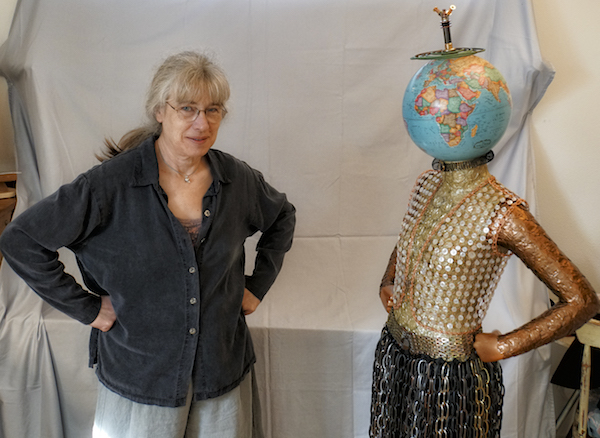
Author: Wendy Jones

  • From Detritus to Delight: Recycled Art Comes to WICA

    From Detritus to Delight: Recycled Art Comes to WICA

    BY WENDY JONES
    Whidbey Life Magazine Contributor
    March 1, 2017

    Beauty is said to be in the eye of the beholder, and appreciation of art often goes the same way. One person may herald a work of art as groundbreaking, important, or visionary, while another may dismiss the same work as junk.

    At the Whidbey Island Center for the Art’s Creative Recycled Art Projects (C.R.A.P.) exhibit, opening Friday, both will be true. The unifying element of each of the seven featured artists’ work is found/recycled/repurposed items used in ways that delight and surprise — making previously unwanted items something to be coveted.

    Exhibit visitors will be greeted by a variety of media and efforts, including jewelry, sculpture, shadow boxes, and woven creations — each as unique as the individual spirits and skills of the artists who created them.

    When artist Janet Pheifer is asked what drives her to create art from, in her own words, “crap,” she says, “There is a book in that answer.”

    Janet Pheifer with her sculpture “The World on Your Shoulders” (Photo by Marsha Morgan)

    Each of the seven women, all Island residents, use found and scavenged items to build three-dimensional expressions of what seems to be collectively understood and internalized:

    Everything has value. Everything has beauty. Everything belongs.

    Another similarity between the women is that each came into her artistic calling as part of a roundabout journey. Sarah Primrose, for example, began working in recycled art after studying display, advertising, and design at Fashion Institute of Technology in Manhattan and then moved into stage and set design, along with stints at Tiffany and Co.

    Jewelry by Sarah Dial Primrose: “Infinity Beerings” are made of smashed bottle caps, silver tabs, silver circles, copper findings and brads, and crystal beads. The “Wanderlust” necklace is made of an old rusted fragment, a wanderlust token, silver pull tabs, glass beads, an enamel butterfly, and an old silver ball charm. The “Found Religion” necklace is made of a smashed aluminum pull-tab top, verdigris cross, turquoise bead, and a faux pearl.

    Although Sara Saltee shares a name with Primrose, her path is very different. A self-taught artist with no formal training, Sara jokes that she became interested in making shrines and assemblages after an overly long stint in academia. But she has dabbled in art throughout her life.

    “As a kid, I often had a project going — collages, collections, paper cutting, and a phase of making those creepy dolls with faces out of pantyhose,” she says. “But I never thought that made me an artist. By my early 30s, I had committed to a minimum of 15 minutes a day of art-making and I’ve never stopped for close to two decades now.”

    Janet Pheifer finds herself somewhere in the middle of the road to artistic endeavors: her professional life melds with her art, as both involve breathing new life into tired items; even fabricating something new from nothing.

    “Life dictated a different path when I was young, and I went into the building trades as a carpenter,” she says. “I’ve been at it for 34 years. I’ve always had an interest in art and design, and building and remodeling involve both.”

    “N’s and M’s” by Janet Pheifer (Photo by Marsha Morgan)

    Some of the artists have formal training and some meandered onto their calling. A few create smaller scale art such as jewelry, while others are focused on large pieces of sculpture.

    In speaking with each of them, however, it becomes clear that there is a shared sense of wonder blended with nuts-and-bolts genius in the way they see and create. It is as if each of them is able to imbue the inanimate with a living spirit, moving them to protect and preserve the things others have discarded or ignored. Combine those human qualities with a pioneer woman’s instinct for extracting every last ounce of value from anything she touches, and it becomes possible to explain how the featured artists are able to spin beauty and meaning from random bits and pieces of detritus.

    Recycled art is a variation of an early 20th-century artistic movement known as assemblage. At that time, Pablo Picasso began adding found items and more pronounced three-dimensional qualities to flat canvas compositions. By the early 1960s, there was enough interest to warrant an exhibit focused on assemblage techniques at the Museum of Modern Art in New York City.

    Natalie Olsen’s work table as she creates “Peacock Spirit” using leaves, a peacock feather, and an ink-stained paper towel (Photo by Marsha Morgan)

    While breathing new life into castaway items is not a new trend, the seed planted by Picasso took root as the assemblage movement and now has blossomed into recycled art, aligning with enviro-centric 21st-century values (for a portion of the population, anyway).

    The exhibit, like the items that comprise the featured pieces, is set have multiple senses of utility, says WICA marketing manager Fritha Strand.

    “We love that the artists we are featuring are a collection of talented women, and that we are able to give them a chance to be heard and seen as a group of female artists,” she says. “That wasn’t our goal from the start, but it is a great thing for us to be able to do for (the artists) and the community. Also, it’s part of our plan to build out more gallery-style events after we invested in upgrades for lighting in the exhibit area.”

    “Foiled,” a copper loincloth by Natalie Olsen, is made of wine foils and topped with speaker wire. (Photo by Marsha Morgan)

    Above all, though, Strand feels the exhibit celebrates the Island residents’ orientation toward sustainability and environmental consciousness, placing those values on a pedestal, literally and figuratively.

    It speaks to Whidbey Islanders’ tendency toward environmentally conscious lifestyles and their reverence for the life force that comes from the island’s natural beauty. It can also be said that each artist exemplifies another trait of Islanders: their sheer dedication to rolling up sleeves, using what is on hand, and pulling it all together, creating in a unique result at the end of the day.

    These women know how to get the goods, get dirty, and get it done; flawlessly and with flair.

    More information

    Second Annual Creative Recycled Art Projects
    Whidbey Island Center for the Arts
    565 Camano Avenue
    Langley, WA 98260

    Featured artists

    • Buffy Cribbs
    • Katrina Hude
    • Natalie Olsen
    • Janet Pheifer
    • Sarah Primrose
    • Sara Saltee
    • Alicia Comne

    Cost

    Free. All art is for sale, with 30 percent of proceeds benefitting WICA.

    Hours

    Friday, March 3, from 5 to 7 p.m.
    Saturday and Sunday, March 4 and 5, from 1 to 5 p.m.
    Saturday and Sunday, March 10 and 11, from 1 to 5 p.m.

    Wendy Jones cut her professional teeth in print newsrooms, writing for a major metropolitan daily a couple time zones away. After too many years of chasing police cars and defense attorneys (and witnessing horrible examples of human suffering), she shifted into advanced marketing strategy. She is pleased to be writing on Whidbey Island, where she finds her car filled with notepads, index cards, and pens again, just as it should be.

    __________________

    Have a great story idea? Let us know at info@whidbeylifemagazine.org.

    WLM stories and blogs are copyrighted and all rights are reserved. You may link to this story. To request permission to use or reprint content from this site, email info@whidbeylifemagazine.org.

  • Kombucha: Brewing a Culture of Immortali-tea

    Kombucha: Brewing a Culture of Immortali-tea

    BY WENDY JONES
    Whidbey Life Magazine Contributor
    January  11, 2017

    Shawn Prickett’s addiction started as a small-scale activity. Like many addictions, the Greenbank resident said it began to escalate steadily, eventually becoming a full-time obsession. Soon, it took over his daily life and professional activities to the point where there was no turning back.

    “I couldn’t stop,” he says, eyes wide open.

    His addiction? Kombucha, a fermented tea drink thought to be an elixir of immortality, sustainer of life, and healer of grave illness with a history dating back to 400 B.C.

    “I got absolutely and madly obsessed with it,” he says, “I started out (brewing) one jar at a time. Then five jars at a time. Then 50 gallons. Now it’s about 250 gallons,” he says with a satisfied, entrepreneur’s smile.

    Man dispensing kombucha into bottle
    While Shawn Prickett’s Amrita Kombucha contains the same black tea, spices, sugar, and cultures as a home brewer, larger volume brings many complications. “I will continue to scale until I reach a point where I cannot keep the same quality standards for ingredients without pasteurization,” he said, indicating he still has room to grow. (Photo courtesy of Shawn Prickett)

    Today, you can find Prickett’s bottled Amrita Kombucha in local grocery stores and restaurants, and he hopes to expand beyond Whidbey Island retailers after finding a new production space that can handle the volume-based goals he is planning for the new year.

    Industry data indicates that kombucha drinkers are mainly female, age 25 to 55, well-educated, health-conscious, and exercise two to three times a week. But Prickett doesn’t believe kombucha drinkers are that homogeneous.

    “I don’t think there is a single demographic profile for kombucha. I know people of all ages and backgrounds who like it, and there isn’t a typical kind of person that I can describe. Really, it’s for anyone who wants to put something healthy into their body,” he says.

    The drink is part of a mystical tradition, but its components are common. Kombucha is essentially black tea, sugar, water, and spices that are combined and fermented for about a week to a month, depending on the brewer’s individual preference. 

    The magic ingredient is also a bit of a wildcard. The only thing elevating kombucha from a jar of run-of-the-mill sun tea that might have spent too long in the back of the refrigerator is the presence of a symbiotic culture of bacteria and yeast. Known as a SCOBY, the slimy mass can be bought commercially in a health-food store, mooched from a brewing buddy, or built from the ground up at home. The SCOBY brings life to the concoction in a very literal fashion.

    Shawn Prickett with a SCOBY in Amrit Kombucha’s Clinton-based kitchen facilities. They are on the small side, but have been adequate for his volume goals until recently. In January, Prickett plans to move into a larger space to allow for more volume to flow from fermentation tanks to bottles. (Photo courtesy of Shawn Prickett)

    Like any other fermented beverage, decisions about the baseline tea and spice combinations, balanced with the length of time the beverage ferments, alter the final product. Factors that are less controllable, such as fluctuations in temperature or stability of cultures, create opportunities for lightning-bolt success through experimentation — along with unforeseen chasms of failure — from batch to batch.

    Even perfect batches can be a bit controversial in terms of mass appeal. Kombucha is not always lauded for having an exceptionally pleasing flavor, to be certain. Some offerings express a more earthy flavor while others taste like vinegar. Nonetheless, there are legions of devotees addicted to the unique flavor, fueling the beverage’s $400-million market.

    People are drawn to specific favorite beers, wines, or spirits, which creates a huge opportunity for differentiation between products. Kombucha consumers are similar. Like its fermented cousins, flavor profiles of kombucha vary widely, making any individual flavor less likely to be universally accepted than the sodas or juices located near kombucha in a grocery display.

    Health benefits are an important driver that brings kombucha into shopping carts and homes and a reason some drinkers simply pinch their noses and take their “medicine” on a daily basis. The drink has been shown to be a strong detoxifying agent, protective antioxidant, powerful digestive aid, and healing joint builder. It is also thought to aid in building elasticity in skin and boosting the immune system.

    People say they report feeling energized and healthier when they feed their kombucha cravings. In fact, health benefits are the primary force that brought kombucha into prominence.

    Traditionally, “the tea of immortality” has healed kings and warriors, built energy, and guarded from illness. An intriguing tidbit of evidence supporting kombucha’s value as a preserver of human resilience came to light when researchers found that elderly residents of Chernobyl withstood radiation effects better after the melt-down due to their kombucha consumption.

    The kombucha marketplace has grown a great deal since it took modern shape in the 1990s, and the evolution continues, says Prickett.

    “A lot is happening with fermenting into a higher alcohol level. I would like to shift to an alcohol level of about 6 percent,” he says.

    A beverage that offers a health kick with, well, a kick? That could be an elixir of life, indeed!

    Wendy Jones cut her professional teeth in print newsrooms, writing for a major metropolitan daily a couple time zones away. After too many years of chasing police cars and defense attorneys (and witnessing horrible examples of human suffering), she shifted into advanced marketing strategy. She is pleased to be writing on Whidbey Island, where she finds her car filled with notepads, index cards, and pens again, just as it should be.

    __________________

    To read more WLM stories and blogs, click here. Have a great story idea? Let us know at info@whidbeylifemagazine.org.

    WLM stories and blogs are copyrighted and all rights are reserved. You may link to this story. To request permission to use or reprint content from this site, email info@whidbeylifemagazine.org.

  • For Some, Tattoos Heal From the Outside In

    For Some, Tattoos Heal From the Outside In

    BY WENDY JONES
    Whidbey Life Magazine Contributor
    Dec.  14, 2016

    Hayden Hixon’s mother is always with him. All he has to do is look to his right, and she is there in flesh and blood. In a way, at least.

    “This is for my mother,” he said as he was lying down on his stomach one Friday evening on a massage table in tattoo artist Eric Tunnell’s Dig It tattoo studio, located in downtown Langley.

    Man with tattoo on bicep
    Hixon’s in-progress mermaid composition is one of three tattoos he has commissioned from Tunnell. Each is different, but all represent his life thus far. His mermaid is a direct reference to his mother. “She doesn’t really like tattoos, but she loves that it’s about her,” he says. (Photo by David Welton)

    Hixon, a 20-year-old Clinton resident, got a warm look on his face as he gestured toward the raven-haired mermaid on his right shoulder.

    “She loves mermaids. They remind me of her, and also remind me of time we spent at my family’s beach house. So it’s part of my history, too.” Hixon said.

    By the end of the night, he would have black outlines of the next stage of the design that he and Eric had planned, a large, rather handsy octopus to encircle his bicep and keep his mermaid-mother company forever.

    Tattoos mean many things to many people and have a shifting history in terms of public opinion. At times, they have been used to mark royalty. Other times, they have designated someone as property. Some periods of history have seen tattoos as pure rebellion, while other times it has been a mark of the pious. But in their earliest form, their utility might surprise some people: a protocol for healing.

    Tattoo origin stories cannot be 100 percent proven, but if they’re true, it would seem that everything old is new again. Tunnell has seen transformations beyond the cosmetic after his clients come in for an ink session at Dig It.
    Tunnell is an artist who works in many types of media, such as the canvas on the wall behind him and wood/metal sculpture. Many artists can claim mastery of more than one material or format, but the number who can also claim skin as a medium is undoubtedly small. (Photo by David Welton)

    “I call people who come to me ‘patients,’ because that is really what they are. It isn’t just the medical nature of what I am doing. The work creates a human connection that is something special. A lot of times, it can be like a six-hour therapy session, depending on why someone is here,” Tunnell said.

    Maybe it isn’t the most sound and tested form of healing protocols, but tattoo artists have seen people walk into their studios broken and beat by things life has handed to them, and then standing taller and walking lighter on their way out.

    It could be said that the motorized whir of a tattoo gun is capable of stitching up a soul as its needle strikes through layers of skin. When the needle is lifted, it leaves behind a marked path and patterns that become permanent evidence of whatever life-changing incident, discovery of self, statement of truth (or vain desire) drove his clientele to seek healing, according to Tunnell.

    To date, tattoos found on an elderly man, whose body was found preserved in the mountains forming the Austrian-Italian border, are the earliest example of the practice itself. Iceman, as our early adopter of tattooing was dubbed, is believed to have lived in about 3,000 B.C. He stood about 5 feet 5 inches tall, with brown hair and a matching beard. When food and bacteria found in his stomach and physical patterns of both injuries and health are compared, Iceman seems to have lived a shepherd’s life in the mountains, where his mummified remains were unearthed in 1991.

    Iceman’s skin is punctuated with small tattoos dotting areas of his body that researchers determined to be likely sites of injury or arthritis. Some of these tattoos are found in spots that he could not have reached himself, and they match treatment patterns used in acupuncture (which, as a therapeutic practice, was not widely adopted until at least one to two thousand years after the good shepherd was alive).

    Tunnell is meticulous in applying an ink rendering of the next phase of “patient” Hixon’s tattoo. Tunnell sketched the image by hand on plastic wrap in advance, and then placed the original design around Hixon’s bicep. (Photo by David Welton)

    For Iceman, tattoos might have been just what the doctor ordered. And while a lot has changed between Iceman’s death and his recent rebirth into mummified fame, tattoos remain a go-to method for some to heal themselves from bumps and bruises to heart and soul. Others turn to tattoos out of vanity as some people turn to aesthetic medicine.

    It isn’t just the life experience of getting the tattoo that heals, according to Tunnell. The physical and spiritual aspects of tattooing wield a pretty hefty healing punch as well.

    “There’s something that happens to people when they’re getting a tattoo,” he says. “It can move someone into a different place. It can be like meditation or an awakening. Sometimes it looks like someone is trading one kind of pain for pain of a different sort. It’s almost like the physical pain helps burn off the emotional pain, and the emotional pain dissipates.”

    The artist’s level of concentration is deeply apparent in his facial
    expressions while he tattoos, even more apparent in the precision of his motions and, then clearly displayed in his final product.(Photo by David Welton)

    Visual cues of all kinds speak volumes without a single syllable being spoken. At times, though, a tattoo can leave room for people to speak directly about their own journey through life by moving others to ask questions that the inked images raise. Questions from others that are sparked by the tattoo open the door for talk therapy of a sort, and healing comes as part of those momentary connections, as well.

    Tattoo artist Andrew Schultz knows well how a visible tattoo leads to healing. His Greenbank studio, Black Mast Tattoo Company, has been serving up tattoos for about two years. His love of tattoos reaches back about 10 years, when he was getting his own ink. A tattoo on his neck is quite significant, placed in that visible spot in remembrance of his brother, who passed away when Andrew was about 17.

    “When I first got it, I wanted to be able to spread around the person my brother was. I wanted to have a chance to tell people what an amazing person he was. I didn’t want him to be forgotten.” Schultz says.

    “Now, I get a funny response to my answers when people ask about the tattoo. They say ‘Oh, I’m so sorry’ and I say, ‘I’m fine now.’ People look at me like I’m a horrible person, but the reality is that I really needed that tattoo after it happened because it helped me talk about it. That isn’t how I answered people a long time ago, but the tattoo helped me get to the place where I’m actually able to say that I’m OK,” Schultz says.

    In addition to driving conversation between strangers, the artists say the ties that bind them to their clients are truly unique. For Tunnell, that role brings a unique benefit to his own life experience. By his own account, the artist is not always the most outgoing chap in the room, and he enjoys the opportunity to join with other people in a way that is fruitful for all involved.

    While the level of precision can be stressful on the artist, and the level of pain can be outlandish for the patient, the shared discomfort builds a uniquely healing connection between both parties. (Photo by David Welton)

    “It’s a luxury for me to be able to talk with people like this. I have a huge appreciation for these chances for me to share experiences with other people. We all have our own journeys and all of them are different. Human connection is rare (in present times) and I think I’m lucky to be part of a person’s life in this way.” Tunnell says.

    Tattoos are a personal choice, for people who to get them, create them, and judge them. Love them or hate them, their place in history is long and as permanent as the ink used to make them.

    Whether the year is 3000 BC or nearly 2017, though, it would seem that there is evidence to support the humanness of tattooing, as well as proof of the ways tattoos might bring people together in dialogue. And that quality is both right on time and timeless.

    Wendy Jones cut her professional teeth in print newsrooms, writing for a major metropolitan daily a couple time zones away. After too many years of chasing police cars and defense attorneys (and witnessing horrible examples of human suffering), she shifted into advanced marketing strategy. She is pleased to be writing on Whidbey Island, where she finds her car filled with notepads, index cards, and pens again, just as it should be.

    __________________

    To read more WLM stories and blogs, click here. Have a great story idea? Let us know at info@whidbeylifemagazine.org.

    WLM stories and blogs are copyrighted and all rights are reserved. You may link to this story. To request permission to use or reprint content from this site, email info@whidbeylifemagazine.org.
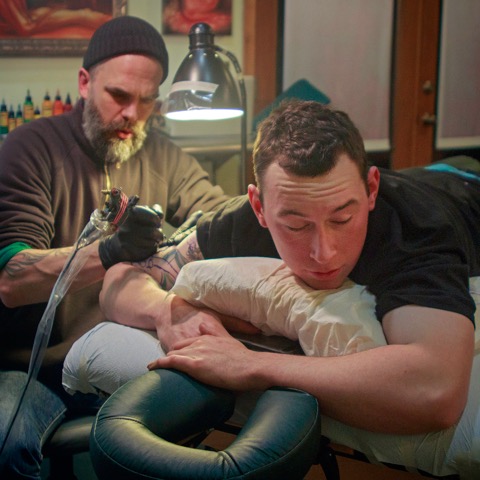
  • Rocks That Build Bridges (And Break Down Walls)

    Rocks That Build Bridges (And Break Down Walls)

    BY WENDY JONES
    Whidbey Life Magazine Contributor
    November 23, 2016

    Rock with map of Whidbey Island on it
    This rock was created as part of a gift basket awarded to celebrate the group reaching a membership milestone. (Photo by Wendy Jones)

    Bright spots in the world often show up in odd places and strange forms. Sometimes, the biggest of those spots fall into our paths at unexpected moments or come from a complete stranger. It’s always a thing of beauty when they reveal themselves in the exact right place and time to flip our entire outlook from stormy to sunny in a split second.

    Whidbey Island Rocks is a group dedicated to creating those serendipitous moments for locals and visitors. People create, then hide — or at times directly give — lovingly decorated rocks in locations all over the island. Some rocks carry images. Others carry a written message of love or encouragement. Some are created by children, who are developing their artistic ability while others come from the hands of Whidbey Island’s established artists. Regardless of appearance, the result is the same: these rocks are destined to deliver an anonymous hug and a smile to those who find them.

    Rock decorators and recipients are connected via a Facebook group managed by Oak Harbor residents Shelly and Scott Darnell. Inspired by a similar group established in Port Angeles, the Darnells didn’t imagine things would grow beyond a small group of their friends and family.

    “When we set up the Facebook page, I thought it would be a fun way for us to stay connected as a little group. Then I started noticing people that I didn’t even know liking the page and getting involved. It took on a life of its own and grew from there,” Shelly says.

    Bailey Darnell
    Bailey Darnell’s connection with the treasures she has collected as part of Whidbey Island Rocks is deep, just like the relationships she has built as part of her participation. (Photo by Wendy Jones)

    Today, the Facebook group has 17,500 members with more people joining daily.

    Scott and Shelly work hard managing the page as part of their busy family and professional lives. While Shelly was primarily responsible for getting the group started, Scott has moved over to doing more of the heavy lifting to keep things running. Every week, he plans and coordinates events that bring group members face-to-face.

    Their daughter Bailey, 11, was the catalyst who put the social experiment in motion after she became aware of a similar group that had recently popped up in Port Angeles. “I get a little hyper-excited sometimes, and I was excited to start it,” says Bailey. “You know how moms can be. I had to keep asking her over and over, but finally, she got it done,” she adds.

    As Bailey shows guests around the family home, her enthusiasm for the rock movement  becomes easy to understand. There are multiple framed examples of Bailey’s artwork, and her talents have earned her impressive accolades for her young age.

    Another thing that becomes evident is how much Bailey loves a good memento. Any item that falls into her field of vision has a unique story attached to it that she expresses with touching detail. To Bailey, each seemingly random artifact is part of her history, and she proves this by explaining its significance with a contagious, effervescent energy. Painting rocks that serve up a smile on impact, and then become part the finder’s history in a tangible form, is right up her alley.

    Shelly Darnell and her daughter Bailey painting rocks
    Shelly Darnell and her daughter Bailey are a team when it comes to painting rocks for Whidbey Island Rocks activities, sharing feedback and suggestions for repairs when things don’t go according to plan (Photo by Wendy Jones)

    Sending good vibes into the world is something the Darnells take seriously, and the whole family is part of the team. (While Shelly, Scott, and Bailey are more public-facing, Bailey’s big brother Brendon, 16, lends his technical skills to keep the digital aspects of the project running smoothly.) Whidbey Island Rockers can tell numerous stories of the way rocks have changed lives, and pivoted outlooks or made strangers into friends. Even a skeptic would have a hard time arguing against that point after hearing a few anecdotes of happy endings the rocks have facilitated, according to group members:

    • A couple on the verge of divorce found a rock while walking the beach. The walk was meant to be a time to discuss their separation, but the rock turned the tide on the conversation and sparked a new mutual interest.
    • A woman found Whidbey Island Rocks as a new mother and lost 20 pounds by hiding and finding rocks (and added a nice outdoor break to her routine).
    • Numerous visitors found a rock by accident, investigated Whidbey Island Rocks, and created their own versions upon returning home.
    Rocks with chickens painted on them
    Whidbey Island Rocks member Barb Cope holds a special spot in the Darnell family’s hearts, and also in their kitchen. Her signature Chicken Rocks have their own place of honor. (Photo by Wendy Jones)

    On a more local level, people are enriching their own lives by gaining friends (and artistic confidence) through the group. Coupeville resident Barb Cope exemplifies this. She hadn’t so much as touched a paintbrush when she got involved. A friend added her to the Facebook group when there were fewer than 200 members. Today, she is a “rock star,” known for dispensing an endless supply of encouragement and support to her fellow group members and also for her rocks, which are emblazoned with her signature image: chickens. She underplays her fame but loves having a personal brand that works in the economy of painted rocks.

    “People ask if I will sell them one, and I don’t want to do that,” Cope says. “I am not an artist. I like trading them. Sometimes it’s someone I know and sometimes it might be a complete stranger. It’s nice to be able to create something that people appreciate.”

    For Cope, being involved with Whidbey Island Rocks provides serenity and variety when life gets crazy. As much as she loves spending time with her family, tending her garden, and other hobbies, the group gives her a special outlet for connecting with her own thoughts and the world in general.

    Rock in drift wood
    While some rocks are hidden in urban locations, hiding them on beaches and forests is most common. It is a special treat to find a bright gem like this tucked amongst the natural beauty. (Photo by Wendy Jones)

    “It is a soft place to land. When I am doing this, I don’t have to think about politics or the pressures in the world. For me, it’s a wonderful, uplifting place where every person and their art can be celebrated. I have met amazing people that I simply wouldn’t have come across in my day-to-day life. It’s like a family.”

    If Whidbey Island Rocks is a family, the family business of bringing happiness in unexpected packages is thriving. Learn more about how to get started here, and watch for rocks as you go through your daily routine. Remember, bright spots come when you least expect them!

    Wendy Jones cut her professional teeth in print newsrooms, writing for a major metropolitan daily a couple time zones away. After too many years of chasing police cars and defense attorneys (and witnessing horrible examples of human suffering), she shifted into advanced marketing strategy. She is pleased to be writing on Whidbey Island, where she finds her car filled with notepads, index cards, and pens again, just as it should be.

    __________________

    To read more WLM stories and blogs, click here. Have a great story idea? Let us know at info@whidbeylifemagazine.org.

    WLM stories and blogs are copyrighted and all rights are reserved. You may link to this story. To request permission to use or reprint content from this site, email info@whidbeylifemagazine.org.