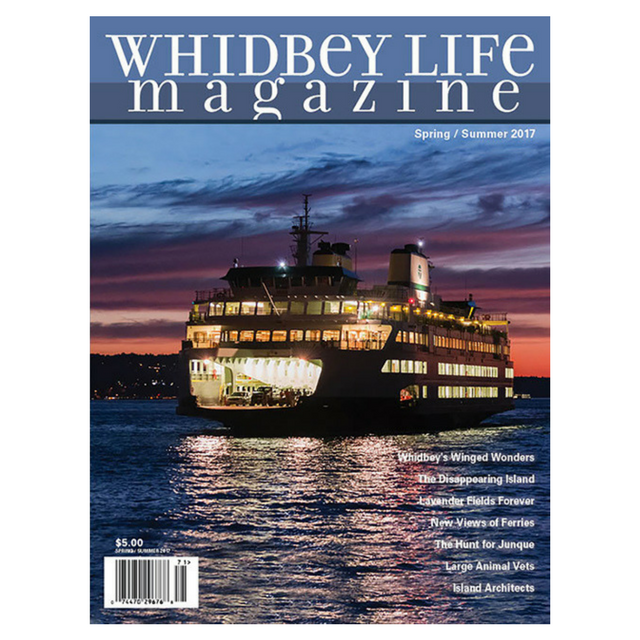
This article is from the Spring/Summer print issue of Whidbey Life Magazine. You can find out where to get a copy of your own at the end of the article.
BY HARRY ANDERSON
Whidbey Life Magazine Contributor
August 9, 2017
On Whidbey Island, we’re outnumbered; there are more domesticated animals than humans. That includes horses, cattle, goats, sheep, alpacas, and llamas as well as dogs, cats, parrots, parakeets, turkeys, and chickens. Given the island’s rural-agricultural heritage, and the passion of many new arrivals to live the “island dream” on a few acres with trees and a pasture, that should come as no surprise. Nobody keeps an exact tally, but that animal-to-people ratio is likely to grow—as will the need for healthcare for all those critters.
Whidbey has a dozen or so veterinarians who attend to our feline, canine, and feathered pets. But who takes care of the bigger ones? Only a small number of vets have that specialty, and they have some unusual stories to tell.

Dr. Ken Leisher, who has practiced on Whidbey for 20 years, recalls the time he was asked to help get an upside-down horse out of an old bathtub. The tub had been used as a water trough in a pasture. Somehow, the horse stumbled and flipped into the tub. “We managed to pull it out and get it back on its feet,” Dr. Leisher says. “It had some minor injuries but nothing serious. All in a day’s work.”
Dr. Robert Moody, a Central Whidbey large animal vet since 2002, was called to a wet pasture in Maxwelton Valley, where several cows had become stuck in deep mud. “We got some rope and pulled them out. Almost like towing stuck cars,” he says.
Dr. Sandi Farris, who arrived on Whidbey in 2011 after practicing for more than a decade in Alaska (and also participating in the annual Iditarod dogsled race there), took care of a pet goat on Whidbey whose rear foot had been accidentally stepped on and crushed by its “best friend,” a horse. “I had to amputate the foot above the ankle, but the goat’s adjusted to it and is doing fine,” she says.

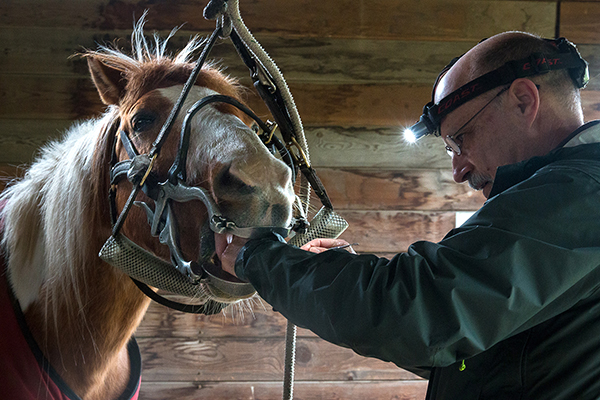
Of course, those are the rare “war stories” usually told to a rapt listener over a cup of coffee. Most of the work done by big animal vets on Whidbey is much more predictable. Annual check-ups. Vaccinations. Dental care. Hoof treatment. Antibiotics and other medications for parasites, respiratory problems, and abdominal pain. Remedies for cuts and bruises. Birthing problems. Euthanasia. The list goes on.
Unlike small animal vets, the ones who treat big animals must go where their patients are, not the other way around. They need to bring virtually all their equipment and medications with them. Leisher, Moody, and Farris—Whidbey’s “Large Animal Big Three”—all arrive in large, well-equipped vehicles that carry portable X-ray and ultrasound machines as well as bandages, syringes, medications, and even power tools for grinding teeth. Only complicated cases that might require surgery or other advanced treatments are handled in their “offices”—barns designed to provide a sterile environment.
Moody, Farris, and Leisher all have barn offices in Central Whidbey, which is convenient for owners who must transport sick large animals that may weigh 1,500 pounds or more. Moody operates Central Whidbey Veterinarian Services, Farris operates Harmony Veterinarian Services, and Leisher is associated with Mount Vernon Veterinary Hospital, although his practice is primarily on Whidbey Island.

One drizzly morning last winter, Moody was called to a Central Whidbey farm, where Summer, a 13-year-old mare, had been experiencing respiratory problems. As a result, she was in a cranky mood and didn’t much like it when the vet tried to take her temperature and listen to her heart and lungs with his stethoscope. She jerked the reins sharply, which momentarily knocked the vet off his feet and down into the mud. His jeans were dirty, but other than his pride, he was unhurt.
The diagnosis was horse “heaves,” a common allergy-based condition similar to asthma in humans and usually caused by breathing dust or other particles in the air. The treatment was a steroid shot, a bronchial dilator medication, and an antibiotic. Moody wrote up the diagnosis, treatment plan, and bill for his services on the laptop in his pickup, printed it out on the printer behind the passenger seat, talked with the owner, and then headed out to his next appointment.
A century or more ago, most of the big animals on Whidbey were dairy cows, oxen, and workhorses. No more. There are no cattle dairies left; there is one producing goat’s milk in North Whidbey and one producing sheep’s milk in Clinton. According to a recent Whidbey Island Conservation District survey, only three farms on the island still have 100 or more head of cattle. A few have 100 or more head of sheep, and one has 100 or more hogs. To be sure, there are still lots of farmers with smaller herds, but large-scale livestock production on Whidbey has dropped significantly in the past few decades.

As a result, the vast majority of patients treated these days by big animal vets on Whidbey are horses. All three doctors said horses represent at least 80 percent of their business. Farmers who still raise cattle, sheep, hogs, and other animals for sale generally don’t need to call a vet unless an emergency develops. The farmers typically handle things like birthing, vaccinations, and simple disease treatments themselves.
Not so with horses. According to the vets, the typical horse owner on Whidbey is a middle-aged woman. “They tend to be women who are done with their careers. Their kids are grown up. They have the economic resources to buy a horse and learn to ride, or re-learn what they loved to do as a girl,” Farris says. Today’s island horse owners often move here to begin such a “second act” in life. They may buy a few acres, acquire one to five horses, and then quickly come to understand just how much is involved. They typically treat their horse like a new child, and they may call their vets about every sneeze or symptom.
In that respect, Whidbey is different from many rural, traditional horse-owning areas. Leisher practiced in Yakima for 12 years before coming to the island. “There is more of a ‘cowboy’ culture there. People have been around horses for many years or maybe their entire lives,” he said. “There are fewer ‘newbies’ and more longtime owners who tell me, ‘Don’t worry about that, doc’.”

Educating horse owners about how to care for their animals is an important part of a day’s work for the vets here.
Jerry and Connie Lloyd were “newbies” more than a decade ago when they moved to their seven and a half-acre property near Greenbank. Today, their hobby has grown to include four horses, a beautiful pasture area with graveled paddock, a manure composting area, and even a covered arena for riding and training. They have become popular mentors for new horse people on the island.
The first thing prospective owners have to learn is how to manage their land, especially the mud that comes in winter and can be harmful, the Lloyds observe. “They need to take the time to talk with the Conservation District and others to figure out drainage and other issues, and then come up with a farm plan,” Jerry Lloyd says. “My advice is to buy a nice piece of property that’s fairly flat and has the potential for pasture, and also has a house you like or can remodel.”
And they need to understand two important things, he says. First, keeping a horse costs about $2,500 a year not counting surprises like illness or injuries. Second, one horse will produce eight or more tons of manure per year, and you have to know what to do with it.
Despite the drawbacks and expense, keeping big animals as beloved pets isn’t holding back people on Whidbey. Christine Williams, a retired university researcher who holds a veterinary degree from her native Great Britain but never practiced, retired to South Whidbey a dozen years ago. She currently keeps 25 sheep ewes on her property, but not for wool or meat. “They’re my lawnmowers,” she says with a laugh. She often mentors others who need help tending their adopted sheep, goats, and other animals.
“People who get into gentleman farming with sheep, goats, or horses learn quickly that they can spend a lot of time and money,” she says. “You’ve got no time for that quiet cabin in the woods. No money for a boat. You can’t take that long cruise or even go to a movie without a ‘sitter.’ But the good news is, you won’t have to buy many nice new clothes. Old, worn farm duds are all you end up wearing.”
Harry Anderson spent his 40-year career in journalism and corporate public relations. He worked for the Los Angeles Times, Paramount Pictures, and Tenet Healthcare. Today, he gardens and writes for the sheer joy of it for the Whidbey Examiner and Whidbey Life Magazine.
Marcia Wesley lives in Freeland with her husband and Bernese Mountain dog. When she is not working in Redmond as a psychologist, she is pursuing her other passion, photography.
Read the other stories published this week
__________________
 To enjoy more articles from the print issue of Whidbey Life Magazine, purchase a copy at local and off-island retailers or receive it in the mail via subscription.
WLM stories and blogs are copyrighted and all rights are reserved. You may link to this story. To request permission to use or reprint content from this site, please contact us.