Author: Lisa Kois

  • The Future of the Ancient Giants and the Price of Camping at South Whidbey State Park

    The Future of the Ancient Giants and the Price of Camping at South Whidbey State Park

    BY LISA KOIS
    Photos by David Welton
    Whidbey Life Magazine Contributor
    April 6, 2016

    When the Washington Department of Natural Resources (DNR) created the precursor to South Whidbey State Park, it chose the most idyllic spot for camping, in the middle of the largest stand of old growth trees. Now, it is one of the only stands of old growth trees left on Whidbey Island. The scattered giants are testaments of what once was: the great forests of the Pacific Northwest. But the now 20-acre campground, with more than 40 campsites, has become incompatible with the environment.

    Should the trees stay and camping go? Or should camping stay and the trees go?
    Should the trees stay and camping go? Or should camping stay and the trees go?

    So the question is, who stays? Camping? Or the trees?

    A large, healthy looking Douglas fir in the campground sounded the alarm when it toppled over one still night in March 2015. Park rangers became concerned that there might be other hard to detect hazard trees in the campground. Washington State Parks closed camping in 2015, pending an evaluation. The evaluation confirmed that many of the trees were indeed diseased. Thus began a four part, public “Classification and Management Planning” process to determine the future of the trees and camping at the park.

    The South Whidbey State Park Campground was closed in 2015 due to concerns about tree health.
    The South Whidbey State Park Campground was closed in 2015 due to concerns about tree health.

    Some of the trees suffer from Schweinitzii Rot, also known as cow pie fungus, which rots the tree from inside the heartwood out, degrading the structural integrity of the tree. Others are suffering from Laminated Root Rot, which attacks the roots of the tree, impairing the ability of the tree to take in nutrients and causing instability. Schweinitzii and Laminated Root Rot can be hard to detect, and are virtually invisible to the untrained eye.

    While decay is a natural and important part of forest ecosystems, the campground likely sped the process.

    Decay is a natural and important part of old growth forests, providing habitat for many species, including endangered species like the Great Horned Owl and Marbled Murrelet.
    Decay is a natural and important part of old growth forests, providing habitat for many species, including endangered species like the Great Horned Owl and Marbled Murrelet.

    Human impact hastens the decline of trees. Vehicle and foot traffic compacts soil around root systems, stressing trees and leaving them vulnerable. Wounds caused during development open gateways for pathogens, as do the unknowing whacks of campers’ hatchets and axes, and nails driven into trees to support tents, tarps and clotheslines.

    Inevitably, we may be destroying that which draws us to wild places and campgrounds like the one at South Whidbey State Park.

    Enchanted Forests

    The Pacific Northwest old growth forest is the stuff of which magic is made, and old growth stands like the one at South Whidbey State Park is what is left of that magic.

    Stands of old growth trees, like the one at South Whidbey State Park, are all we have left of the icon of our region – the Pacific Northwest Old Growth Forest.
    Stands of old growth trees, like the one at South Whidbey State Park, are all we have left of the icon of our region – the Pacific Northwest Old Growth Forest.

    Painted 100 shades of green. Garlanded by feathery wisps of blue green lichen on giant trees. Blanketed by the mossy down of the forest floor, where iridescent red, pink, yellow and orange fungi play peek-a-boo through the seasons. One needn’t reach too far in one’s imagination to see dancing sprites and forest fairies in the fairy tale world of an old growth landscape.

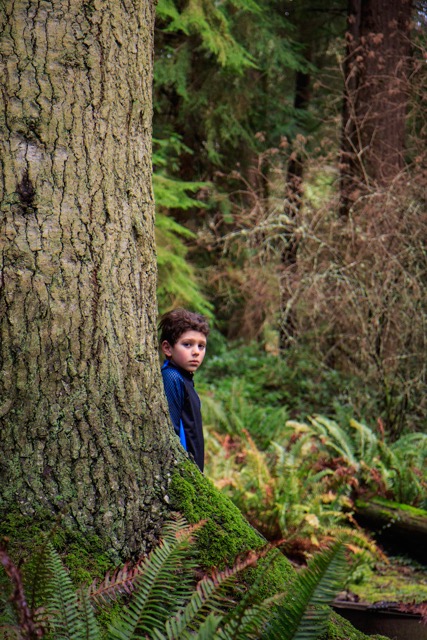
    Like forest sprites, the students of the Calyx School are home in the forest of South Whidbey State Park.
    Like forest sprites, the students of the Calyx School are home in the forest of South Whidbey State Park.

    But magic is not the exclusive domain of the imagination. Old growth stands are full of biological magic.

    Take, for example, fungus. With a cellular structure more akin to an animal than a plant, fungi create an underground information superhighway to share and exchange information between plants. And lichen, a hybrid species of algae and fungi, hangs in the highest reaches of old growth trees and is as old or older than the trees themselves, but with deep sea algae ancestors. Over 100 million years old, horsetail is considered a living fossil. And the virtually indestructible Tardigrade, also known as the water bear or moss piglet, is a tiny eight-legged animal that dwells in moss and can survive extreme conditions such as cold, fire, pressure, or radiation that would kill most known life forms.

    Our old growth forests, and the few remaining old growth stands, are full of unfathomable biological miracles. They are full of magic.

    Pacific Northwest old growth forests range in age from 200 to 1000 years old. Home to thousands of species of trees, plants, fungi, arthropods, lichen, birds, mammals and microorganisms, some of these species exist nowhere else on earth. The Pacific Northwest old growth forest is an oxymoron. It is simultaneously dead and ever so alive, depending on rich decaying matter like nurse logs and standing snags to sustain the rich cycle and diversity of life.

    The diversity of tree species, and the size and age of trees of our old growth forests are unmatched by any other forests in the world. Some forests, such as California’s Redwood Forests, have larger trees of a single species, and some have older trees of a single species, such as the Bristlecone Pine; however, only the Pacific Northwest old growth forest has a variety of tree species – Douglas Fir, Western Hemlock and Sitka Spruce – that grow very large and very old.

    This diversity of very large, very old trees contributes to another unique feature of our old growth forests, which is the sheer amount of biomass, the weight and density of living organisms that call the forest their home. Found in parts of Northern California, Western Oregon and Western Washington, such density of life and diversity occurs nowhere else in the world.

    Diversity is the fountain of youth for the Pacific Northwest old growth forest, sustaining more life than any other forest in the world.
    Diversity is the fountain of youth for the Pacific Northwest old growth forest, sustaining more life than any other forest in the world.

     “Unless”

    While change is a natural part of old growth ecosystems, not all change is natural. One thing we may be collectively learning through mass extinctions and melting glaciers is that some change is irreversible. There are some things that just don’t come back. At least not in the foreseeable future, in the centuries to come. Old growth trees are part of this group.

    Calyx School, located in the park, is an academic program for ages 5 – 10 with lessons that include naturalist trail hikes, ecological surveying and stewardship of the park. Its mostly outdoor, nature and arts based curriculum is science rich and supports interdisciplinary learning.

    Today, the older Heartwood students of Calyx are outside preparing for a staged reading of “The Lorax” by Dr. Seuss. The sun is shining and the group is joyful, as they read their parts in turn, helping each other and giggling along the way. This will be the Calyx contribution to Whidbey Earth Day celebrations on April 23. They also hope to perform “The Lorax” in the amphitheater at the Park itself to inform the Park’s public decision-making process. Should the trees go and camping stay? Or should camping go and the trees stay?

    As the group reaches the story’s apex, and the students’ reading becomes more passionate, the words seem to echo among these ancient giants. “Unless,” the students chorus, “Unless someone like you cares a whole awful lot, nothing is going to get better. It’s not.”

    “Unless someone like you cares a whole awful lot…”
    “Unless someone like you cares a whole awful lot…”

    Editor’s Note: Please scroll down for more photos by David Welton of the South Whidbey State Park Forest.

    Lisa Kois has a long relationship with South Whidbey State Park. In 1977, her grandfather helped save the old growth trees of what was then the Classic U Forest, which became part of South Whidbey State Park in 1985 after a lengthy legal battle. Lisa now runs Calyx School, the 347-acre classroom at South Whidbey State Park, where she spends her days with the Calyx students, learning from and caring for the Park. 

    Stairway to nowhere

    Feb112016_0012

    Shelf Mushrooms, fallen tree

    Feb112016_0049

    Picnic Table

    Danger Tree

    ___________________________

    CLICK HERE to read more WLM stories and blogsHave a great story idea? Let us know at info@whidbeylifemagazine.org.

    WLM stories and blogs are copyrighted and all rights are reserved. Linking is permitted. To request permission to use or reprint content from this site, email info@whidbeylifemagazine.org.

  • Dance, Community and Artistry over 23 Years: Whidbey Island Dance Theater’s ‘The Nutcracker’

    Dance, Community and Artistry over 23 Years: Whidbey Island Dance Theater’s ‘The Nutcracker’

    BY LISA KOIS
    Whidbey Life Magazine Contributor
    December 9, 2015

    The Nutcracker” opens Friday, Dec. 11 and runs through Sunday, Dec. 20 at South Whidbey High School Performing Arts Center. For more information and tickets, visit http://www.widtonline.org/.

    If you think Whidbey Island Dance Theater’s (WIDT) “The Nutcracker” is just another cheesy, small-town production of an overdone holiday classic, you are mistaken. The only cheese to be found in this production is in the Battle Scene of Act One, when two toy soldiers wield a large block of it. The soldiers, who have come to life to defend the young protagonist, Clara, from the wicked Rat King and its minions, successfully entice two of the pesky (albeit adorable) knee-knocking and tail-swinging baby mice onto the electric-car-sized mousetrap. Snap goes the trap, and off they go as the battle continues.

    Grace Colby as The Rat King. (Photo by David Welton)
    Grace Colby as The Rat King   (photo by David Welton)

    In the same way that Whidbey Island “small town” blends committed localism with a cosmopolitan flare, WIDT’s homegrown Nutcracker combines strong community rootedness with sophistication. Filled with insects and forest creatures, tap dancing, acrobatics and ballet, WIDT’s “The Nutcracker” is a local take on the classic ballet story and includes professional dancing, stunning sets, ingenious props and elaborate costumes.

    WIDT Company dancer Faith O’Brochta with choreographer and guest dancer Bojohn Diciple, (Photo by David Welton)
    WIDT Company dancer Faith O’Brochta with choreographer and guest dancer Bojohn Diciple   (photo by David Welton)

    “It’s the best of both worlds,” explained Co-Assistant Artistic Director Britany Falso. “You get to see super cute little kids, and you get to see professional dancing.”

    Falso, following her studies at Cornish College of the Arts, now dances professionally with DASS Dance in Seattle. Although this is her first year as assistant artistic director, she has years of experience with WIDT’s ‘The Nutcracker’ and has danced almost every role. Like many young dancers who begin to dance soon after they begin to walk, Falso began dancing at the age of three at Island Dance and Gymnastics and eventually spent eight years as a member of WIDT’s pre-professional dance company.

    What keeps professional dancers and choreographers like Falso coming back? “I don’t know what it is exactly. There’s something magical,” said Falso. “I can’t help but want to be involved. It’s my community. I just love it.”

    “The Nutcracker” inspires loyalty amongst the entire cast and crew. There are 76 cast members this year. Some have performed for as many as 20 years. Even the young dancers have danced consecutively for three, five, eight or ten years.

    Charlene Brown, founder of WIDT and Island Dance, is a large part of that magic, and one of the reasons dancers return. Although Brown engenders love and loyalty amongst her dancers and the community, she is quick to point to the large cast of WIDT board members, dancers, artists, parents and children who create the magic year after year. “Without their dedication and sacrifice to commit to our show, there wouldn’t be one,” Brown said. It’s her 23rd year producing “The Nutcracker.”

    “You’ve got to get your kicks up,” yelled Brown at the first onstage rehearsal for the 2015 production of the holiday classic. On this particular Saturday, there was no heat in the high school auditorium, and dancers were bundled. It was also cold and flu season, and many of the dancers were battling colds. Nonetheless, they pirouetted, chasséd and jetéd across the stage. They were there to rehearse, even if they couldn’t breathe.

    Foot attire in an unheated auditorium. (Photo by David Welton)
    Foot attire in an unheated auditorium   (photo by David Welton)

    During rehearsals, the much-loved Brown watched every move and coached dancers, young and old. The youngest dancer is five years old, the oldest over 70. WIDT company dancers are middle- and high-school age.

    “Don’t itch or twitch!” Brown reminded the “itty-bittys,” as she affectionately calls the youngest dancers. Rehearsals are long—for some, as long as seven hours—and require extreme focus, athleticism, endurance and grace.

    Members of the Whidbey Island Dance Theater, a local pre-professional dance company. (Photo by David Welton)
    Members of the Whidbey Island Dance Theater, a local pre-professional dance company    (photo by David Welton)

    What makes WIDT’s version of “The Nutcracker” special is what Falso calls “our twist on the story. It’s more Whidbey Island-esque. Ours is more of an enchanted forest, with dragonflies, bees, butterflies, swallowtails and forest creatures. We have traditional elements, but there is always something new and different.”

    This year, there’s a new Godfather Drosselmeyer as Ethan Berkley takes on the iconic role for the first time. When asked how his Drosselmeyer will differ from Lars Larson’s much loved Drosselmeyer, a role Larson played for six years, Berkley thought for a moment, laughed and replied, “I have a beard.”

    Ethan Berkley as Godfather Drosselmeyer practices his magic. (Photo by David Welton)
    Ethan Berkley as Godfather Drosselmeyer practices his magic.   (photo by David Welton)

    “Do you know the series “Doctor Who”? I feel like I am stepping in as the new Doctor,” explained Berkley, who comes from a theater background. Berkley is used to spoken lines and cues. He admits that he sometimes makes up lyrics and sings along in his head. As a ballet, “The Nutcracker” traditionally contains no dialogue.

    When asked about other new aspects this year, Brown said she is excited to unveil the snow castle that artist and parent-volunteer Val Haggenes designed, built and painted. “Parents like Val—and there are many—keep our show moving forward,” said Brown.

    This year, WIDT has teamed up with Good Cheer and South Whidbey and Coupeville School Districts in an effort to provide more than 500 free tickets to children and families who would otherwise not be able to attend the show.  To give a gift of “The Nutcracker,” visit the WIDT website.

    Lisa Kois, co-founder of the arts and nature based Calyx School, once doubted that the WIDT version of “The Nutcracker” was as good as friends and family said. She was mistaken. For more information about The Calyx School, visit: calyxcommunityartsschool.wordpress.com.

    _______________________

    CLICK HERE to read more WLM stories and blogs. Have a great story idea? Let us know at info@whidbeylifemagazine.org.

    WLM stories and blogs are copyrighted and all rights are reserved. Linking is permitted. To request permission to use or reprint content from this site, email info@whidbeylifemagazine.org.

  • If the Land Could Talk—Thank You, Whidbey  Camano Land Trust

    If the Land Could Talk—Thank You, Whidbey Camano Land Trust

    BY LISA KOIS
    Whidbey Life Magazine Contributor
    December 24, 2014

    If the land could talk, oh—the stories it would tell: Classic legends of life and death, rebirth and renewal… Epic poems of love and survival… Stories of adventure, hardship and perseverance… Songs of endurance…

    Libby Beach, from the Land Trust's 2015 calendar   (photo courtesy of Brian Schneider)
    Libby Beach, from the Land Trust’s 2015 calendar (photo courtesy of Brian Schneider)

    Some believe that the land, trees and wildlife can, and do, talk and that most humans have lost the ability to hear what the land has to say… To listen to the trees… To gather stories from the rocks… To hear the sweet song of the prairie…

    The people who make up and support the Whidbey Camano Land Trust—staff, members, volunteers, land owners and donors—can and do hear the land.

    And the Land Trust, like Dr. Seuss’ famed Lorax, speaks for the land—for the trees, tidelands, farms, wetlands and prairies. And they help us all hear what the land has to say.

    Since its founding in 1984, the Land Trust has permanently protected 76 properties, comprising more than 7,800 acres of land on Whidbey and Camano Islands. More than 7,000 acres of this has occurred in the last 11 years under the leadership of Executive Director, Pat Powell, and her professional staff.

    (photo courtesy of Land Trust staff)
    (photo courtesy of Land Trust staff)

    The Land Trust’s mission is to actively involve the community in protecting, restoring, and appreciating the important natural habitats and resource lands that support the diversity of life on our islands and in the waters of Puget Sound.

    Albert Heath, the Land Trust’s creator, wanted to save his land forever and he needed a land trust to hold the conservation easement; a conservation easement protects land from development while allowing the property owner to continue to own or sell the land. Heath created the Whidbey Camano Land Trust and donated a conservation easement to the Land Trust, forever protecting Ebey’s Bluff Trail and ensuring access to the public. Ebey’s Bluff Trail is one of the most visited trails on Whidbey Island.

    Heath’s is not an uncommon story. It is the paradox of private land ownership. Landowners do not live forever. And yet over a lifetime, or sometimes over generations, a deep bond with the land grows. Whether it’s a connection to open spaces, tall trees, clean water or one’s heritage and way of life, landowners often come to realize that although they cannot live forever, their love for the land can. And so they turn to the Land Trust to help translate that love into legal protection. That is one of the ways the Land Trust accomplishes its mission—through partnerships with landowners.

    During the last 30 years, the Land Trust has grown from an all-volunteer organization working out of the homes of its members into a nationally accredited land trust—a status that recognizes standards of excellence and has been conferred on only about 15 percent of land trusts nationally.

    A large part of the Land Trust’s success is its professional staff—experts in land protection, land management, ecology, conservation and finance. Despite its land-based mission, most of the Land Trust staff is tied to their computers, telephones and desks much of the time. So they make a special effort to get out of the office and onto the land, whether through staff meetings on Land Trust land, tours of different properties, special events or staff development.

    I caught up with the Land Trust’s 10-person staff one windy morning at Fort Casey last week, along with Whidbey Life Magazine photographer, David Welton, who was leading a photography workshop for the group.

    Whidbey Camano Land Trust Staff   (photo courtesy of David Welton)
    Whidbey Camano Land Trust Staff (photo courtesy of David Welton)

    The Land Trust’s success depends on its staff’s ability to capture and convey the stories of the land so they can engage the community, expand membership and secure large grants. Compelling photos can make all the difference, particularly when time is short and stakes are high in the competitive grant process.

    The organization’s success in securing large grants has made local dollars stretch much farther. Every dollar donated by the community is worth $24 in land value because the Land Trust is able to leverage community dollars to help secure large million or multi-million dollar grants. In order to do this, staff members need all the tools in their toolbox to be sharp and ready so, on this day, they are sharpening their photography skills.

    Welton guides staff members first to the beach and then to the forest, where they practice the skills he has taught in an in-house session at the Land Trust’s Greenbank Farm office. At Fort Casey the staff is learning what it means to get their cameras off automatic mode and to adjust the ISO, aperture and shutter speed so that they can take technically excellent documentary photos. It’s not an easy or necessarily intuitive process. There is the science of it—and the art.

    LT staff practice
    Members of the Land Trust staff practice their technique. (photo courtesy of David Welton)

    “The hands-on application really helps,” Janelle Castro, the Land Trust’s Outreach Manager, told Welton. “I must admit I was confused when you were explaining it all, but now it’s starting to make sense,” she said.

    Janelle Castro focuses her frame. (photo courtesy of Land Trust staff)
    Janelle Castro focuses her frame. (photo courtesy of Land Trust staff)

    Welton agreed that nothing beats hands-on learning, which is why he took Castro and her colleagues out on the land to learn.

    It’s often the Land Trust that plays that role, getting people out on the land through tours, work parties and stewardship projects. At a recent work party, volunteers between the ages of 12 and 85 planted 46,000 native prairie plants. But today, it’s the staff’s turn to be guided through the forest—learning techniques to better capture and convey the story of the land so they can continue their work, protecting the iconic lands of Whidbey and Camano islands.

    (photo courtesy of Land Trust staff)
    “What we learned!” (photo courtesy of Land Trust staff)

    Image at top: David Welton demonstrates technique to Ida Gianopulos, Carrie Viers, Vicky Riemer and Janelle Castro. (photo courtesy of Land Trust staff)

    After 13 years in South Asia working as a human rights lawyer, writer and documentary filmmaker, Lisa Kois returned to Whidbey Island with her daughter and founded Calyx Community Arts School, the 347-acre classroom at South Whidbey State Park. She believes passionately in the transformative powers of nature and the arts.

    ________________

     CLICK HERE to read more entertaining and informative WLM stories and blogs.

    WLM stories and blogs are copyrighted and all rights are reserved. Linking is permitted. To request permission to use or reprint content from this site, email info@whidbeylifemagazine.org.


  • Anne Smidt, Encaustic Painter, in Summer Art Tour

    Anne Smidt, Encaustic Painter, in Summer Art Tour

    BY LISA KOIS
    Whidbey Life Magazine Contributor
    August 27, 2014

    Encaustic artist Anne Smidt describes herself as a tech nerd. She came to art after a career in the tech industry. It was her encounter with encaustic painter Michel Tsouris during the 2005 Whidbey Studio Tour that helped steer Smidt down a different path. She was immediately taken with Tsouris’s work and told her she’d be interested in taking a class if Tsouris ever offered one.

    Smidt took the class and, by 2006, she was painting. The experience, she said, was transformative—helping her move out of a reclusive year grieving the loss of her stepfather in 2004, followed by the death of her mother in 2005.

    “Defying Gravity” by Anne Smidt (photo by Michael Stadler, Stadler Studio)
    “Defying Gravity” by Anne Smidt (photo by Michael Stadler, Stadler Studio)

    During that year, Smidt spent much of her time in the small woodshed-turned-cottage where Smidt’s mother lived during her final months. She rarely left the house. The 2005 Fall Studio Tour changed that, drawing Smidt out. Now, eight years later, Smidt is one of the artists on the Tour and that cottage is her recently renovated art studio.

    Anne Smidt at work in her studio (photo by Lori Tate)
    Anne Smidt at work in her studio (photo by Lori Tate)

    The earliest known encaustic painting dates back to Egyptian mummy portraits from the 1st Century BC. Encaustic—or hot wax painting—employs hot wax mixed with colored pigments that are applied to a surface, typically wood. The wax is then layered, painted upon, collaged, shaped and molded. The results are diverse—from transfers of simple timeless images, to original paintings and collage, to three-dimensional sculptures and installations. Encaustic painting made a resurgence in the 1950s when technology caught up with the form, making tools of the art more accessible. Smidt’s favorite tools are spoons and nails.

    “I’m known as the bee lady,” said Smidt, about her successful series of paintings using antique images of queen bees.

    She laughed and added, “I’m deathly allergic to honey bees.”

    “Bumblebee, Bombus Terrestris,” by Anne Smidt (photo by Michael Stadler, Stadler Studio)
    “Bumblebee, Bombus Terrestris,” by Anne Smidt (photo by Michael Stadler, Stadler Studio)

    Although known for her bee and botanical transfers, Smidt’s real love is three-dimensional installations. “I think my best work is 3-D. It’s more expressive,” she said, and admitted that she is eager to move on to bigger paintings and more 3-D installations.

    Smidt and fellow encaustic artists Shirley Ashenbrenner, Kathleen Otley, Patty Picco, Kim Tinuviel, Ellen Vlasak and Ron Ward, richly represent the ancient art form of encaustic painting in the Whidbey Working Artists Summer Art Tour. The number of encaustic artists in the Tour speaks to the popularity and diversity of the form. Smidt’s work and the work of the others can be seen Friday through Sunday, Aug. 29, 30 and 31.

    “Poppies,” by Anne Smidt (photo by Michael Stadler, Stadler Studio)
    “Poppies,” by Anne Smidt (photo by Michael Stadler, Stadler Studio)

    The Whidbey Working Artists Summer Tour is on two consecutive weekends: Aug. 23 and 24 and Aug. 29, 30 and 31, from 10 a.m. to 5 p.m. This self-guided tour features 27 artists at 18 locations from Oak Harbor to Freeland. The participating artists invite the public to see how and where they create their art. Art mediums include pottery wheels, looms, liquid glass, wet paint, wood and clay. For more information visit www.whidbeyworkingartists.com and a brochure can be downloaded here

    Photo at the top: Anne concentrating on her work in her studio (photo by Lori Tate)

    After 13 years in South Asia working as a human rights lawyer, writer and documentary filmmaker, Lisa Kois returned to Whidbey Island with her daughter and founded Calyx Community Arts School, the 347-acre classroom at South Whidbey State Park. She believes passionately in the transformative powers of nature and the arts.

    ________________

    CLICK HERE to read more entertaining and informative WLM stories and blogs.

    WLM stories and blogs are copyrighted and all rights are reserved. Linking is permitted. To request permission to use or reprint content from this site, email info@whidbeylifemagazine.org.

  • Uncommon Communication in the Summer Art Tour

    Uncommon Communication in the Summer Art Tour

    BY LISA KOIS
    Whidbey Life Magazine Contributor
    August 27, 2014

    Glassmaking is not a solitary art. Glass artist Katrina Hude compares it to partner dancing. “It’s nonverbal. You’ve got to follow the music,” says Hude, a Whidbey Island glass artist featured in the Whidbey Working Artists Summer Art Tour.

    Hude uses Canework and Murrine in her glass art—complicated 16th century Venetian techniques in which fine threads of vibrant color dance intricately around one another. These threads are stretched and suspended in clear glass rods, which are then cut into shorter rods or cross-sections, fused together, shaped and blown to form glasses, bowls, vases and other works of glass art.

    “Pod & Thistle” provides an example of Katrina Hude’s murrine blown glass art. (photo by Katrina Hude)
    “Pod & Thistle” provides an example of Katrina Hude’s murrine blown glass art. (photo by Katrina Hude)

    The colors of the cane suspended in motion capture the intricate dance of the glassblowing studio. It is a collaborative process that requires many hands, careful choreography and what Hude describes as “uncommon communication.”

    Glass art studios are filled with fiery furnaces and molten glass. It’s hot, sweaty work with the temperatures of the glass being shaped hovering over 1000° Fahrenheit and the temperature of furnaces at least 2000° Fahrenheit.

    Artists are in tank tops and shorts, often with bare skin close to extreme temperatures.

    Trust and communication are paramount.

    Katrina Hude and her assistant shaping a canework vase. (Photo by David Welton)
    Katrina Hude and her assistant shaping a canework vase. (photo by David Welton)

    Last Sunday during the Tour, Hude worked with an assistant and two others who supported her work to transform 20 or so cut rods of dancing blues and purples into a flattened glass vase. Each member of the team stepped in and out of the process seamlessly, often without a word being exchanged, supporting Hude as she worked.

    Glass making can get demanding quickly.

    Flames leap from the glass as Hude flattens the vase. (Photo by David Welton)
    Flames leap from the glass as Hude flattens the vase. (photo by David Welton)

    A practice in presence and mindfulness, glass-making requires absolute, undivided attention. Hude appreciates the collaborative process that, she says, “causes you to reflect on yourself, and how you react when something goes wrong. It exposes you.”

    Hude’s approach to art making—thoughtful, intelligent, connected and aware—seems to reflect her approach to the world. This is evident in her newest series, “Watering Cans.” With her watering can sculptures, Hude hopes to engage others in dialogue about nature and the preservation of natural resources.

    (PHOTO 5 – “Official Tender” is the name of this blown glass sculpture from the Watering Can series. Photo by Katrina Hude)
    “Official Tender” is the name of this blown glass sculpture from the Watering Can series. (photo by Katrina Hude)

    Hude has been thinking a lot about water. Concern creases her face as she describes the way that water has become a commodity controlled by large corporations. In Hude’s art, her concern manifests through symbol, color, shape and texture. “I am a symbol maker,” explains Hude. “Visual objects are my chosen language.”

    Whether in her studio or through her art, Hude has a knack for uncommon communication. The soft, delicate lines and warm colors of the glass Watering Cans belie the fire that created them.

    The Whidbey Working Artists Summer Tour continues this weekend Aug. 29, 30 and 31,  from 10 a.m. to 5 p.m. This self-guided tour features 27 artists at 18 locations from Oak Harbor to Freeland. The participating artists invite the public to see how and where they create their art. Art mediums include pottery wheels, looms, liquid glass, wet paint, wood and clay. For more information visit www.whidbeyworkingartists.com.

    “Quench” by Katrina Hude. (Photo by Katrina Hude)
    “Quench” by Katrina Hude. (photo by Katrina Hude)
    Peering in the Glory Hole. (Photo by David Welton)
    Peering in the Glory Hole. (photo by David Welton)
    The temperature of glass is over 1000° F while it is being shaped. (Photo by David Welton)
    The temperature of glass is over 1000° F while it is being shaped. (photo by David Welton)


    Image at top: Katrina Hude and her assistant at work.  (photo by David Welton)

    After 13 years in South Asia working as a human rights lawyer, writer and documentary filmmaker, Lisa Kois returned to Whidbey Island with her daughter and founded Calyx Community Arts School, the 347-acre classroom at South Whidbey State Park. She believes passionately in the transformative powers of nature and the arts.

    ________________

    CLICK HERE to read more entertaining and informative WLM stories and blogs.

    WLM stories and blogs are copyrighted and all rights are reserved. Linking is permitted. To request permission to use or reprint content from this site, email info@whidbeylifemagazine.org.


  • The Calyx in the Park Invites Learning

    The Calyx in the Park Invites Learning

    BY LISA KOISSidebar-Calyx.SHAPE
    Whidbey Life Magazine Guest Contributor
    May 21, 2014

    Are you curious about outdoor schools or what a year-round outdoor education is like? On Sunday, May 25 you have the chance to find out at the Celebration of the Water at South Whidbey State Park.

    The Celebration is a free, all-ages community event sponsored by Calyx Community Arts School and a number of other local non-profits as part of the Puget Sound Starts Here campaign. You can play and learn about our Whidbey Waters as you experience the 347-acre classroom at South Whidbey State Park, and meet the students, teachers and mentors who spend all their school days outside.

    347-Acre Classroom
    Last year, Calyx spearheaded an innovative response to cuts in public funding to Washington’s State Parks, by working with WA State Parks and the non-profit organization Service, Education and Adventure (SEA). They have transformed South Whidbey State Park into a year-round outdoor classroom, and reactivated the former ranger house. Now it’s an indoor learning center to support outdoor education.

    Stream Painting  (photo by Lauren Atkinson)
    Stream Painting (photo by Lauren Atkinson)

    Calyx, SEA and the Friends of South Whidbey State Park moved into the former ranger house at the park last summer and Calyx moved its year-round learning center for children ages 5-8 to the park in September. It’s the first time since Calyx started three years ago that its main site has had a heated indoor space with electricity. “It’s a real luxury to have a warm space to come home to,” said Sarah Gillett, one of Calyx’s lead teachers.

    Calyx students serve as stewards of the Park, monitoring trails and reporting findings (downed trees, broken bridges, etc.), creating interpretive trail maps by and for kids, and serving as a presence in the park throughout the year when there is no ranger on site. Throughout this year, they have had help from classes at South Whidbey Elementary, Middle School and Academy, who have joined Calyx at the Park for service and outdoor learning.

    Nature and Arts
    The former ranger house has been transformed by nature and art, which can be found throughout the house, on the walls and on the tables. Literally.

    On one wall is a wall-sized interpretive map of the park’s trail system, an example of the way nature, art, and academics are woven together at Calyx. The children’s nature discoveries and special places are documented through their stories and illustrations—places like The Story Tree, The Hungry Mud, Squirrel Café, and even The Toilet Tree.

    Propped up against another wall is a handmade PVC Pipe Loom, on which the children are weaving a large, colorful rag rug for the Calyx floor as part of the math curriculum. Good Cheer has donated many of the T-Shirts and one of Calyx’s crafty moms has led the project. The kids have written and illustrated a book, “How to Make a Rag Rug,” as part of their literacy work and for those interested in learning their process.

    The tables the children sit at to do inside work are works of forest and water art, created by the children with the help of an artist dad.

    A sunny spot below a window is home to Calyx’s nature table. Here the children’s nature finds are available for examination, study, and sometimes dissection. You might find the skull of a vole removed from an owl pellet, cones of all shapes and sizes, a colorful array of sea glass, deer antlers, an unidentified jawbone or spore prints from the park’s numerous varieties of fungi.

    Much of Calyx’s art and academics take place outdoors on the trails, next to streams, and on the beach. The “lunchroom” is next to an old Douglas Fir. Seals have been known to interrupt a lesson on the beach. Everything stops when a child notices a bald eagle or osprey overhead, or a mouse or deer alongside a trail. A gunnel in a tide pool is an exciting find.

    Boys on the Beach  (photo by Sarah Gillett)
    Boy on the Beach (photo by Sarah Gillett)

    Whidbey Waters
    During the Spring Quarter, the Calyx kids have been studying water with support from Puget Sound Starts Here and Whidbey EcoNet. From the fresh water that runs through the park to the waters of Admiralty Inlet, Puget Sound and the greater Salish Sea, their study has included an exploration of the watershed, mapping of the fresh water in the park, experiments with viscosity, cohesion and gravity, an exploration of marine habitats, water art, and lessons in the geography of our region, including a trip through the San Juan Islands.

    On May 25, they will bring their learning to the community with a community wide Celebration of the Water at South Whidbey State Park. This event—with nature games, an interpretive walk by and for kids, a haiku hike, water art, a beach walk, and a free BBQ, along with opportunities to learn about whales, composting, and how to protect Puget Sound—is an opportunity to learn more about Calyx School and its partners, Service, Education and Adventure and Friends of South Whidbey State Park, as well as WA State Parks.

    So, come on out for free fun and learning for the whole family, Sunday, May 25th from 11 a.m. to 2 p.m.

    Image at top: Kids on tree  (Photo by Lisa Kois)

    CLICK HERE to read more entertaining and informative WLM stories and blogs.

    WLM stories and blogs are copyrighted and all rights are reserved. Linking is permitted. To request permission to use or reprint content from this site, email info@whidbeylifemagazine.org.