Author: Ann Linnea

  • A Bicycle Pilgrimage Departs for the Athabasca Tar Sands

    A Bicycle Pilgrimage Departs for the Athabasca Tar Sands

    BY ANN LINNEA
    Whidbey Life Magazine Contributor
    August 5, 2015

    Some dreams happen spontaneously. Others require years of diligence.

    Somewhere in between lies the dream of four young people to bicycle more than 1,000 miles between Whidbey Island and Ft. McMurray, Alberta, along the Trans-Mountain pipeline. Owned by Kinder Morgan and constructed in 1953, it is the only pipeline system in North America that transports both crude oil and refined products to the west coast.

    Erika Lundahl and Derek Hoshiko fills bike tires in preparation for the 68-mile training ride.   (photo by Ann Linnea)
    Erika Lundahl and Derek Hoshiko fill bike tires in preparation for the 68-mile training ride. (photo by Ann Linnea)

    The quartet will pedal from one of the pipeline’s terminals—the Tesoro refinery near Anacortes—on Aug. 15 and arrive on Sept. 8 at Ft. McMurray, Alberta, the nearest community to the open-pit tar sands mines, which are the pipeline’s source of oil.

    Tar sands are not like crude oil, obtained from conventional drilling; they are mined by scraping away the top layer of trees and soil in the fragile boreal forest. Then gargantuan shovels scoop the sticky mix of sand, water and bitumen into trucks. An onsite processing facility separates the sand, clay and tar bitumen.

    The tar is too heavy to pump in a pipeline so it’s mixed with hot water, heavy chemicals, natural gas and light crude oil—a toxic, corrosive mixture—that is pumped to ports like Anacortes.

    The four Tar Sands riders near the Eagles Lodge on South Whidbey on their training ride   (photo by Ann Linnea)
    The four Tar Sands riders near the Eagles Lodge on South Whidbey on their training ride (photo by Ann Linnea)

    Following the pipeline, the dedicated cyclists will spend 14 actual days of biking from 55 -102 miles/day with daunting elevation gains and very few days of rest. This journey isn’t for the weak of body. Their destination aims them at one of the ugliest open-pit mining sites in North America, a journey not for the weak of spirit. They ride to bear witness and to call others to attention.

    One of the pedaling four, Erika Lundahl, the youngest rider at 23, and the one handling most of the media outreach, said “It’s hard to relate to climate change, and biking every mile is a good way to ‘know the reach’ of the problem. It’s a time in my life with the least day-to-day responsibility and a good time to bring my body to the cause.”

    _____________________

    “Oregon, Washington and British Columbia

    are the ‘Thin Green Line’ of defense…”
    _____________________

    The three Whidbey riders, Phil Jones, 34, Derek Hoshiko, 37, and Kyle Rapp, 36, regularly commute by bicycle to their places of work. Rapp’s focus on the ride is to support his friend, Phil Jones, and to be immersed in the well-being that comes from a long bike ride. Jones and Hoshiko are passionate about “doing something” to raise awareness about the “wide reach” of the tar sands—from potential pipeline spills to the devastation of First Nation’s lands to the larger issue of global climate change.

    Idealistic, determined, creative, athletic, and resourceful would be good descriptors for each of the riders. They have organized a Kickstarter campaign: https://www.kickstarter.com/projects/tarsandsride/the-road-to-athabasca to help with some of the funds they need for food, camping, biodiesel for their “sag” wagon, and support for filmmaker, Phil Walker, who will document the journey. Aug. 12 is the deadline for contributing to their Kickstarter campaign.

    First Leg of the Journey—Whidbey Island

    The teamwork of this group was obvious as they prepared for the “trial run/first leg” of their journey on July 11. Leaving from Hoshiko’s and Jones’ side-by-side homes in Maxwelton Valley, the crew was a whirlwind of activity.

    The cyclists on the Greenbank hill on the first leg of their ride to the Tar Sands Mines north of Edmonton, Alberta   (photo by Ann Linnea)
    The cyclists on the Greenbank hill on the first leg of their ride to the Tar Sands Mines north of Edmonton, Alberta   (photo by Ann Linnea)

    Jones, the “logistic’s coordinator” who has organized every camping spot and made connections with many local folks along the way, including First Nations people, adjusted bike after bike and derailleur after derailleur for the 68-mile training journey.

    The bikers are not using high tech, elite bikes. Hoshiko explained they chose slightly heavier bikes and tires to provide greater comfort on the road and fewer flat tires. Jones rescued his bike, a Peugot 208 constructed in 1972, from Island Recycling. “The only original part left is the plastic front derailleur” he said, “and I’ll replace that before the trip.” Rapp described his 2004 Kona as a mountain and road bike “squished together.”


    Turning off 525 and heading towards Coupleville/Pt. Townsend Ferry     (photo by Ann Linnea)
    Phil Jones leading the Tar Sands riders along Madronna Way north of Coupeville on the first leg of their 1,000 mile ride (photo by Ann Linnea)

    The Goal

    They are storytellers, activists, and artists and they’re taking this journey to educate people about the tar sands and global climate change. This story will include elevating the voices of those most impacted by the oil industry’s development—First Nation’s people in western Canada.

    Independent filmmaker Phil Walker was drawn to the project by the caliber of the people and the magnitude of the issue. “Documenting these committed and passionate activists on an epic journey of discovery and protest will yield a compelling story of great value,” he said. Walker (http://jumpcutpro.com/About_JumpCut.html) will accompany the crew in a van loaned by the Backbone Campaign.

     Turning off 525 and heading towards Coupleville/Pt. Townsend Ferry     (photo by Ann Linnea)
    Turning off 525 and heading towards Coupleville/Pt. Townsend Ferry (photo by Ann Linnea)

    “The fossil fuel industry,” said Hoshiko “wants to expand and use the Pacific Northwest as a corridor for pipelines and rail transport for tar sands, Wyoming Powder River coal and North Dakota Bakken oil field products.” “Most of these products will be shipped to China,” he added.

    “Oregon, Washington and British Columbia are the ‘Thin Green Line’ of defense against a future of accelerating global climate change because of continued fossil fuel use,” said Hoshiko, who is a professional environmentalist working for Climate Solutions in Seattle. (http://climatesolutions.org).

    He reiterated that the team is calling this a pilgrimage. “The idea of a pilgrimage is to step away from the western mindset of predetermining outcomes. We are using organizing tools, like a website and a Kickstarter campaign, but we hold them lightly so that emergent outcomes can occur. It is important to us to keep that mystery alive.”

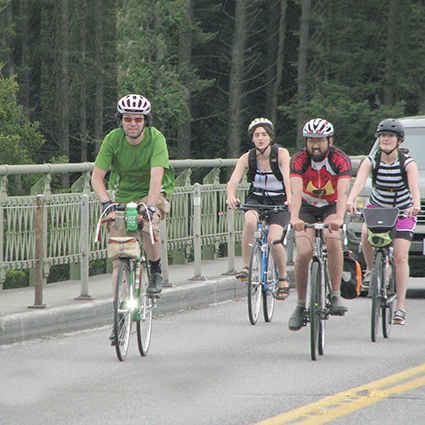
    The Tar Sands riders on the Deception Pass bridge, (and photo at top) L-R: Phil Jones (green), Erika Lundahl, Derek Hoshiko and Heather Elder, graphic artist for the project   (photo by Ann Linnea)
    The Tar Sands riders on the Deception Pass bridge, (and photo at top) L-R: Phil Jones (green), Erika Lundahl, Derek Hoshiko and Heather Elder, graphic artist for the project (photo by Ann Linnea)

    All four are determined to create something that has not been created before. Visit their website: http://www.TarSandsRide.org to learn more and have the opportunity to participate in an important endeavor.

    Ann Linnea is a frequent contributor to Whidbey Life Magazine. Author of numerous environmental books, including “Keepers of the Trees” (http://peerspirit.com/product/keepers-of-the-trees-a-guide-to-re-greening-north-america-by-ann-linnea/) and articles, she is dedicated to writing about the local/personal angle of environmental issues.

    __________________

    CLICK HERE to read more WLM stories and blogsHave a great story idea? Let us know at info@whidbeylifemagazine.org.

    WLM stories and blogs are copyrighted and all rights are reserved. Linking is permitted. To request permission to use or reprint content from this site, email info@whidbeylifemagazine.org.
  • The 100th Maxwelton Fourth of July Parade

    The 100th Maxwelton Fourth of July Parade

    BY ANN LINNEA
    Whidbey Life Magazine Contributor
    July 1, 2015

    What image does your mind conjure up when you hear the words, “a parade straight out of the 1950s”?

    • Kids on red, white, and blue-decorated bicycles riding down a two-lane road?
    • Tractors bedecked with patriotic crepe paper?
    • Costumed people on stilts?
    • Politicians in fancy convertibles throwing candy to the crowd?
    • Various kinds of marching musicians?

    The annual Maxwelton Fourth of July parade is all of this and a lot more. It is hot dogs and buttons. It is past-Grand Marshals sitting in the VIP area, and egg-toss and three-legged races on the ball field afterwards. It is summer Puget Sound breezes and friends seeing each other. It is a Whidbey Island experience not to be missed!

    Colorful costumes abound, such as shimmering butterflies
    Colorful costumes abound, such as these delightful young women dressed as shimmering butterflies. (photo courtesy of Nancy Waddell)

    At 1 p.m. on Saturday, July 4, the Maxwelton Community Club will host their annual Fourth of July parade for the 100th time. It is the single event Whidbey Island folks most associate with this beachside community. Its longevity is a tribute to the deeply held sense of place of Maxwelton residents.

    The community was settled in 1905 when the Mackie brothers and their large families arrived on the wilderness beach at the mouth of the Maxwelton salmon stream. The Mackies brought an enterprising spirit. Within five years they had organized a summer Chautauqua for 4,000 people, despite the fact that the community had only 20 families in residence! In 1912 they organized a Fourth of July parade that has been held every year since, except for some years during World Wars I and II.

    This year’s parade coordinator is Bob Brooks, strongly supported by his wife, Trish. “The first parade my wife and I attended was 1978 or 1979 when we came out and camped in a tent on a friend’s lot. Over the years I’ve had a host of parade jobs ranging from selling hot dogs to being a parking attendant to now being the overall coordinator,” said Brooks.

    When asked to share a favorite parade entry, Brooks talked about the Weber marching drill team. “About 25 years ago a bunch of guys brought their rolling Weber grills and had this clever marching drill. It was such a kick to watch!”

    Grand Marshal Just Announced!

    The South Whidbey Record announced on Saturday, June 27 that the Grand Marshals for the 2015 parade will be Dana and Ken Gilroy. (The paper has the exclusive right to be the first to make the Grand Marshal announcement.) The Gilroys claim a Maxwelton Beach residence since 1976 and have been participants, volunteers and, finally, parade coordinator (Dana) from 1996-2008. They will ride in Ray Gabelein’s 1955 red convertible and wave to crowds before joining past VIPs in the grandstand. To commemorate the 100th year, there will be photos and other memorabilia near the VIP area.

    Matt Hoar, the very, very tall pirate, can walk on stilts and juggle at the same time!  (photo courtesy of Nancy Waddell)
    Matt Hoar, the very, very tall pirate, can walk on stilts and juggle at the same time! (photo courtesy of Nancy Waddell)

    There is no entry fee to participate in the parade and no need to pre-register. Whoever shows up is welcome, as long as your vehicle is not over 5000 pounds GVW (the size of a Ford Explorer). Registration on site begins at 11:30 a.m. at the corner of Maxwelton and Swede Hill Roads.

    Even though the parade is only two blocks long and ends at the Dave Mackie Park boat ramp, Brooks estimates that it is witnessed (or participated in) by nearly 2,000 people. “We have better parking than in the past because the Vander Pols let us use their farm field down near the parade site at the corner of Swede Hill and Maxwelton Roads. Two to three hundred cars can be parked there. And then there is that shuttle from the Little Brown Church at French Road we’ve set up for years.”

    Parking is free but bring your cash to purchase this year’s parade button for a dollar, designed by Seattle fifth grader Kate Okerstrom. In an improvement the Mackie brothers could never imagine, this year—for the first time—hot dogs, chips, pie, pop, and t-shirts can be charged with a credit card using the “square” phenomenon on smart phones.

    “Really we don’t need too much publicity,” said Brooks. “We welcome anyone but we have been having about as many folks as we can handle. What we really need are volunteers to help the Maxwelton Community Club put this event on.” Call Brooks at 579-2030 to volunteer or email mailto:maxweltonclub@whidbey.com.

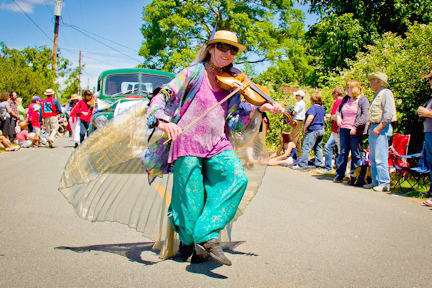
    Image at top: Toni Talia Marcus is happiest when she’s in the midst of a parade.  (photo credit David Welton).

    Ann Linnea is the author of “A Journey Through the Mawelton Watershed—A Natural and Social History” published in 2002 by Maxwelton Salmon Adventure and a person who cherishes the spirit of the Maxwelton Valley.

    __________________

    CLICK HERE to read more WLM stories and blogs. Have a great story idea? Let us know at info@whidbeylifemagazine.org.

    WLM stories and blogs are copyrighted and all rights are reserved. Linking is permitted. To request permission to use or reprint content from this site, email info@whidbeylifemagazine.org.

  • Our Shared Future—Global Climate Change

    Our Shared Future—Global Climate Change

    BY ANN LINNEA
    Whidbey Life Magazine Contributor
    April 22, 2015

    Right in the middle of April—earth and ocean month—the Whidbey Institute hosted a two-day conference on global climate change that attracted activists, artists, students, business leaders and educators from throughout the Cascadia bioregion.

    Cascade Climate Collaborative logo
    Cascade Climate Collaborative logo

    While the gathering included the dedicated gray-haired activists one would expect at an environmental conversation convened on South Whidbey, most of the participants were under forty. Since the event was billed as an “intergenerational dialogue,” conference organizers went out of their way to ensure a diversity of ages. Students and representatives from nonprofit organizations were well represented, thanks in part to vigorous fundraising efforts and the generosity of the Institute.

    State of the Movement

    KC Golden, conference keynoter (photo by Ann Linnea)
    KC Golden, conference keynoter (photo by Ann Linnea)

    KC Golden, senior policy director at Climate Solutions in Seattle (named Seattle Magazine’s #1 “Eco-Hero”), gave the keynote speech after flying the red-eye back from “Harvard Heat Week.” Golden’s observations were fresh from the front lines, where students had demanded their influential university divest from fossil fuels and take a leadership position for climate justice.

    “The students are so clear and bold,” said a clearly moved Golden. “Administrators were scurrying around being vague, but the students did not budge from their conviction that the university must take principled action.”

    Golden also reported on activities in Port Angeles and Seattle protesting the arrival of a Shell Oil Arctic drilling rig for repairs and refurbishment. “Climate denial has reached its fullest expression when we burn enough fossil fuels to melt the ice cap, and then view this as an opportunity to go drill because the ice is gone.” Golden referred participants to the sHELLNO.org website for the latest news on planned actions.

    Small group presentation by Bellingham woman on Coal Train Facts
    Small group presentation by Bellingham woman on Coal Train Facts (photo by Ann Linnea)

    During an afternoon workshop, citizen activists from Bellingham described efforts to limit coal trains in their city. A young mother/writer/filmmaker, Julie Trimingham, recalled her reaction when she learned that as many as 18 coal trains/day—each 1.5 miles long—could invade her city, scattering coal dust all the way. “Not near my six-year-old son, you won’t!” Although Trimingham had never been an activist, she felt she had skills that could influence hearts and minds; she went on to organize a website (www.coaltrainfacts.org) and prepare educational posters to be displayed all over the city. “Our purpose has been to provide the best information possible regarding West Coast coal export,” she said. “In particular, the proposed Gateway Pacific Terminal at Cherry Point.” The movement has united citizens from all walks of life, including members of the Lummi Nation.  The Department of Ecology’s environmental impact statement is eagerly awaited.

    Mother and daughter presenters
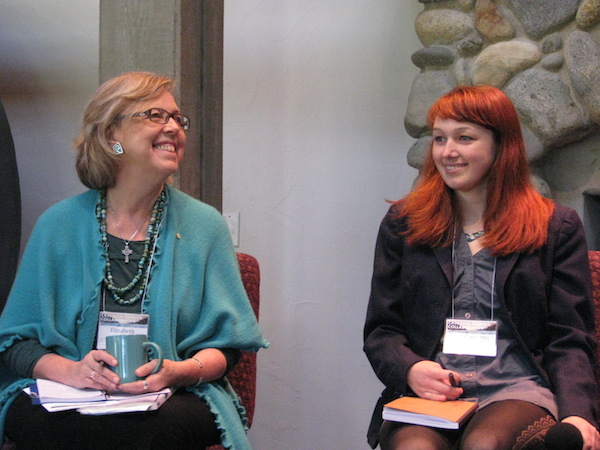
    Mother and daughter presenters, Elizabeth May and Cate May Burton (photo by Ann Linnea)

    Mother/Daughter team inspires

    The real heart of the intergenerational dialogue about climate change was evident in a Saturday morning conversation between Elizabeth May and her daughter Cate May Burton. Elizabeth May currently serves as leader of the Green Party of Canada and is a member of Parliament representing Saanich—Gulf Islands. Cate May Burton is a graduate student in feminist studies in Nova Scotia.

    A lifelong, tireless advocate for the environment, Elizabeth May was named by Newsweek as one of the world’s 100 most influential women. Executive Director of the Sierra Club of Canada from 1989 to 2006, she has now turned her attention to the complex task of being an elected official.

    “I am disciplined in my thinking and do not give way to despair,” she said. “Two things were significant in 2014.  It was the first year that the accumulation of global greenhouse gases did not go up in a year where there was not an economic downturn. It was also the first year when the amount of investment in renewable energy surpassed the investment in fossil fuels. I believe it is important to speak about the complex, sometimes discouraging subject of global climate change in a way that does not polarize people or elicit guilt.”

    Daughter Cate, raised by an activist mom and also inspired by an activist grandmother, said, “There was no point in my life that I did not know climate change was significant. I have had a first hand look at a lot of amazing strategies.”  Inheriting such a legacy has caused Cate to identify the links between environmental and social justice. “My generation brings an understanding that everything is connected. Climate activism may open the door for correcting many social injustices.”

    In the face of dire predictions of rising seas, severe weather changes, melting ice caps, and the creation of millions of climate refugees, Elizabeth often hears the comment, “Of course, you don’t tell your daughter the worst things.”

    “I think it is important to tell our children the truth without terrifying them,” she responded. “And I think it is valuable to raise our children so they know that the things that need changing can be changed.” Elizabeth is preparing to attend the 2015 United Nations Climate Change Conference in Paris, France, where a legally binding and universal agreement on climate from all the nations of the world will be sought.

    Plant for the Planet presenters
    Plant for the Planet presenters (photo by Ann Linnea))

    Whidbey Island Activism

    A stunning sequel to the mother-daughter conversation was presented by ten young “Plant for the Planet” activists, aged 8-14. They are part of a worldwide movement started by a 9-year-old German boy, Felix Finkbeiner, committed to raising awareness about climate change and global justice—and to planting trees.  (http://www.cnn.com/2011/LIVING/02/23/teenage.tree.ambassador)

    As slides played across the wall, each of the children spoke in turn, stating their name and proclaiming, “I am a climate justice ambassador.”  Marguerita Litvachuk , a nine-year-old from Oak Harbor, explained how droughts affect animals and people. Her mother, Veronica, said her two daughters have been highly motivated since the first “Plant for The Planet” academy was held in March on Whidbey Island. “They made a presentation to the Oak Harbor City Council on April 7,” she said.  [To learn more, visit www.climatechangeforfamilies.com].

    Phil Jones, one of two Whidbey bike riders to Tar Sands.
    Phil Jones, one of two Whidbey bike riders to Tar Sands (photo by Ann Linnea)

    Among the many efforts to “think globally, act locally” are plans by Whidbey residents Phil Jones and Derek Hoshiko to stage a bicycle “pilgrimage” to the open-pit tar sands near Ft. McMurray in Alberta, Canada.  Jones and Hoshiko, both long-distance bicyclists, have enlisted participants throughout the region.  “It will be about a 1,000 mile journey, about the same as from here to San Francisco,” said Jones. “We want to go and see for ourselves what is happening there, how different groups of people feel about it and connect it more directly to our lives here.”  To learn more about the trip, planned for August, visit www.tarsandsride.org.

    Divesting from fossil fuels. Blockading oil rigs. Halting coal trains. Planting trees.  Biking to bear witness. From ages eight to 80, our bioregion’s climate justice ambassadors will try just about anything to reverse the trend of global warming.

    Whidbey bike rider to the Tar Sands  Derek Hoshiko
    Whidbey bike rider to the Tar Sands Derek Hoshiko (photo by Ann Linnea)

    Fortunately for us all.

    To find out more about local activities and celebrations during earth and ocean month, visit www.whidbeyearthday.org.

    Image at top: KC Golden, conference keynoter (photo by Ann Linnea)

     Ann Linnea has been writing about environmental issues for decades beginning with her 1991 award-winning book, “Teaching Kids to Love the Earth.” Most recently her full color “Keepers of the Trees—A Guide to Re-Greening North America” was published by Skyhorse Publishing in New York.

    ________________________

    CLICK HERE to read more WLM stories and blogs. Have a great story idea? Let us know at info@whidbeylifemagazine.org.

    WLM stories and blogs are copyrighted and all rights are reserved. Linking is permitted. To request permission to use or reprint content from this site, email info@whidbeylifemagazine.org.